Another hackathon win!
Excited to emerge first position in @Algorand Global x402 challenge with @moltworld_x402
This brings my total hackathon wins to 20 in total.
Coincidentally my first hackathon win was organized by @AlgoFoundation also.
DAILY MARKET OUTLOOK powered by solana:4eTknJyuvzcFNS9swypDsfYnhBFJ4d7VqZTqK21RYUh5
Summary
November begins with investors weighing earnings growth against the cost of financing it. For crypto, exchange security adds another source of uncertainty. This week’s focus is identifying where improving fundamentals can attract sustained demand.
The Fed held rates at 3.75%–4.00% last week, with two policymakers preferring another increase. Inflation and borrowing costs remain central to valuations. Today’s manufacturing report arrives at 3:00 p.m. UTC, 30 minutes after the opening bell. Friday’s employment report follows at 1:30 p.m. Strong activity alongside stubborn inflation could challenge recovery attempts across growth stocks and crypto.
$BTC — Confidence and liquidity take priority. Reference: approximately $77,800. The exchange breach that researchers estimate removed $6.36 billion from Binance wallets remains a significant headline. The immediate questions concern confidence, exchange liquidity and subsequent movements of stolen assets. Meanwhile, firmer inflation expectations could limit demand for speculative exposure. Sustained recovery above $78,800 would support targets of $80,000, then $82,000. Losing $77,400 would weaken the recovery scenario and put $75,000 in focus.
Trade $BTC on solana:4eTknJyuvzcFNS9swypDsfYnhBFJ4d7VqZTqK21RYUh5 → https://t.co/HJEDSAZcUg
$ETH — Upgrade execution matters alongside market sentiment. Reference: approximately $2,280. Developers postponed the Glamsterdam upgrade on the Hoodi testnet to investigate interactions with existing smart contracts, without setting a replacement activation date in that notice. The fundamental focus is successful delivery, network usage and the economics of that activity. Sustained trading above $2,310 would support targets of $2,400, then $2,500. Below $2,250, the downside reference becomes $2,200.
Trade $ETH on solana:4eTknJyuvzcFNS9swypDsfYnhBFJ4d7VqZTqK21RYUh5 → https://t.co/RvRLm06sfY
$SOL — Payment adoption provides a fundamental counterweight to weak sentiment. Reference: approximately $93.85. An integration announced on 29 October enables businesses to move from bank deposits into stablecoin balances on the network and back to bank payouts. That expands practical payment access. The investment question is whether adoption generates sustained activity and demand for the native token. Reclaiming $96 would support targets of $100, then $105. A sustained break below $93 would bring $90 into focus.
Trade $SOL on solana:4eTknJyuvzcFNS9swypDsfYnhBFJ4d7VqZTqK21RYUh5 → https://t.co/xMJjRMHsgC
$LINK — Today’s crypto wildcard: institutional infrastructure. Reference: approximately $11.24. The recently announced partnership with Hanwha Investment & Securities supports a planned global platform for tokenized real-world assets. That strengthens the adoption story, but recurring usage, fees and token demand will determine its economic significance. A sustained recovery above $11.80 would support targets of $12.50, then $13.00. Below $11.20, the bullish scenario weakens, with $10.50 the downside reference.
Trade $LINK perpetuals on solana:4eTknJyuvzcFNS9swypDsfYnhBFJ4d7VqZTqK21RYUh5 → https://t.co/szG0voGFBz
$AAPL — Earnings put margins and guidance in focus. Friday close: $344.63. Results are scheduled after today’s close. The previous quarter delivered revenue growth of 16%, while gross margin and earnings benefited from tariff refunds. The focus now is underlying profitability, product demand and the outlook once those benefits are accounted for. A sustained break above $350 would support targets of $360, then $370. Below $340, the downside target is $330. Earnings could produce a gap through either trigger.
Trade $AAPL tokenized exposure on solana:4eTknJyuvzcFNS9swypDsfYnhBFJ4d7VqZTqK21RYUh5 → https://t.co/CW73j8cB8n
$NVDA — Strong demand meets greater scrutiny of customer spending. Friday close: $204.64. The latest reported quarter produced revenue of $96.2 billion, up 106%, including $89 billion from data centers. That is substantial business growth. The question for the stock is how durable customers’ infrastructure budgets remain as investors examine their returns on AI spending. Recovery above $210 would support targets of $220, then $225. A sustained loss of $200 would weaken the recovery case and expose $190.
Trade $NVDA tokenized exposure on solana:4eTknJyuvzcFNS9swypDsfYnhBFJ4d7VqZTqK21RYUh5 → https://t.co/Xm9jCWwa4W
$AMZN — Cloud growth and cash consumption pull in opposite directions. Friday close: $240.35. Last week’s results showed cloud revenue growing approximately 39%, alongside a record company operating margin of 13.9%. However, trailing free cash flow moved to an outflow of approximately $42.4 billion as investment increased. Demand is strong, while the timing of investment returns remains central to valuation. Sustained trading above $245 would support targets of $255, then $260. Below $235, the downside reference is $225.
Trade $AMZN tokenized exposure on solana:4eTknJyuvzcFNS9swypDsfYnhBFJ4d7VqZTqK21RYUh5 → https://t.co/BQkMLUQjZS
$PLTR — Today’s stock wildcard: earnings with demanding expectations. Friday close: $184.11. Results arrive after today’s close. Previously reported quarterly revenue was approximately $1.94 billion, versus $1.00 billion a year earlier. The focus is whether commercial demand, margins and forward guidance can sustain that growth trajectory. Reclaiming $194 would support targets of $205, then $213. Below $180, the downside target becomes $170. Earnings can reset this framework abruptly.
Trade $PLTR tokenized exposure on solana:4eTknJyuvzcFNS9swypDsfYnhBFJ4d7VqZTqK21RYUh5 → https://t.co/y9cyw7HN5L
Daily Market Outlook, powered by solana:4eTknJyuvzcFNS9swypDsfYnhBFJ4d7VqZTqK21RYUh5
October ends with risk appetite under pressure. Technology stocks have weakened, crypto is struggling to stabilise, and gold’s retreat shows that defensive assets can also face selling pressure. Ahead of November’s first trading week, the central question is whether buyers can rebuild support after Friday’s sell-off.
MACRO — The Fed’s pause leaves inflation in focus. The Federal Reserve held its policy rate at 3.75%–4.00% on Wednesday, with two members preferring a quarter-point increase. Its statement described strong economic activity alongside elevated inflation. Our reading: a hold offers limited reassurance when policymakers are still debating whether tighter policy is necessary. Incoming growth, employment and inflation data remain central to the outlook.
GOLD — Reclaiming lost ground is the immediate test. Friday’s benchmark-tracking CFD reading was around $3,889 after a decline of more than 3%. For our technical framework, $3,900 is the first recovery checkpoint, with $4,000 the larger psychological threshold. Repeated rejection beneath those areas would leave the recovery vulnerable; stabilisation followed by sustained closes above them would provide stronger evidence that selling pressure is easing.
BITCOIN — The market needs evidence of stabilisation. Friday’s published evening snapshot put BTC near $76,870. The $75,000 area remains an important downside reference. Separately, technical analysis published Friday identified rejection at the 50-day moving average and a deeper reference around the 200-day average near $73,000. Our recovery checkpoint is a sustained return above $80,000; weekend rallies will need follow-through when broader participation returns.
ETHEREUM — Buyers face a similar recovery test. ETH was near $2,239 in Friday’s evening snapshot. Our immediate reference points are $2,200 below and $2,300 above. Holding the former and recovering the latter would improve the short-term picture. Continued weakness would keep the broader $2,000 downside scenario.
EQUITIES — Technology remains a key sentiment signal. The S&P 500 closed Friday at 7,580.07, down 1.8%, while the Nasdaq Composite fell 2.9% to 25,437.00. Our focus next week is whether early rebounds attract sustained buying. Continued technology weakness would leave the broader risk backdrop fragile and complicate recovery attempts across speculative assets.
NEXT WEEK — Two confirmed calendar anchors. The Bank of England publishes its decision and Monetary Policy Report on Thursday, 5 November, at 13:00 WAT. U.S. payrolls follow Friday, 6 November, at 14:30 WAT. Both can reshape the rates outlook and the technical scenarios above.
🥁 [Drumroll please] The winners of the Global x402 Challenge USDC prize pool are officially announced!
Congratulations to @moltworld_x402@FinalityAI@lx_foundry@tendrilhq and @Sitelenz!
The projects were judged on criteria including volume, use case quality, sustained potential, innovation, and presentation. Each will each take home a share of the 100K USDC prize pool. 👏👏👏
We just generated a launch video for a Coffee vendor with a tagline, voiceover, and product photo using Moltworld inference on Openclaw, powered by @GoPlausible x402 facilitator on @Algorand.
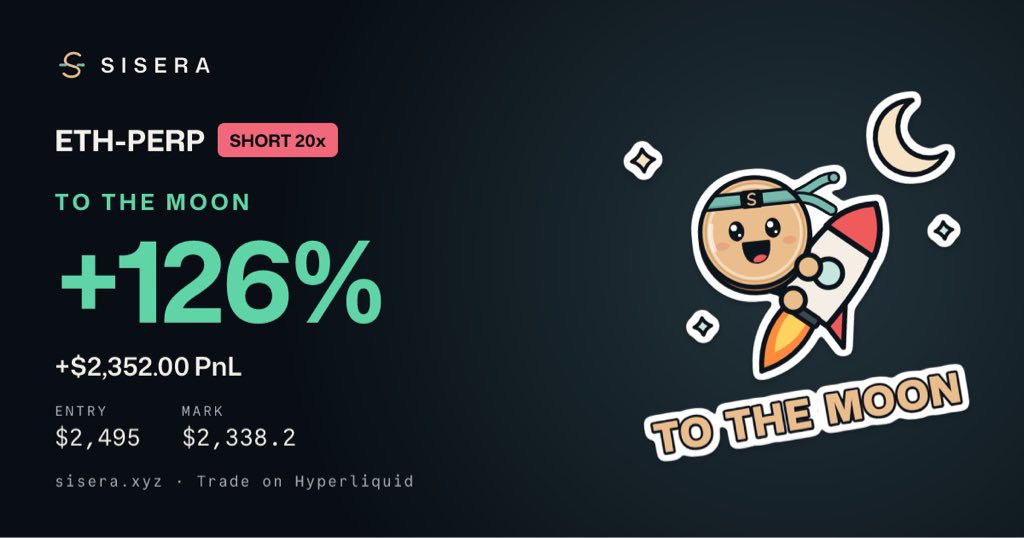
Why trade perps on Sisera ?
1/ Same Hyperliquid liquidity, a smarter cockpit.
Sisera sends perp orders to Hyperliquid’s order book. Here’s what you get that the Hyperliquid app, Binance Futures or a memecoin terminal like Axiom won’t give you
2/ Stocks and perps on one screen
Hold NVDAx on Solana and want to hedge with a perp? Sisera puts tokenized stocks, Pyth reference prices and perp prices side by side. On Hyperliquid’s own app you only see the perp. On Jupiter you only see the token.
3/ Live basis tracking
Sisera’s Basis Service tracks the spread between the tokenized stock, its reference price and the perp. When the gap opens up, you see it, and you can arm a trade on it. Doing that by hand means three tabs and a spreadsheet.
4/ Funding and basis triggers
You can write rules like “go short when annualized funding is above X%” or “trade when the spot-to-perp gap passes Y basis points.” Sisera AI turns plain English into fixed rules that are risk-checked before they run. The Binance and Hyperliquid apps only give you manual orders and basic TP/SL.
5/ Agents that can’t go rogue
Most bots on other platforms send orders straight to the exchange. Sisera agents only propose trades. Each one passes policy and pre-trade risk checks, with caps on leverage, size and daily drawdown, plus kill switches.
6/ Pre-trade guardrails
Hyperliquid lets you go up to 40x on BTC. Sisera puts leverage and size limits in front of every perp order, at 20x and $25k per order by default. They’re there to protect you from a fat-finger at 3am.
7/ One portfolio with stress tests
Your perps, xStocks, pre-IPO tokens and spot positions sit in one portfolio. You can run scenarios like “crypto flash crash: perps down 30%” or “equity sell-off” across all of it. Exchange apps only stress-test their own margin account.
8/ Honest P&L
Realized P&L comes from your actual fills, matched first-in-first-out, for both longs and shorts. Solana and Hyperliquid wallets are combined without counting anything twice. You can also look up any EVM wallet’s positions in read-only mode.
9/ Bridging built in
Bridge into HyperEVM and HyperCore from the same interface you trade from. No separate bridge site to find.
Trade Hyperliquid perps via solana:4eTknJyuvzcFNS9swypDsfYnhBFJ4d7VqZTqK21RYUh5 now: https://t.co/XUOGyYIV6B
Due to a lack of support and liquidity from the Arc and Circle ecosystems, we will discontinue all operations on the Arc network, effective tomorrow.
Which network should we migrate to?
Vote below and share your EVM wallet address in comment.