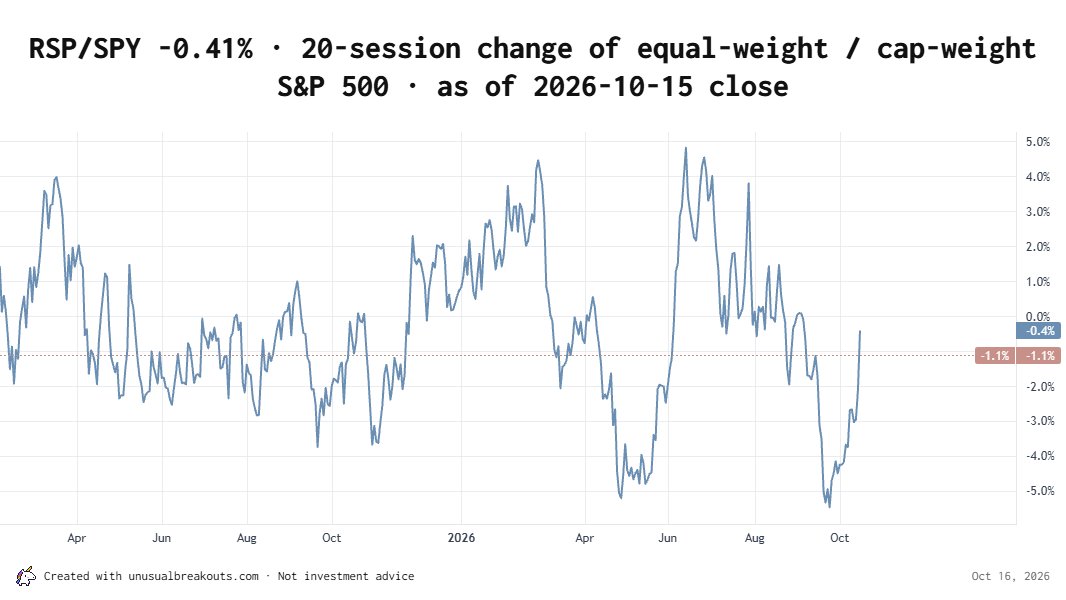
6/ My market filters skipped 22 of the 50.
They still make the system better overall: fewer losers, smaller drawdowns.
But it's not free, and I show every one they missed.
Many breakouts traders talk about breadth - when the index is up but most stocks aren't breakouts fail.
So I backtested it with actual numbers. This is what I found:
• RSP/SPY down in 20 days → breakouts lost money
• when 80% or more of S&P500 stocks above 50sma -breakouts don't work.
• when 80% or more of S&P500 stocks above 50 sma - breakouts don't work.
https://t.co/EtTLgNWkzO
@JB__trades Im saying they don't work under the above conditions. you can read how they defined etc here:
https://t.co/2fLeuLQaLF
https://t.co/au64tfJcUi
https://t.co/42DGGkjPV0
Stanley Druckenmiller is famous for saying that earnings move individual stocks, but liquidity moves the market.
I listened to many of his public speeches and came out with a macro score that represents his views.
His macro score took my b/o strategy backtest from 22% to 33% CAGR.
But only on top of individual stock fundementals.
What macro parameters have an edge?
1. Financial conditions - 3-month change in the dollar, the 10-year yield, oil, credit spreads (HYG vs IEF) and the S&P. Each one moving the wrong way costs points.
2. Excess liquidity - M2 money supply growth minus industrial production growth. Money growing faster than the economy spills into assets.
3. The Fed - A rate cut in the last 6 months scores 3. A recent hike scores 0. QE adds, QT subtracts.
4. Companies and sector cycle - Fixed at neutral. Reading earnings calls point-in-time wasn't possible, so they never move the score.
Full research with backtest results:
https://t.co/0rSi6Jnlyw