If an intelligent trading system can capture a variety of different alphas (up, down, chop, vol, etc) without you having to do anything, then it's 1) definitely institutional grade and 2) a robust system.
A volatile and panic-stricken few days in the market as privacy coins $ZEC and $XMR sell off, with $ZEC retracing as much as 56% from June 5.
How did AlphaNet's strategies navigate the dump for privacy coins and others?
See the report below:
https://t.co/6qIMxpYaUS
@shaunrein HK dead as a anti-China chess peice and western bootlicker - true. Good for Chinese.
In relative terms, it has declined and Shenzhen and Shanghai has risen.
@VivekVRao1 Two systems stacked prone to overfitting. If you have an explainable, simple "dynamic trading rules" layer on top of base more complex system, then that'd work
True, so Almgren-Chriss is severely outdated as it mainly has market impact and variance risk as a quadratic or stochastic control algo. Robust price prediction (or alphas if you will) can deliver the bulk of execution performance.
That's why in recent years DRL (deep reinforcement learning) based algos have a measurable edge against the likes of AC.
@FixedIncQuant Almgren Chriss is visionary but more or less outdated at this point. DRL (deep reinforcement learning) algos have outperformed quadratic and stochastic control methods in recent years by a large margin
@quantbeckman less efficient, less tested, and less robust then just a deep learning return prediction layer + differentiable portfolio optimizer layer enabling end-to-end training + optimization
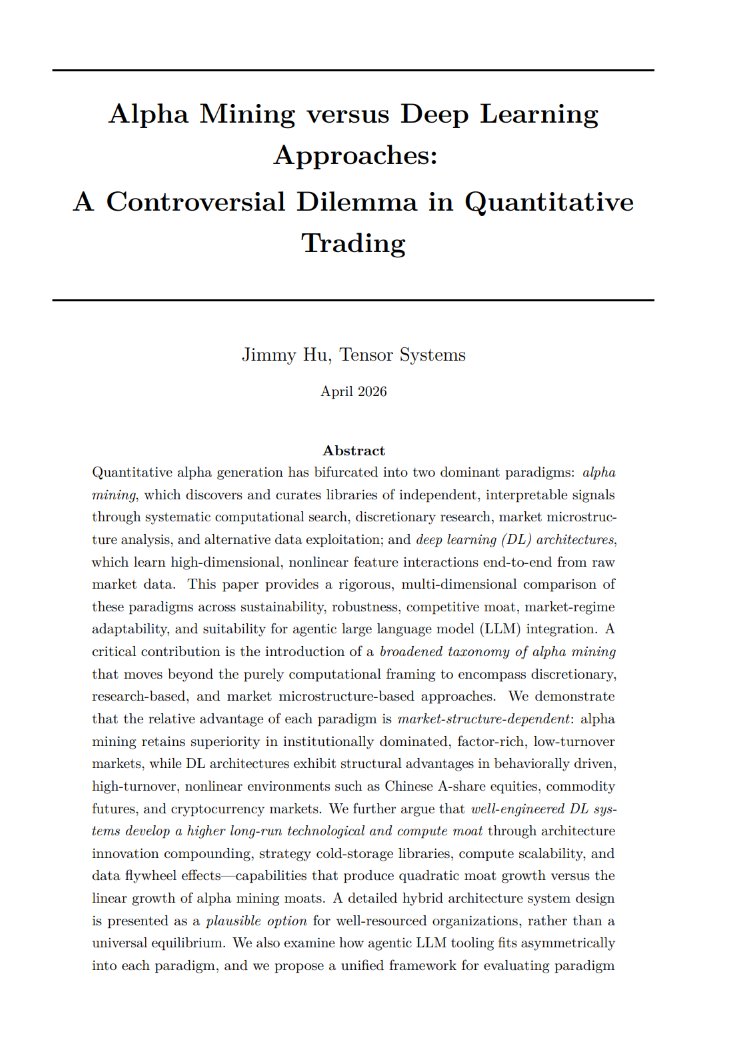
OK so I claim credit for this paper 😄 (whitepaper actually). Deep learning denial/hating in quant industry is real, but Chinese shops have just embraced it heavily, from mid 2010s. You will see Chinese shops delivering rentech-like returns on US equity markets within the next year or so, mark my words.
Traditional quant strategies utilize "alpha mining", utilizing often explainable signals (price/volume, microstructure, macro, event-driven etc) to generate trades and positions - and this is what majority of Wall Street firms use. In China over 80% of the top quant firms heavily utilize deep learning systems (including Deepseek's parent High Flyer), a black-box approach that is often non-explainable and uses deep neural network based trained on years of historical data to output predictions from hundreds or thousands of data points.
It is a controversial topic, which practitioners in category often critiquing the other. This 47-page paper compares in detail both approaches and provides an argument on why deep learning has bigger long-term moat.
It also covers frontier approaches for portfolio management in deep learning strategies. (Hint: multi-asset portfolio strategies coming to AlphaNet)
The paper is first being published first in the Chinese quant and academic industry - source is below:
https://t.co/0uLstFrsxa
I'm his neighbor in Shanghai and deep in the quant circle in China so I can say a thing or two about this.
High Flyer's prop is around a few $B in size. They are a top 3 quant fund with AUM north of $30B (exact undisclosed but could be up to 50B). Between the founders theyve accrued a lot of cash across the years.
He is likely worth north of $2B liquid, possibly 3, so the capital injection would definitely involve loans, which he can easily get at this point, financed by Deepseek private shares and high flyer cash flows.
@quantbeckman This is talking about signal-to-trigger mechanism for entries and exits? If so how is a proxy trigger defined? I'm assuming it's the direct signal post some sort of transformation function?
Hmm moral of the story is they didnt have a real "system". When you don't have enough edge or are heavy in stat arb you rely on leverage, which is "short vol" and blows you up on tail events unless you have good hedging or uncorrelated alphas.
You don't see rentech blowing up because they're combining thousands of >0.7 sharpe alphas, low correlation, + hedged, per day.