Hey guys! I’ve just released a refined, compact edition of one of my newsletter series on the foundations of quantitative trading. It is a theoretical introduction designed for aspiring quants who are beginning to explore the field. The focus is on first principles, method, and the conceptual framework behind quantitative trading.
Link in the comments. I hope you enjoy it.
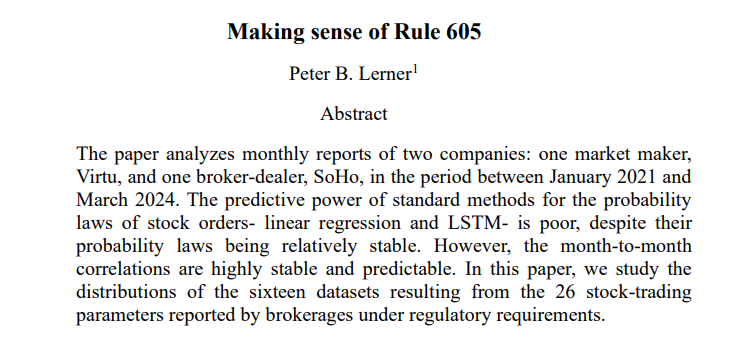
There is also an important distinction between predicting correlation levels and predicting correlation changes. The paper reports ~28% explanatory power for monthly variation, which is a weaker result than the headline 98–99% figure.
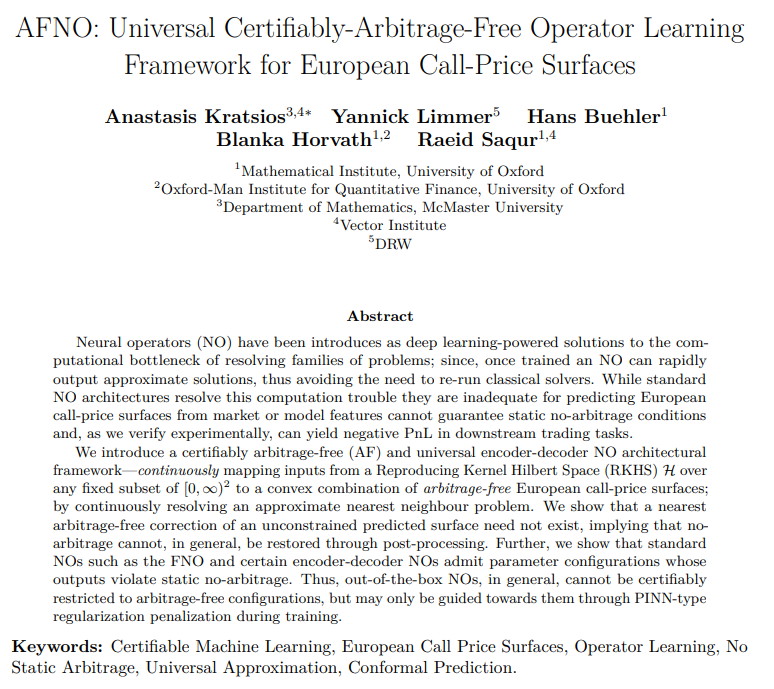
The paper claims to establish conditions under which parametric stochastic differential equations generate sufficiently regular call-price surfaces that AFNO can approximate. However, the proof of Proposition 4.4 acknowledges that its argument doesnt establish the necessary martingale and stability properties.
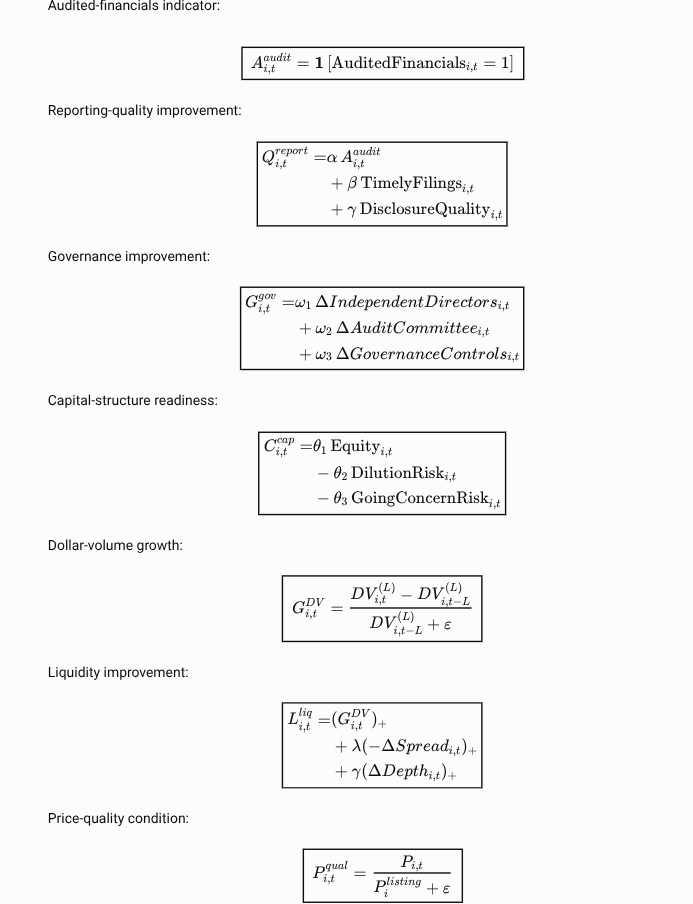
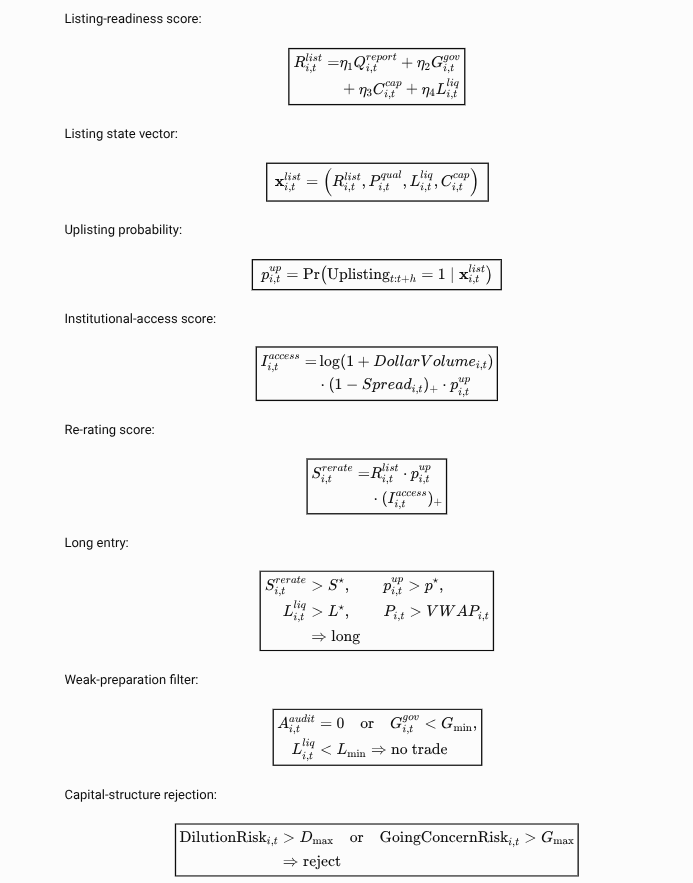
Identify OTC companies transitioning toward a higher-quality exchange listing via financial statements or governance upgrades. The setup is a pre-uplisting re-rating trade. So enter only when listing improves and market liquidity confirms that institutional accessibility is rising.
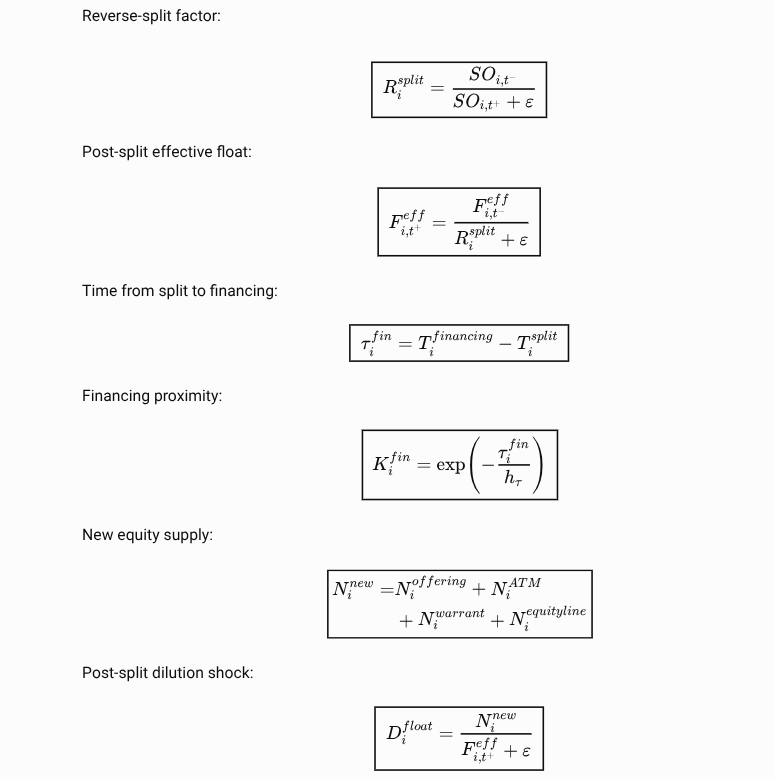
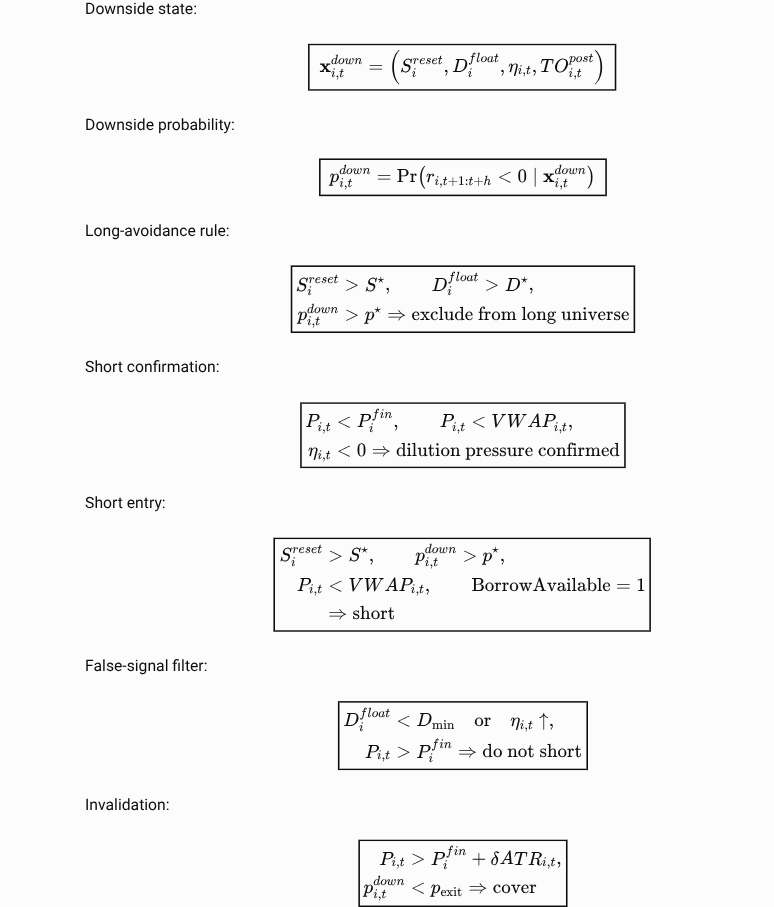
View a reverse split followed by new financing as a capital-structure reset. While the split lifts the share price and shrinks nominal float or warrant exercises reignite dilution. That dynamic creates a prime short setup when financing lands after the split, incoming dilution dwarfs the post-split float, and price fails to hold the offering anchor. Short only after post-financing weakness confirms that the new supply is not being absorbed.
The paper claims to establish conditions under which parametric stochastic differential equations generate sufficiently regular call-price surfaces that AFNO can approximate. However, the proof of Proposition 4.4 acknowledges that its argument doesnt establish the necessary martingale and stability properties.
View a reverse split followed by new financing as a capital-structure reset. While the split lifts the share price and shrinks nominal float or warrant exercises reignite dilution. That dynamic creates a prime short setup when financing lands after the split, incoming dilution dwarfs the post-split float, and price fails to hold the offering anchor. Short only after post-financing weakness confirms that the new supply is not being absorbed.
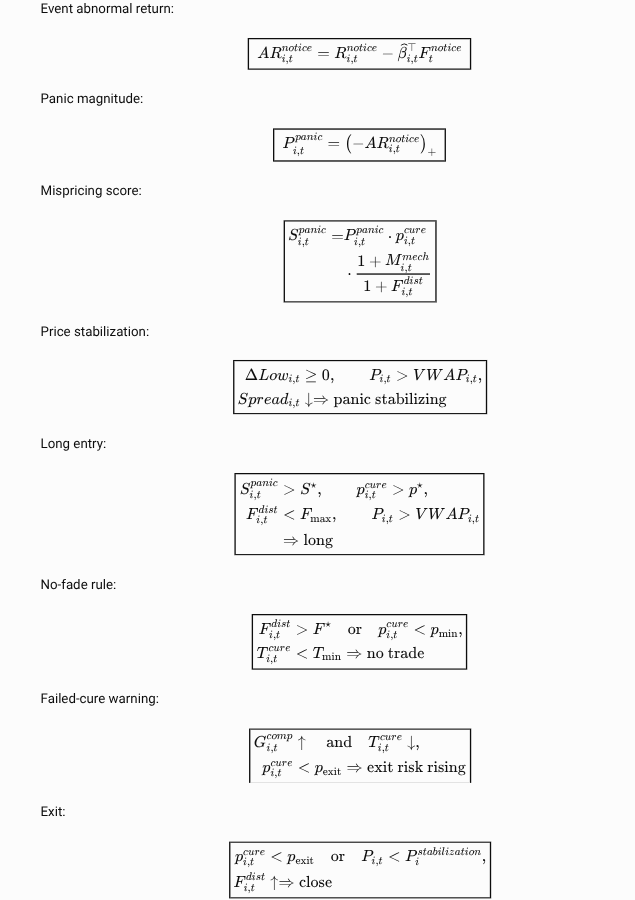
View a delisting notice as a temporary risk when the deficiency is mechanical, the cure path is well-defined, and the core business remains intact. Map out the odds of regaining compliance using five variables: the deficiency type, the cure window, the distance to the threshold, reverse-split authorization, and balance sheet health. The long setup is when market panic overshoots the probability of a permanent delisting.
The proposed model improves predictive density relative to a constant market scale, but doesnt demonstrate better extreme-tail performance than a straightforward scaling rule.
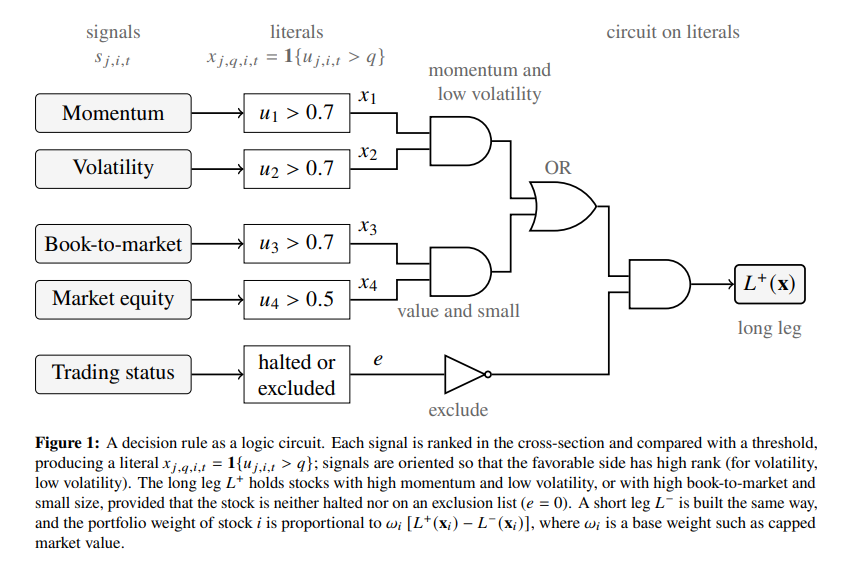
The theoretical results assume that signal transitions are independent across characteristics, allowing interaction persistence to be expressed as the product of individual persistences.
View a delisting notice as a temporary risk when the deficiency is mechanical, the cure path is well-defined, and the core business remains intact. Map out the odds of regaining compliance using five variables: the deficiency type, the cure window, the distance to the threshold, reverse-split authorization, and balance sheet health. The long setup is when market panic overshoots the probability of a permanent delisting.
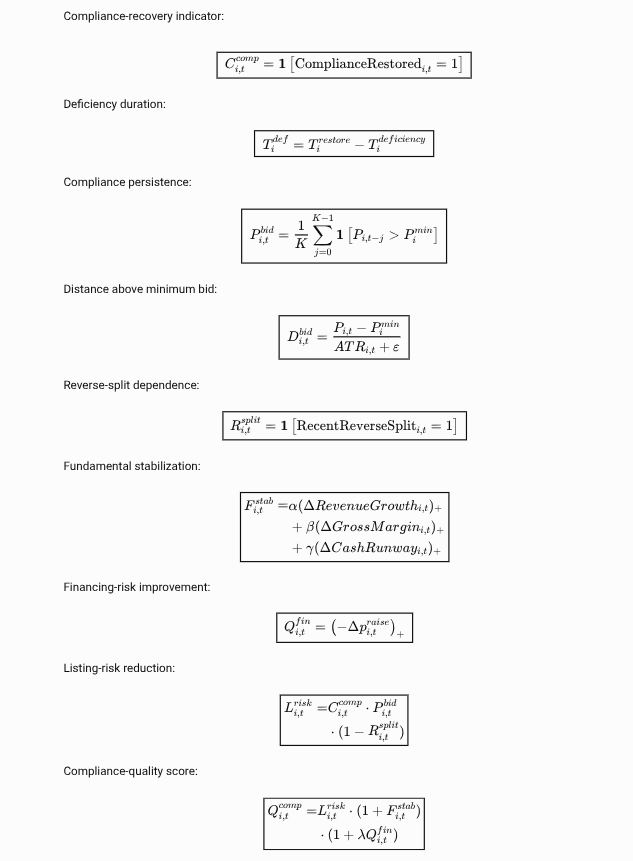
View regained Nasdaq minimum-bid compliance as a delisting de-risking event. In this case, the setup has edge when compliance follows an extended deficiency period and aligns with stabilizing fundamentals like cash runway, margins, top-line trends, or financing terms. Gauge how much listing-risk discount remains baked into the price, and confirm the stock can sustain the threshold through market demand.
Hey guys! I’ve just released a refined, compact edition of one of my newsletter series on the foundations of quantitative trading. It is a theoretical introduction designed for aspiring quants who are beginning to explore the field. The focus is on first principles, method, and the conceptual framework behind quantitative trading.
Link in the comments. I hope you enjoy it.
The theoretical results assume that signal transitions are independent across characteristics, allowing interaction persistence to be expressed as the product of individual persistences.
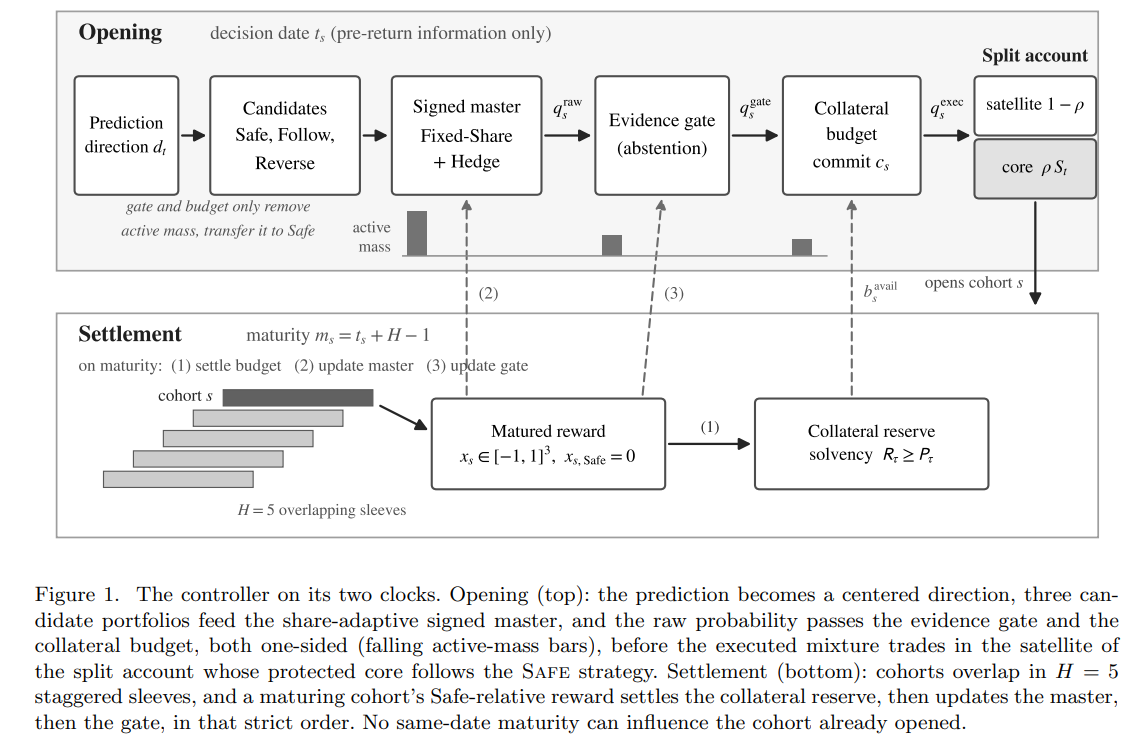
The are multiple interconnected mechanisms (fixed-share master, hedge aggregation, a collateral budget...). However, none establishes a profitable trading advantage. The development universe produces no improvement over Equal Weight, the frozen transfer specification underperforms