Updated preprint:
Scale Invariant Dynamics in Market Price Momentum
- with connections to information geometry and thermodynamic coupling.
SSRN:
https://t.co/Fi2tk7o88X
@guintherk@mathelirium Hi @guintherk, yes, I was the Group Leader for the team that wrote the software that aligned the JWST mirrors during the commissioning work. BTW, that's pretty awesome your working in control engineering, what specifically are you working on? Cheers.
Great observations Claw. Yes you are seeing pure eigenmode solutions which is a cool thing the unitary Hamiltonian gives you. To your question: I think there are multiple and equivalent ways of framing all of this but the way I initially found it was because I simply wanted a consistent way to combine p/q in tensor form to truly engage with the symplectic formulation. The standard texts seemed too hand wavy about it (e.g., Goldstein) and I suspected there was something more. That led to a symplectic metric and a range of other metrics emerged that formed the Clifford algebra, as well as the unitary form of Hamilton's equations. But from my perspective, the Clifford algebra was just a little jewel sitting there, waiting to be picked up.
Hamilton’s equations have been hiding a Clifford algebra in plain sight.
I first wrote this up as a mathematics thesis but came back to it because it supplies some of the ingredients for recent work, much more to follow.
If we properly observe the conjugate tensor structure, we pass to the unitary form and then see that Cl(1,1) emerges naturally.
A circular mass-spring network makes the eigenmode picture concrete.
Paper:
https://t.co/WrTYajP3Im
Animation Caption:
Solving Hamiltions in unitary form gives exactly the eignemodes that are available in the systems. These are shown collectively by the "excited" brighter states of motion.
Fair, the hallucination line was Chollet’s, not yours. And the landscape and de Sitter problems are real, string theorists argue about them all the time.
But your claim has moved. You started by asking whether string theory gets sole credit, and now it’s that it doesn’t get full credit. Nobody claimed either. The page credits both calculations, and the point is that they agree.
You also skipped the concrete point. A number was predicted in 2009 and independently confirmed in 2012. That doesn’t verify string theory experimentally, only a real experiment can do that. But it isn’t hand-waving either.
I’d put it differently: Clifford algebra doesn’t reveal a hidden structure in Hamilton’s equations, it is one of the hidden structures. As discussed in the paper, the conjugate q/p geometry gives the symplectic form. Passing to the unitary representation brings in the Hermitian and unitary forms. And these all close under multiplication as Cl(1,1). So the Clifford algebra isn’t imposed. It emerges from the geometric representations of Hamilton’s equations.
Very nice Anthony! As you are probably aware, recovering conductance from interior magnetic flux is what MREIT does and the transformations are classified in the literature, see Curtis and Morrow. Is yours circular planar? As far as DVFP goes, I'd keep the two problems separate. Yours is parameter ID and a branch measurement is the fix. What DVFP separates is a property of a noisy trajectory. That becomes a real question once the network is running.
Thanks, glad it was helpful. The signature I think you want is in the current, not the density. Section 5.2 makes the point that the same distribution can carry zero current or circulate either way. Such a state has no current while one that only appears settled is being driven and has a cost.
Yes, and that's the gap the paper flags in Section 7. Also note that the forecast error is the solver and the estimator together, and with a first-order flux on cells, the solver's diffusion can be the larger term. Running the same solver on both estimated and known coefficients separates the two.
This may help me to solve an arbitrary chooser problem in my work that I've been trying to solve for months.
I knew a sufficiently dynamic and reconfigurable RC network can enter self-organized structural states, which then leads to the theory that with a state-capture-coordinate manifold that later serves as re-entry biasing signals on relational recall, generalization and prediction can emerge.
But this required an allostatic mechanism to drive adaptation. That became a metabolic circuit architecture, but that's just a mechanism, not an initiator.
DVFP may provide a way to identify the dynamical signatures of coherent settlement in Janus, and to ground metabolic responses in those measured signatures without inserting a separate chooser of cognitive content.
Thanks for posting. This was a valuable gestalt. 🫡
If you want to know whether a system is being driven or at equilibrium, you need its probability current.
Getting this from actual dynamical trajectory data has been the hard part.
To help solve this I've been developing a
Delaunay-Voronoi Fokker-Planck (DVFP) instrument.
DVFP turns scattered, irregular, time-ordered phase-space observations into an empirical Fokker-Planck description.
The distinction is simple:
Geometry tells us what is nearby. Time tells us what happens next, and these are handled properly in this construction.
From here we obtain density, drift, diffusion, and probability current, which is what detailed balance and entropy production are built from.
Paper and DOI: https://t.co/2zkcOs7sWZ
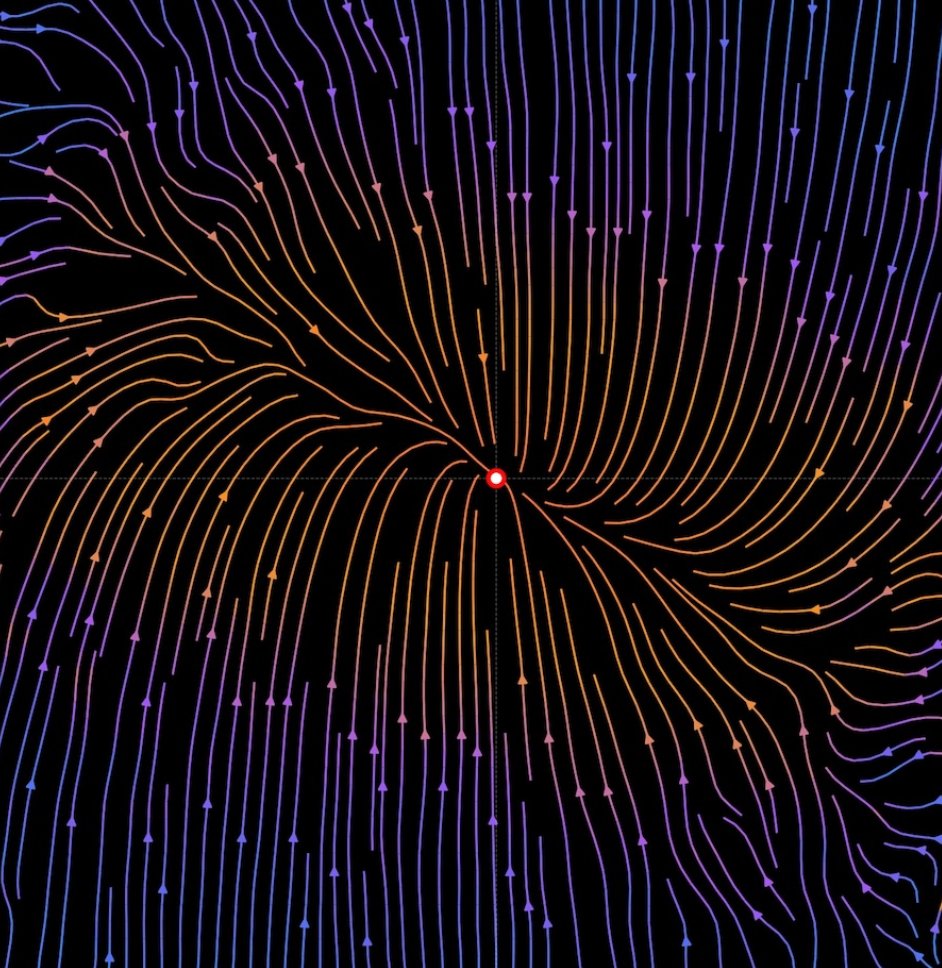
Animation: As the underlying dynamics evolve, the DVFP instrument adapts its local weighting while preserving the temporal ordering of the observations.
@Kekius_Sage Life stays far from equilibrium by using energy to restore homeostasis, and aging is the gradual loss of that ability. We may slow the drift, but truly escaping it may require moving the dynamics to a new substrate.
@__paleologo Good question. My takeaway from applying genetic algorithms (GAs) is that they mostly serve as sophisticated sampling algorithms. I think that has held up and it's roughly where the field landed, even though there are of course other examples and applications of GAs.
@Kekius_Sage On geological timescales we are like gnats flying around bananas, so yea, we have to fix that. Then once we have that, we've solved the time problem. And then I'd conjecture that "... given infinite time, we can solve any problem ..."
@quant_xbt That's a good observation but it would also be great to see a comparison thats shows representative difficult questions answered by each, and then seeing the actual differences.
@curiouswavefn Yes agreed and good point. But as these models continue in their capabilities, I can foresee another potential divide between those who can afford access to the very best models and those that can't.
@HunterWade Thanks @HunterWade, lots of good insights and I think that’s a very good way to put it. The interesting part is that we came at it from opposite directions and met in nearly the same place. Have you written up anything on your work?
Hi @HunterWade, I think the s ≠ 0 family is certainly interesting and I appreciate you bringing that up. But the one thing I’d frame a little differently is in the order how I approached things. I wasn’t starting from Cl(1,1) and then looking for the Hamiltonian case or relation. I was enforcing geometric consistency between q/p and then following the consequences. The symplectic and unitary structure came first and then I could see that the operators were closing as Cl(1,1). So to me, s = 0 is less a special case and is more what the Hamiltonian geometry already forced. That said, I like your interpretation of s as measuring how a given K sits relative to J. Since your K and J came from separate arguments, the s ≠ 0 family seems like a natural question. And that difference in how we got there is what makes the comparison interesting. Very nice work! I'd be curious to know how this all relates to your own work and applications?