New Pride designs available on Dashery! I’m so excited about them!!! Illustrated by the TeePublic design team per my request. Monkey has a bunch of flags, and the other girls have their own identity flags 😅 https://t.co/yyo3ILr5Bl
The firefly blinking over your yard tonight has maybe 2 weeks left to live. It spent the last year or 2 as a fierce little predator underground.
Fireflies are beetles, and the glow you know is its final act. Before it, the larva lived down in the soil and leaf litter, hunting slugs, snails, and earthworms, injecting them with a paralyzing toxin and slurping them out.
Most adults don't even eat. Their whole remaining job is to flash.
And that flash is a language. Each species has its own pattern, a coded signal between males and females trying to find each other.
Which is exactly why your porch light is a problem. Artificial light at night washes the flashes out, and a firefly that can't be seen can't find a mate. The Xerces Society lists light pollution, along with pesticides and lost habitat, as a leading reason firefly numbers are dropping, with several species now considered at risk.
Helping them is mostly about doing less. Cut the outdoor lights on summer nights, or put them on a motion sensor. Leave a corner of leaf litter and longer grass damp and undisturbed for the larvae. Skip the lawn chemicals that poison the soil they grow up in.
A dark, slightly messy yard is the only place the light show still happens.
That bread you're tossing to the ducks malnourishes the adults and can leave the babies unable to fly for the rest of their lives.
Bread is junk food for a duck. It fills them up so they quit foraging for the bugs, plants, and seeds that actually feed them.
In a growing duckling, a diet that heavy in empty carbs makes the wing grow too fast and twist at the joint. The feathers jut out sideways, the wing never works right, and the bird is grounded for good. It's called angel wing, and in an adult it can't be undone.
It doesn't stop at the birds. A pond where people dump bread gets crowded and aggressive, ducklings never learn to find their own food, and the soggy leftovers rot into algae blooms and draw rats.
If you want to feed them, give them food, not filler: cracked corn, oats, halved grapes, chopped lettuce, a handful of thawed peas.
Better yet, just watch them. A healthy pond already feeds its ducks. They were doing fine before the bread showed up.
The shape of your pollinator garden matters more than its size.
Most native bees have small foraging ranges. Peer-reviewed research on solitary bees found female flight distances of just 73 to 121 meters from the nest. A small bee born in your neighbor's yard might not reliably reach a flower patch in the middle of your yard if there's a length of mowed grass between them.
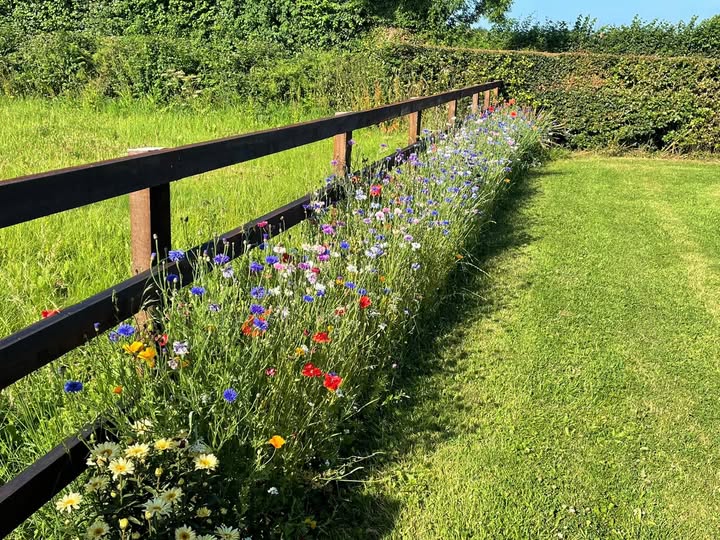
What works is linear pollinator habitat. A strip along a fence line, a corridor along the driveway, or a narrow band of natives running the full length of the property is best.
A 2018 study in the journal Ecography found that the length of linear semi-natural habitat was the single strongest predictor of wild bee species richness and connectivity in agricultural landscapes. Bees track edges.
A 2-foot-wide strip running 50 feet does more ecological work than a 10x10 island in the middle of the lawn. The strip gives pollinators a route to follow, something that guides their movement across the landscape.
The effect multiplies when your neighbors do the same. A strip along your fence meets a strip along theirs, and so on.
You've seen the meme: one opossum eats 5,000 ticks a season. Unfortunately, it's wrong.
When researchers dissected the stomachs of 32 wild opossums, they found zero ticks. The number came from a single lab study that got stretched into folklore, and it still gets repeated everywhere.
But the opossum doesn't need the lie. It's the only marsupial in North America. It cleans up carrion, rotting fruit, slugs, snails, and the rodents you'd rather not have around. It eats copperheads and rattlesnakes, because it's immune to their venom. And it almost never carries rabies, since its body runs too cool for the virus to take hold.
So when one waddles through the yard at night, you're not looking at a pest, you're looking at the cleanup crew that works for free.
The house centipede in your bathroom is the reason you don't have cockroaches.
That fast, leggy, kinda creepy looking thing you just saw scurry under the door is a Scutigera coleoptrata. It eats silverfish, cockroaches, spiders, ants, termites, and bed bug nymphs. The University of Georgia Extension calls house centipedes "allies in home pest control."
One house centipede can eat its body weight in pests every few days, hunting at night while you sleep. They don't damage your house, don't eat your food, don't carry disease, and don't bite unless you grab one.
Best of all: they're self limiting. When they run out of pests, they begin to hunt each other.
If you kill the centipedes, the pests they were eating multiply. Homes that exterminate house centipedes typically see cockroach, silverfish, and spider populations rise.
The bug that looks like a horror movie prop is doing the work of an exterminator for free. The bug it eats is the one that would actually wreck your stuff.
If you help a turtle across the road, move it in the direction it was already heading. Never turn it around.
It's turtle season. Females are crossing roads right now to reach nesting sites, and they know exactly where they're going. If you turn one around "toward the water" or "back to safety," it will just try to cross again the moment you leave.
If it's safe for you to stop, pick the turtle up by the sides of the shell, keep it low to the ground, and walk it across in the same direction it was facing. Don't relocate it somewhere "better." Turtles have small home ranges they spend their whole lives in, and a relocated turtle will often wander trying to get back, crossing more roads to do it.
One exception: snapping turtles bite and have long necks. For those, slide a car mat under them and drag it, or lift from the very back of the shell near the tail, never the front.
The turtle knows where it's going. Your only job is to get it to the other side faster.
In an exciting milestone for the Irwin’s turtle, we’ve been able to finally successfully breed the next generation of this vulnerable species. We’re so proud to be leading the charge in conserving the turtle that my dad discovered.
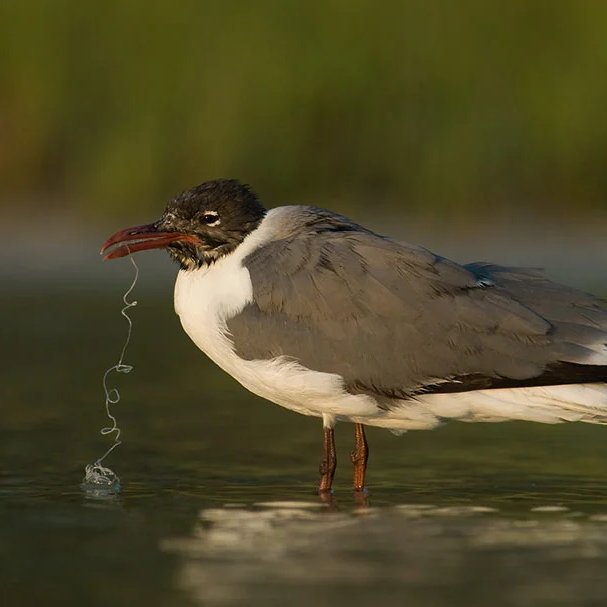
Monofilament fishing line is one of the longest-lasting and most lethal kinds of litter for wildlife.
Birds, turtles, seals, and fish get tangled in discarded line and either drown, lose circulation to a limb, or slowly starve as it tightens. Because the line is thin and often clear, animals don't see it and people don't pick it up. A single carelessly discarded tangle can kill for decades.
The fix is simple. Don't cut and drop line at the water's edge. Reel it in, bag it, and drop it in a monofilament recycling bin (most tackle shops, marinas, and boat ramps have one) or cut it into short pieces before throwing it in a covered trash can so nothing can get tangled.
Carol and Hubert are still here and are approaching 1 year old. at this point, I'm willing to let them go separately if that helps them find homes. They are getting 0 interest as a pair and they'll be fine separated. please share
Can't get rid of your lawn? Add flowers to it.
You don't have to rip out your turf to help pollinators. You can overseed flowers directly into the lawn you already have. Rake to expose some soil, scatter seed, water. Many low-growing flowers tolerate mowing and bloom right alongside the grass.
The most reliable, easiest to establish:
Common blue violet (Viola sororia). Native across the eastern US, host plant for fritillary butterflies, thrives in lawns where it's usually called a weed.
Self-heal (Prunella vulgaris). Look for the native subspecies lanceolata. Low, mow-tolerant, covered in bees all summer.
Pussytoes (Antennaria). Native, silvery, forms a low mat, handles mowing, and hosts the American lady butterfly.
Frogfruit (Phyla nodiflora). For the South and warm West (roughly Zone 7 and warmer). A tough, creeping native that hosts buckeye and white peacock butterflies and takes both mowing and foot traffic.
Mow higher (3+ inches), mow less often, skip the herbicide. A lawn with flowers in it does more for your local ecosystem than the greenest yard on the block.
The bee hotel you bought at the garden center is probably hurting native bees.
A 2015 study tracked 600 bee hotels across Toronto over three years. The results were pretty sobering: introduced (non-native) species occupied a third of all hotels, native bees were infected by parasites at higher rates, and pathogens spread between bees at densities that would never occur in nature.
The mass-produced versions are the worst offenders. Glued bamboo tubes can't be cleaned, which means parasitic mites, fungi, and parasitoid wasps build up year after year. Native bees can't help themselves, they keep moving in despite the danger.
If you want to support native cavity-nesting bees, the better moves are: leave standing dead plant stems through winter, leave bare patches of unmulched soil (most native bees nest in the ground), and plant a wide range of native flowers.
A messy yard is a better bee hotel than any bee hotel. Bees don't need a hotel, they need habitat.
Your porch light is killing the night shift pollinators by the hundreds. The fix is a $5 light bulb swap.
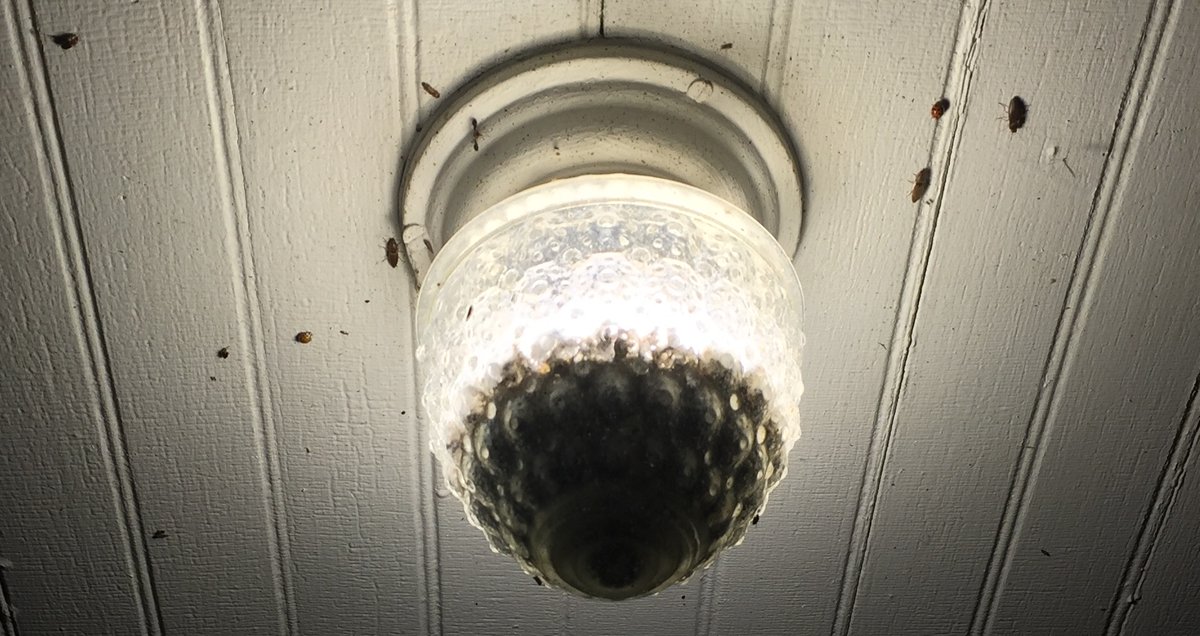
Insects navigate by celestial light from the moon and stars. They're especially sensitive to UV and blue wavelengths, which is what cool-white and standard white bulbs put out. Cool-white and standard white light bulbs are short-wavelength and disrupt that navigation.
Moths circle the bulb until they die of exhaustion. Beetles, midges, fireflies, mayflies, lacewings, and small predatory wasps are pulled out of their habitat the same way, all summer, every night the light is on.
The result, if your porch light has been white for years, is a steady local depletion of the nocturnal pollinators, predators, and decomposers your local ecosystem runs on. Moths alone pollinate dozens of native plants no day insect visits.
Warm amber bulbs (2700K or lower on the package) attract a fraction of the insects. Red bulbs attract almost none.
Either one costs about $5 and lasts a decade if you get an LED.
You get the same visibility with a fraction of the dead insects.
Dirty bird feeders kill birds and can make you sick too.
A 2021 salmonella outbreak spread through bird feeders across the western US and killed enough pine siskins that 14 people across 12 states were hospitalized from cross-contamination.
Mycoplasmal conjunctivitis spreads the same way: birds touch the contaminated surface, swell up, go blind, starve.
Clean your feeders every two weeks: 1:9 bleach to water. Scrub, rinse, dry fully before refilling.
A feeder you don't clean can quickly become a contagion station.
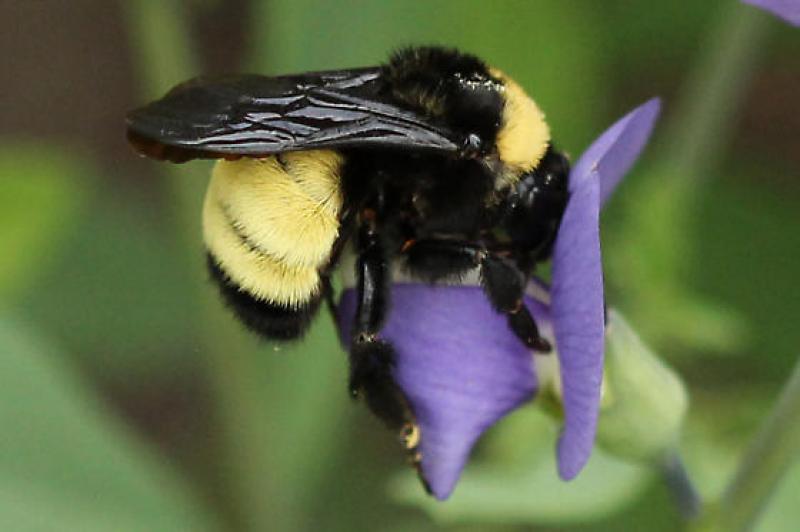
Everyone's worried about honeybees, but the American bumblebee has declined by 89% in the last 20 years.
Bombus pensylvanicus was once the most common bumblebee in the southern United States. It's now functionally extinct in eight states (Maine, Rhode Island, New Hampshire, Vermont, Idaho, North Dakota, Wyoming, and Oregon) and down 99% in New York.
The honeybee, the species most "save the bees" campaigns are organized around, is not native to North America. It was brought over by European colonists in the 1600s as livestock for honey production. It is managed, bred, transported across the country in trucks, and is doing fine. Beekeeping is an agricultural industry, not a conservation effort.
The American bumblebee is what we actually have. It pollinates wild plants honeybees can't, including ones with deep flowers and ones that require buzz pollination (a technique honeybees don't perform). Tomatoes, blueberries, eggplants, cranberries, and countless wildflowers depend on it.
The Center for Biological Diversity petitioned to list the species as endangered in 2021. The federal review is now in its fifth year. The species is still not protected.
Three things help.
1. Plant native flowers, the kind bumblebees evolved with (asters, goldenrod, milkweed, native sunflowers, beebalm, mountain mint).
2. Leave standing dead plant stems through winter, that's where queens overwinter.
3. Stop spraying for mosquitoes, those sprays kill every pollinator they touch.
The bees we built an industry to "save" are not the bees that need saving. The ones that do are quietly disappearing while we celebrate the ones that aren't.
Need a fence? What you really need is a deadhedge.
It's a barrier made of dead branches stacked between two rows of posts. You feed it with branches, fallen limbs, and woody yard debris. Over a season it becomes denser than most commercial fencing. Over years, the bottom layers compost down and the top gets refilled with whatever you trim that week.
Wrens, robins, and ground-foraging birds nest in the structure. Hedgehogs, field mice, frogs, and toads shelter in the base. Solitary bees, ladybirds, and beetles overwinter in the cavities.
Germany has been planting deadhedges as wildlife corridors since the 1990s. The UK uses them for riverbank restoration.
A wood fence costs thousands of dollars and supports no wildlife. A deadhedge costs nothing, gets denser every year, and provides habitat for dozens of species you want in your yard anyway.
It's actually a myth that deer are a vector for Lyme disease. They are definitely a target for ticks, but deer don't contract or carry Lyme.
White-footed mice are the most common reservoir for Lyme disease, and looking at the photo below, you can see just how many ticks can attach themselves to a single mouse and come away infected.