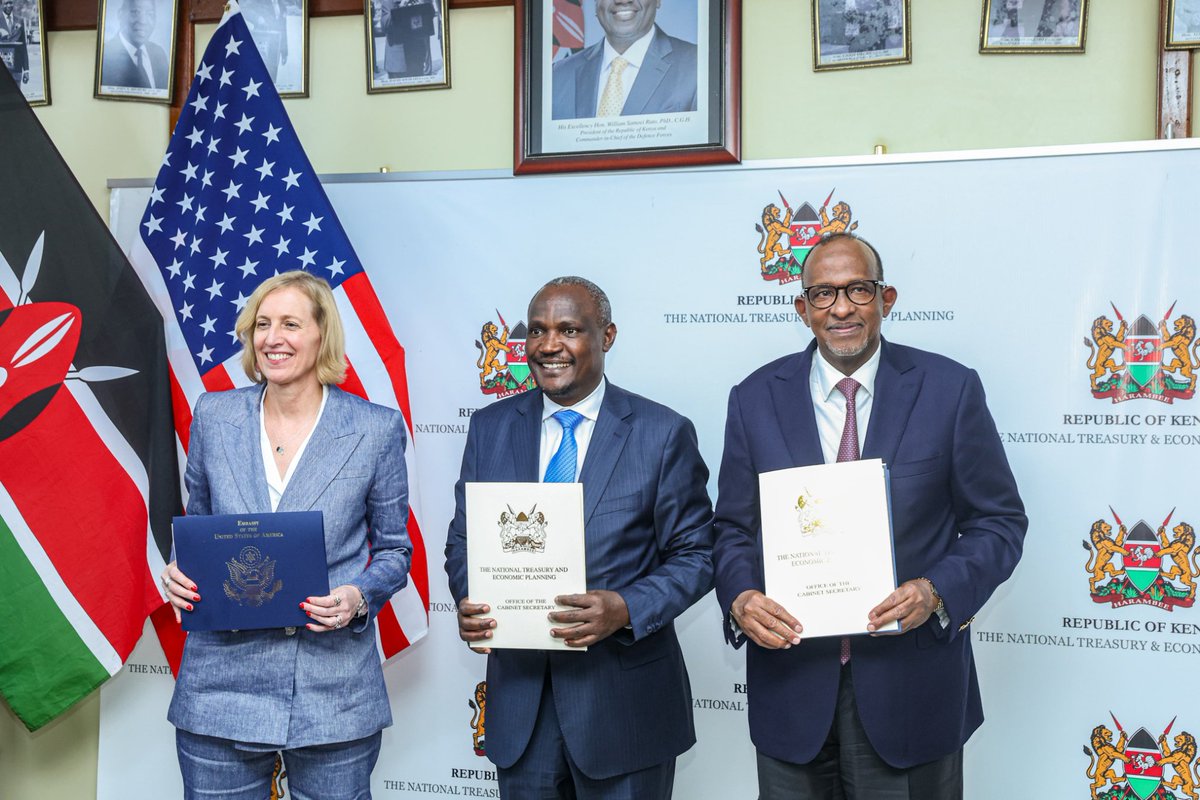
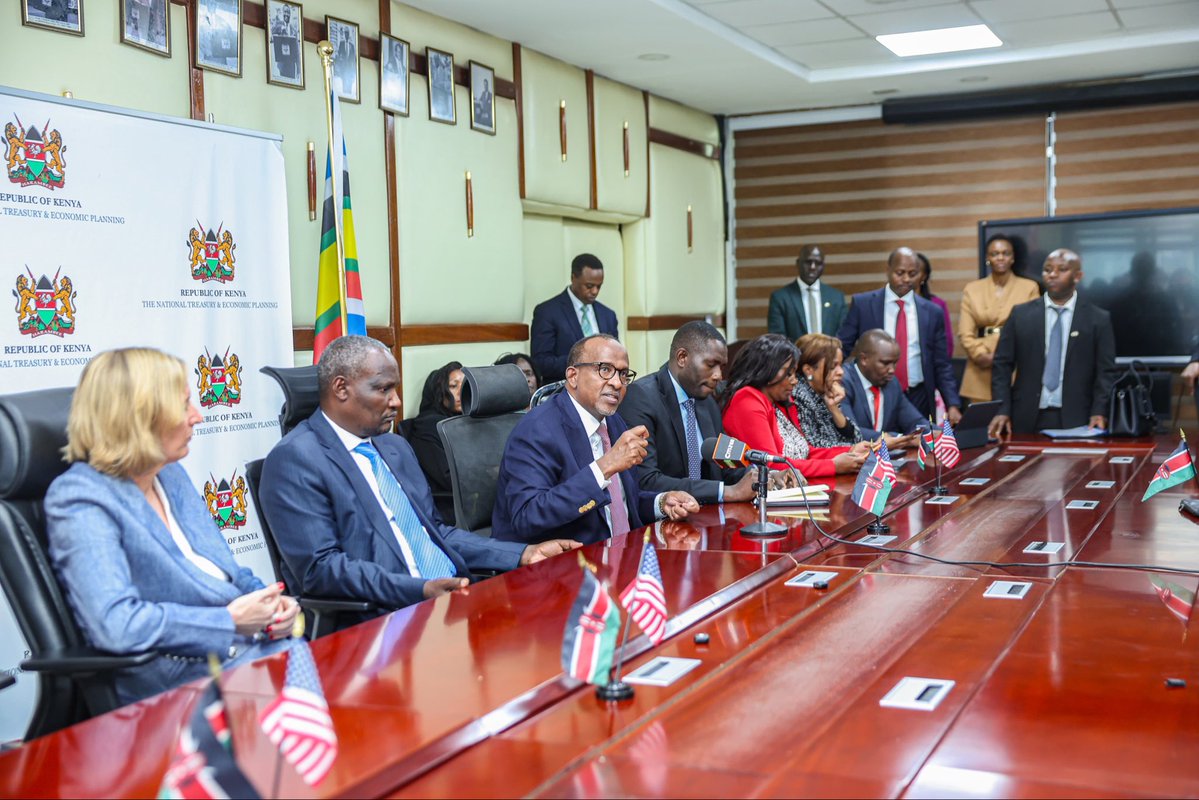
Cabinet Secretary for Health Hon. Aden Duale today joined the Cabinet Secretary for the National Treasury and Economic Planning, Hon. John Mbadi, in witnessing the signing of the Strategic Objective Grant Agreement (SOAG) under the Kenya–United States Health Cooperation Framework.
The agreement was signed at the National Treasury Headquarters in Nairobi in the presence of a United States delegation led by U.S. Chargé d’Affaires Ms. Susan Burns.
The SOAG provides a structured framework for Kenya–United States health cooperation, setting out shared strategic priorities, financing arrangements, implementation targets and performance measures to guide joint health interventions while strengthening transparency and mutual accountability.
The signing followed months of consultations and technical engagements between the two governments to translate the broader cooperation framework into an actionable programme aligned with Kenya’s health sector priorities. The agreement places emphasis on strengthening national institutions and health systems, improving supply chain resilience and building local capacity.
Over the next five years, the Framework is expected to mobilise approximately USD 1.6 billion to support Kenya’s health agenda and advance the country’s transition towards a resilient, self-sustaining and increasingly domestically financed healthcare system.
Key areas of cooperation include reforms at the Kenya Medical Supplies Authority (KEMSA), intensified efforts against HIV, tuberculosis and malaria, expansion of digital health services through the Digital Health Superhighway, health systems strengthening and improved access to affordable, quality healthcare.
Hon. Duale reaffirmed the Government’s commitment to a Government-to-Government cooperation model anchored on national ownership, accountability and prudent use of resources. He noted that the approach is intended to ensure development investments deliver measurable and sustainable health outcomes for Kenyans.
The agreement further strengthens Kenya–United States cooperation in advancing Universal Health Coverage through Taifa Care, supporting disease prevention and control, improving health service delivery and building a responsive and resilient health system capable of addressing current and emerging public health challenges.
Present were Principal Secretary for Medical Services Dr. Ouma Oluga, Principal Secretary for Public Health and Professional Standards Ms. Mary Muthoni, Social Health Authority Chief Executive Officer Dr. Mercy Mwangangi, Digital Health Agency Chief Executive Officer Eng. Anthony Lenayara, National AIDS and STIs Control Programme Director Dr. Andrew Mulwa, DPH-K Chairperson Brian Rettman, alongside senior government officials and representatives from both governments.
The Ministry of Health, the National Treasury and Economic Planning, and the United States Government today signed the Strategic Objective Grant Agreement (SOAG) under the Kenya–United States Health Cooperation Framework, marking a significant milestone in the two countries' longstanding health partnership.
The five-year agreement is expected to mobilise approximately USD 1.6 billion to support Kenya's health agenda, focusing on strengthening health systems, reforming KEMSA, combating HIV, tuberculosis and malaria, expanding digital health services through the Digital Health Superhighway, and advancing Universal Health Coverage under Taifa Care.
The agreement underscores a Government-to-Government cooperation model anchored on national ownership, accountability and sustainable financing, reaffirming the shared commitment to building a resilient, responsive and self-sustaining healthcare system for all Kenyans.
We held a debrief meeting with the World Bank Team to review the implementation progress of the Building Resilient and Responsive Health Systems (BREHS) Project and align on key priorities.
We assessed progress in the procurement of essential health products and technologies through KEMSA, with counties expected to receive the supplies in September. We also explore strategies for fast-tracking the implementation of the STEPS Survey, the Mental Health Survey, and the Kenya Household Health Expenditure and Utilization Survey (KHHEUS) to strengthen evidence-based planning and decision-making.
The meeting reaffirmed our commitment to accelerating priority interventions to ensure the BREHS Project remains on track in strengthening Kenya's health system. We appreciate the continued partnership with the World Bank team, led by Dr. Elizabeth Wangia.
PS @psmuthoni joined the Kerugoya Boys High School community for the launch of the school's Strategic Plan 2026–2030, reaffirming Govt's commitment to accrediting the school's health clinic under SHA, urged vigilance against drug & substance abuse, encouraged SHA registration.
@TheStarKenya 1.Jave a hybrid system....day school for those who don't stay far,boarding for those from far .
2 Decongest to reduce stress and anxiety for both teachers and students
Strengthening tobacco control remains a key priority in protecting public health and reducing the burden of tobacco-related diseases across the country.
Principal Secretary for Public Health and Professional Standards, Mary Muthoni, today appeared before the National Assembly Committee on Health, chaired by Seme MP Hon. Dr. James Nyikal, to provide an update on the implementation of the Tobacco Control Act, 2007.
The PS outlined progress made in strengthening tobacco control measures, including enforcement of smoke-free public spaces, implementation of graphic health warnings, public awareness campaigns, tobacco cessation programmes, and enhanced regulatory oversight.
She also highlighted emerging challenges posed by novel nicotine and tobacco products, illicit trade, and the growing use of digital platforms to market tobacco products to young people.
The PS emphasized the importance of sustained collaboration among government agencies, Parliament, civil society, and other stakeholders to strengthen enforcement, address emerging threats, and support effective implementation of tobacco control interventions.
I think people should just do whatever they want at this point.
I have just come across a Harvard research that found people who enjoyed moderate amounts of ice cream appeared to have lower rates of cardiovascular disease.
Ice cream?
Ebola is serious, but panic does not protect us, correct information does. Over the next few days, I will share simple facts on what Ebola is, how it spreads, symptoms to watch for, what to do if you feel sick and how Kenya is strengthening preparedness. Stay calm. Stay informed.
We continue to expand training opportunities for health professionals through the establishment of various KMTC campuses as we improve service delivery and advance Universal Health Coverage.
Hosted local leaders from Kikima, Mbooni sub-county, Makueni County led by Mr. Joseph Ndavi, who presented a memorandum on the creation of a KMTC campus in the area.
On their part, the community has already invested in and put up structures intended to host the campus, sustaining this vision for over a decade.
To move the initiative forward, the Ministry of Health will undertake a technical inspection of the facilities, improve them where necessary, and work towards the accreditation and operationalization of the campus.
The people of Mbooni have shown what local leadership and partnership can achieve, and their efforts deserve recognition and support.
Also present was Dr. Andrew Mulwa, Head of NASCOP in the Ministry.