Independent Web3 researcher. Market structure, liquidity flows, and macro signals. No noise, just data-driven reads on where crypto actually goes next.
70% of co-living startups fail within 3 years. My 3-point checklist:
• Cash flow per bed
• Hybrid lease terms
• Community retention
Real estate is still real estate.
37,000 car parts, one bad sensor. Clean API maps fool you: real automotive failures hide in shared buses, not single endpoints. Trace the wiring harness next.
What stops hospitals, labs, and pharma from reusing the same coordination rails today: incentives or interoperability? Reusable rails compound only if every actor gains.
gen z thinks crypto is just gambling. they're wrong. here's the actual framework: learn proof of stake. it pays you passive income for holding. stop chasing pumps. stake $ETH. earn yield. that's the real game.
Aye! Found a hidden gem: sub-$50M cap, real tech, zero hype.
Staking now live with fees routed straight to holders.
Narrative lines up for Q4. Do your own research, but this is undervalued.
SpaceXAI just made a massive jump in image generation
Grok Imagine Image 2.0 is now #4 on Artificial Analysis’ Text-to-Image Leaderboard with 1,154 Elo.....the highest-ranked model outside OpenAI
Imagine Image 2.0: #4 — 1,154 Elo
It also sits on the Pareto frontier for quality vs price
Going from #18 to #4 in a single generation is insane
SpaceXAI is moving ridiculously fast
A 10 year old child’s experiment demonstrated that memories can be inherited across generations.
The story started when Jo Nagai, a second grader from Kobe, Japan, observed that swallowtail butterflies he had raised by hand appeared to recognize him, whereas wild butterflies would flee.
Motivated to uncover a scientific explanation, he contacted Georgetown University entomologist Dr. Martha Weiss, who had previously shown that moths retain memories despite the extensive cellular reorganization during metamorphosis.
Encouraged by her research, Jo suggested conducting a similar study with butterflies. This led to a remarkable international collaboration. Using a simple setup created at home, Jo conditioned caterpillars to link a gentle vibration with the smell of lavender.
Remarkably, after their brains were entirely reconstructed inside the chrysalis, 70 percent of the adult butterflies still avoided the lavender scent, demonstrating that their memories had endured the transformation.
The most surprising result emerged when Jo bred these conditioned insects. Neither the offspring nor the grandchildren had ever encountered the vibration, yet both generations displayed an instinctive aversion to the lavender scent.
At the age of ten, Jo compiled his groundbreaking observations into a 33 page paper and presented them alongside Dr. Weiss at the International Congress of Entomology in Kobe. This discovery of transgenerational memory challenges conventional views of genetics and inheritance while illustrating how a child’s curiosity can push the frontiers of scientific understanding.
Charts alone won't save you. But three rules before any entry:
• Structure
• Volume
• Invalidation
Skip one and you're gambling, not trading. Price is just the last signal.
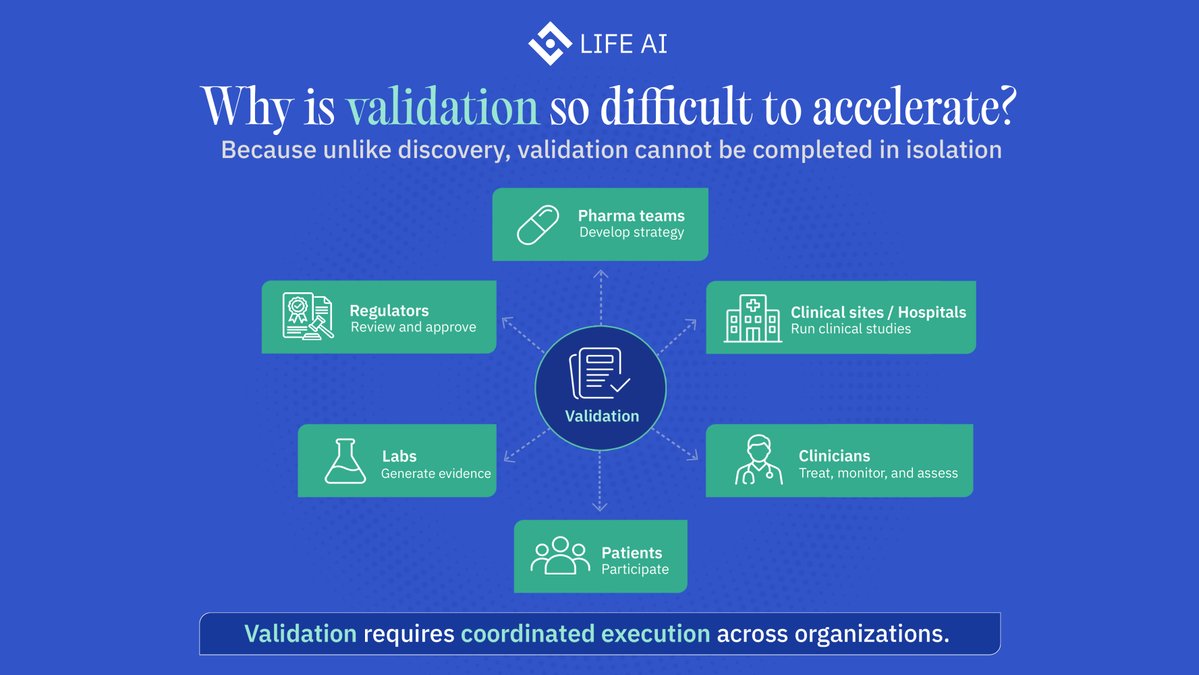
Why is validation so difficult to accelerate?
Because unlike discovery, validation cannot be completed in isolation.
An AI-generated drug candidate still has to move through key players across the healthcare value chain, including pharma teams, clinical sites, hospitals, clinicians, patients, and regulators. Each operates with different timelines, evidence requirements, compliance constraints, and operational priorities.
A candidate can move forward on one front while remaining constrained elsewhere, whether by patient recruitment, study execution, evidence generation, or the decisions required to advance it.
This makes validation more operationally complex than discovery. Discovery can be accelerated within a model, platform, or controlled environment, while validation depends on how effectively these key players coordinate and execute across the development process.
With more candidates entering development, that operational complexity compounds, requiring more evidence generation, clinical execution, patient participation, and coordinated decision making across organizations.
As AI accelerates discovery, the need for better coordination and the infrastructure to support it becomes increasingly important downstream.