Artwork Analysis — Edward Hopper, Nighthawks (1942)
Hopper paints with precision and restraint: smooth brushstrokes, crisp edges, and light that feels almost architectural. The diner’s glow isolates its figures, turning an ordinary night into a study of stillness and distance.
You are invited to an HAD Faculty Conversations by Alex Todd, “‘All this repeats”: Wild Plakken and the neo-avant-garde.”
* This event is for Pratt community only.
Date: Thursday, February 26th
Time: 12:00 – 1:00 pm
Venue: Main 210
You are invited to “Art as Social Cartography: Tracing Communities in Malaysia’s Everyday Landscapes,” by Kenneth Wong See Huat.
* This event is open to the general public.
Date: Monday, November 24, 2025
Time: 5:30 pm
Venue: Alumni Reading Room
RSVP: https://t.co/4seu0qTFnS
“Heirlooms and Heiresses: How women who inherited Caribbean Slavery wealth funded British art, architecture and interiors,” by Dr. Miranda Kaufmann.
Date: Wednesday, October 22, 2025
Time: 5:30 pm
Venue: ARC E-02
RSVP: https://t.co/mxDqGdiGtR
* This event is open to public.
You are invited to “Becoming Leonor Fini – Theatrical Self-Performances between Art and Life,” by Andrea Kollnitz.
* This event is for the Pratt community only.
Date: Wednesday, October 15, 2025
Time: 5:30 pm
Venue: ARC E-02
Seurat’s monumental painting is one of the most celebrated works of Post-Impressionism. Instead of using broad brushstrokes, Seurat employed a method called pointillism, applying countless small dots of pure color that blend in the viewer’s eye.
Minimalism was not just a style for Mies van der Rohe, it was a philosophy of design. His buildings and furniture stripped away ornament to reveal clarity, proportion, and precision. The phrase “less is more” continues to inspire designers and architects to this day.
The 20th and 21st centuries introduced modern fixtures, halogen and fluorescent lamps, and today’s smart, energy-efficient LEDs. Beyond illumination, lighting now shapes mood, highlights design, and integrates seamlessly with technology to create dynamic spaces.
💡 From the flicker of oil lamps and candles to the glow of gas and early electric bulbs, lighting has always been a mirror of human progress. These early innovations brought light into homes, streets, and cities, transforming the rhythm of daily life. #DesignEvolution
HAD Faculty Conversations by Caterina Pierre, “Trust in the Soul: Attilio Piccirilli’s Fragilina (1923) and the Beginnings of Modernism in American Figurative Sculpture.”
* Pratt community only event.
Date: Wednesday, September 17th, 2025
Time: 12:00 – 1:00 pm
Venue: Main 210
The Anglepoise Lamp was first created by engineer George Carwardine. Soon after, the Herbert Terry & Sons company helped refine and manufacture the design, making it accessible for both industrial and domestic use.
Kandinsky’s Composition VIII marks a turning point in modern art.
Rather than depicting objects, Kandinsky sought to evoke emotion through pure form and color. He believed that geometric abstraction could act like music, speaking directly to the soul.
Made by heating a mix of sand, copper, and natron, this luminous blue was used to decorate tombs, statues, and ceramics. Its brilliance symbolized the heavens and eternity, making it one of the most treasured colors of the ancient world.
Fall 2026 applications are officially open for the Department of History of Art and Design at Pratt Institute. Explore, question, and contribute to the future of art and design.
Admissions Link: https://t.co/0CwmIOSnHX
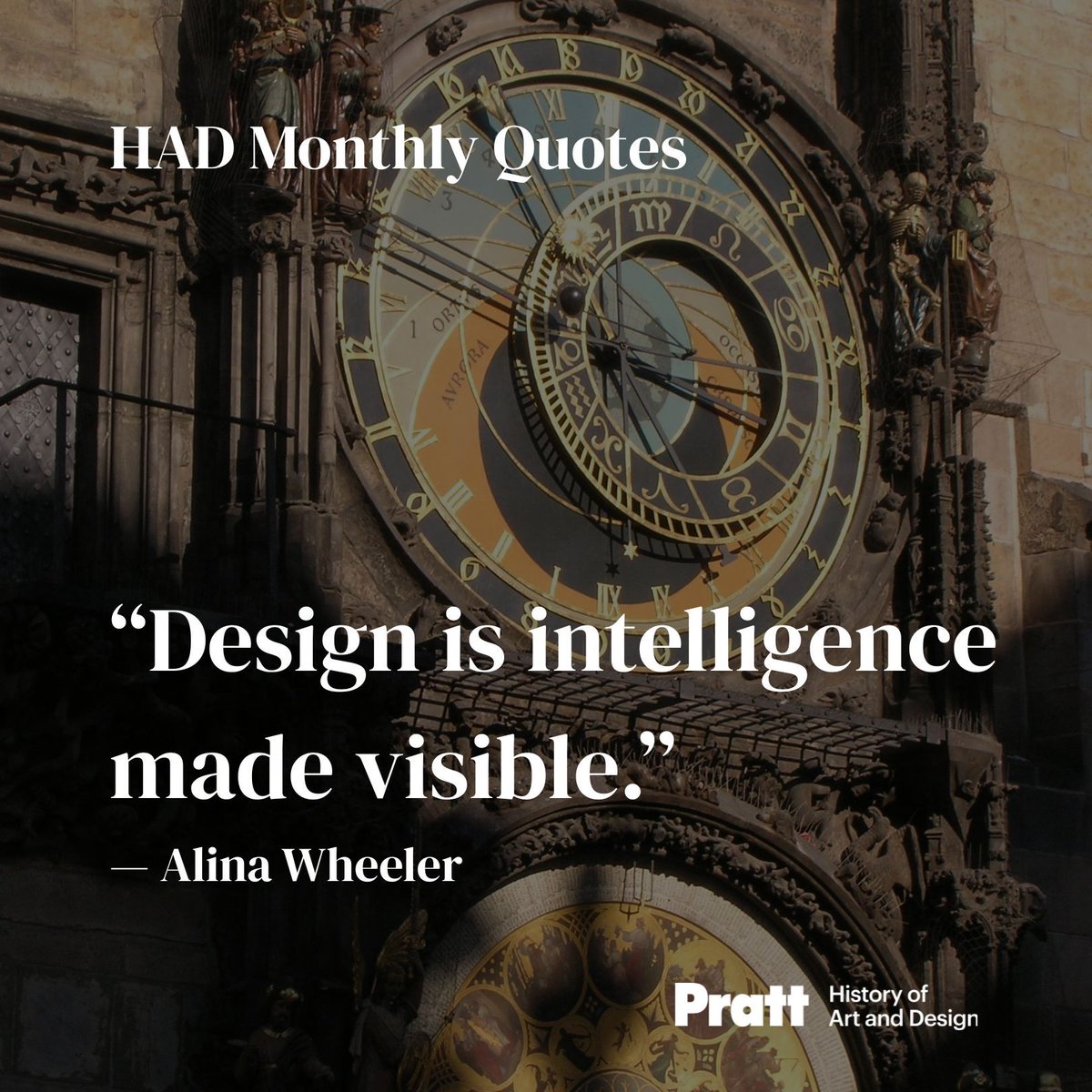
"Design is intelligence made visible." – Alina Wheeler
This June, we’re celebrating the invisible logic behind beautiful design. From Bauhaus simplicity to sleek digital interfaces, smart design shows up when form and function align.
#DesignQuote#DesignHistory#HAD
Art Term: Aniconism
The intentional avoidance of figural imagery, often seen in religious art.
Example: The muqarnas ceiling in Alhambra’s Hall of the Abencerrajes uses intricate geometry instead of human forms to reflect divine order.
#ArtTerms#Muqarnas#Alhambra#ArtHistory