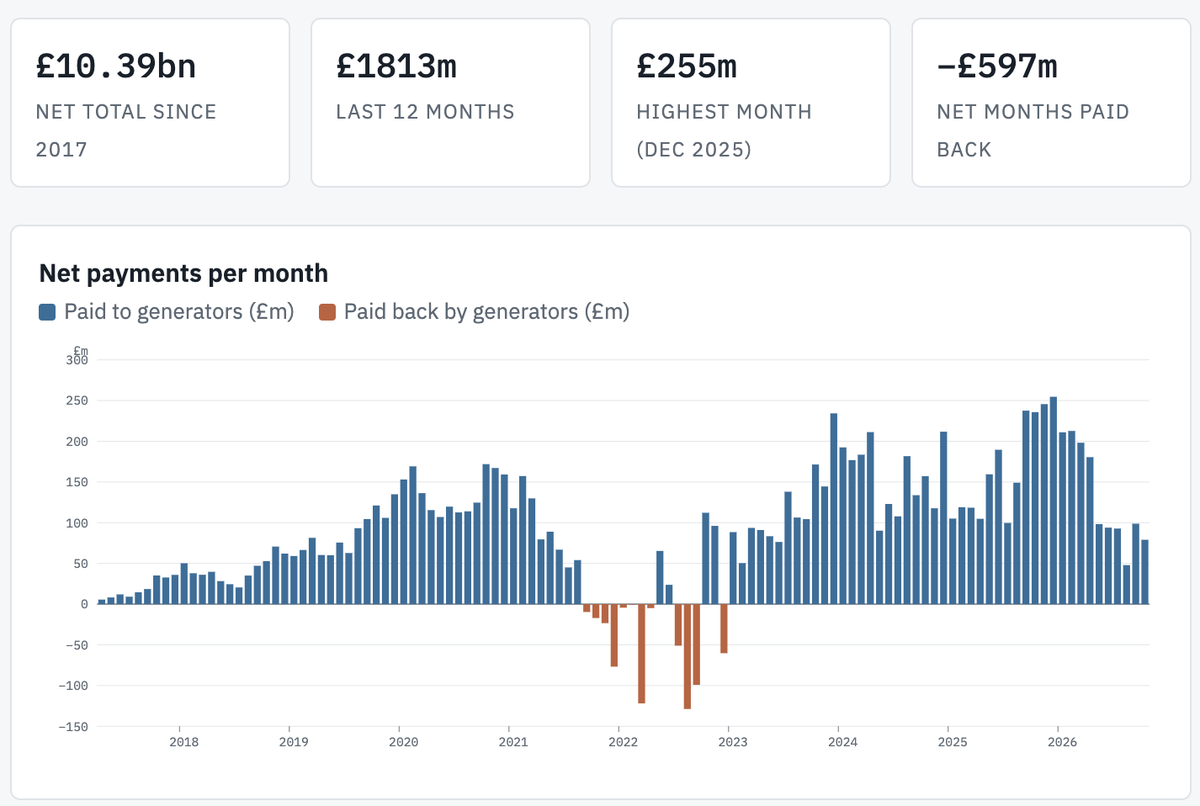
@JeevunSandher Here is the actual real result of the CfD system. Over £10 bln net transferred to offshore wind farm developers. You imply it is a balanced scheme, it is anything but, it is rigged against the consumer.
@JeevunSandher If it is such a good thing then why not share the terms of the NWF "investment"? After all it is taxpayer money at risk. There is simply no justification for lack of transparency. Public funding or loans did not form any part of their bid.
@JordanEVGuy There is no commercial floating offshore wind anywhere in the world. I don't see why bill-payers should celebrate paying £210/MWh for ideologically driven unproven technologies.
@mgshanks The developers bid £91/MWh in 2026 but post-auction extracted £1 billion of taxpayer funding on top. Their bid should have been disqualified and the consortium ejected for attempted extortion of public funds. Instead we get press releaes as if increasing bills is a good thing.
@RichardN7@afneil £91.20/MWh excludes connection and grid costs and the cost of backup for when the wind doesn't blow. If that is factored in wind costs closer to £150/MWh.
@robinenergy Robin, Gulf countries are using cheap, Chinese state subsidised solar and batteries in order to power the growth in essential domestic conditioning and free up oil and gas volumes for export. It has nothing to do with trying to change the climate.
@Miatsf Please show the public these wind farms will lower bills. It is not possible with a CfD at £91/MWh and intermittency and grid costs on top of that.
@Miatsf@RWE_AG These wind farms will harvest about £5-10 billion in bill-payer subsidies through their lifetimes on top of the cost of the power itself. CfD, grid upgrade and intermittency costs. It would be impossible to demonstrate that these projects will reduce bills.
@DaleCloudman Silicon transistors today are down to 200k atoms, but might not be able to get much smaller. The gap with atomic transistor concepts isn't that large.
@BrknMan Floating offshore will never reduce bills. There is not a single commercial floating wind scheme in the world. Celtic Sea projects are going nowhere without further massive bill payer subsidy. on top of £216/MWh CfD.
@FUDdaily Fix energy first, stimulate job creation, get people into work, reduce welfare bill, create growth, allowing fair welfare for those who really need it and cutting off for those who don't. Addressing welfare first is the cart before the horse.
@BrknMan This is what I wrote:
"Floating wind in AR4 was 50% of AR7"
Regardless whether 32MW is small or not, it does not support your original point implying there is a cheap wind bonanza just waiting off Cornwall.
@BrknMan I said AR4, not AR5. AR4 awarded the first floating wind contract to Twin Hub at £87/MWh, off Cornwall, funnily enough. The CfD contract was terminated and the company sold in 2026 for £1, without a single Watt ever being generated.
@BrknMan Offshore fixed wind is 75% more expensive in AR7 than it was in 2022 AR5. Technology may have improved but realistic interest rates are now crushing the technology. Floating wind in AR4 was 50% of AR7, so costs are going up all round.
@sydney_ev Any idea what those turbines are made of Syd? Think Rare Earth magnets and the massive radioactive waste that mining and processing them creates.