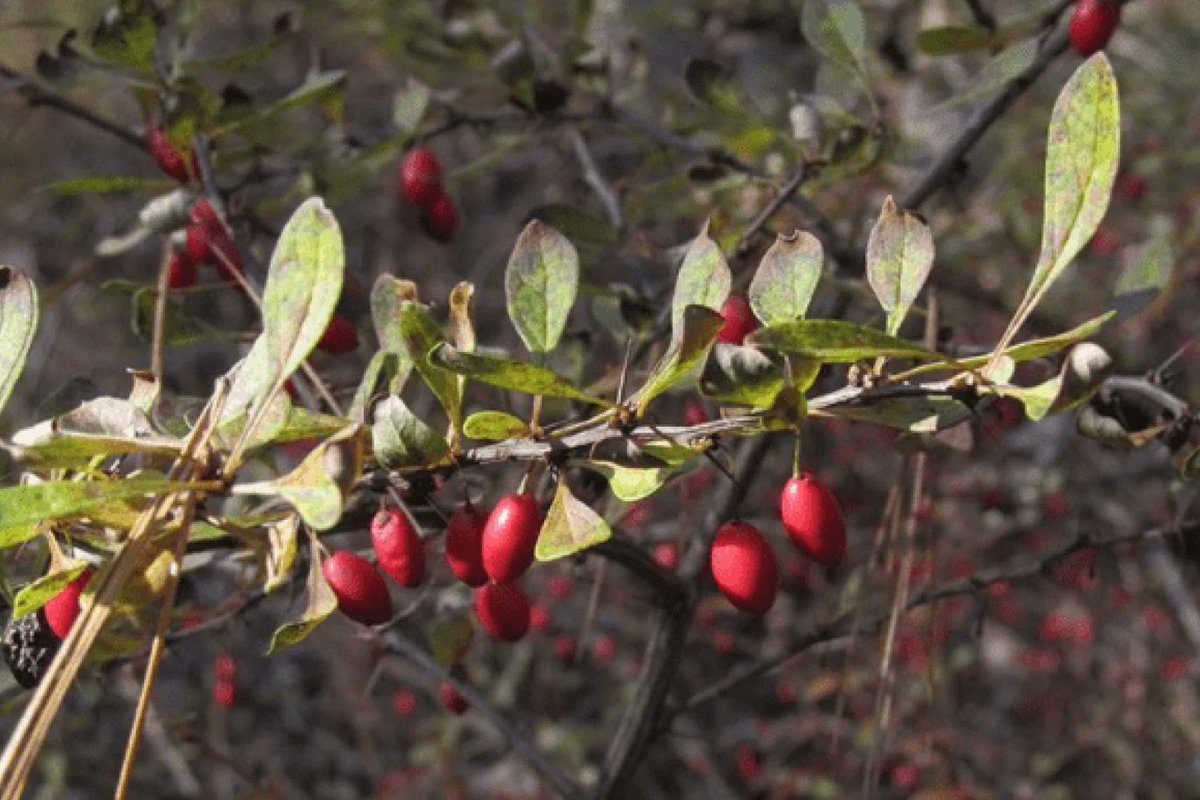
Japanese barberry is the invasive shrub that throws gasoline on your local tick population.
This popular landscape plant from Japan, sold at garden centers for decades, creates the cool, humid microclimate ticks thrive in. Its dense thorny thickets also shelter white-footed mice, the main reservoir for Lyme disease bacteria.
Connecticut researchers found that an acre of forest with Japanese barberry averages 12 times more Lyme-carrying ticks than an acre without it.
If you have it, pull it. New York and Connecticut have banned its sale. Several more states list it as invasive. Native alternatives like inkberry, winterberry, or chokeberry do the same landscape job without raising tick populations or starving local birds of the food they need.
A pretty shrub from Japan isn't worth all the tick drama.
@giveashitnature Great way to use up that left over muscle cream and minty arthritis slave you have lying around.. slather on lower legs. Most ticks won't come anywhere near you.
One thing no one tells you about the individuation process is that it will make you seem more unhinged to regular people except it will feel completely natural and normal to you
Tick season is here, and it's a doozy. There's a ton of misinformation about ticks makes them worse.
Myth: If bitten, you should cover the tick with petroleum jelly, dish soap, or nail polish to make it back out.
Fact: None of those cause the tick to release. The CDC, Yale, and every major tick lab have confirmed it. What does happen is the tick gets irritated and regurgitates its stomach contents (saliva, bacteria, viruses) into your bloodstream, which increases your infection risk.
Myth: Burn it off with a match.
Fact: Same problem as above, plus you might burn yourself. Heat triggers the same regurgitation response. The tick is anchored with backward-facing barbs, it physically cannot back out from a flame.
Myth: Twist it counterclockwise to unscrew it.
Fact: Ticks don't screw in. Twisting tears the mouthparts off in your skin. What actually works: fine-tipped tweezers, grip as close to the skin as possible, pull straight up with steady pressure. That's it. Wash the bite, drown the tick in alcohol or flush it.
Myth: A perfectly manicured yard is tick-proof.
Fact: Most ticks in a yard live in the edge zone between lawn and woods, and the actual reservoir is the white-footed mouse. Spraying the whole yard kills bees and beneficial insects without touching the mouse population. Owls and snakes do the same work for free.
The best tick prevention is mostly letting other animals do the work.
It is time to start making ume-syrup. 400g of plums, 400g of rock sugar. Cover with an airtight lid (I just use plastic wrap), store in a cool, dark place. That’s it. Let it sit for about a month, and you have a tasty and traditional "lemonade-esque" base to add to soda!
Le 4 juin 1783, deux fabricants de papier ont fait quelque chose que personne n'avait réussi depuis Icare. Ils ont fait voler un objet.
Annonay, en Ardèche. Joseph et Étienne Montgolfier dirigent la papeterie familiale. Mais ils ont une obsession : l'air.
Un jour, ils tiennent une chemise au-dessus du feu. Elle se gonfle, se soulève. L'air chaud monte. Tout part de là.
Ils fabriquent un immense globe de toile et de papier. Onze mètres de diamètre. Et ce 4 juin, sur la place des Cordeliers, devant les notables du Vivarais réunis, ils allument un feu de paille et de laine sous le ballon.
Les cordes sont coupées.
Le globe s'arrache du sol. Il monte. Cent mètres, cinq cents, mille mètres dans le ciel. La foule est pétrifiée. Certains crient au miracle, d'autres ont peur.
L'engin retombe dans une vigne, à trois kilomètres de là.
Ce jour-là, l'humanité cesse d'être clouée au sol. Quelques mois plus tard, un homme s'envolera à bord.
Chaque montgolfière que vous voyez dans le ciel d'été descend de ce ballon de papier ardéchois.
Vous êtes déjà monté en montgolfière ?
🦔SpaceX priced its IPO at $135 a share today. $75 billion raise, $1.75 trillion valuation, largest IPO in history. Goldman Sachs, the lead underwriter, projects SpaceX AI revenue will go from $3.2 billion to $322 billion by 2030. Morningstar says the company is worth $780 billion, less than half that.
Fidelity dropped the buy-in from $500,000 to $2,000 and SpaceX reserved 30% for retail. S&P just confirmed it won't fast-track mega-cap IPOs into the index.
My Take
SpaceX is a real company with a real business. Starlink prints revenue, the launch division has no serious US competitor, and the engineering is world class. None of that is in question. What's in question is whether a $1.75 trillion valuation built on a 100x AI revenue projection from the same bank collecting fees on the deal reflects reality or a sales target.
Goldman needs this IPO to be massive because Goldman gets paid when it's massive. So they wrote a forecast where xAI and X, neither of which has proven sustainable economics, somehow produce $322 billion in AI revenue by 2030. Morningstar looked at the same company and came up with half the valuation. Meanwhile Fidelity dropped the minimum to $2,000 and SpaceX carved out 30% for retail, which starts to look a lot like exit liquidity when you consider that the S&P 500 won't fast-track the stock into the index and the institutional demand backstop everyone assumed was coming isn't there.
Anthropic just filed its S-1, OpenAI is next, and every AI valuation in the pipeline leans on the same kind of projections Goldman used here. If this one doesn't hold, it pulls the floor out from under all of them.
Hedgie🤗
How’s this for a throwback - the brilliant first generation Honda Civic tearing up Road Atlanta in 1978.
📸 William Etges
#HondaCivic#CVCC#RoadAtlanta#SCCA
Good advice. A far less healthy alternative was (maybe still is) what were known as "moth crystals"* which were tins containing some toxic insecticide that were put into Mom's cedar chest containing her wool items.
*In Jersey City. Your language may vary.
A New York cemetery just turned out to be the world’s most unexpected bee metropolis. Cornell scientists dug around and discovered 5.5 million mining bees living deep underground like tiny, polite subterranean tenants who’ve been paying rent in pollination for over a century. The place has everything a bee could want, perfect soil, no pesticides, and absolutely no humans messing with them. Now researchers are studying this accidental bee utopia to figure out how it stayed stable for 100 years so we can stop driving pollinators toward extinction. Scientists are now studying this accidental bee paradise to figure out how to keep pollinators alive everywhere else. Spoiler-maybe stop nuking the landscape with chemicals. https://t.co/G2jieiKPqP
Le M de CMJN, sur vos cartouches d'imprimante, porte le nom d'une bataille française. Une des plus sanglantes du XIXe siècle.
Le magenta.
Ce rose intense que vous voyez tous les jours sans y penser. Sur un logo, un emballage, une page mal imprimée. Il a une date de naissance presque exacte : le 4 juin 1859.
Quelques années plus tôt, un chimiste français, François-Emmanuel Verguin, met au point une teinture artificielle d'un rose éclatant. Du jamais vu. Il la baptise fuchsine, en pensant à la fleur de fuchsia.
Le même printemps, l'armée de Napoléon III affronte les Autrichiens près d'un village de Lombardie. Le 4 juin 1859, c'est la victoire. Mais le sol est jonché de milliers de morts. Le champ de bataille est rouge.
Le village s'appelle Magenta.
Pour célébrer la victoire, on rebaptise la teinture rose du nom de la bataille. La couleur du sang versé devient la couleur de la mode.
Aujourd'hui encore, chaque imprimante du monde fonctionne avec ce rose-là.
Vous le saviez, vous, d'où venait ce nom ?