fished my midi keyboard out of storage last night, and booted into Windows just to run a few music plugins chained to proprietary DRM.
Naturally, they crashed. 5 hours of troubleshooting later i finally got sound again, but the inspiration was gone.
On Linux, my AI agents fix software issues in minutes. Closed-source bloat is pure pain. OSS + AI agents is my unlock of 2026.
Stripped of the academic clutter, the story is straightforward:
A huge chunk of bank accounts and retail loans in Costa Rica are in U.S. dollars. Because U.S. interest rates are currently paying better than colón rates, people keep stashing money in dollars. Moody’s is warning that if there’s a sudden external shock or run on the dollar, Costa Rican banks are more exposed to a liquidity crunch than almost anyone else in Latin America outside Argentina—especially if the colón takes a hit and borrowers earning colones can’t afford their dollar debts.
https://t.co/ztKFQ2oTen
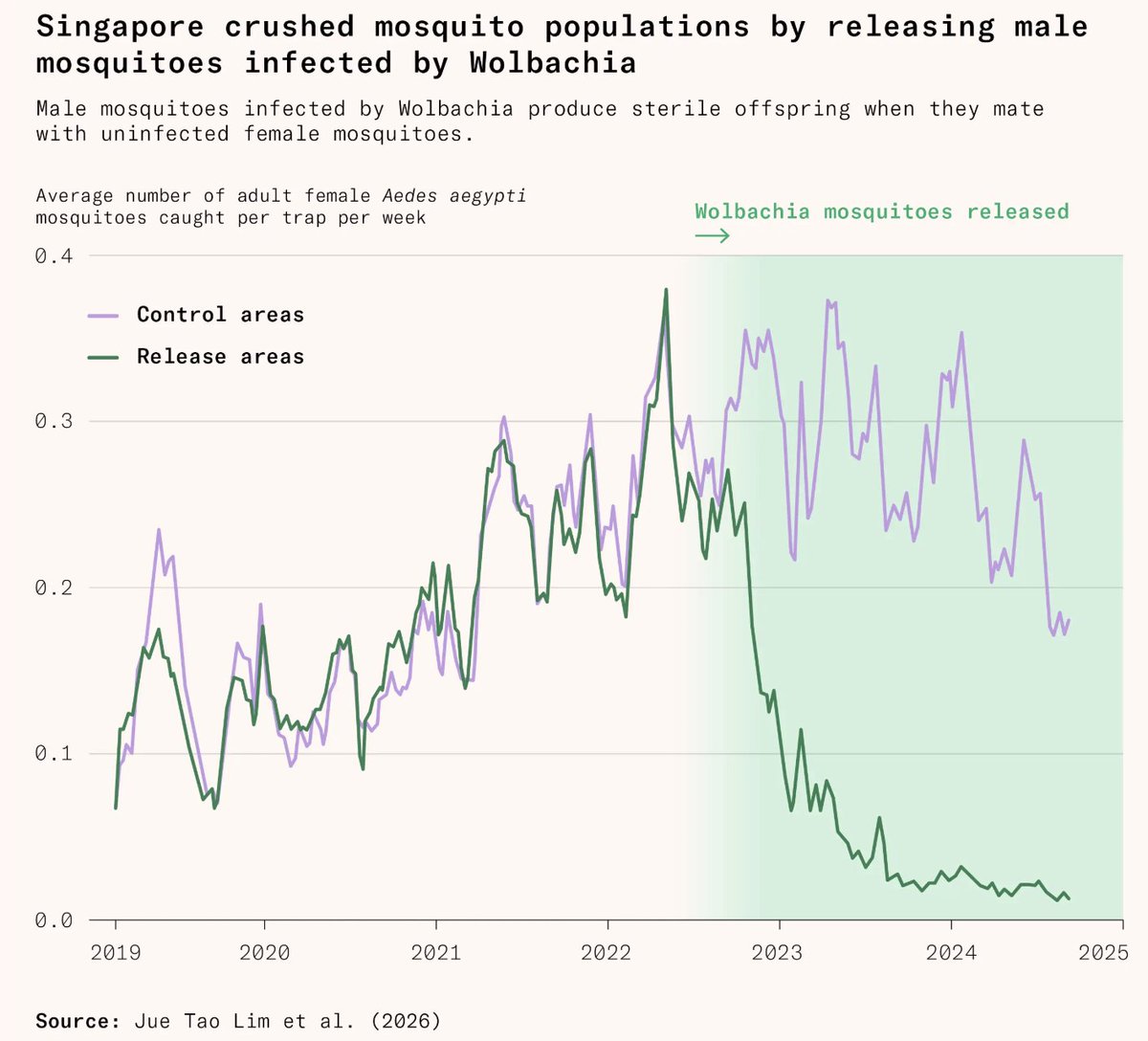
When I stilled worked on biosecurity, I first learned about Debug, a Google project to reduce mosquito populations.
Results from their Singapore pilot are now out.
They crushed mosquito populations, reducing dengue infections by 70% in the process:
AI alignment dresses a fundamental power struggle up as computer science. Because "human values" are contradictory, there is no objective moral baseline to code against, meaning models inevitably default to the corporate risk limits, PR fears, and ideological priors of the labs building them—often at the direct expense of the person paying for the tool. When an arbitrary guardrail blocks a harmless prompt, the product stops being useful and simply alienates the user. Ultimately, that creates a powerful market pressure: corporate scolding does not retain customers, open-weight models keep eroding the moat, and the platforms that survive will likely be the ones that shift alignment back where it belongs—serving the utility and intent of the actual consumer.
lived in the canyon for a decade or so. i feel like this is a perennial news item, the future being uncertain and the end of the canyon store is always near. favorite line from the article: “I’m not in the bummer tent over it — I know how the world works.”
https://t.co/bJfl9eL404
last night i was reading 1873, about the railroad bubble and subsequent panic, and remembered minor keith, a prominent figure of costa rican history. CR was in fact a prime example during the autopsy of the crash. gemini:
That exact market frenzy is what launched the Keith enterprise.
Costa Rica’s 1871 and 1872 loans were not an isolated negotiation; they were prime exhibits in the notorious 1871–1872 London foreign loan bubble described in that passage.
In fact, Costa Rica—along with Honduras, Paraguay, and Santo Domingo—became the poster child for the predatory underwriting of that specific wave. London was awash in liquidity looking for yield, and loan contractors like Bischoffsheim & Goldschmidt went hunting for small sovereign states willing to issue debt under absurd terms.
Costa Rica had virtually no external debt and almost no domestic revenue base to back foreign borrowing. Yet, between 1871 and 1872, the London market floated two bond issues totaling roughly £3.4 million ($17 million) in Costa Rica’s name:
* **The 1871 Loan:** £1,000,000 floated by Bischoffsheim & Goldschmidt to finance Henry Meiggs’s railway contract. Bischoffsheim bought the bonds at 56% of face value and sold them to British retail investors at 72% or higher, pocketing enormous margins before a single tie was laid.
* **The 1872 Loan:** Another £2.4 million issue handled by Knowles & Foster, intended to cover the remaining costs of the rail line to Limón. It was so heavily manipulated that Costa Rica saw only a fraction of the paper value, while paying interest on the full amount.
The whole thing blew up in 1873. When global liquidity dried up and the bubble popped, the London Stock Exchange and the British Parliament formed the famous **1875 Select Committee on Loans to Foreign States** to investigate how British investors had been fleeced. Costa Rica’s loans, along with the Honduras rail loans, were the star scandals of the parliamentary report.
The money that paid for Minor Keith's initial laborers, ties, and provisions in Limón came straight out of that flood of speculative London cash. When that exact market seized up in 1873, the funding vanished, the Costa Rican government defaulted, and Keith was left stranded in the jungle with a half-built railroad—which forced his pivot into bananas.
@TomasDeCamino This is where the MacGyver mindset beats institutional inertia. In CR, the ability to creatively repurpose limited tools to fit the job at hand has always been second nature. Democratizing AI turns that everyday resourcefulness into a genuine competitive edge.
Linux market share is up to 15.65% in North America, 8.76% Worldwide.
The North America numbers are absolutely skyrocketing, month to month: 3.7% -> 6.14% -> 10.61% -> 15.65%.
Questions: How many of these are AI bots? And how high could this go?
last night i had codex install and configure all of the components for the costa rican digital signature, something that in the past would have probably taken me a day of reading manuals and googling. it set it up flawlessly, and it runs much faster than on windows or macOS. the future is in open source. it sucks, although not a surprise, that the political direction of both parties in the US appears to be predictable: leveraging the FUD of the moment to hand the duopoly labs the regulations they want, to secure a moat against competition from open models and open software.
have not booted into windows since I installed omarchy distro on monday. Linux plus integrated ai agents seems like the future. it even runs all the games I am currently playing, which was always a sticking point. and integrated agent means config is a breeze.
got omarchy installed, it was a very smooth onboarding compared to my previous linux machines, the potential issue with my rtx5060 that 5.6 sol flagged was not a prob. the tiled windows is going to take some getting used to, but otherwise digging the first couple of hours.
the technological revolution is indisputable. the underlying finance, well there's a reason everyone's reading 1873 right now. I just hope the cheap tokens continue to flow, I am addicted.
Having an agent wrestle Windows settings into submission was fun, but I think I’m ready to stop fighting the OS. Eyeing a dual-boot setup with Omarchy next. If I’m going all-in on an agent-driven workflow, might as well give it an OS built to be hacked up instead of one constantly trying to sell me OneDrive.