Many students are sold a lie that learning should feel pleasurable, and when that's not their experience, the cognitive dissonance eats them alive.
It's like someone signs up for strength & conditioning at a gym and the trainer tells them that they should feel pleasure doing pushups, sprints, deadlifts, etc. Or like a nutritionist saying "you should enjoy the taste of broccoli." Completely alienating.
What a good trainer will say is "Yes, it feels taxing, and that's okay, that's normal. Our goal here is not pleasure, it's satisfaction -- making progress, doing things you weren't able to do before, feeling good about what you've accomplished, transforming yourself in ways that are beneficial for your future. You're here to work, so let's do work."
People respect that, and there's a kind of comfort in knowing that we're all here to do serious work. Whether it's the gym or the classroom, that's what people need to hear.
Imagine having to stop at a toll booth every few hundred feet.
You can still reach your destination, technically.
But every stop breaks your momentum, slows you down, and forces you to pay before you can keep moving.
That’s what algebra feels like when multiplication facts are not automatic.
The student’s supposed to be solving equations, transforming both sides, simplifying expressions.
Instead they get stuck on factoring. What are all the factors of 48? Is it a perfect square?
The algebra is constantly stopping to multiply numbers, and each stop takes another payment of the student’s limited attention.
It increases the chance they’ll make an arithmetic mistake.
And then they have to reorient themselves afterwards. What was I even doing? Where am I?
That’s why multiplication facts need to be automatic.
That’s the only way the student is going to be able to focus their limited attention on the algebra ahead of them.
---
Here is the 100% manually-written long-form that this teaser is distilled from, if you want to dive deeper: https://t.co/DDK5wj4a9E
What's the best way to teach math: explicit instruction or less guided learning?
This might seem like an opinion-based question where the proper answer is "to each their own."
... except, it's not.
One of these options is supported by decades of research into the science of learning. The other is not.
Assuming that we define "best" as "produces measurably superior learning outcomes," then the best way to teach math, hands-down, is explicit instruction.
Nobody who knows the science of learning is actually debating this (though unfortunately much of the education world does not know the science of learning, hence the debate).
A quote from Clark, Kirschner, & Sweller (2012, https://t.co/Jm417z2f1L):
"Decades of research clearly demonstrate that for novices (comprising virtually all students), direct, explicit instruction is more effective and more efficient than partial guidance.
So, when teaching new content and skills to novices, teachers are more effective when they provide explicit guidance accompanied by practice and feedback, not when they require students to discover many aspects of what they must learn.
...
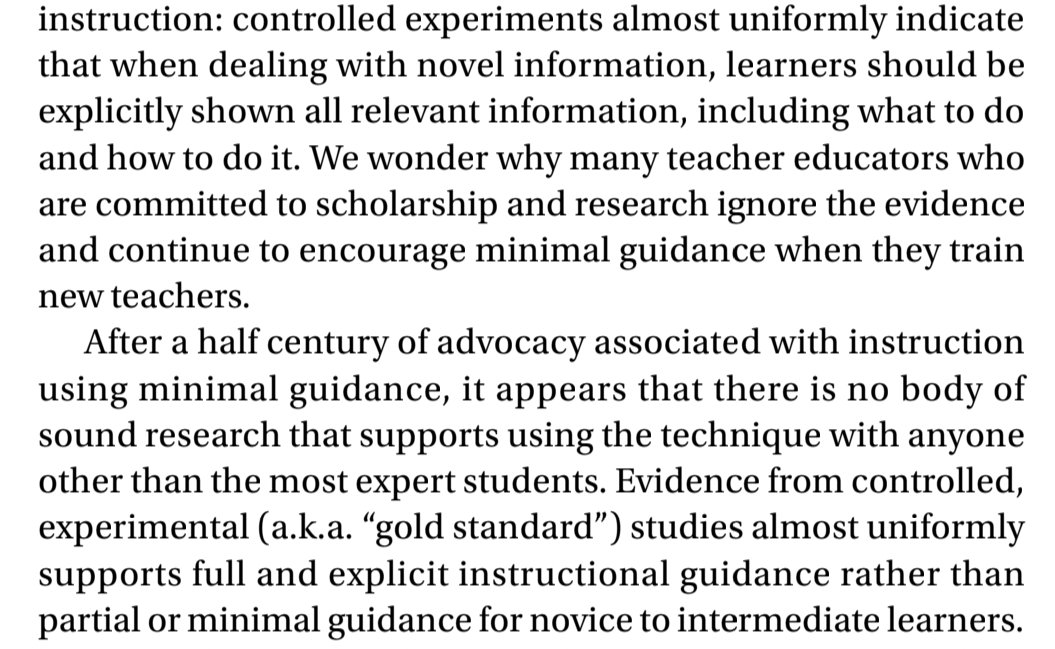
We also have a good deal more experimental evidence [since the 1960s] as to what constitutes effective instruction: controlled experiments almost uniformly indicate that when dealing with novel information, learners should be explicitly shown all relevant information, including what to do and how to do it.
We wonder why many teacher educators who are committed to scholarship and research ignore the evidence and continue to encourage minimal guidance when they train new teachers.
After a half century of advocacy associated with instruction using minimal guidance, it appears that there is no body of sound research that supports using the technique with anyone other than the most expert students.
Evidence from controlled, experimental (a.k.a. "gold standard") studies almost uniformly supports full and explicit instructional guidance rather than partial or minimal guidance for novice to intermediate learners.
These findings and their associated theories suggest teachers should provide their students with clear, explicit instruction rather than merely assisting students in attempting to discover knowledge themselves."
I am a high school chemistry teacher. For years, I encountered students who did not know their multiplication tables and it interfered with their ability to understand chemistry. This year, I decided to take matters into my own hands. ⬇️
People who like even numbers: "I like even numbers."
People who like odd numbers: "I like odd numbers."
People who like prime numbers: "PRIME NUMBERS ARE AMAZING! DID YOU KNOW THERE ARE INFINITELY MANY PRI-"
🧵I’m not sure where to start. I’ve done this type of teaching before, and it’s simply unsustainable and not effective. I understand the appeal. It’s similar to learning styles. It sounds like it makes sense: give students lots of choice and they will want to learn, and therefore learn more. This plays well in short video clips like this and on paper, but it’s not realistic especially from a planning or implementation perspective. Just look at this chart. No one can, or should, attempt to do this.
The chart shows why. It’s a menu of preferences, not instruction. Planning and implementing parallel options like this for every lesson is wildly inefficient and unmanageable. Teachers end up spreading their attention thin, coherence suffers, and instruction weakens. Learning doesn’t improve because students choose preferred formats; it improves when methods match the task and are grounded in evidence. This isn’t realistic, sustainable, or effective.
1/4
🎁 Just published: Free Christmas Gift!
⚗️ DistillED Playbook
→ 30 page, printable A4 booklet
→ 6 high-impact teaching strategies
→ Strategy checklists
→ QR codes to planning resources
→ Built from the most-read DistillED posts this year.
If you want a copy, comment below and I’ll DM you the PDF.
⏰ Free until Boxing Day.
“The way we make our children smarter is not by giving them practice in thinking. We need to give them more to think with.“
I still hear many teachers in the US say, ‘I teach critical thinking, not facts.’ No—you don’t. Kids can’t think deeply about content they don’t know.
No student should be allowed to use a laptop, tablet or phone in class.
You might think you "can use them well" but you can't, sorry.
You stand to lose everything for a tiny gain that will never materialise.
A year of studying and adhering to Rosenshine’s Principles has improved my instruction, and my students’ learning, more than anything else in my career. They’re a practical blueprint for evidence-based teaching. People often ask, “Where do I start?” Start with Rosenshine. 👇
So much of high quality explicit instruction is the ability to adapt in the moment, not just in terms of content but also the feeling in the room that day. Sleepy Tuesday morning? 😴🥱I adapted by hitting them with more choral response and “I say, you say” than I had planned. 🗣️
I made this classifying perfect squares mystery picture worksheet awhile back, but I never got around to sharing it. Decided I should get it up before Perfect Square Day next week (9/16/25)!
https://t.co/Z1t0Dp7xOE
#mtbos#iteachmath#perfectsquareday
📡 COLD CALLING! This one-page guide breaks down the ‘what’, ‘why’, and ‘how’ of the cold calling strategy, ensuring ALL students stay actively engaged in the thinking process.
Support my work by tapping REPOST and grab a FREE high-quality copy here: https://t.co/QKGJjjeiKT