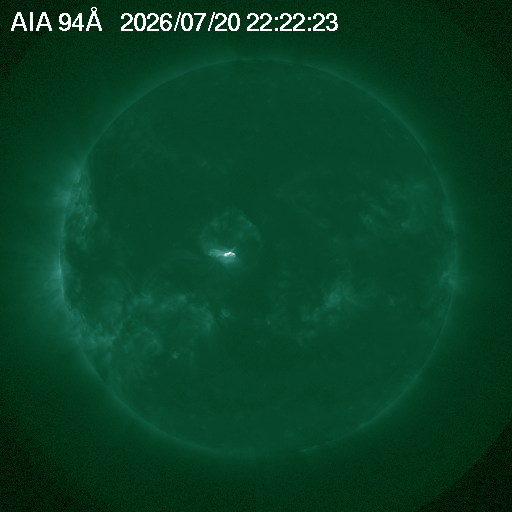
Solar physicist at @ LMSAL (alum UTkyAst). I believe space weather forecast needs 4π coverage of remote-sensing and in situ observations. Until then use AI.
A gorgeous eruption (accompanying a coronal wave) associated with an M1.4 flare from AR 14549. The CME may be Earth-bound for 9-Oct arrival.
Personal note: I have been hospitalized since 15-Sep. I think the most critical phase has passed, and look forward to come back soon.
News.
A strong shock arrived (2026-10-10 14:34UT).
I think this is from the CME on 8 October associated with the M6.7 flare.
We should keep monitoring if/when Bz becomes solid negative.
Yesterday's M6.7 flare in AR 14549 was followed by a filament eruption in AR 14548 in southeast (lower left). My colleague @MarcDeRosa_ is studying whether the filament eruption had to do with the M6.7 flare.
M6.7 flare from AR 14549 today. Nice coronal wave.
I cannot predict the possibility of a #solarstorm before taking a look at coronagraph data. But the CME-driven shock may not be particularly strong, given no protons observed by GOES.
Eruptive M6.9 flare in AR 14513 today. The coronal wave was not very strong, but the associated CME may have been quite extended . We may be hit during 27-28 August.
There was an M1.7 flare from AR 14507 on the west limb. It was long duration and eruptive as expected, followed by a bright CME. It seems that the eruption started on a large scale, which may have been related to the coronal wave being quite weak.
Today's M8.1 from AR 14513 was quite eruptive with an impressive coronal wave propagating preferentially southward (counterclockwise). This was followed by a filament eruption. This is the first time this month I see an eruption of this magnitude.
Full-resolution videos of the M8.1 flare + CME shows a beautiful eruption off the eastern limb. This won't affect Earth as the region is on the side of the Sun as seen from our planet. Over time, AR 4513 will rotate closer to the Earth strike zone, and future CMEs have a higher chance of being at least partially Earth-directed.
Attending COSPAR 2026, I was away from monitoring the Sun. Here is an animation of an M1.9 flare on July 30 from AR 14492, associated with an energetic CME responsible for an S1 storm (18 pfu). A classic eruptive flare by a filament eruption and accompanying a weak coronal wave.
AR 14493 is growing. It recently produced an M3.4 flare. So far none of the flares from the region were eruptive (hence no CME), but this can change while it is still in Earth-strike zone.
The X1.3 flare from the newly numbered region AR 14482 looked less eruptive than the three M-class flares in AR 14479 (X1.1 on 06/30, M4.2 on 07/02 and M6.7 on 07/03), as suggested by coronagraph images. But it was accompanied by a weak coronal wave.
Last week I attended the very productive SHINE 2026 Workshop, and was behind looking at solar images.
I now find a major eruption in AR 14479 on 2 July 2026 associated with a M4.2 flare. Not sure if this contributed to the latest (4 July) geomagnetic storm, but a nice wave.
The first eruption (from AR 14479, north) in my last post resulted in a much bigger CME than the second eruption (from AR 14478, south). The peak fluxes of the flares associated with these eruptions were M6.7 and M6.3 - I mistakenly labeled the latter M6.7, sorry.
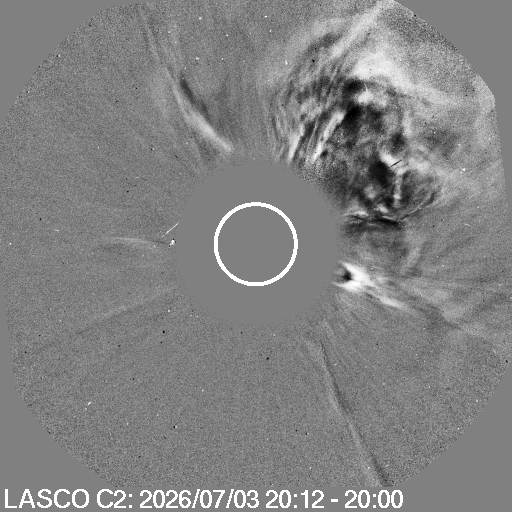
Today (2026-07-03) two major eruptions occurred successively. First in AR 14479 in associated with an M6.7 flare, then in AR 14478 in associated with a shorter-duration M6.7 flare. Both were accompanied by a coronal wave, which may inform the extension of the eruption.
Today (2026-07-03) two major eruptions occurred successively. First in AR 14479 in associated with an M6.7 flare, then in AR 14478 in associated with a shorter-duration M6.7 flare. Both were accompanied by a coronal wave, which may inform the extension of the eruption.
Please don't hack my account, which is just to report observations of the Sun and the heliosphere in relation to space weather. I hope people find my posts useful.
My account seems to have been hacked recently. My name and profile were changed. My pinned tweet disappeared.
Here is the original. It was about the M9.0 flare on 3 October 2024.
MOST POWERFUL FLARE IN SOLAR CYCLE 25. It was X9.0 in GOES X-ray measurement. It was quite eruptive, leaving a coronal wave. The eruption/CME seemed to result from magnetic reconnection rather than ideally from a pre-existing flux rope. It may come in less than 3 days.
Eruption associated with an X1.1 flare in AR 14479 - peak time 30 June 2026 20:50 UT. Nice coronal wave was observed but no SEP, even though there was a partial halo CME. Look at the ejected material falling down.
My account seems to have been hacked recently. My name and profile were changed. My pinned tweet disappeared.
Here is the original. It was about the M9.0 flare on 3 October 2024.
MOST POWERFUL FLARE IN SOLAR CYCLE 25. It was X9.0 in GOES X-ray measurement. It was quite eruptive, leaving a coronal wave. The eruption/CME seemed to result from magnetic reconnection rather than ideally from a pre-existing flux rope. It may come in less than 3 days.
Eruption from the latest M6.5 flare in AR 14473. A coronal wave is seen, but it does not propagate to right or across the disk due to the extended coronal hole. This effect may help geoeffectiveness of eruptions from the same region a week or so later - if it survives.