This is an interesting question. My take: I do not quite accept the notion that China did not seek to "weaponize" rare earths and instead stumbled into a position of advantage. For at least 16 years, and likely more, the purpose has been an economic weapon. This is not like, say, solar or EVs, where excess capacity is sort of an accident.
Here, for example, is a semi-authoritative book cited by @JohnF_Sullivan on rare earth strategy written in 2011 for the state China Economic Publishing House the year after the Japan situation:
"What magical quality do rare earths possess that makes the usually arrogant and domineering Americans so furious? What magical quality do rare earths posses that leaves the usually wealthy and arrogant Japanese grief-stricken? China is the only country in the world capable of supplying all 17 rare earth elements, particularly holding a larger share of heavy rare earths that have prominent uses in military applications. To change China’s international position in the rare earth industry, since 2009, the Chinese government has launched a vigorous rare earth defense war, adopting a series of rectification measures including suspending approval of mining rights, controlling total mining volume, reducing export quotas, raising export tariffs and and severely cracking down on rare earth smuggling."
A key purpose of these post-2009 steps, which PRECEDE China's weaponization against Japan in 2010, was to hone a better coercive instrument.
Then there is some empirical evidence suggesting PRC action in this sector was about leverage.
First, most obviously, China used this as a coercive instrument in 2010. That shows, for at least 16 years, they have understood it as a critical leverage point.
Second, China's government has for decades manipulated the price of rare earths to prevent anyone else from achieving scale - dropping the price to kill foreign investment. Why did they do this when they already had 90% market dominance? The logic is toward control, not profit, and it is not the result of disaggregated independent Chinese market actors (which do not exist in this sector).
Third, related to that point, if this industry operated on economic logic, we would probably see more fragmentation. Indeed, for a brief time, we did see that before 2010. But then the PRC sharply consolidated the rare earths industry into state-backed companies. They shut down, arrested, harassed, and outright expropriated private actors. This was partly to ensure greater state control over external flows - the better to maintain leverage. The quote above refers to that effort.
Fourth, I do not think China's controls on rare earth minerals were modeled off U.S. controls. For example, the October controls went far beyond any U.S. controls. China's idea was any product, anywhere in the world, with .1% value coming from Chinese produced rare earths, required a license to be sold to anyone else in the world. The closest analogy -- and Chinese scholars have said this directly -- is to U.S. financial sanctions, not export controls.
Fifth, this is not a case where "there are many different actors, and they often overperform in search of particular targets." The industry has for a long time just been a few actors, tied to the state, acting at the state's direction. China's cultivation of leadership in this sector dates back to the 1960s, accelerating in the 1980s, with direct involvement of Deng's family in the 1990s and Premier Wen in the 2000s.
The empirical evidence seems to indicate a conscious desire to dominate this sector. One can debate whether or not such an intention was justifiable given U.S. control over chokepoints like finance.
But I think it is hard to advance the claim this was just the independent action of market participants that happened to accidentally create a position of extreme concentration and dominance.
Our extreme ultraviolet (EUV) lithography systems print features just 13 nm wide – orders of magnitude smaller than the letters in even the densest books – because that’s the level of detail and complexity needed to make today’s advanced chips a reality.
Fact: FDD’s graphs on “enriched uranium” omit the large build-up in low enriched uranium during the first Trump admin.
This build-up enabled the highly enriched uranium production shown in the graphs.
While the US infuriates the world in Iran, China is using this moment to burnish its reputation and build its power.
Beijing is playing the long game.
My take:
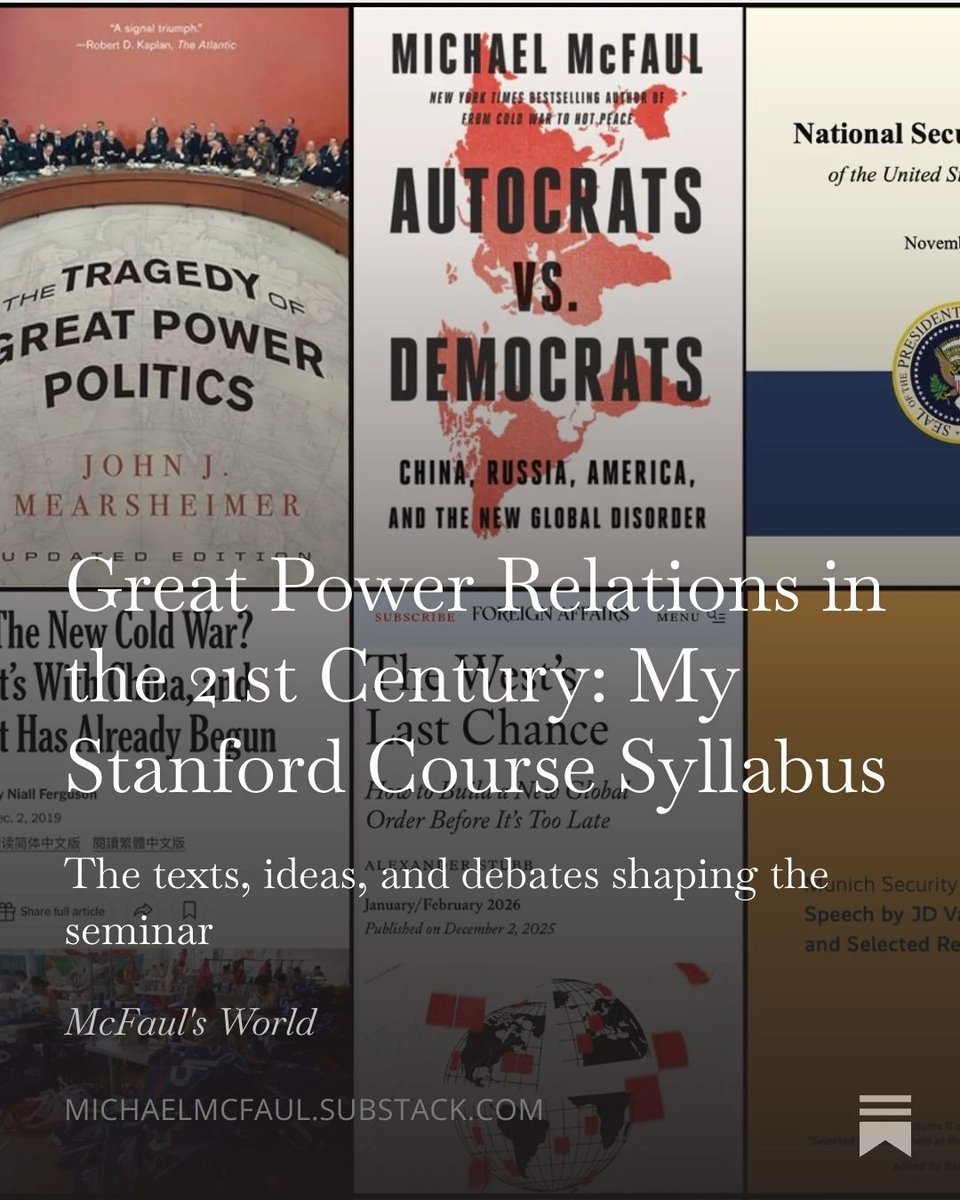
I’m teaching a seminar on great power relations this quarter. The full syllabus is now online. I’ll host a virtual discussion at the end of term so stay tuned for more details. Suggestions for future readings also welcome! https://t.co/9jhRdpU7cI
The key question for now is whether Iran and the United States share Pakistan’s understanding. If they do, there is still time for more talks.
In fact, in this case, I’d be surprised if there wasn’t further diplomacy of some type (perhaps indirect or secret).
Pretty interesting high-level meeting for China's senior military officers held on April 8 at the PLA's National Defense Univeristy —
an "army wide senior cadre training course" (全军高级干部培训班)
1/
@zahirhkazmi@iaeaorg The commissioning of the 500 MWe Prototype Fast Breeder Reactor will increase India's annual weapons-grade plutonium production from the current 24-26 kg to 170 kg. When completed, five additional FBRs will increase this capacity to 921 kg WG Pu, sufficient for 300 warheads/yr.
Ground operations, as described by @DanLamothe, suffer from a serious what then problem.
The purpose of a possible invasion is to reopen the Strait. If ground forces are successful in that, what then? (1/n)
In fairness, the counterproductive use of force in pursuit of ill-defined and unachievable political objectives is very much a continuation of the last 60 years of U.S. foreign policy.
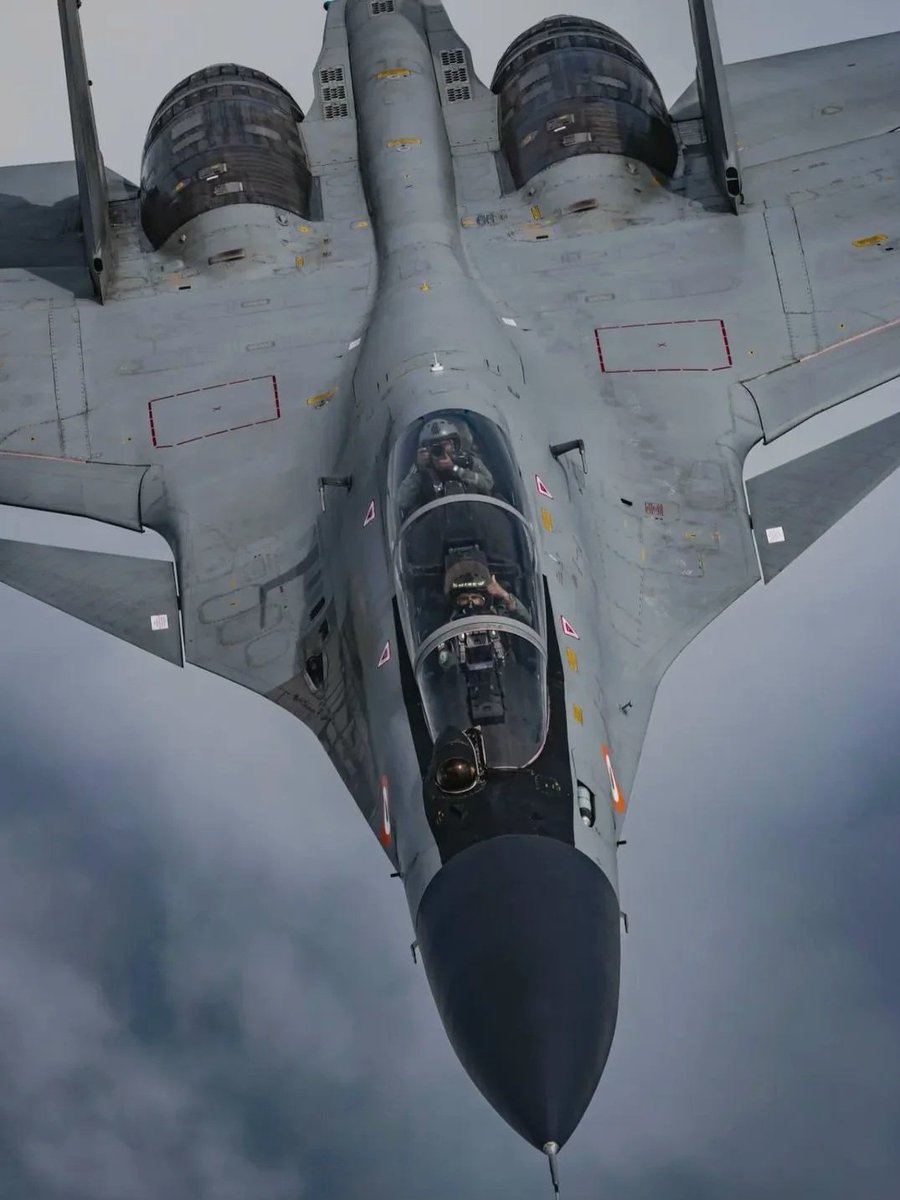
In the early 1990s, both India and China were looking to modernize their air forces. In a twist of history, they both chose Russia's most capable (and available) Sukhoi Flanker as their starting point. However, from there, their journeys split. India focused on getting the best possible modern jet for its air force; China focused on learning how to build its own. Thirty years on, one is still a customer, the other is a peer competitor. This is how the Flanker shaped, or could have shaped, two nations' aviation industries 🧵 1/6
I'm thrilled that I have a contract with @OxUniPress/@OUPAcademic for my book on "Entanglement and Unintended Escalation." (They'll be a better title!)
The manuscript is drafted and currently being revised. Hopefully should be out second half of next year!
I’m hardly a China hawk. But one cannot read too much into the past official discourse of the CCP. If for no other reason than that goals shift as you acquire more power and influence or as your threat perception changes.
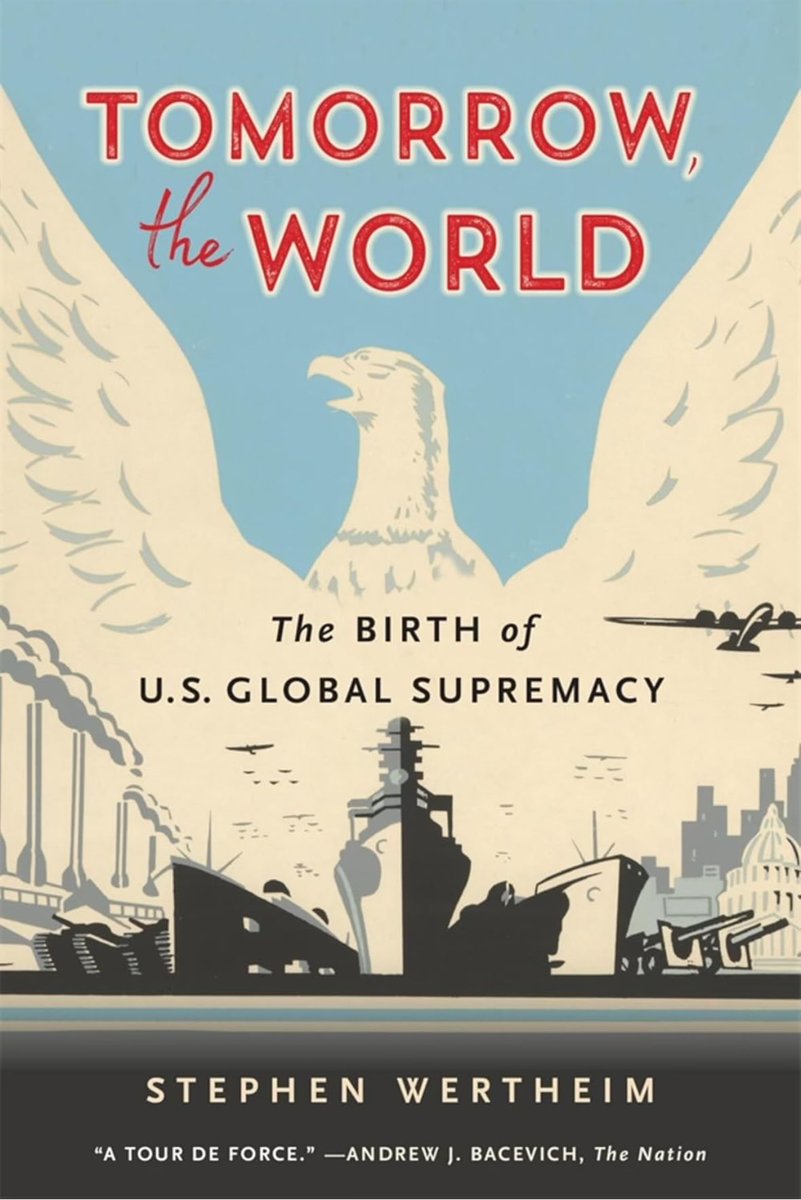
Think about how the US before WWII was simply not interested in displacing Britain. And how quickly we muscled them out. On the explosion of US global interests during the war see @stephenwertheim book; on muscling out the British see Kolko’s Politics of War.
My main concern is that the Chinese may not want to go on a rampage at all. But they may be forced to do so if we push them too hard—just like we did the Japanese.
Specifically, Chinese goals will certainly be revised if they come to believe that they cannot secure a coordinate place in the world without a fight, or that their core economic interests would be undermined if the US and the West further weaponize the world economy.
In fact, we’ve already pushed them too far. Jake’s chips escalation was the trigger for their search for weapons that they would use to win their arm-wrestle with Trump. If the cold warriors return to the cockpit, this process may well become irreversible. Don’t complain later.
🌍SVI Analysis |
The debut of three new specialized arms and the display of cutting-edge information support and countermeasures platforms demonstrate that not only has the PLA achieved significant proficiency in conducting operations in the individual technologically intensive domains [space, cyber and information], but it is also growing increasingly confident about the achieved scale of “informatization” to prevail in multi-domain operations.
The display of a vast range of autonomous weapon platforms for multiple domains underscores that China is simultaneously making progress towards the next phase of modernization: “intelligentization”.
✍️SVI Researcher Hamdan Khan
(@HamdanKhan08) writes for
@strafasia.
🔗 Read More: https://t.co/ui8ZhOZNSH
#SVI #StrategicVisionInstitute
My two cents on China's evolving military posture.
"Beyond Pageantry: Decoding China’s Military Posture Through the 80th Victory Day Parade" https://t.co/ftpuAQxpwC






![SVI_Pakistan's tweet photo. 🌍SVI Analysis |
The debut of three new specialized arms and the display of cutting-edge information support and countermeasures platforms demonstrate that not only has the PLA achieved significant proficiency in conducting operations in the individual technologically intensive domains [space, cyber and information], but it is also growing increasingly confident about the achieved scale of “informatization” to prevail in multi-domain operations.
The display of a vast range of autonomous weapon platforms for multiple domains underscores that China is simultaneously making progress towards the next phase of modernization: “intelligentization”.
✍️SVI Researcher Hamdan Khan
(@HamdanKhan08) writes for
@strafasia.
🔗 Read More: https://t.co/ui8ZhOZNSH
#SVI #StrategicVisionInstitute](https://pbs.twimg.com/media/G1qrUzRaAAQSS3j.jpg)



