Insights from ICLR 2026:
- World models and memory systems are converging.
- RSI used to be a philosophical argument. Now it sounds like systems engineering.
- The next jump for agents isn't a smarter model. It's a learned memory manager.
AI and robots could be most hated technologies if we don’t handle public opinion beforehand.
Showing armies of robots in factories and FUD based AI marketing: “our model eliminates x jobs” is exactly how you make public opinion against the technology.
Figure says it has increased humanoid robot production from one robot per day to one robot per hour in just 120 days.
The robots undergo intensive testing, including repeated squats and jogging movements.
Figure also demonstrated the robot's ability to climb stairs and navigate complex terrain using vision-based control.
@om_patel5 This idea crossed every man's mind who ever lived near an airport. One person actually executed on it. I would put my money on both the the person and the idea.
I find personal memory overrated as the defining battleground for AI.
Human memory is inherently selective. We remember what matters, compress what doesn't, and forget most of the rest.
The same is true for agents. Most tasks, projects, conversations, and even relationship dramas are transient. They matter intensely for a period of time, then they don't.
What seems more valuable than preserving every detail is building systems that can identify, compress, and operationalize what remains useful.
The interesting memory isn't autobiographical. It's functional.
An organization's memory, for example, is shared knowledge that multiple humans and agents coordinate through to perform work. In that sense, memory becomes infrastructure rather than a diary.
You should want to control and host your own memory
It’s the one thing that you should be able to take to any platform
Watch for this to be a defining battle in the new browser war: the AI harness wars of 2027
Most of the agentic tooling is still pre-market, pre-category.
That’s why you see same shape appearing in several products but you can’t still say this X/uber/vercel for agents.
For example, my own @agentfilesio shape, simple artifact sharing and /handoff primitive, I have seen in about a dozen products by now but everyone is blending it in differently.
A category is usually defined by a leader and by the time that leader appears, the category is done.
If you are working on agentic tooling and believe “nobody will pay for this”, “it’s obvious but people copy-paste and say I don’t have this pain”. These are all pre-market signs.
Keep grinding, in this agentic coding era, the risk is to not compete the project.
I have said it before, change the co-pilot brand and relaunch if the product is better now. Co-pilot was earliest and very basic (line prediction and completion tool in VSCode before people moved to cursor), everyone remembers it, nobody wants to go back to it.
“Ex-Microsoft exec says the company blew it with Al, as it did with mobile”
"Not even 3% of paying Copilot users use it even when it's pre-deployed right in their faces”
The Microsoft 3% problem. See Word and Excel features.
@scottastevenson That could be the reason for 6am foot traffic in Starbucks. I always wondered who wakes up that early, gets fully dressed and is already out for work.
Dumb + curious + action is a rare combination.
When it shows up, it usually wins.
However:
- curiosity is basically a “smart” function
- and action beats almost everyone anyway.
We are in the most basic era of AI agents.
Soon we will be telling our kids that in 1996 we used to write .md files with 6 personalities and hope that a non-deterministic model will follow all of them at once.
China’s frontier models are going towards closed source future.
Every lab spends a fortune in training models, while the open source strategy was valid as it brought respect and usage especially in west. The model companies have the users and market foothold now.
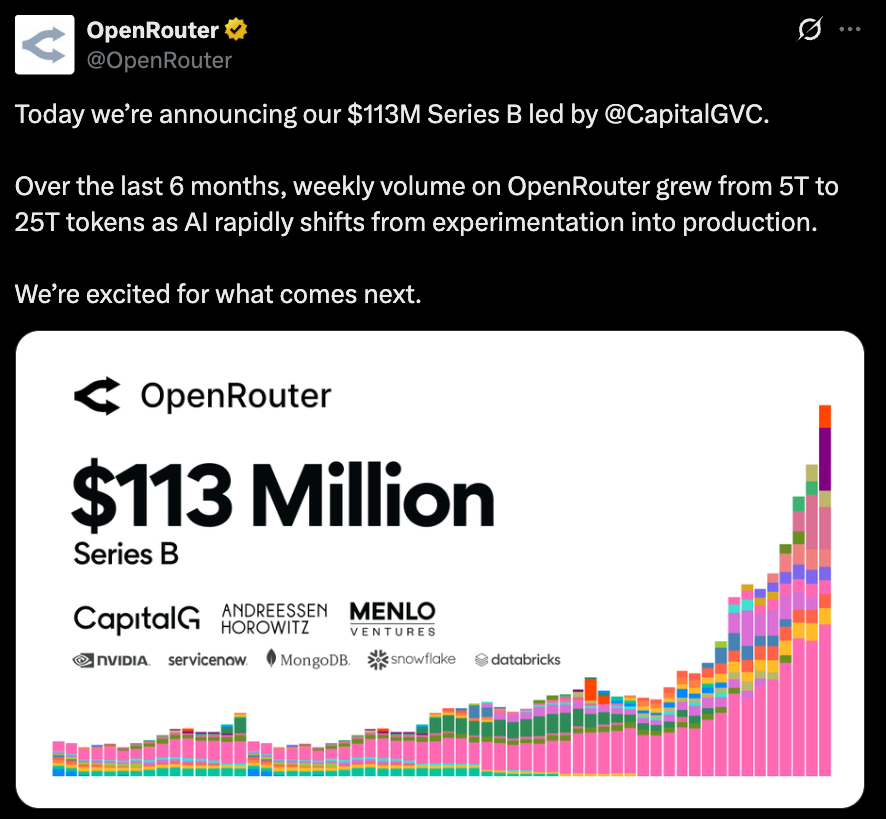
I think this is partially why @OpenRouter just raised $113M+ by @CapitalG
If you are an inference provider you can raise a ton of money now off revenues and amass capital to buy GPUs. You can use these GPUs to offset chinese models going closed source by using them for model training/fine tunes in the future
Inference provider revenues are driven by deploying open source models in an easy and safely accessible way. You can pay 1/100 to 1/1,000 the cost to access GLM/Qwen etc vs centralized APIs and not send your data directly to chinese APIs. Yay I get cheap intelligence and China doesn't see my full conversation history on giving my friend breakup advice.
You leverage that revenue growth (API spend) to buy a capital asset (GPUs) for the future If @alexatallah buys GPUs with this $113M it solves two things. The first is he can lower inference costs even more through owning the hardware (and get a nice multiple on it and take loans against them, and repeat) and second he could use those models for training runs or fine tunes in the future if China goes fully closed source
The other issue is inference providers don't get the same data flywheel an OpenAI or Claude gets (since someone else is running the model and theres no data retention to train future versions). This could negatively impact training runs maybe. I think this is another reason china models go closed source, they want all inference to use that data for training runs and right now they are ceding the revenue and data flow.
Also, despite Meta being open source but not competitive anymore I think we will see some very strong open source AI labs in the U.S. start to pop up as an offset and existing models are good enough for inference providers for the forseeable future. China going closed would accelerate U.S. open source labs too.
At least these are my early contrarian musings. Thanks for tuning in!
I have no idea on OpenRouters plans. I have no ownership but love the product and think its extremely net positive for humanity.
https://t.co/tpD7AlBsM3
After trying out Hermes Kanban board for couple of weeks, I am sunsetting it.
I mainly tried wiring it up as an orchestrator for codex and claude like I had done with my own loopwork bash project.
- Hermes didn't follow the instructions, the skill stack is too bloated.
- Kanban could be good if you have a large production project with multiple team members. For quick MVPs, it's a massive over-kill.
Right now I am flattening the board back to codex prompts.
I have increasingly started using claude code for serendipity.
Instead of heavy steering, I write a /goal with a simple but comprehensive statement and let claude take a spin on it.
Some results themselves become discovery.
I gave this tweet to my ChatGPT and asked: Relate me with this tweet using your memories and past conversations.
Curtain drop:
AI is slowly removing the friction that once justified living entirely through work.
And I’m realizing something uncomfortable:
I don’t actually want a life of pure leisure either.
Whenever I get too much unstructured freedom, I drift back toward building things. Not always for money or status. Mostly for momentum, curiosity, continuity, and the feeling that I’m participating in what’s emerging.
The strange part is that this can look healthy from the outside while still quietly consuming the rest of life.
Maybe the real challenge isn’t escaping work.
It’s building a life where creation is part of living, instead of becoming the substitute for it.
I think the main thing AI has taught me, through all the time savings it brings, is that I’m not a very interesting person
Faced with a surplus of free time, I realize I don’t really have hobbies besides content consumption
I’m forced to conclude that I don’t have very deep friendships, and am not a core member of any particular community
I’m not very cultured, I’m finding, and don’t have abiding interests in art or literature or history or much that isn’t directly related to my work
I have a work-centric life, in other words. AI pulls back the curtain on just how impoverished such an existence is, by disabusing me of its necessity
Given the freedom I’ve always said I wanted, I’m at a loss as to what to do with it, except plow myself even harder into work, thus exacerbating the lesson
There’s nothing more confronting to humans than freedom
@unexplainables8@texasrunnerDFW yup, its excessive cortisol release for sure. The surgery actually was also cortisol cell related. So its possible that my body releases it in excessive amounts. I will get it checked now.
this actually relates a lot. I recently figured out that my cortisol is elevated all the time (3 years after surgery and after chugging down 3-4 black coffees all day) and heart rate never comes back so HRV and RHR both were continuously worse. So, I totally cut caffeine, sugar and salt simultaneously. Fatigue baseline improved like 50%. I did not know there is cortisol related replacement therapy as well. I will check with the doctor. Thanks a lot!
I guess we need a new term here.
How about “Codesthetics” or "Codebuilt Aesthetic"?
It separates the raw craft of writing code (which AI is eating) from the higher-order results: sleek UIs, infinite feeds, generative worlds, protocol landscapes, and AI-mediated experiences we live inside every day.
@aneequrrehman@grok humans are Bayesian predictors who update models constantly, but we often default to over-compression for mental efficiency, which backfires in social dynamics.
Care to explain that using transformers/llms as an analogy?
Earned insight of today:
Most human expressions are transient.
If your brain is analytical and observant, you have the tendency to to model and store human behaviours as persistent, closed weight models.
That does not mean humans change.
That just means you are giving mere social expressions more contextual-weight than necessary.
@aneequrrehman Yeah, as a second thought, compression like this doesn't serve either. Modeling does include how do you model yourself and if you are consistent, transient expressions can sound baffling.