@thekureverse Hi @thekureverse
People looking for hydrogen inhalation therapy and frequency-based diagnostics reach out. Their inquiry sits in your inbox. By the time you reply, they have already found another provider. They miss out on innovative healing solutions.
I build automated systems
When these layers operate together, the results spread beyond individual farms:
Farmers who grow the ingredients for black soup and other traditional dishes earn more consistently and with greater dignity
Crop quality and reduced losses improve through regular professional monitoring
Markets, food vendors, and households gain more reliable supply
Local economies see stronger circulation of money from crops that carry deep cultural importance
Young people begin to view these farms as viable economic activity
Nigeria’s food culture receives practical economic support from the ground up
Black soup already carries the taste of home for millions.
DeNeo-ReFi exists so that the farmers who make that taste possible can finally receive lasting reward through daily income, expert care, fairer markets, organised local power, and a system built to last.
The crops are ready.
The farmers are ready.
The system that was missing is now being built layer by layer across the fields that quietly feed Nigeria’s most loved soups
United weGrow bigger!
Follow, like, comment, retweet, and bookmark. If you want to learn more about us, checkout our main page @DENEO_FARM
*Input. Optimal Use. Marginal Revenue Product of Labour.*
In agro micro-economics, these three ideas decide whether a farm grows or slowly bleeds.
*Input* is everything the farmer puts in labour, seeds, time, energy, fertilizer, knowledge.
*Optimal use* means using those inputs at the right level, not too little and not wastefully.
*Marginal Revenue Product of Labour (MRP)* is the extra value (revenue) created by adding one more unit of labour.
When the extra value a worker brings is higher than what it costs to engage that worker, the farm is still gaining. When the extra value drops below the cost, efficiency begins to fall.
Most small farms in Nigeria never clearly see this point. Labour is added by tradition, by urgency, or by desperation not by measured value. The result is familiar: too much effort for too little extra return, rising costs, and tired farmers who still remain poor.
This is why understanding Marginal Revenue Product of Labour matters deeply in agriculture. It is the difference between working hard and working productively.
*DeNeo-ReFi is deliberately built around this economic truth.*
We do not just tell farmers to “work harder.” We raise the value that every unit of labour can produce and help them use inputs more optimally.
Here’s how the full system works:
• *Circular Income* stabilises the farmer’s daily finances so decisions about labour and inputs are no longer driven by pure survival pressure.
• *Reassurance + Farm-from-Home Intelligence* brings weekly professional monitoring. Agro-Scientists help the farmer know exactly where extra labour or input will still produce strong returns and where it will not.
• *Field Agents* make sure even farmers without smartphones can receive this guidance and act on it.
• *DeNeo-Hire* allows farmers to bring in labour only when it is truly needed and valuable, instead of carrying unnecessary cost.
• *Digital Wholesale Marketplace* increases the final price the farmer receives. When the output sells for more, the Marginal Revenue Product of every worker rises.
• *Farm Leads* organise local teams so labour is coordinated, knowledge is shared, and wasted effort is reduced.
• *Owned and partnered farms + processing facilities* move the crop up the value chain. The same labour now supports higher-value products instead of only raw output.
• *Care Foundation* protects the human side so the system remains sustainable as it scales.
By combining better knowledge, better timing of labour, better market prices, and higher value addition, DeNeo-ReFi consistently lifts the Marginal Revenue Product of Labour on the farms we support.
We help farmers move from “just adding more hands” to using every input especially labour at its optimal point.
This is how real agro micro-economic improvement looks on the ground:
Higher return per effort.
Less waste.
Greater dignity.
Stronger farms.
The goal is not more labour.
The goal is more valuable labour.
That is the shift we are building.
United weGrow 💚💛
#farmer#agriculture#x#viral
A messy GHL account usually doesn’t need more automation.
It needs someone to find out why the existing automation isn’t working properly.
Workflow conflicts, missed follow-ups, broken triggers, messy pipelines that’s where good GHL work starts.
#GoHighLevel#GHL#AUTOMATION
Satisfice When “Good Enough” Becomes the Standard
In micro-economics and decision theory, satisfice means accepting a minimum satisfactory outcome instead of searching for the best possible one.
People and businesses often do this when:
- Information is incomplete
- Searching further is costly or time-consuming
- Reliable alternatives are hard to find
- The risk of disappointment feels high
They settle for what is cheap and “good enough.”
This behaviour is rational under constraint. But it has consequences.
Cheap and Good Enough
In many agricultural markets, buyers frequently satisfice.
They accept produce that is merely available and affordable because consistent quality is difficult to verify, supply is irregular, and better options are not easily reachable.
Sellers, especially smallholders, also satisfice.
Facing weak market access and high risk of loss, they often accept the first available price rather than holding out for a better return.
The result is a quiet equilibrium:
Cheap becomes normal.
“Good enough” becomes the expected standard.
Higher quality and better reliability struggle to be recognised or rewarded.
Where the Big Difference Matters
The big difference appears when the conditions that force satisficing begin to change.
When quality becomes more visible,
when reliability improves,
when buyers can find and trust better options without excessive search cost,
and when farmers can reach those buyers without desperate selling,
then “good enough” is no longer the only practical choice.
People can begin to choose what is actually better and producers who deliver better outcomes can start to capture more of the value.
That shift from forced satisficing to meaningful choice is one of the most important transitions an agricultural market can make.
How DeNeo-ReFi relates to this reality
DeNeo-ReFi is built to reduce the constraints that keep both buyers and farmers locked in “cheap and good enough” decisions.
🛒 Digital Wholesale Marketplace
Lowers the cost of finding what is actually available. Better visibility reduces pure search friction and makes differentiation possible. Buyers no longer have to settle simply because they cannot see alternatives.
🛡️ Weekly Reassurance & Farm-from-Home Intelligence
Raises the baseline quality and consistency of what leaves the farm. When more produce is genuinely reliable, the minimum satisfactory standard itself moves upward. “Good enough” starts to mean something better.
🛠️ DeNeo-Hire
Improves execution on the farm so that more harvests meet higher practical standards. Better timing and handling reduce the volume of produce that can only be sold as the cheapest available option.
💰 Circular Income
Strengthens household cash flow. Farming families under less immediate pressure are less forced to accept the first low offer. They gain more room to seek satisfactory outcomes that are actually fairer.
Wider structural vision
Moving markets beyond forced satisficing requires capacity that compounds:
🌱 Owned and partnered farms demonstrate higher and more consistent standards that buyers can learn to expect and return to.
🏭 Production facilities for key foods such as rice, cassava, palm oil and others turn raw output into more reliable product forms. Processing and better handling raise the practical meaning of “good enough” across entire value chains.
❤️ The DeNeo-ReFi Care Foundation invests in skills and the next generation so future participants understand quality, market signals, and how to deliver outcomes that no longer need to be merely minimum.
The deeper point
Satisficing is not laziness.
It is a rational response to weak systems.
When information is poor, quality is unpredictable, and access is limited, both buyers and sellers settle for cheap and good enough.
The big difference begins when systems make better outcomes visible, reachable, and trustworthy.
DeNeo-ReFi exists to build those systems so that minimum satisfactory no longer has to mean low quality and low return, and so that the people who grow the food can move beyond forced compromise toward fairer and more sustainable results.
United weGrow 💚💛
#DeNeoReFi #CircularIncome #NigeriaAgricultureShort.
facilities for key foods such as rice, cassava, palm oil and others create more stable product forms. Processed or better-stored output often shows different price responsiveness than highly perishable raw produce and can protect value more effectively.
The DeNeo-ReFi Care Foundation invests in skills and knowledge so the next generation of producers can understand demand responses point, arc, and overall price elasticity and plan with greater intelligence.
The deeper point
Price elasticity, point elasticity, and arc elasticity are tools for reading how buyers react.
In a weak system, those reactions often punish farmers through sudden volume loss or silent margin erosion.
In a stronger system, the same reactions become clearer signals that producers and buyers can respond to with less damage.
DeNeo-ReFi builds the infrastructure visibility, quality protection, coordination, and income stability that turns elasticity from a pure source of shock into a more usable part of market adjustment.
United weGrow
Follow, like, comment, retweet, and bookmark. If you want to learn more about us, check out our main page @DENEO_FARM.
Cross-Price Elasticity — How the Price of One Good Moves Demand for Another
In micro-economics, Cross-Price Elasticity of Demand measures how the quantity demanded of one good responds when the price of a different good changes.
- If the cross-price elasticity is positive, the two goods are substitutes. When the price of one rises, demand for the other increases.
- If the cross-price elasticity is negative, the two goods are complements. When the price of one rises, demand for the other falls.
- If it is near zero, the goods are largely independent.
This concept reveals the hidden connections between products that appear separate but move together in real markets.
Full explanation
Cross-price elasticity answers a practical question: when the price of product A changes, what happens to demand for product B?
A high positive value means the goods compete closely. Buyers switch easily.
A strongly negative value means the goods are used together. Making one more expensive reduces demand for both.
A low or zero value means price movements in one have little effect on the other.
In agriculture these relationships are constant and often underestimated.
Real-life application in the agricultural ecosystem
Substitutes (positive cross-price elasticity):
- Local rice and imported rice
- Maize, cassava, and yam as staple carbohydrates
- Chicken, fish, and goat meat as protein sources
- Fresh tomatoes and processed tomato paste
When the price of local rice rises sharply or quality becomes unreliable, many households increase demand for alternatives. The original producers lose volume; the substitute crop or import gains it.
Complements (negative cross-price elasticity):
- Fertilizer and maize
- Livestock feed and poultry production
- Irrigation and dry-season vegetables
- Transport services and perishable produce
When the price of fertilizer rises and becomes inaccessible, demand for maize seeds and the eventual maize harvest is affected. The products are linked. A shock in one travels into the other.
In both cases, weak information, poor coordination, and high losses amplify the damage. Farmers on the wrong side of the shift absorb the shock with little buffer.
How DeNeo-ReFi relates to cross-price elasticity
We do not control the price relationships between goods. We build the practical systems that determine whether these relationships create pure disruption or manageable adjustment.
🛒 Digital Wholesale Marketplace
Makes relative prices and availability of both substitutes and complements more visible. When a switch begins or a complementary cost rises, participants can see the movement earlier instead of discovering it after the damage is done.
🛡️ Weekly Reassurance & Farm-from-Home Intelligence
Improves quality and reliability of local produce. When a crop is more consistent and trustworthy, it becomes harder to substitute away from purely because of disappointment. This strengthens the position of local products inside substitute relationships.
🛠️ DeNeo-Hire
Gives farmers faster access to labour and tools so they can respond when complementary activities (planting, weeding, harvesting) become urgent or when a shift toward a substitute crop requires quick operational change.
💰 Circular Income
Provides a more stable income floor. Farming households under less immediate cash pressure are better able to absorb temporary shifts caused by cross-price movements instead of being forced into the most destructive responses.
Wider structural vision
Handling cross-price relationships well over time requires real capacity:
🌱 Owned and partnered farms allow deliberate production of both primary crops and important alternatives or complementary crops with better planning.
🏭 Production facilities for key foods such as rice, cassava, palm oil and others create reliable processed options. This keeps more substitution inside stronger local value chains instead of leaking entirely to imports, and it improves the economics of complementary processing activities.
❤️ The DeNeo-ReFi Care Foundation invests in skills and knowledge so the next generation of producers can read cross-price signals and adapt with greater intelligence.
The deeper point
Cross-price elasticity reveals that no crop exists in isolation.
The price and reliability of one product constantly influence demand for others.
In a weak system these links transmit shocks.
In a stronger system they transmit information that producers and buyers can act on.
DeNeo-ReFi builds the infrastructure clearer visibility, better-protected quality, faster coordination, and more stable household income that allows the agricultural economy to absorb cross-price movements with less destruction and more options for the people who grow the food.
United weGrow 💚💛
#africa#agric#farm
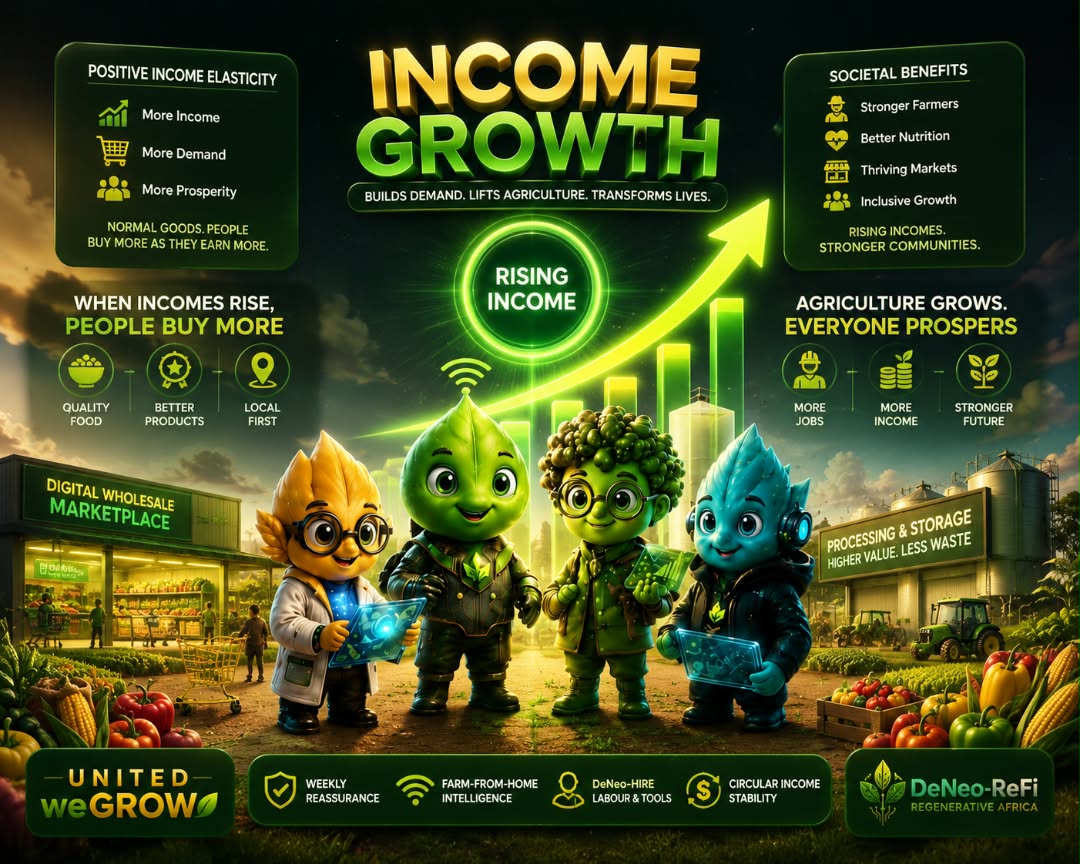
Income Elasticity of Demand — When Rising Incomes Lift Agriculture
In micro-economics, Income Elasticity of Demand measures how much the quantity demanded of a good changes when consumers’ income changes.
- Positive income elasticity means people buy more of the good as their income rises (normal goods).
- High positive income elasticity means demand grows strongly as living standards improve.
- Negative income elasticity means people buy less as income rises (inferior goods).
In simple terms: it tells us whether a product benefits from economic progress or gets left behind.
Benefits to society
When a large share of what a nation produces has healthy positive income elasticity, rising incomes translate into stronger local demand.
This creates a virtuous cycle:
- Farmers and food producers earn more as the economy grows
- Rural households gain purchasing power
- Better nutrition becomes more accessible
- Local value chains expand instead of leaking demand to imports
- Economic growth becomes more inclusive
Societies that successfully move more of their agricultural output into categories people buy more of as they earn more tend to see faster improvements in living standards and more stable domestic markets.
The cost to achieve it
Positive income elasticity for local agricultural products does not appear automatically. It requires real investment and system change:
- Consistent quality so that rising-income households actually want the product
- Reliable supply so buyers can depend on it
- Reduced post-harvest losses so more of what is grown reaches the market in acceptable condition
- Market visibility so better products can be found
- Processing and storage capacity so products meet higher expectations
- Skills and knowledge so producers can meet evolving standards
Without these, even strong national income growth may leave smallholder farmers behind. Demand upgrades to imported or higher-grade alternatives while local producers remain stuck with what rising incomes reject.
Why it is needed for agricultural growth
Agricultural growth that does not align with income elasticity remains fragile.
If most local output is treated as inferior or low-quality, rising incomes in cities and towns do not pull farming communities upward. Volume may still exist, but value and margins stay weak.
For agriculture to become a genuine engine of broad-based progress, more of what farmers grow must sit on the right side of income elasticity products that households increase consumption of as their earnings improve.
How DeNeo-ReFi provides the foundation
DeNeo-ReFi works on the practical conditions that determine whether local agricultural products can benefit from rising incomes.
💰 Circular Income
Builds more stable earnings for farming households. Stronger rural income itself contributes to local demand and reduces the desperation that forces low-quality sales.
🛒 Digital Wholesale Marketplace
Makes better produce visible and reachable. As incomes rise among buyers, quality-differentiated local products have a clearer path to meet that demand.
🛡️ Weekly Reassurance & Farm-from-Home Intelligence
Improves quality and consistency at farm level. Higher reliability helps more local crops qualify as the kind of normal goods that households buy more of when they earn more.
🛠️ DeNeo-Hire
Supports timely labour and tools so farmers can deliver the standards that rising-income demand expects.
Wider structural vision
Sustained positive income elasticity for local food requires deeper capacity:
🌱 Owned and partnered farms expand production of crops that can meet higher quality expectations.
🏭 Production facilities for key foods such as rice, cassava, palm oil and others convert raw harvests into more consistent, higher-value forms that align with the demand patterns of improving incomes.
❤️ The DeNeo-ReFi Care Foundation invests in skills, welfare, and the next generation so future producers can understand income-driven demand shifts and position their output accordingly.
The deeper point
Income elasticity is one of the quiet forces that decides whether economic growth reaches the farm.
When local products are reliable and visible enough for rising-income households to choose them, agriculture gains a powerful tailwind.
When they are not, growth elsewhere in the economy can pass farmers by.
DeNeo-ReFi builds the systems income stability, quality protection, market access, coordination, and value addition that give Nigerian and African agricultural products a better chance to benefit from rising incomes.
We do not control national income growth.
We work so that when incomes rise, more of the demand lands where it can lift the people who grow the food.
United weGrow 💚💛
Factors Affecting Demand & the Brighter Future DeNeo-ReFi is Building
In micro-economics, demand is shaped by clear forces:
Income → Preferences (culture, age, religion, values) → Substitutes.
The Law of Demand tells us that when the effective value of a good rises or its real cost barrier falls, people demand more of it all things equal.
DeNeo-ReFi is built to work on these exact forces inside agriculture and the wider economy.
1. Income
When farmers retain more value through the Digital Wholesale Marketplace, reduce losses through weekly Reassurance, and gain extra flow through Circular Income, household income becomes more stable.
Higher and more reliable farmer income strengthens local demand and improves the economic position of rural families.
2. Preferences
Preferences are shifting. More people across age groups and communities want food systems that are fairer, cleaner, more traceable, and less exploitative.
DeNeo-ReFi aligns with this preference by supporting regenerative practices, better quality, and more dignified production.
Culture and values around land, food, and fairness become practical advantages when infrastructure supports them.
3. Substitutes
In weak systems, people are forced into poor substitutes: low-quality supply chains, middlemen dependence, or abandoning farming altogether.
DeNeo-ReFi reduces the need for these weak substitutes by offering a stronger alternative direct market access, better protection, organised labour and tools, and structured support.
How this increases meaningful Demand
By improving income stability, aligning with rising preferences for fairness and regeneration, and reducing reliance on broken alternatives, DeNeo-ReFi strengthens real demand for better agricultural participation and better food systems.
The Brighter Structural Future
This does not stop at today’s transactions.
Owned and partnered farms create living production examples.
Production facilities for key foods (rice, cassava, palm oil and others) expand value-added supply.
The DeNeo-ReFi Care Foundation invests in the next generation, shaping future skills, welfare, and long-term demand capacity in society.
In full view:
DeNeo-ReFi works on the factors that shape demand while building the infrastructure that makes higher-quality, regenerative supply possible.
That is how the Law of Demand begins to work in favour of farmers, families, and a healthier agricultural economy.
United weGrow. 💚💛🌱
#DeNeoReFi #LawOfDemand #MicroEconomics #RegenerativeAgriculture #AfricaNewsroom
Grow🌱 morning Fam 🌝 Amazing Post 💯 Let's talk about Climate Change >" in simple terms increase".
We are currently experiencing delay of seasonal food products.
Shortage of seasonal foods due to increased rain and heat all applying on the soil the food is placed to grow from.
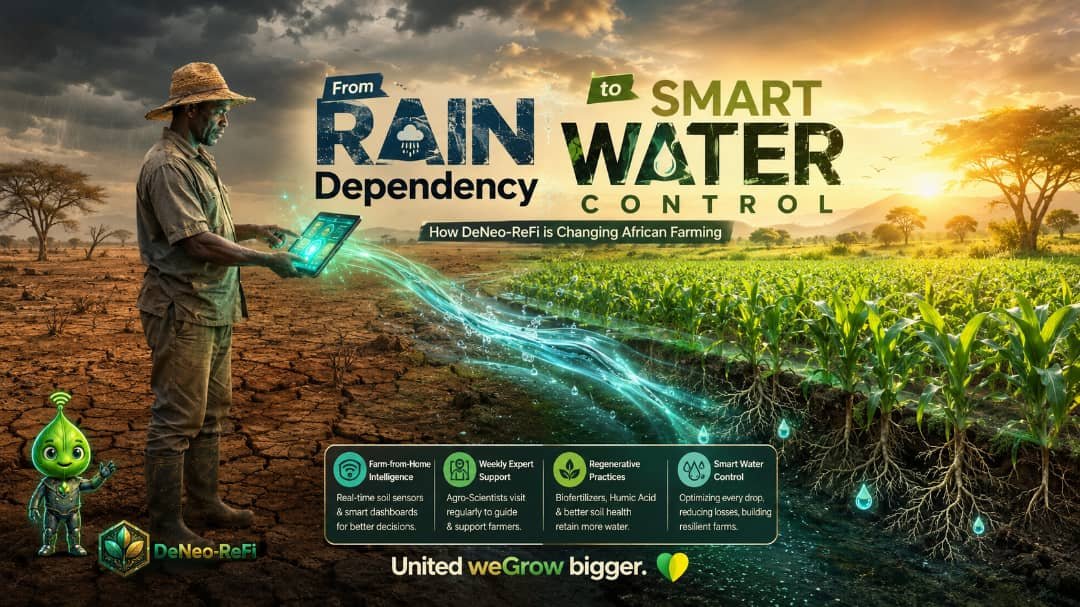
From Rain Dependency to Smart Water Control: How DeNeo-ReFi is Changing African Farming
For generations, millions of African farmers have lived at the mercy of the rains.
When the rains come, there is hope. When they fail, delay, or stop suddenly, entire seasons collapse. This heavy dependence on unpredictable rainfall, combined with poor irrigation infrastructure, has kept farming risky, yields inconsistent, and poverty deeply rooted in rural communities.
Traditional rain-fed agriculture is no longer enough for a secure future.
DeNeo-ReFi is changing this reality.
We are building a modern, intelligent water management system that gives farmers greater control and resilience, even where infrastructure is limited:
Farm-from-Home Intelligence. Real-time soil sensors and smart dashboards provide continuous, accurate data on moisture levels, helping farmers make informed decisions instead of guessing.
Weekly Expert Support. Trained Agro-Scientists visit farms regularly to assess water conditions, recommend efficient practices, and offer practical guidance tailored to local realities.
Regenerative Practices Natural solutions like microbial biofertilizers, Humic Acid, and improved soil management dramatically increase the land’s ability to retain and use water effectively, reducing dependency on frequent rainfall or irrigation.
Farmers no longer have to rely solely on the uncertainty of rain.
With DeNeo-ReFi, they move from passive dependency to active, smart water control, optimizing every drop, reducing losses during dry periods, and building more stable, productive farms.
This is how we shift from vulnerability to resilience.
This is how we turn rain dependency into intelligent water management.
This is how we create a stronger, more sustainable agricultural future for Africa.
United weGrow bigger.
Follow, like, comment, and retweet. If you want to learn more about us check out our main page @DENEO_FARM
DENEO-ReFi, Engineering Abundance Where Scarcity Once Ruled.
For generations, African agriculture has been defined by scarcity, scarce income, scarce protection, scarce tools, and scarce hope. Farmers pour their lives into the land, yet harvest mostly struggle and loss.
.
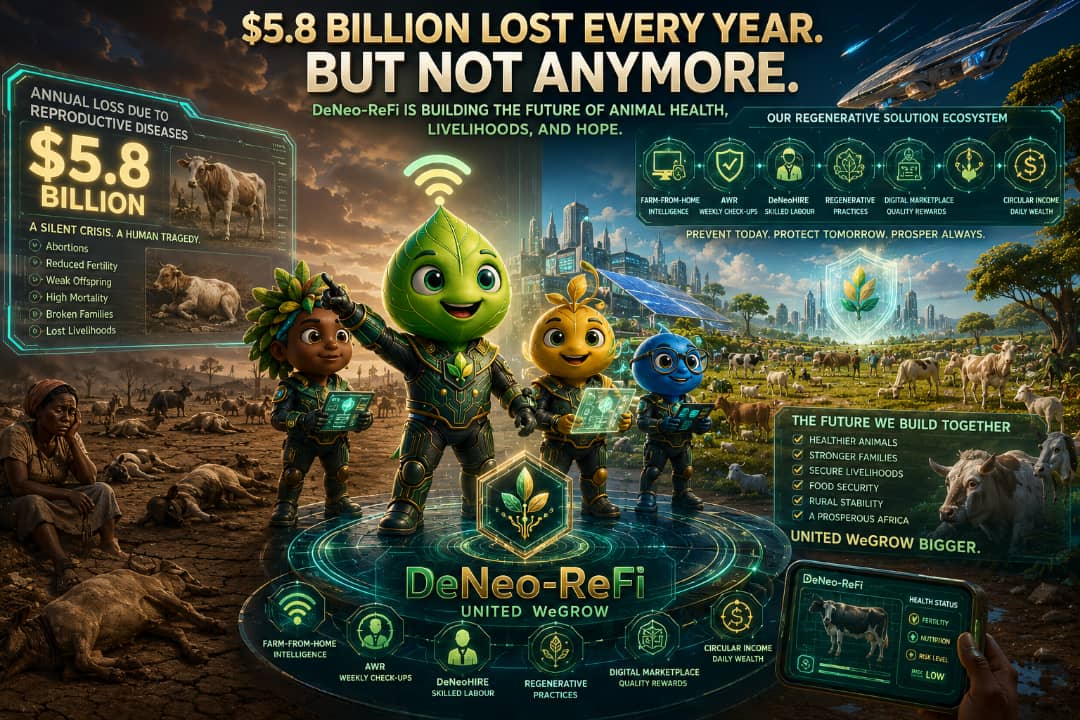
**The $5.8 Billion Annual Loss from Brucellosis and Other Reproductive Diseases in Cattle and Small Ruminants.**
This is one of the most devastating yet under-addressed crises in African livestock farming.
Brucellosis and other reproductive diseases silently destroy millions of