Demographic dominance does not equal ownership of a country.
By that logic, Somalia would be a Hawiye-Darood state.
As a citizen of Awdal, I see no problem with the demographic strength of another clan.
Somaliland’s governance system is inclusive, flexible, and merit-based political power is earned through contribution, not inherited through birth.
That is why we’ve had non-Isaaq presidents and permanent vice presidents.
I firmly support a system with a clear mandate, balanced constitutional power, and fair resource sharing.
These principles are what truly define governance, not clan dominance.
The key fact remains:
in Somaliland, whoever secures 51% of the vote regardless of clan wins the presidency.
This is a proven, functioning system that contrasts sharply with Somalia, where clan allegiance still overrides democratic choice.
Somaliland shows that a modern, inclusive, citizen-focused democracy is possible, even in a historically clan-based society.
Saudi Arabia’s Real Anxiety: Change and Loss of Control
(The history of Saudi involvement in Yemen reflects its strategic anxieties and helps explain why it engages with Somaliland while prioritizing Somalia over it.)
Saudi Arabia’s regional behavior is often misread as rivalry, sectarianism, or reactive politics, but it is more accurately driven by geography and the nature of its political system.
Its long and costly entanglement in Yemen was never merely about borders, security, or rival powers it was about fear of change.
For decades, Riyadh has intervened in Yemen in various ways, including militarily, whenever political transformations threatened to escape containment.
Today, that same fear is increasingly mirrored in its posture toward Somaliland.
The pattern is consistent :
Saudi Arabia tolerates weakness, fragmentation, and failure, but reacts defensively to systems that demonstrate democracy, institutional independence, freedom of political participation, and sustainable governance especially when these qualities are contagious.
That is why Saudi Arabia has fought against various regimes in Yemen (monarchies, republics, communist governments, and Islamic political movements) driven by a fundamental anxiety over potential changes along its borders.
For the same reason, Saudi Arabia has at times supported certain ruling systems in Yemen, and it has preferred engaging with Somalia over Somaliland, as Somalia, despite its fragmentation and fragility, remains more manageable in comparison.
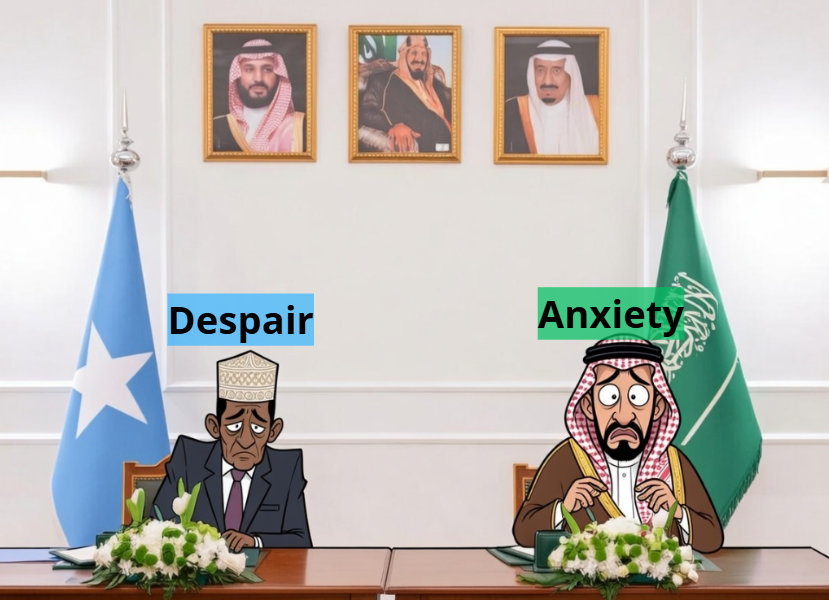
The agreement between Somalia and Saudi Arabia appears to reflect Saudi attempts to secure its influence in Somalia, similar to Turkey’s role, potentially filling the space left by the UAE’s withdrawal.
This pattern is most clearly visible in Yemen and is increasingly relevant to Somaliland.
Acceptable Order: The Mutawakkilite Kingdom of Yemen
Before 1962, Yemen was ruled by the Zaydi Imamate, a conservative, inward-looking religious monarchy rooted in lineage and tribal authority essentially a summary of the Saudi system, but poorer and more isolated. It exported no ideology, mobilized no masses, and posed no challenge to monarchical legitimacy elsewhere.
Saudi Arabia accepted this system. Even the 1934 war was about borders, not ideology Riyadh fought the Yemeni state, not its political order.
This is why the Treaty of Taif (1934) was eventually signed between the Zaydi Imamate in Yemen and Saudi Arabia.
Later in 1962, Saudi Arabia supported the Imamate to protect the monarchy against the rise of the republicans, who were backed by Arab nationalist countries and leaders, notably Egypt’s Gamal Abdel Nasser.
Saudi Arabia hosted republican opponents of the Imamate and engaged militarily against Egyptian forces in Yemen to defend the monarchical system and prevent the spread of republicanism.
The Imamate was weak, conservative, and non-contagious therefore manageable.
When Change Became Existential: The Republicans
The 1962 republican revolution changed everything. Backed by Nasser’s Egypt, Yemen became a platform for Arab nationalism, anti-monarchism, and military republicanism.
The danger was not Yemen’s strength but its example.
A successful republic on Saudi Arabia’s border threatened the legitimacy of absolute monarchy across the Gulf.
Riyadh responded by backing royalists and financing guerrilla warfare not to dominate Yemen, but to block revolutionary precedent.
This was Saudi Arabia’s deepest ideological conflict in Yemen.
Maximum Threat: Communist South Yemen
South Yemen (1967–1990) crossed every Saudi red line. A Marxist-Leninist state abolished religion and tribal authority, aligned with the Soviet bloc, and actively exported revolution.
Here, containment became confrontation. Saudi Arabia applied military pressure, fought proxy wars, and enforced diplomatic isolation. Yemen was no longer just a neighbor—it was a Cold War frontline.
Political Islam: Fear of Participation, Not Faith
After the 1970s, Saudi anxiety shifted toward political Islam. Sunni Islamist movements were initially tolerated as tools against leftists, but their embrace of elections, accountability, and mass participation made them incompatible with absolute rule—especially after the Arab Spring.
The lesson was clear: participation itself is dangerous, even when Islamic.
The Houthis: Change with Weapons
The Houthis combined multiple Saudi fears into one actor: ideological mobilization, armed power, border proximity, and later Iranian alignment. This was no longer abstract change it was enforced transformation. Confrontation became inevitable.
Saudi Arabia has repeatedly intervened militarily in Yemen whenever the situation became unmanageable or threatened its regional interests, often led by princes who later became kings.
In 1934, King Abdulaziz fought the Saudi–Yemeni War against the Zaydi Imamate (Treaty of Taif).
In 1969, King Faisal led the Al‑Wadiah War against South Yemen.
Since 2 April 2015, Saudi forces have waged a campaign against the Houthis in northern Yemen.
These actions reflect a consistent pattern of engagement whenever Yemen’s politics posed uncontrollable change.
The Pattern Is the Proof
- Saudi Arabia confronts systems that are:
Revolutionary, Anti-monarchical, Exporting ideas and Institutionally independent
- Saudi Arabia tolerates systems that are:
Conservative, Inward-focused, Weak or fragmented and Non-contagious
Riyadh does not oppose republics when they fail. Somalia poses no ideological threat precisely because it lacks sovereignty, institutions, vision, and exportable success.
Failure is safe. Chaos is containable.
Why Somaliland Triggers Anxiety
Somaliland represents what Saudi Arabia fears most:
successful change. A Muslim society with local legitimacy, elections, independent institutions, and governance not concentrated in one family, located near critical maritime chokepoints.
Success makes it contagious.
A functioning alternative model does not need to attack Saudi Arabia to threaten it it simply needs to exist.
Bottom Line
Saudi Arabia’s greatest fear is not monarchy versus republic it is transformation beyond its control.
Yemen became a problem whenever it changed.
Somaliland now raises the same anxiety, not because it is weak, but because it works.
That is the pattern.
🧧🧧"Like Father, Like Son"
His father was the head of the missile division that bombed Hargeisa in 1988.
Today, the son is completing what remains of his father's legacy.
" Aweys Geedow wuxuu ahaa ninkii ku caan baxay " Lama Lama Deey" 1988 Hargaysa.
Now that Somalia owning F-16s has been debunked, let’s take a closer look at this photo they’ve been circulating over the past few years.
The photo was screenshotted from an advertisement video, and Somalia’s flag was later added to legitimise it.
Source: https://t.co/a1hMUSxUu4
The Photo. The video
This is Mogadishu, Somalia. The children you see here are the future migrants who will one day head to the USA and Europe. It is baffling how Western governments fund this path and allow such individuals to enter their countries, settle, and even hold high-ranking offices