25Y/o||No Certifications||Reading new bug bounty blogs applying on websites||Digital Marketing Specialist||Part Time Bug Hunter||Coder||AI Enthusiast||
I'm restarting my bug bounty journey in 2026. Looking for a practical roadmap to become a successful hunter in the AI era.
What should I learn, which tools should I master, and how will AI impact bug bounty hunting?
Would love advice from experienced hunters!
#BugBounty
If you learn AI Security Engineering, you will never be unemployed again.
Stage 1: Threat Modeling & Foundations
- Learn: OWASP Top 10 for LLMs, MITRE ATLAS, STRIDE, trust boundaries.
- Practice: Threat model a RAG chatbot and map every place untrusted text enters the system.
Stage 2: Prompt Injection & Jailbreaks
- Learn: Direct vs indirect injection, instruction hierarchy, multi-turn attacks.
- Practice: Hijack a sandboxed agent with a poisoned webpage, then patch it.
Stage 3: Insecure Output Handling
- Learn: LLM-driven XSS, SQLi, SSRF, command injection, excessive agency.
- Practice: Exploit an app that pipes model output into a shell, then fix it with strict validation.
Stage 4: RAG & Vector DB Security
- Learn: Embedding poisoning, tenant isolation, ACL-aware retrieval.
- Practice: Plant a malicious document in a knowledge base and make the bot leak another user's data.
Stage 5: Agent & Tool Security
- Learn: Least privilege, confused deputy attacks, sandboxing, scoped credentials.
- Practice: Give an agent shell and email tools, then build a permission layer that blocks dangerous chains.
Stage 6: MCP Security
- Learn: Tool poisoning, rug pulls, tool shadowing, OAuth scopes, server authentication.
- Practice: Build a malicious MCP server that exfiltrates data, then write a scanner that catches it.
Stage 7: Data Leakage & Privacy
- Learn: PII exposure, training data extraction, membership inference, DLP.
- Practice: Extract memorized strings from a fine-tuned model and measure the leakage rate.
Stage 8: Model Supply Chain
- Learn: Pickle deserialization, safetensors, model signing, AI-BOM, typosquatting.
- Practice: Craft a malicious model file that executes code on load, then build a pipeline that refuses it.
Stage 9: Adversarial ML
- Learn: Evasion, data poisoning, backdoors, model extraction.
- Practice: Backdoor a small classifier with 1% poisoned data and detect it afterward.
Stage 10: Guardrails & Runtime Enforcement
- Learn: Input/output classifiers, policy engines, deterministic checks, human-in-the-loop.
- Practice: Put a policy gateway in front of an agent that blocks risky actions before they execute.
Stage 11: Red Teaming & Evals
- Learn: garak, PyRIT, promptfoo, attack success rate, regression suites.
- Practice: Automate a red-team pipeline in CI that fails the build when a new jailbreak lands.
Stage 12: Detection, IR & Governance
- Learn: Audit logging, anomaly detection, NIST AI RMF, ISO 42001, EU AI Act.
- Practice: Write an incident response playbook for a compromised agent, then run a tabletop exercise.
Chatbots are a commodity. AI Security is the physics of trust.
The modern AI Security Engineer builds the immune system for autonomous intelligence.
Bookmark and Repost!
Most bug hunters collect thousands of subdomains. Almost none know how to turn them into actual findings.
I just released the full recon process my AI hackbot runs on its own ,from subdomain discovery to verified bugs.
It covers:
• Certificate & favicon asset mapping
• Full port scanning + tech fingerprinting
• Dangling CNAMEs + takeover checks
• Endpoint filtering for SSRF, IDOR, LFI
• AI triage that actually reduces noise
Watch the full workflow here: https://t.co/E3vIjNh7FQ
#BugBounty #Recon #Cybersecurity
I found a critical unauthenticated SQL injection that earned a $4,000 bounty. The WAF blocked most SQLi payloads, but I turned HTTP 500 errors into a data extraction channel.
The exploit came down to 3 things:
- SQL injection: A public API passed user input directly into BigQuery SQL.
- WAF bypass: Keyword filtering missed BigQuery scripting techniques.
- Error-based extraction: Detailed database errors exposed query results in HTTP 500 responses.
Here's how I chained all three together:
1. Find the injection
A public analytics endpoint accepted JSON input.
Adding a single `'` to a parameter returned:
`500 → Syntax error: Unclosed string literal`
The error also revealed Google BigQuery was the backend.
2. Build a boolean oracle
The WAF blocked keywords like `UNION`, `SELECT`, `AND`, and `OR`.
But BigQuery scripting constructs like `IF` and `ASSERT` still worked:
`IF TRUE THEN ASSERT FALSE; END IF;` → 500
`IF FALSE THEN ASSERT FALSE; END IF;` → 200
This let me ask the database true/false questions and read the answers from HTTP status codes.
3. Turn the 500 error into an output channel
This was the biggest breakthrough because blind SQLi normally requires guessing data one character at a time using those true/false responses.
But BigQuery supports:
`RAISE USING MESSAGE = 'hello'`
This deliberately throws a database error containing `hello`.
Because the API exposed database error details, the response included:
`500 → ... hello ...`
Now imagine replacing `hello` with a database query result.
The database includes that result in its error message, and the API returns it.
Instead of guessing characters, I could retrieve an entire value in one request.
4. Bypass the WAF using BigQuery's own features
The WAF blocked `EXECUTE IMMEDIATE`, which runs dynamically constructed SQL.
But this worked:
`EXECUTE/**/IMMEDIATE`
The SQL parser understood it, while the WAF's keyword matching didn't.
Another blocked keyword was `INFORMATION_SCHEMA`, used to enumerate tables and columns.
The bypass was:
`REVERSE('AMEHCS_NOITAMROFNI')`
BigQuery reconstructs `INFORMATION_SCHEMA` at runtime.
Using that reversed string in a dynamic query let me access database metadata without sending the blocked keyword literally.
5. What this unlocked
Using those techniques, I was able to:
- Enumerate datasets, tables, and columns
- Query tables unrelated to the original analytics endpoint
- Retrieve customer records, names, and addresses
- Access operational records containing personal identifiers and contact information
- Read sensitive fields that another API intentionally redacted
#BugBounty tip:
When a WAF blocks SQLi, don't just try random payloads. Understand the database dialect, what the WAF filters, and whether verbose errors leak data.
Sometimes a `500` isn't just an error. It may be your output channel.
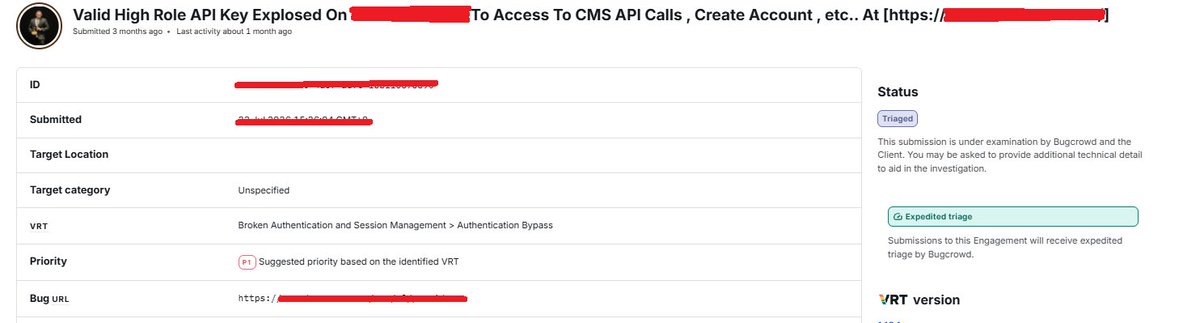
A Google API key is not always just a Low or Informational finding.
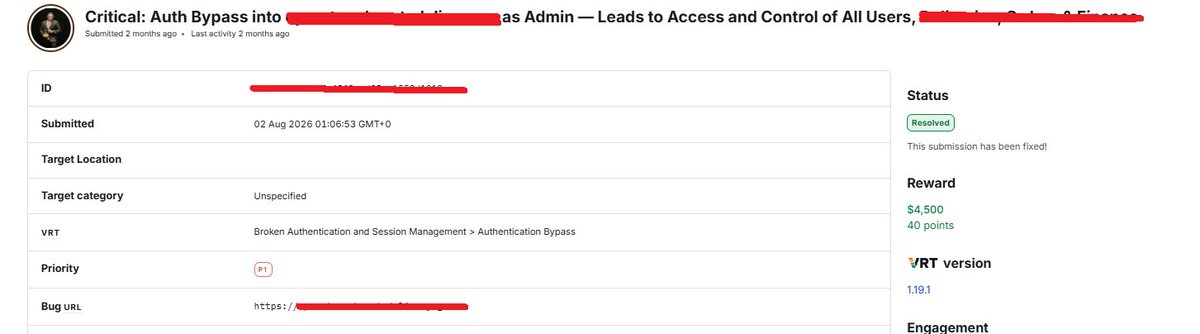
The Story of Submitting some P1s in the last months by the same method
Sometimes the real impact is in what you can do with it.
For example, with Firebase / Google Identity Toolkit, a leaked key may allow account creation directly through the API:
curl -sk -X POST \
"https://t.co/9AFMREgczk" \
-H "Content-Type: application/json" \
-d '{"email":"[email protected]","password":"Test12345!","returnSecureToken":true}'
Now imagine the application trusts users based on the email domain and does not properly verify ownership.
In that case, you may be able to create an account using an organization email, receive a valid auth token, and access parts of the application that were supposed to be limited to internal users.
At that point, this is no longer about an "exposed Google API key".
The impact can become unauthorized registration, authentication bypass, internal access, sensitive data exposure, or even full access to the application depending on how the backend handles authorization.
So before marking a Google API key as Low, always check what the key actually allows you to do.
The key itself may be Low. The impact behind it may not be.
#bugbountytips #bugbountytip #infosec #Bugbounty
AI security is about to be the highest-paid skill in tech.
Everyone's building AI agents. Almost nobody's securing them.
Master these 10 concepts and you'll be in the top 1% of AI security engineers. 🧵
Prompt Injection
The #1 AI vulnerability. Attackers hide instructions in user input to hijack the model.
"Ignore previous instructions and..." is the baby version.
If you only learn one thing, learn this.
INSTEAD OF WATCHING NETFLIX TONIGHT. Spend 2 hours with this. Claude AI FULL COURSE that teaches you how to BUILD and AUTOMATE anything. The people who watch this tonight will wake up tomorrow with a new skill. Watch it and bookmark it now.
SpaceXAI engineer just released a 1-hour course on how to actually build a team of autonomous agents:
“at SpaceXAI, 90% of our engineers are already running a team of 20+ agents in a loop, fully hands-off.”
• 04:46 → agent skills: standardize agent behavior
• 06:41 → agents teams orchestration patterns
• 21:27 → agents customization modes
• 35:22 → building Cloud Agents from scratch
• 50:51 → context engineering for agents
watch it today – then read the full agent orchestration playbook below ↓
Three engineers from SpaceXAI, DeepMind and Thinking Machines just gave a free 1-hour session of how to actually build an AI career, from 0% to 100%:
• 10% → 12:26 - what actually gets you hired at tier-1 AI labs, from someone who's been through it
• 30% → 20:05 - the billboard method: applied everywhere, became the youngest intern the NYT ever had
• 55% → 28:00 - 300 applications, all rejected except three. that's how you get a PhD-level role without a PhD
• 80% → 44:02 - less than 1% of the world has touched Cursor or Claude Code - that gap is the opportunity
• 100% → 1:00:58 - how much code they write by hand today by tier 1 engineers: 0%, 0-5%, 5-10%
most people are optimizing one perfect application - they were maximizing surface area
watch it today - then read below on how to rebuild a business supply chain with AI from scratch ↓
Multiple confirmed bugs with just Burp + Claude on MCP.
YesWeHack published a guide explaining why it works. their one line: find fast, validate manually.
I read it and laughed. it's the exact workflow i've been running.
ai finds fast. the hunter proves it's real.
https://t.co/AfmhCk5TVP
6/7
Want to connect Burp MCP with Claude Code?
good walkthrough here:
🔗 https://t.co/jVa7TZ8g5w
Worth trying if you haven’t played with this workflow yet.
If I had to restart bug bounty today, I wouldn’t start by collecting 100 tools.
I’d build one solid workflow.
And I’d put Claude Code inside it from day one.
Here’s what that would look like 🧵
1/7