Why are some neurons more selective than others? We report now in @Nature how calcium permeable-AMPA receptors in PV neurons make them less selective to sensory features https://t.co/Y7sXbtE8I3 Long live the geniuses behind this🧠🔍https://t.co/87BqmXxYje @thainmueller @rhuganir
Very happy to share our latest review @NeuroCellPress on plasticity within cortico-basal ganglia circuitry in motor learning! It was fun to take stock of all the progress we've collectively made, but there are still many exciting directions ahead.
https://t.co/z6v5vajlPX
We are excited to introduce the Johns Hopkins University OneNeuro Initiative.
Neuroscience research and education is thriving across Johns Hopkins University in over 30 departments across all schools. The OneNeuro Initiative's vision is to bring the vast neuroscience community at Johns Hopkins together to promote interaction and collaboration and forge new understanding of the brain and mind in health and disease. This includes the full arc from molecules and cells to the complex network of neuronal circuits that constitute the mind.
We hope you will visit the OneNeuro Website often to learn what is happening in the neuroscience community at Johns Hopkins.
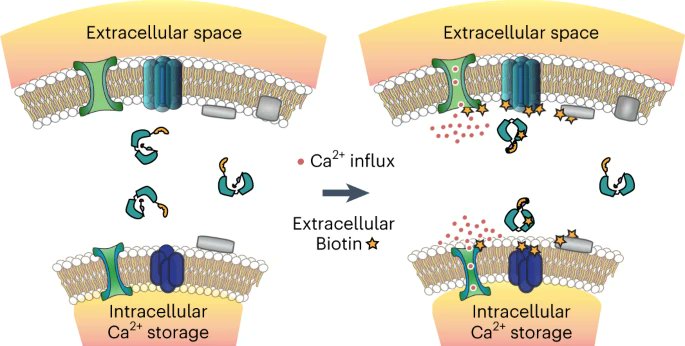
We use Ca2+ indicators as a proxy for activity, but have you wondered what molecular events occur within cells during activity? I’m thrilled to have collaborated with @jwrenkim & @nickingolia on Cal-ID, a calcium-dependent TurboID, that can allow us to answer such questions.
Cal-ID, a calcium-dependent protein proximity labeling tool, is finally published @nchembio! We (@nickingolia) present a simple, scalable, in vivo compatible, and versatile platform that connects calcium signals to biochemical labeling of proteins. https://t.co/yv6AEfYqgj
LYTACs pioneered by @CarolynBertozzi opened the door to degradation of cell surface and extracellular proteins through lysosomal targeting. Here, we introduce genetically-encoded LYTACs, or GELYTACs, which are (1) easier to produce by recombinant expression (LYTACs, antibody conjugates to glycopeptides, are harder to make), (2) amenable to engineering via directed evolution, and (3) possible to secrete from therapeutic cells such as T-cells.
We demonstrate degradation of various soluble targets, including TGFb, IL6R ectodomain, and mCherry with GELYTACs optimized via yeast display directed evolution, added either as recombinant protein or secreted from living T-cells.
Congratulations to lead author @Jony_theChemist, our wonderful collaborators Sean Yamada-Hunter, @LouaiLabanieh and @molecular_elena from the @mackalllab, and great teaming up again with the formidable @CarolynBertozzi.
https://t.co/WVYAadruBP
Thank you, @FemkeF and @rikvanderkant for the great spotlight piece about our paper on trafficking of #APOE to #LipidDroplets! @ApoEdscvr
An inside job: New roles for ApoE at the lipid droplet https://t.co/2NVU0WmeIu
Since our lab tech Alyson is moving on to grad school (🎉), we are in need of a new tech. We are especially interested in folks who have tissue culture experience as the duties will be to generate primary rodent neurons. Please RT and DM me if interested. https://t.co/yP3dHlltUa
Paradigm shift for this new paper by @rhuganir SynGAP regulates synaptic plasticity and cognition independently of its catalytic activity | Science https://t.co/BYHMnVlK6p
And my commentary on it:
https://t.co/EM48wUAOet
@iins_bordeaux@BIC_Bordeaux@Neuro_Bordeaux@CNRSbiologie
Given the renewed interest in my post on the unaffordability of childcare for many postdocs, and the continued financial burden many postdoc parents face, @natblackpostdoc is relaunching our NBPA Childcare Fund:
https://t.co/rfxkP1qsyo
🙏🏾 RT/share with institutional leaders
Thrilled to share our preprint reporting the discovery of a previously unrecognized population of LepR-expressing fast-acting satiety neurons in the hypothalamus ARC. These neurons directly inhibit AGRP neurons, providing a crucial counterbalance. https://t.co/yQ9djK3hHo
One of my favorite things is that at least once a month a stranger will email me expressing how helpful they found this guide. It's been read 20k+ times since I've published it, and it's time to share it again.
https://t.co/kM7NkQeZUf
20-30% of scientists may be using commercial antibodies that don’t work as advertised in their protein studies, potentially skewing results. https://t.co/z0DvGseExY.
My lab is hiring a postdoc to work on a BRAIN Initiative funded position in collaboration with Bryan Copits and Patrick O'Neill to develop novel optogenetic tools to selectively manipulate user defined afferent inputs onto user defined post-synaptic neurons. DM or email
Stop by booth #3201 to learn more about the Stanford Knight Initiative @BrainResilience , postdoc openings and @StanfordBrain research Institute. Looking forward to seeing my neuro friends at #SfN23!