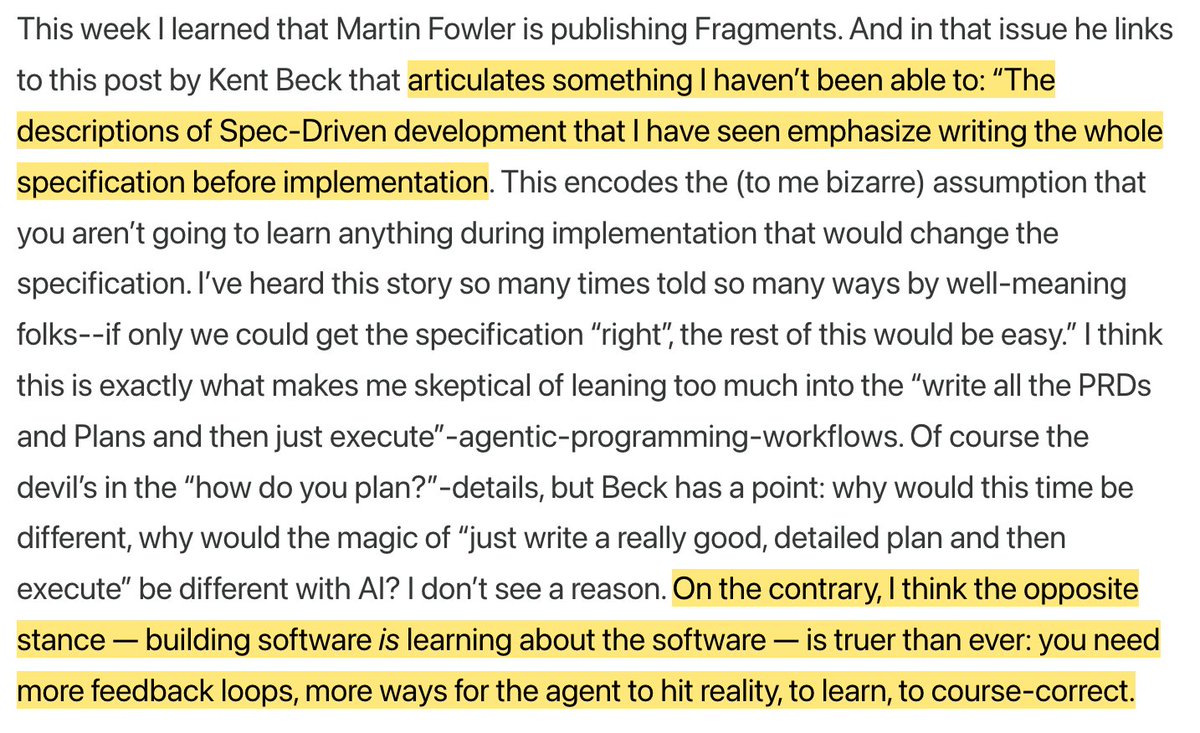
Thorsten's observations here definitely ring true.
Both "No Plan" and "Too Much Plan" tend to blow up. Finding that perfect balance of preparation and just-in-time learning is at least half of the art of learning how to build successfully with LLMs.
It's possible to strike this balance when you're working step-by-step with an LLM – but when you really lean into letting it not only do the work, but also discern the right work to do (e.g. Ralph) it feels like you have to divine a pitch-perfect incantation for it up front.
Instead - after picking an area of work to focus on (who you want help and for which outcomes) - the work becomes designing an environment that can provide the right signals that will teach what quality means in that context (inputs, feedback loops, etc.)
Gardening, Urban Planning, Project Management, Search-and-Rescue Dog Training – pick your metaphor – they're not always clear or easy, but certainly doable.
Intentional outcomes for a living system through dynamic inputs and feedback.
@thorstenball
https://t.co/BQD8dEJjuY
Junior engineer mindset: "I need to write all the code myself so I get credit"
Senior+ engineer mindset: "I need to make my project successful, that's it. I don't need to write all the code myself"
Good designers can design something good enough in a day if they had to. Doesn't mean they should. Doesn't mean they will often. Doesn't mean it'll be their best. Doesn't mean they didn't cheat a little. Doesn't mean they got paid less.
Doesn't mean anything.
It just is.
So I guess there’s a git rebase vs merge debate happening? Lemme help out the correct answer is whatever the fuck GitHub’s “Squash and Merge” button does. Beyond that who gives a shit there’s nothing less important than this get a life you weird nerds.