Agreed, and this varies based on the segment. Some buyers prefer meeting in person, some like zoom calls, some want everything online/email, some like texting. We are now even letting your AI agent handle the majority of the info then will follow up and verify with you after the fact.
Be avaialble however your customers want you to be.
The tickets one surprises a lot of people because they are actually using them for business purposes by taking clients or similar.
And you see all of these companies with suites and whatnot, everyone assumes its a write-off.
The one that angers me the most is the change in how food/drinks for the office are handled. I should be able to deduct expenses for coffee/drinks/snacks for my workers.
Why is your lender repulling credit before closing if the current credit report isn't expired?
I understand making them debt monitoring, making them qualify with the payment, etc. but making them use a new credit report with a new credit score is wild to me.
I would immedietly cut of any lender that required that. Way to easy for a terrible 'bait and switch' expierence.
@TheJSantiago You will never grow substantially without taking risks. About 3-4 years ago I came to the realization that you can just do things... since then, I've been heavy on the risk-taking side, and loving it, even in a down market.
IMPORTANT: This is someone who would be way better off talking to a mortgage pro before making any of these moves.
Can any of my mortgage peeps give an example or two of why?
Prospective buyers: Loan officers, like myself, are happy to help give you guidance on how to maximize what you can qualify for, timelines, where we recommend parking funds, what you should/shouldn't do with income, etc.
There are very specific rules we need to follow when qualifying you. It is better to have a pro explain the applicable ones (for free) ahead of time so you aren't doing unnecessary things (or even harmful things) that could impact your ability to buy.
Wife wants me to stop investing for the next 5 months so we can buy our first home faster
I want to keep doing my normal $500/week into the market + $1,000/week cash
She’s picking up a $200/week job just to boost our borrowing capacity
We have a timer until March 2027 to move out of the in laws so we either need to buy a home then or go back renting
Two options:
- Save $160k cash and put 20% down
- Put 10% down, keep $50k dry powder, and stay liquid for a BTC smash buy if it ever goes under $50k
Keep in my HYSA is yielding 5.5%
Opportunity cost of this next 6 months is crucial
I’m leaning toward the 10% down + dry powder route so I can still BTFD and keep stacking
Just smashed a juicy $400 of $QQQ today at these prices either way
What’s the actual correct play here?
Pause everything for the house or keep investing and put less down?
@SparkingFIRENC Depends on your age, health, oppurtunity costs, amount you already have saved, etc. There is no one set answer for this one, but if there was more info I could make a decision on the scenario.
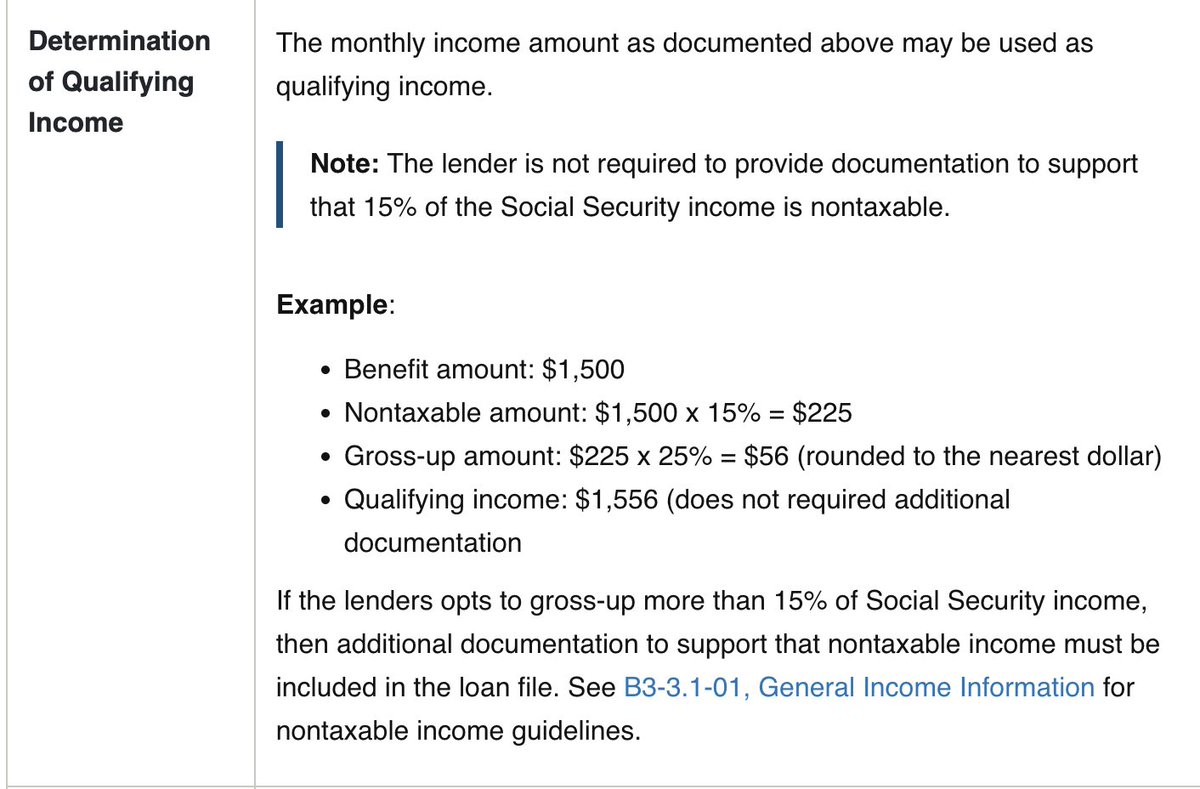
Thought I would share a tip with my fellow mortgage pros this AM. Did you know 15% of social security income is non-taxable? Meaning you can gross up 15% of it by 25% for conventional without tax returns or any documents other than the award letter.
Most lenders will also allow this on FHA, VA, etc. using the factors that program allows (i.e. 15% for FHA) but conventional is the only one that spells it out explicitly.
It isn't a ton of extra income, but on a file where every cent counts, here is some free extra income with no needed docs!
@rustydish2331@texasrunnerDFW I agree bull case is status quo, but new permits are generally a leading indicator for actual builds, and they are quickly trending down (check today's numbers)
@dfwaaronlayman The incentives to get people to buy new construction (especially existing builds) are absolutely insane. Almost every one I am seeing have 6% or more in seller credits. Several are also offering 6% to the buyer's RE agent as well.
@TheJSantiago I'm the crazy person that loves an office. Rented an office for myself back when I had 0 employees, just so I would have a place to work outside my house.
I guess I would need clarification on the rule. Does it have to be a positive return or you lose it, but get to keep it if positive? If so, I am rolling short term US Bonds. Guaranteed (as much as anything can be) returns with captial back. Then after the year and it is mine, put it somewhere more aggressive. Maybe a downpayment for a multi-unit property somewhere.