Board-certified orthopedic surgeon. Solo private-practice hand surgeon (NJ/NY). Breaking down physician pay, Medicare, insurers & policy. Not medical advice.
@brian_blase@HammondOnHealth@washingtonpost Solo docs don't get market negotiations. We get a fee schedule. Cap awards at an insurer-set rate and that sheet becomes the ceiling. Keep patient protections. Audit bad actors. Don't hand insurers the pen.
@CharlesLutzMD That ban is the double standard. Doctors can't open new physician-owned hospitals that bill Medicare. Insurers buy practices and surgery centers and call it integration.
I can't raise my fees. Insurers won't negotiate.
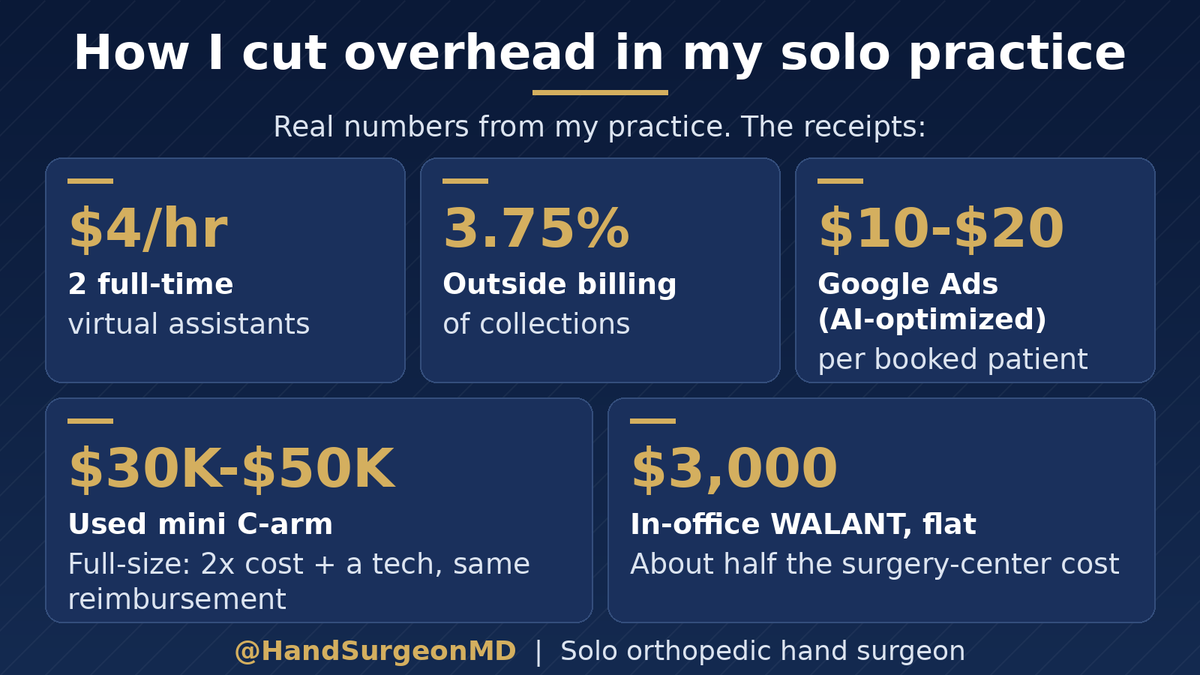
So I cut costs. VAs at $4/hr. Billing at 3.75%. A used mini C-arm. $3,000 in-office WALANT.
Still 45 to 55 patients a day, weekends off. Wrote up exactly how I run lean as a solo hand surgeon.
@wendellpotter Another thing the ads skip: an Advantage plan can approve your surgery, then decide afterward it wasn't necessary and pay less. There's a bipartisan bill to stop that, H.R. 10394.
Residents: 5 years out, 2 years owning my own practice. Office 4 days, OR 1 day, most weekends off.
You've been told private practice is dead. It isn't.
What's stopping you?
@Ds_9981 No company. I hired them directly on https://t.co/qwgJJVhNUK and interviewed them over Zoom. You still have to train them like any other employee.
@BostonGlobe My med school debt was $300,000, and it's much higher for students now. Debt like that is why most residents take the first hospital job they're offered when they finish.
@DutchRojas Nobody taught me business in training. I learned it after I opened. Overhead was the first number I had to learn. In the age of AI, it's easy to learn.
@robolivermd Real people, not AI. Two full-time remote assistants in the Philippines. They answer the office phone, schedule patients, and handle email.
@anish_koka Plans get paid more when they code patients sicker. When I code exactly what my op note says, I get a denial to fight. Same program, different rules.
Employed surgeons get told "your collections don't cover your salary."
Then why does the hospital keep recruiting you?
Your cases fill their OR. That facility fee just never shows up on your line.
Insurers won't negotiate with a solo doc. Hospitals keep buying the practices that could compete with them.
This isn't a free market. It's a monopoly.
The one job I want government doing: break up the monopolies.
Solo docs don't negotiate. We get a fee schedule.
Make the median the out-of-network cap and it becomes the ceiling. Then it drifts down.
I've never had a real rate negotiation. Just a take-it-or-leave-it sheet.
If doctors out of network rates are limited to median in network rates, that leads to downward pressure on doctor pay. If you can’t negotiate any higher than the median rate, the insurance company will never offer anything more than that. So you see a slow decline in doctor pay. This isn’t a hypothetical, CA did this and @EdGainesIII can show the receipts.
@LorenAdler would say that declining doctor payments aren’t a bad thing in themselves. I agree we shouldn’t assume that high doctor pay is a good thing in itself. I’d be nothing but a cartel mouthpiece if that was the case.
However, declining doctor pay does lead to fewer independent doctors. There is overhead, and if you can’t pay your bills, your practice either closes or gets acquired. As proof, I offer the previous 20 years of declining independent physician practice.
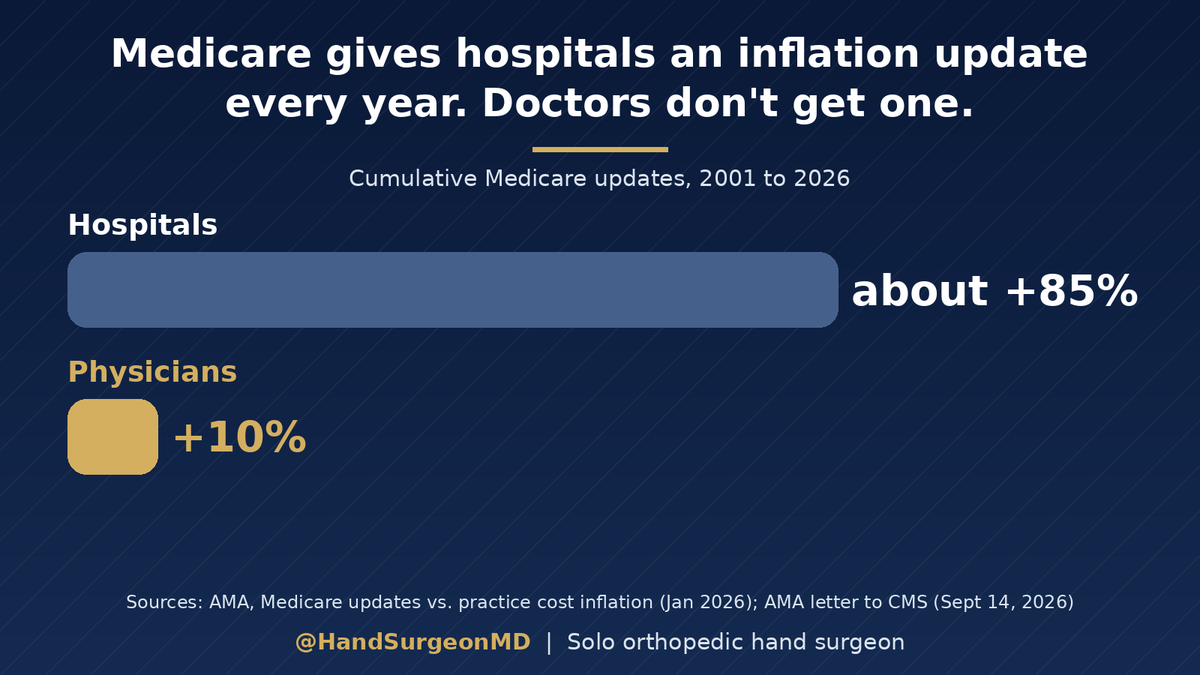
While declining reimbursement isn’t the only cause, it’s a big one. Medicare rates are 30% lower than they were 20 years ago. Most practices cant keep the lights on with medicare rates, anymore. So they rely on private insurance.
Take away a fair arbitration process and you’ll see more practices bought out by large hospital systems.
And that vertical integration drives up prices. So on net you end up with an even more expensive system.
@RojaGarimella Hand rates aren't great either. Medicare pays me about $423 for a carpal tunnel release. That includes 90 days of care after surgery. I make it work with low overhead and in-office procedures.