That is correct.
As a solo doc I have a similar experience except one insurance company has recently made serious attempts to negotiate. Could be related to the fact that there may not be many thoracic surgeons in their network.
But for Blue Cross , Cigna , Aetna it’s a fee schedule and it’s take it or leave it
It’s unfair but I doubt anyone cares.
Two-thirds of Americans now say they favor Medicare for All, according to a new @KFF poll. That's the highest level KFF has recorded since it started polling the idea in 2016, up from 53 percent in 2020.
This tells me two things: Americans are fed up with rising health care costs, and no one is offering up a more realistic, more effective alternative.
You can't beat something with nothing, and right now Medicare for All is close to the only something on the table. Health policy experts need to offer something else.
What are your best ideas? (Mine are coming)
Massachusetts regulators said they had no authority over Steward's malpractice insurer because it was based offshore. So hundreds of doctors were covered by a company nobody here was watching. If your coverage is offshore, who is checking that the money is really there?
Who actually holds your malpractice money?
Your hospital says you're covered for malpractice. Ask who actually holds the money. Steward's captive insurer TRACO is effectively broke, and doctors who trusted it now face legal bills and personal judgments. I chose independent practice partly for this reason.
https://t.co/pCMtIDlKeU
The TRACO debacle should be a warning to every hospital-employed physician. Captive malpractice insurance can leave doctors personally exposed when the system fails—even through no fault of their own. Many hospitals act ethically, but this industry needs far greater transparency and oversight.
YES! Absolutely. We have been working with societies and expert groups (such as @JACCJournals ) to create a virtuous cycle of knowledge gap identification --> knowledge creation. This pulse on the clinical knowledge requirements, paired with the evidence gaps uncovered by our engine is truly one of the projects @IAmSamFin and I have been most passionate about working on
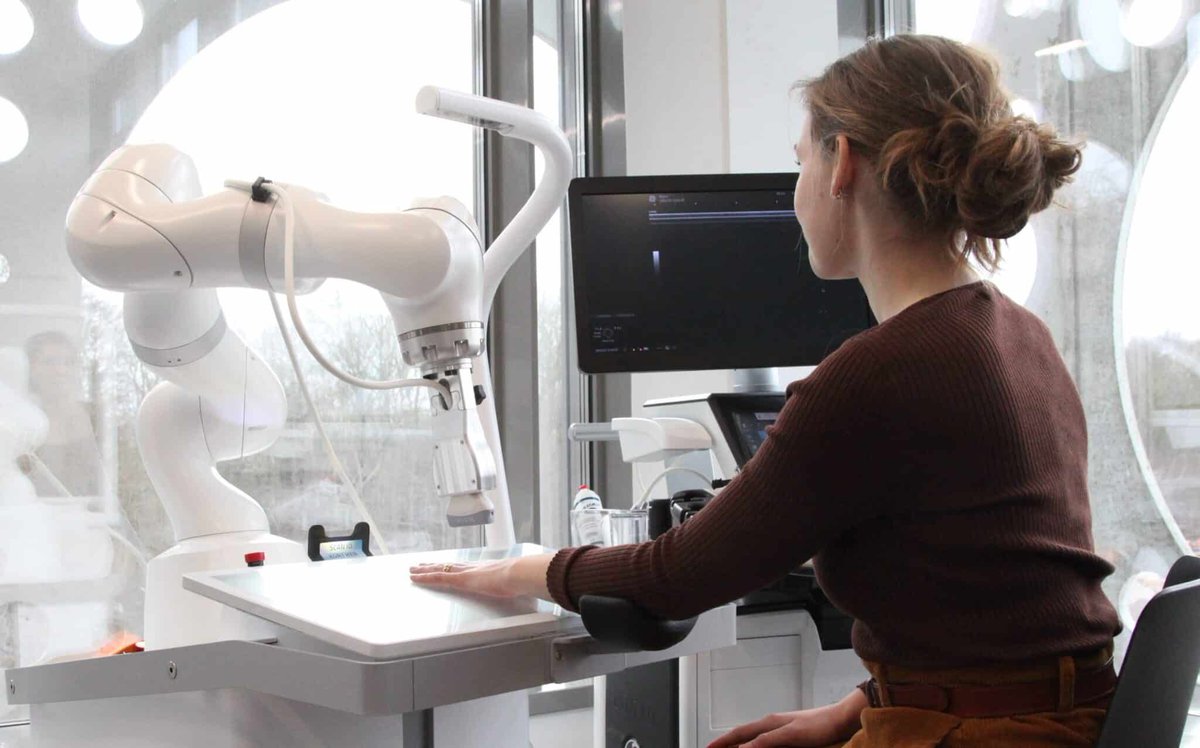
The FDA cleared a robot that performs joint ultrasounds and writes the report itself. @ROPCA3's Arthur scans fingers/hands/wrists for arthritis; its AI, Diana, reads them. 72% of US counties have zero rheumatologists. Translation: the scan and the first read move from a scarce specialist to a machine
https://t.co/K8YlCpZ5Ov
#HealthTech #Rheumatology #AI
I recently shared a bold prediction that AI will soon outperform physicians. Earlier this year, another bold take of mine caused a stir: ice cream can be key to a healthy life.
The same standard fuels both arguments: follow the evidence, even if it makes you uncomfortable.
As I write in “Eat Your Ice Cream,” the six rules for a long, healthy life require evidence, not the overblown claims from the wellness industrial complex.
I don’t think there is much that can be done to slow the progress of AI in radiology.
NVIDIA and others already have imaging models that, while still imperfect, provide a remarkable foundation to build on. The important question is no longer whether AI will become capable of interpreting medical imaging. It is how that capability will change clinical workflows.
For decades, imaging interpretation has largely been separated from the clinicians directly managing the patient. AI has the potential to narrow that gap.
Surgeons and other clinicians will increasingly need to become more proficient at interpreting the imaging that drives their decisions, with AI functioning as a powerful second reader and reasoning tool. That does not make radiologists irrelevant. It changes where their expertise adds the most value.
I think the future is less about protecting traditional professional boundaries and more about integrating imaging, clinical context and decision-making around the patient.
Done well, that should mean faster workflows, better decisions and, ultimately, better patient care.
Holy crap POTUS just phoned in @JensenHuang live on stage at All In Summit
We will not lose the ai race! And whatever Dario said this weekend won’t stop our progress
This made my morning!
$NVDA
Oped: Medicine Needs to Get Serious About AI; Let the robots try being doctors by @ZekeEmanuel & @vkhosla. We need to get past biases and knee jerk responses and have FDA really certify AI based on it performing better than median human doctor as a predicate. Uplevel medicine to above median standards https://t.co/5yx2WrR6pN
It took me awhile to figure out that I was trading compensation for embroidery on a white coat….
And that community doctors were often way more competent than the Ivory Tower physicians.👇🏽
I agree with much of this. The average age of the lung cancer population I serve is over 70, and in that group especially, the human element still matters enormously. Trust, judgment, communication with families, and helping patients navigate uncertainty cannot simply be reduced to a series of tasks.
But I do think something fundamental is going to change.
We have an entire generation coming into healthcare that interacts with technology very differently. The doctor patient relationship will remain because medicine is ultimately a service profession, but I suspect it will not be valued in quite the same way it is today. Patients will rightly expect more: faster access, better information, greater transparency, higher-quality outcomes, and far more personalized care.
At the same time, AI will narrow the performance gap between physicians and other clinicians for a large amount of routine cognitive work. An experienced APP augmented by excellent AI may produce outcomes comparable to physicians in many standardized areas of care. That will inevitably raise uncomfortable questions about physician training, cost, reimbursement, and even the rationale for pursuing medicine as a career.
Physicians will likely be expected to do more, with greater scrutiny and accountability, for less reimbursement.
Personally, I welcome much of that disruption.
For too long medicine has placed disproportionate emphasis on documentation, hierarchy, credentialing, billing complexity, and process rather than the things patients actually care about: Was the diagnosis correct? Was the treatment appropriate? Was it performed well? Did someone explain it clearly? And did the patient get better?
AI may force us to refocus on those questions. That would be a very healthy correction.