I'm just going to leave this here today for anyone who might need to hear it, whether you're applying it to the #Yankees current #postseason situation or to life in general. 🙏⚾️❤️
Such a good man! I knew/covered Donny in both Detroit & New York. For five years until he hurt his back he may have been the greatest all-around first baseman in baseball history!
He doesn't need this CRAP anymore. Hope he now retires happily.
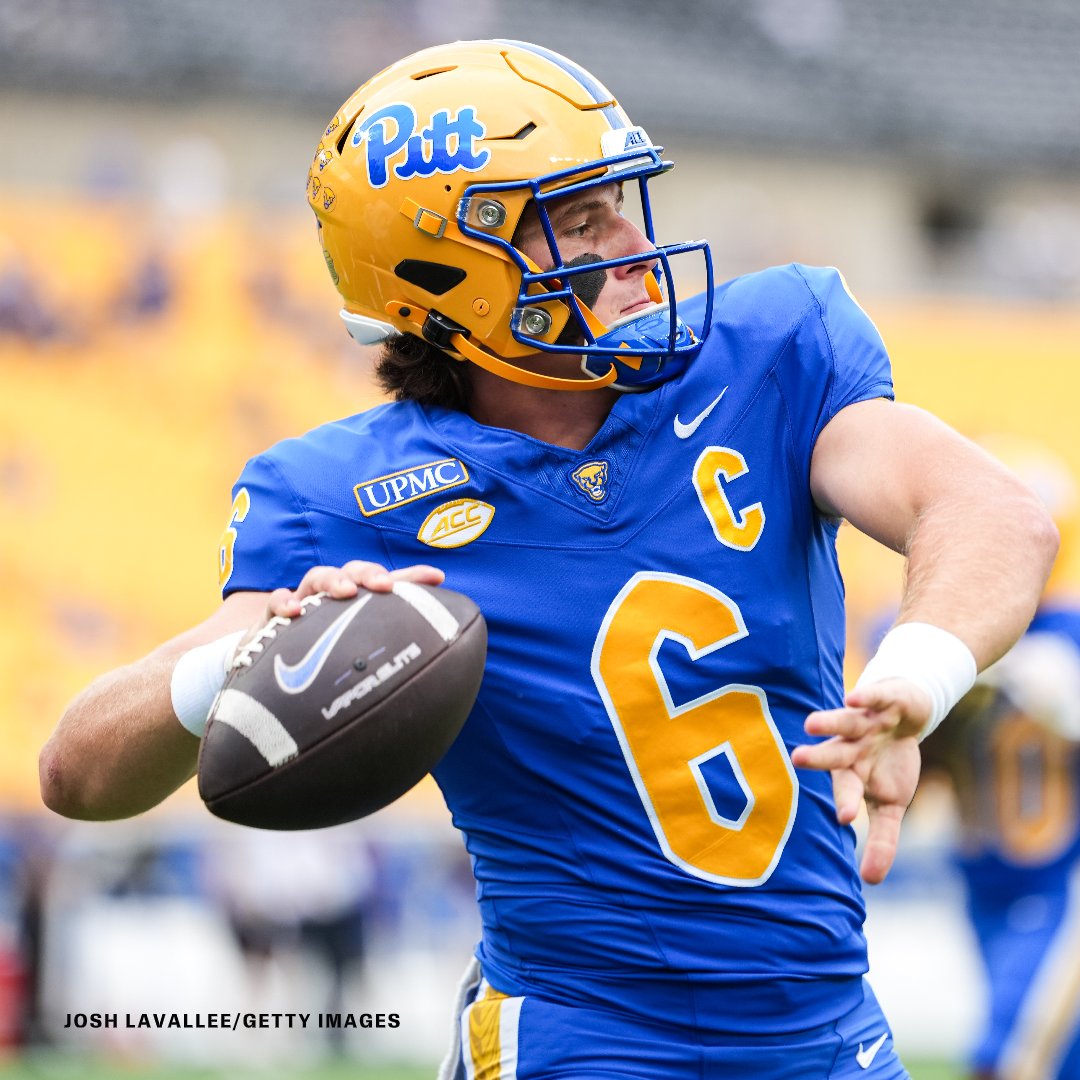
Pitt's Mason Heintschel is the first player in ACC history to throw for 6+ TDs in multiple games in the same season‼️ He's the first FBS player to do so since 2021 (C.J. Stroud and Bailey Zappe).
He's only the second player in ACC history to have multiple such games in a career, joining Deshaun Watson who did so in 2014 and 2016 🏈
An 18-year-old girl, a classical guitar, and one of Paganini’s most famous technical challenges. Haruna Miyagawa performs Caprice No. 24 with remarkable finesse, bringing its intricate variations and arpeggios, originally written for violin, into the world of classical guitar.
Mason Heintschel just made ACC history 🤯
In a 59-14 win over Miami (OH), Heintschel went 31-of-41 for 453 yards and 7 TDs, setting a new ACC single-game record 👏
On Sept. 1st, 1971 nine Pittsburgh Pirates made history with an entirely Black and Black Latino starting lineup.
Roberto Clemente, Willie Stargell, Manny Sanguillen, Dock Ellis, Al Oliver, Dave Cash, Jackie Hernandez, Rennie Stennett and Gene Clines filled out this historic cast.
UNREAL: Carson Kelly hits a ball to the ivy that is caught, but a different ball pops out 😂
Wrigley Field is something else, man. One of the most unique parks in all of sports.
There is one player in the history of baseball with 3,000 hits, a career average above .300, 300 home runs and 300 stolen bases.
One. In 150 years.
Willie Mays. 3,293 hits, .301, 660 home runs, 339 steals.
And the reason nobody else has it isn't that the bar is impossibly high in any single category. It's that those four things almost never live in the same body.
Here's what each one actually measures.
Three thousand hits is longevity. You have to be good for two decades.
A .300 average is precision. You can't just be a slugger who strikes out.
Three hundred home runs is power.
Three hundred stolen bases is speed.
Now look at who gets close and where they fall off.
Rickey Henderson had 3,055 hits and 1,406 steals. He finished with 297 home runs. THREE short of the club, and his career average was .279.
Craig Biggio had 3,060 hits and 414 steals. He finished with 291 home runs.
Hank Aaron hit .305 with 3,771 hits and 755 home runs. He had 240 stolen bases.
Barry Bonds had 762 home runs and 514 steals. He finished 65 hits shy of 3,000 with a .298 average.
Every one of them missed by a category.
Only eight players in the entire history of the sport have even reached 300 homers and 300 steals. Mays, Bobby Bonds, Andre Dawson, Barry Bonds, Reggie Sanders, Steve Finley, Alex Rodriguez and Carlos Beltran.
Of those eight, exactly one also has 3,000 hits and a .300 average.
And here's the part that makes it worse for everybody else.
Willie Mays missed most of two seasons to the Army in 1952 and 1953. He was 21 and 22 years old and in the middle of becoming the best player alive.
He also isn't in the top 100 all time in stolen bases. He wasn't a burner. He was just fast enough, on top of being everything else.
Mays won two MVPs, made 24 All-Star teams, won 12 Gold Gloves, and made a catch in the 1954 World Series that is still the most famous defensive play in baseball.
In 2024 the United States Senate passed a resolution honoring him after his death at 93. The resolution specifically cites this exact stat line.
Congress put it in the record because there was no other way to say it.
Nobody else checks all four boxes.
For more stories like this, follow us on any platform @thesportsontap
In 2008, an 18 year old minor leaguer in the Red Sox system was diagnosed with Hodgkin lymphoma.
He sat in a hospital room in Boston with his mother and told her that one day they were going to start a foundation.
Ten years later he cut the ribbon on a waiting room named after his family, in a children's cancer center he had given millions of dollars to.
Anthony Rizzo was a sixth round pick out of Florida. Nineteen games into his second professional season he got the diagnosis.
Six months of chemotherapy. He's been in remission since 2008.
Then he made the major leagues. He became a three time All-Star and one of the best first basemen in baseball, and in 2016 he caught the final out of the World Series that ended the Chicago Cubs' 108 year drought.
And the entire time, he kept the promise he made in that hospital room.
For years, Rizzo visited Ann and Robert H. Lurie Children's Hospital in Chicago about once a month. Not for cameras. He rarely told the media he was going, because he didn't want the visit to be about him.
Then in 2017 his foundation gave the hospital $3.5 million.
He was very specific about where it went. Two endowed funds. One pays for oncology Child Life specialists, a role funded entirely by philanthropy. The other gives grants directly to families facing financial hardship, covering things like insurance copays, meals, parking, transportation, rent, utility bills and childcare for siblings.
Because Rizzo understands something about pediatric cancer that people who haven't lived it don't.
His words: "I believe that an individual does not battle cancer alone. His or her entire family does. That's why we've designated this money to go directly to help families on the front lines."
At the ribbon cutting for the waiting room, patients and families lined the hallway holding signs to thank him.
He broke down.
"I remember sitting with my mom saying we were going to do this ten years ago."
And then: "Today was a day when I had flashbacks about sitting in the waiting rooms and going through the treatments and being sick. I don't do that much, but today was one of the days when it got to me."
His total giving to that one hospital passed $4 million, and his foundation delivered another $2 million to the same programs the following year.
There's one family in particular worth mentioning. The Rizzos helped pay a family's medical bills AND their mortgage when they couldn't make the payments, and sent the mother and her three kids to Disney World.
Her assessment of him: for all the kids and families in that hospital, he's far more than an All-Star and a World Series champion. He's someone their kids look up to. He gives them hope.
Joe Maddon, his manager, said it best: it's one thing to give money, but he's always there, and he doesn't get enough recognition for it.
In 2017 Rizzo won the Roberto Clemente Award, baseball's highest honor for character and community.
His message to the kids he visits is four words.
Stay strong, dream big.
He was one of them.
For more stories like this, follow us on any platform @thesportsontap
"Ted Williams, one of the greatest natural hitters of all time was retired and giving some tips to the rookies at the Red Sox spring training camp.
One of them asked how to tell apart a curveball from a slider when they were coming in.
Williams replied:
"Oh! That's easy.
If it's a curveball, the red spot you see on the ball will be rotating clockwise;
If it's a changeup, counterclockwise."
They rookies all nodded and politely thanked Ted Williams for the tip.
One of the rookies turned to the others and whispered:
"Now who the f*** can even see a red spot on a ball coming at you at 95 mph?"
Then Ted Williams went on to claim that he could tell exactly where on the seams he hit a baseball.
No one believed him.
Ted Williams was long retired at this point. Williams took a bat and covered the barrel with pine tar and they started throwing him some pitches.
Ted would hit and say, "across the seams" or "between the seams" or "across one seam" or whatever.
They retrieved all the balls and found out Ted Williams was right, EVERY single time.
We are deeply saddened by the passing of Tommy John, a veteran of 26 MLB seasons who helped revolutionize recovery from pitching injuries in the 1970s.
John broke in with Cleveland as a 20-year-old in 1963 and made his last appearance for the Yankees at age 46 in 1989, also pitching for the White Sox, Dodgers, Angels, and Athletics. The left-hander won 288 games, made 4 All-Star teams and anchored 3 pennant-winning teams, while twice finishing as a runner-up for the Cy Young Award. His 700 games started rank 8th on the all-time list.
After John injured his elbow in 1974, he received the first ulnar collateral ligament replacement surgery from Dr. Frank Jobe. John returned to pitch in 1976, then won 20 games three times in four years from 1977-80.
He would go on to pitch 14 of his 26 seasons after the procedure that is now known as Tommy John Surgery, a measure that has helped extend pitching careers in the more than half a century since it was first performed.
He was 83.