I was lucky to have Stephen Morris as my PhD game theory Professor at Penn. We later became colleagues, coauthors and friends at Yale. Last November at his alter mater Univ of Cambridge, he showed me his Clare College. Thank you for being you, Stephen!
https://t.co/fhPLI4iiAh
Regulating access to platform data requires balancing fair competition against the incentive to generate valuable data inputs, from @HanmingF and Soo Jin Kim https://t.co/k3Sy1Zvv9h
Soo Jin Kim and I consider equilibrium effects of platform data neutrality regulations. Such regulations intensity downstream competition, but may reduce amount of data platform produces in equilibrium. Overall welfare effects may be ambiguous.
https://t.co/wFDAdzh81L
A few months ago I sat through a PhD student's talk that wasn't great. Clear delivery, well prepared. The ideas just weren't there yet. Several professors asked tough but respectful questions. Exactly what's supposed to happen.
For a while there, this had become suspect. Critical feedback from someone with more power directed at someone with less got coded as punching down, especially in public. That norm seems to have receded, thankfully, but plenty of people still treat the practice as immoral.
I want to defend it. Scratch that. I want to defend punching, full stop. Up, down, sideways.
Science runs on Merton's principle of universalism: evaluate ideas, not the person attached to them. The "don't punch down" rule violates that. Worse, it ends up infantilizing the people it claims to protect. Telling junior scholars their work is too fragile to scrutinize is not respect.
New essay, free for all. Punch back in the comments.
https://t.co/hSvVsG2iB0
An article on Penn Gazette (May-June issue) on Balance of Power, based on my written interview with Mary Anne Meyers. The interviewe actually took place in February and covered more topics, but as expected the space limitation forced it to be short. https://t.co/K3Sn0EmhyE
US and China are converging in AI patenting, but differ in who innovates and where; AI patents are more valuable, and China relies more on US knowledge, from @HanmingF, Xian Gu, Hanyin Yan, and Wu Zhu https://t.co/zrwU7lEXd3
Incoming Skyline Scholar Hanming Fang's (@HanmingF) recent research reveals that China's fertility decline is driven by what women want, not what the government permits. Read the latest SCCEI China Brief for research insights: https://t.co/DEK0F3ZBlU
Recent analysis of nationally representative data finds that China's fertility decline is driven by what women want, not what the government permits. Read the latest SCCEI China Brief on Substack: https://t.co/Q5Im0skFVI
I am totally saddened by the passing of Chris Sims. He influenced generations of Penn students in macro, econometrics and empirical microeconomics. Chris left Yale a year before I joined Yale faculty but I did see him in seminars in 2018/19 during my visit to Princeton. R.I.P.
One of the more frustrating trends in public life over the past decade is how people who lead failing institutions blame social media for their failures.
A university president whose faculty have become political activists instead of educators and whose administrators multiply like rabbits will tell you that “misinformation on social networks” is eroding public trust in higher education. An editor whose publication lost its readership will claim that the real problem is X, rather than consider that the publication became boring, that the writing was uniformly uninspired, and that it stopped covering anything that mattered. A politician who loses an election will blame Meta algorithms rather than admit that voters simply did not like what was offered. A central banker whose institution missed the worst inflation in 40 years will worry publicly about TikTok videos spreading financial illiteracy.
The pattern is always the same. The institution fails at its core mission. The public notices. The people in charge, rather than examining what went wrong, identify an external force that is “polarizing.” The diagnosis is never “we did a poor job.” It is never “we lost our audience because we gave them nothing worth reading.” The diagnosis is always “bad actors are distorting the conversation.”
This is not new, of course. Before social media, talk radio was the scapegoat. Before talk radio, it was television. Before television, it was tabloid newspapers. Every generation of leaders has found a communication technology to blame for people’s loss of trust in them.
What is new is the intensity and the shamelessness. Over the last few years, “social media” has become a universal excuse that requires no evidence and tolerates no scrutiny. It is deployed reflexively.
The people who make this argument never seem to ask the obvious question: why are people on social networks so receptive to criticism of your institution in the first place? If your university were delivering excellent education at a reasonable price, no number of tweets would persuade parents otherwise. If your publication were covering important questions with clarity and substance, readers would not have migrated elsewhere. If the work you showcased were serious rather than trivial, people would still be paying attention.
Trust is not destroyed by social media. Trust is destroyed by poor performance, and social media makes it harder to hide. That is a different thing entirely, and the people running these institutions know it, which is what makes the excuse so cynical.
The honest version of the argument would be: “We used to be able to fail quietly because there was no mechanism for people to compare notes. Now there is, and we do not like it.”
That, at least, would have the virtue of being true.
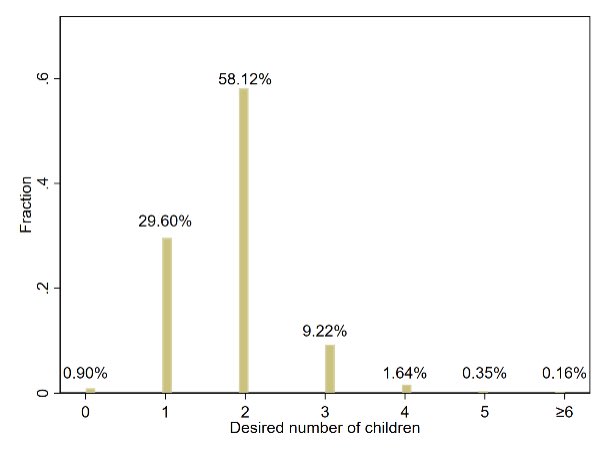
While fertility decline is a global phenomenon, China’s demographic challenges are significant because the gov’s elimination of one-child policy had little effect. The constraint is fertility desire, no longer birth quota. Mean fertility desire is 1.73, absent any constraint.
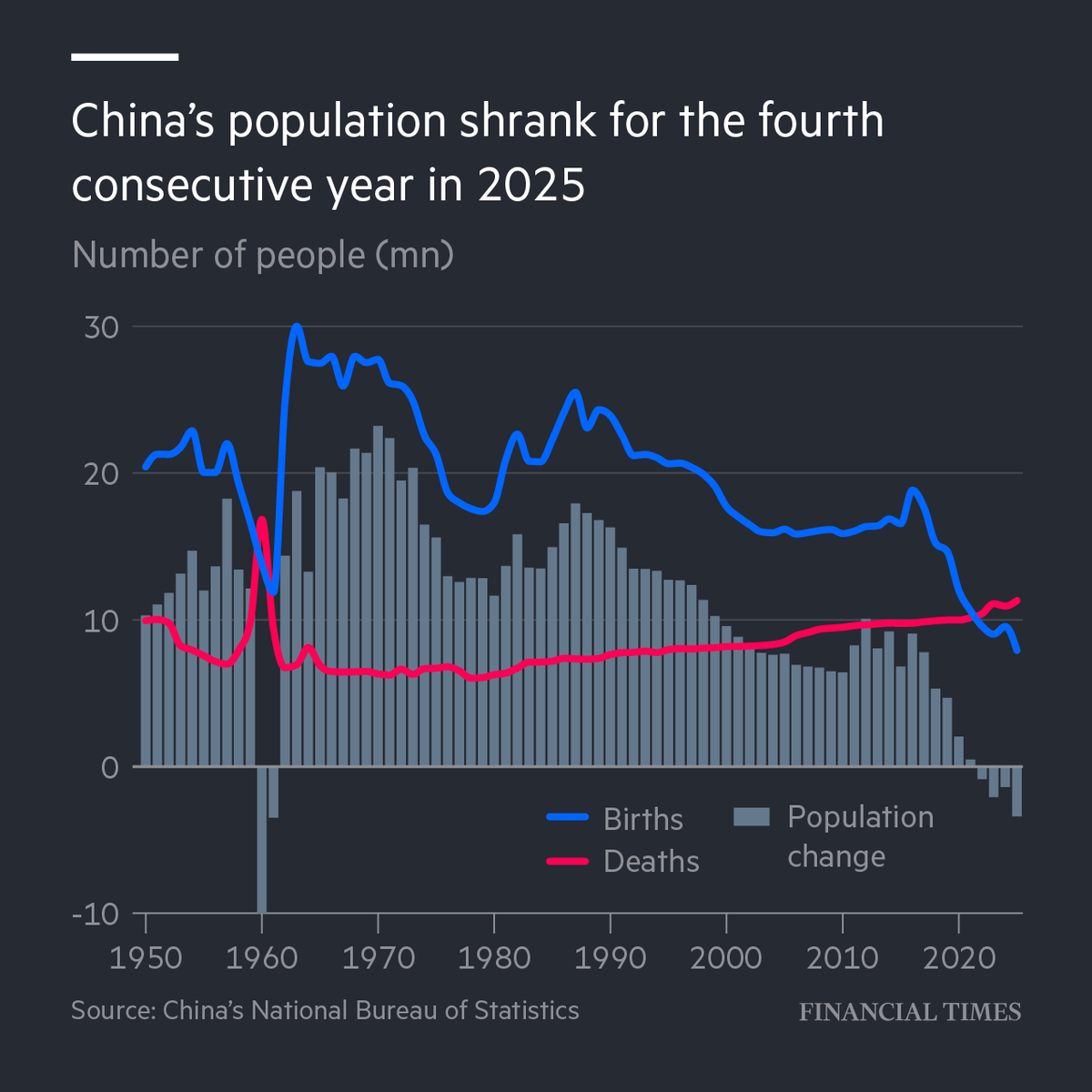
China last year registered the lowest number of births since records began, marking the fourth consecutive year of population decline as policymakers grapple with a demographic crisis. https://t.co/Hg64IXVfr6
In a new @JHealthEcon study, LDI Fellow @HanmingF examines why insurers on the Federally Facilitated Marketplace may cover some counties but not others, and what it means for patients.
Read more here: https://t.co/JbQqZc9bfu
I am not sure if there will be big fights on enhanced Obamacare premium subsidies fights in the Congress in the next weeks as they are set to expire on Dec 31. For those who may not be on top of the situation, the basic premium subsidies in the ACA will remain intact. 1/
Also relevant is my paper with Juan Pablo Atal, Martin Karlsson and Nicolas Ziebarth @NicolasZiebarth where we examine Germany’s long term health insurance. Why is health insurance plan in the US always annual? 10/10
https://t.co/HSJa5UKkyo