From the Battlefield to the Embrace of Nature: The Story of the Sherman Tank
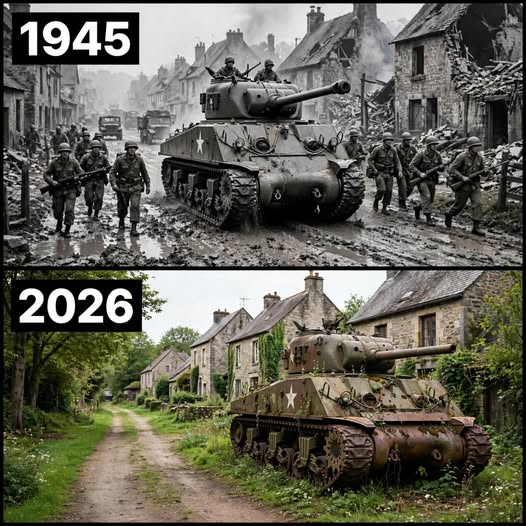
From Roaring Through Ruins to Resting in Green: In 1945, a Sherman tank rolled through mud, smoke, and shattered houses with soldiers beside it, yet in 2026, the same tank rusts quietly in the grass, reclaimed by nature and peace.
This photograph tells a powerful story about the passage of time, the destruction of war, and the return of peace. It contrasts two very different scenes: a Sherman tank moving through a devastated European village in 1945 and an apparently abandoned Sherman surrounded by greenery in the image labelled 2026.
But behind this emotional comparison is a fascinating piece of real military history.
1. The birth of the Sherman tank
The M4 Sherman was an American medium tank developed during World War II. Production began in February 1942, and it quickly became one of the most important armoured vehicles used by the Allied forces.
More than 49,000 Sherman tanks were produced between 1942 and 1945. They served with American, British, Canadian, Free French, Soviet and other Allied forces.
The tank was valued for:
Its mechanical reliability.
Its relatively straightforward maintenance.
Its mobility across different types of terrain.
Its ability to support infantry and engage enemy positions.
Its large-scale production, which allowed Allied armies to field substantial numbers.
The standard versions commonly carried a 75 mm main gun, although later versions received more powerful weapons.
2. Why 1945 was such an important year
By 1945, World War II was entering its final and most decisive phase in Europe.
American and Allied armoured units had fought through North Africa, Italy, France, Belgium and Germany. Sherman tanks played an important role in these campaigns.
They supported advancing infantry, attacked defensive positions, protected supply routes and helped Allied forces move through occupied territories.
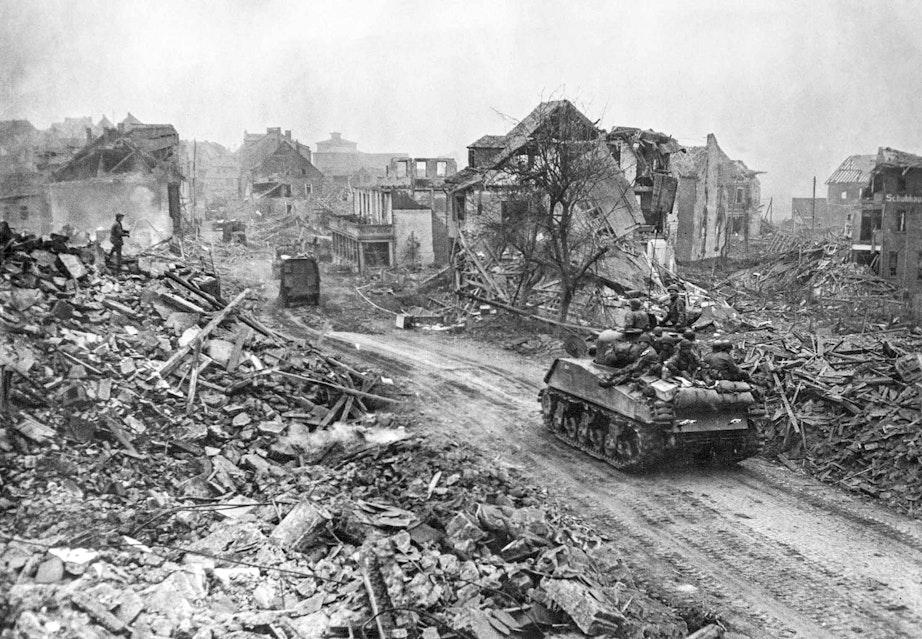
Many European towns and villages had suffered enormous destruction. Buildings were reduced to rubble, roads were damaged, and civilians faced the consequences of years of fighting.
The ruined streets shown in the upper image resemble the conditions experienced in many European communities during the final stages of the war.
However, the photograph alone does not establish which town, military unit, or battle is depicted.
3. What happened to Sherman tanks after World War II?
The end of World War II did not mean the end of the Sherman tank's story.
Thousands of these vehicles remained in military inventories around the world. Some were repaired, upgraded, and sent into service again.
They continued to appear in later conflicts, including:
Korean War (1950–1953): Sherman tanks were used by American and other forces during the conflict.
Middle Eastern conflicts: Several countries continued operating modified Sherman variants.
Postwar military service: Some countries kept Sherman tanks in service for decades.
Their long operational history demonstrates how durable and adaptable the original design was.
4. Why does the tank look abandoned in the 2026 image?
The lower image presents a completely different atmosphere.
Instead of soldiers, smoke and destroyed buildings, we see greenery, quiet surroundings and an apparently abandoned tank.
It represents something important: the transformation of former battlefields into places of peace and remembrance.
Over time, military vehicles that once served in combat have been preserved in museums, placed in memorials, abandoned in remote locations or restored by collectors.
However, there is an important historical distinction: there is no verified information accompanying this particular image that establishes that the tank shown in 2026 is the same vehicle pictured in 1945.
The location, ownership, military history and present condition of the tank cannot be established from this picture alone.
5. The deeper meaning of the comparison
The contrast between these two images is what makes the photograph emotionally powerful.
1945 represents destruction, sacrifice, uncertainty and the struggle for survival.
2026 represents the passage of time, nature's return and the possibility of peace.
The tank represents a reminder of a period when machines like these shaped the fate of nations and millions of lives.
The metal may rust, the roads may disappear, and buildings may eventually be rebuilt, but the history of those who experienced war remains important.
6. Important historical facts about the M4 Sherman
FeatureHistorical information
Official designationMedium Tank M4
Country of originUnited States
Production began1942
Production ended1945
Total productionMore than 49,000
Standard crew5 soldiers
Common main gun75 mm
Primary roleInfantry support and armoured warfare
Major conflictWorld War II
7. Final message
Perhaps the most powerful lesson behind this comparison is that war does not last forever, but its consequences can remain visible for generations.
A tank that once moved through streets filled with destruction can eventually become a silent reminder of history.
The soldiers moved on. The battles ended. The buildings were rebuilt. Nature returned.
Yesterday's battlefield can become tomorrow's peaceful landscape.
One important note for publishing: Treat this as a historical comparison, not a verified before-and-after photograph of the same Sherman tank. The specific vehicle, location, and connection between the two images have not been established.
**From living mountain eagle to futuristic skyscraper city.**
Watch a lush forest giant morph into a gleaming glass-and-steel metropolis under the same eagle form.