☢️ @falloutonprime Season 2 is here — now 7 episodes and #1 on @PrimeVideo .
@PinscreenInc delivered a large number of shots this season, pushing our most advanced generative AI–based facial de-aging to date. Huge thanks to Enigma 2 for a great post collaboration, and an honor to work alongside @magnopus and @ILMVFX on incredible VFX.
Massive thanks to our Pinscreen team for the hard work, and special thanks to Jay Worth, Andrea Knoll, and Jonah Nolan for the collaboration.
Grateful to @PrimeVideo, @AmazonMGM, and Kilter Films for sending us back into the Wasteland. ⚡️
#Fallout #FalloutSeason2 #VFX #GenerativeAI
Glad to see @mbzuai , a university 5 years old, is in this list of top contributors alongside world leading universities. Contributions to my colleagues.
A great honor to kick off the 30th edition of FMX 2026, especially with @mikeseymour introducing me.
My talk: AI Face VFX: from Feedforward Transformer to Diffusion Control.
With AI playing a central role this year, I included a Generative AI 101 alongside a production talk, with real use cases from @PinscreenInc , from early facial reenactment to de-aging (Fallout 2), plus new work from @mbzuai on telepresence, video generation, and interactive generative worlds powered by IFM-PAN.
Great to speak alongside Ben Grossmann, Mike Seymour, and Roland Emmerich.
Thx to 3DVF for featuring me: https://t.co/y7q3oNjdgc
Today, we released Lyra 2.0, a framework for generating persistent, explorable 3D worlds at scale, from NVIDIA Research.
Generating large-scale, complex environments is difficult for AI models. Current models often “forget” what spaces look like and lose track of movement over time, causing objects to shift, blur, or appear inconsistent. This prevents them from creating the reliable 3D environments required for downstream simulations. Lyra 2.0 solves these issues by:
✅ Maintaining per-frame 3D geometry to retrieve past frames and establish spatial correspondences
✅ Using self-augmented training to correct its own temporal drifting.
Lyra 2.0 turns an image into a 3D world you can walk through, look back, and drop a robot into for real-time rendering, simulation, and immersive applications.
➡️ Learn more: https://t.co/ROR7miJeCU
📄 Read the paper: https://t.co/1osU9EGjGD
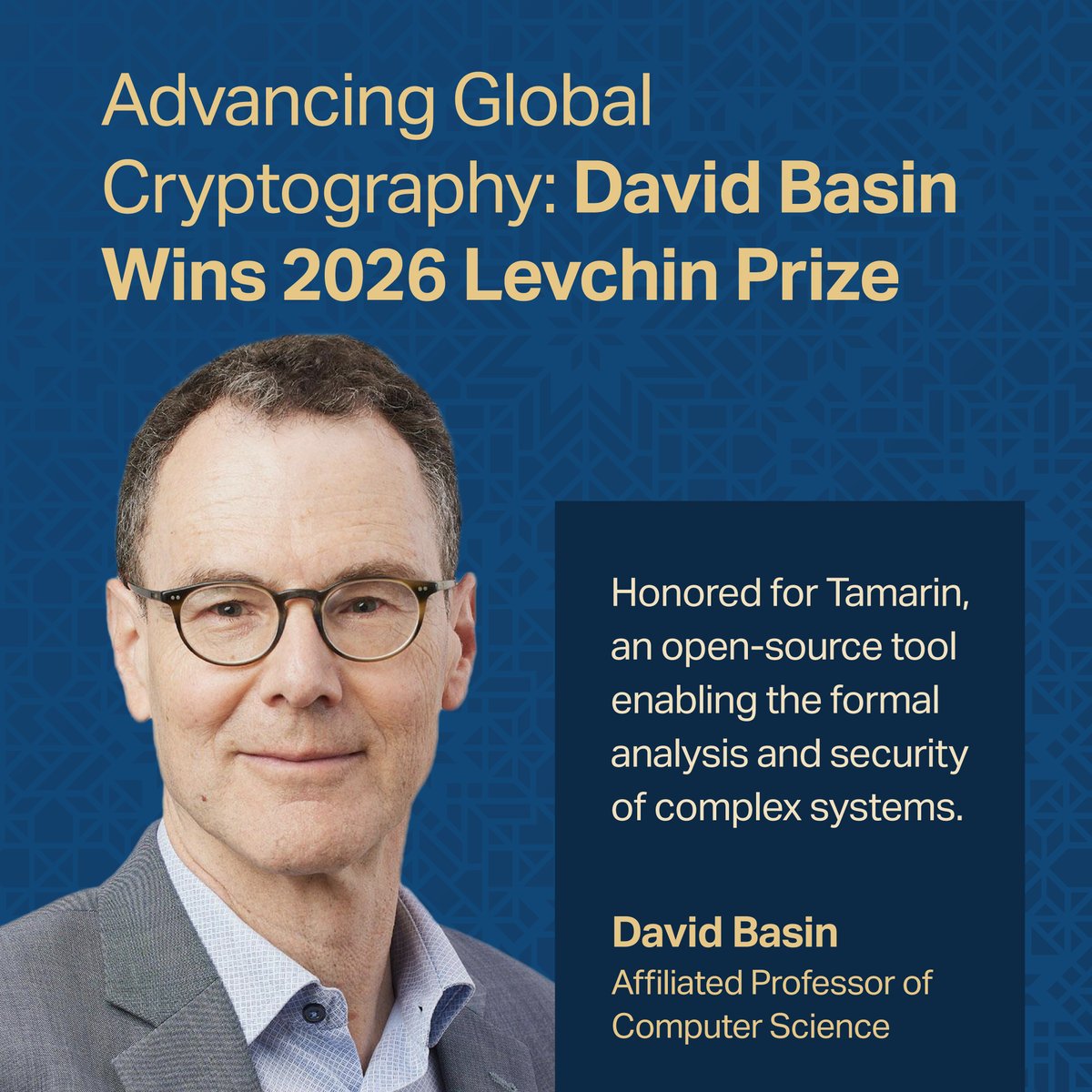
Congratulations to David Basin, Affiliated Professor of Computer Science at MBZUAI, on receiving the 2026 Levchin Prize for Real-World Cryptography.
The Levchin Prize recognizes major innovations with lasting impact on the practical use of cryptography, and Professor David's work is a testament to exactly that.
He and his collaborators were honored for Tamarin, an open-source tool for the formal analysis of security protocols. Tamarin has been used to model and verify the security of some of the most critical systems in the world, including 5G, TLS, EMV, and iMessage PQ3.
Established in 2016, the Levchin Prize celebrates contributions that strengthen the foundations of secure digital infrastructure globally — and we couldn't be prouder to have David as part of the MBZUAI community.
#MBZUAI #LevchinPrize #Cryptography #CyberSecurity #Tamarin #AIResearch #ComputerScience
One thing you can’t miss in Chicago: Giordano’s deep (S*) eh dish pizza.
An impressively calorie-dense π, each slice could power a full @siggraph paper review cycle. Believe it or not, it's actually good!
Perfect fuel for cold Chicago days.
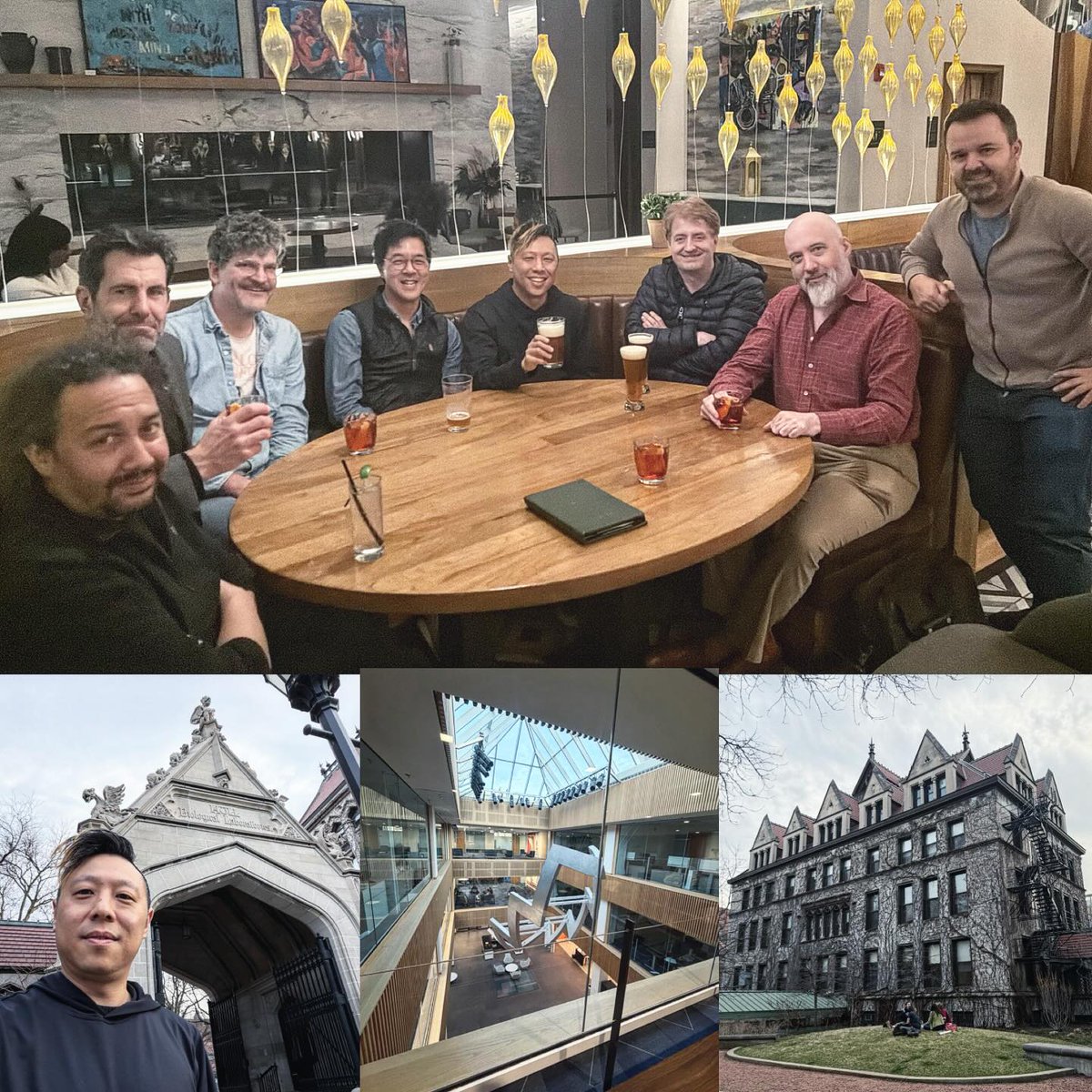
Our ACM @siggraph 2026 Technical Papers Committee meeting in Chicago: Great discussions, great people, and great beer. Nothing replaces catching up in person. It was also my first time visiting the @UChicago, a really nice campus and an excellent venue.
Also got to celebrate a few accepted papers, my @mbzuai students will be in for a nice surprise :-)
Great to be at the in-person ACM SIGGRAPH Technical Papers Committee 2026 meeting at the @UChicago. Wonderful catching up with @siggraph friends and meeting new faces. Submissions keep growing, with a clear rise in AI image/video generation and agentic approaches, while traditional areas remain strong.
We also had thoughtful, intense discussions on responsibly incorporating AI into the review process while preserving the rigor and quality that make SIGGRAPH unique.
Truly an honor to serve. Thanks Miri Ben Chen (@TechnionLive ), @JustinMSolomon (@MIT ), and Leona Caffey (@siggraph ) for the incredible organization.
🚨 BREAKING: NVIDIA proved backpropagation isn't the only way to build an AI.
They trained billion-parameter models without a single gradient.
Every AI you use today relies on backpropagation.
It requires complex calculus, exploding memory, and massive GPU clusters.
Meanwhile, an ancient, gradient-free method called Evolution Strategies (ES) was written off as impossible to scale.
Until now.
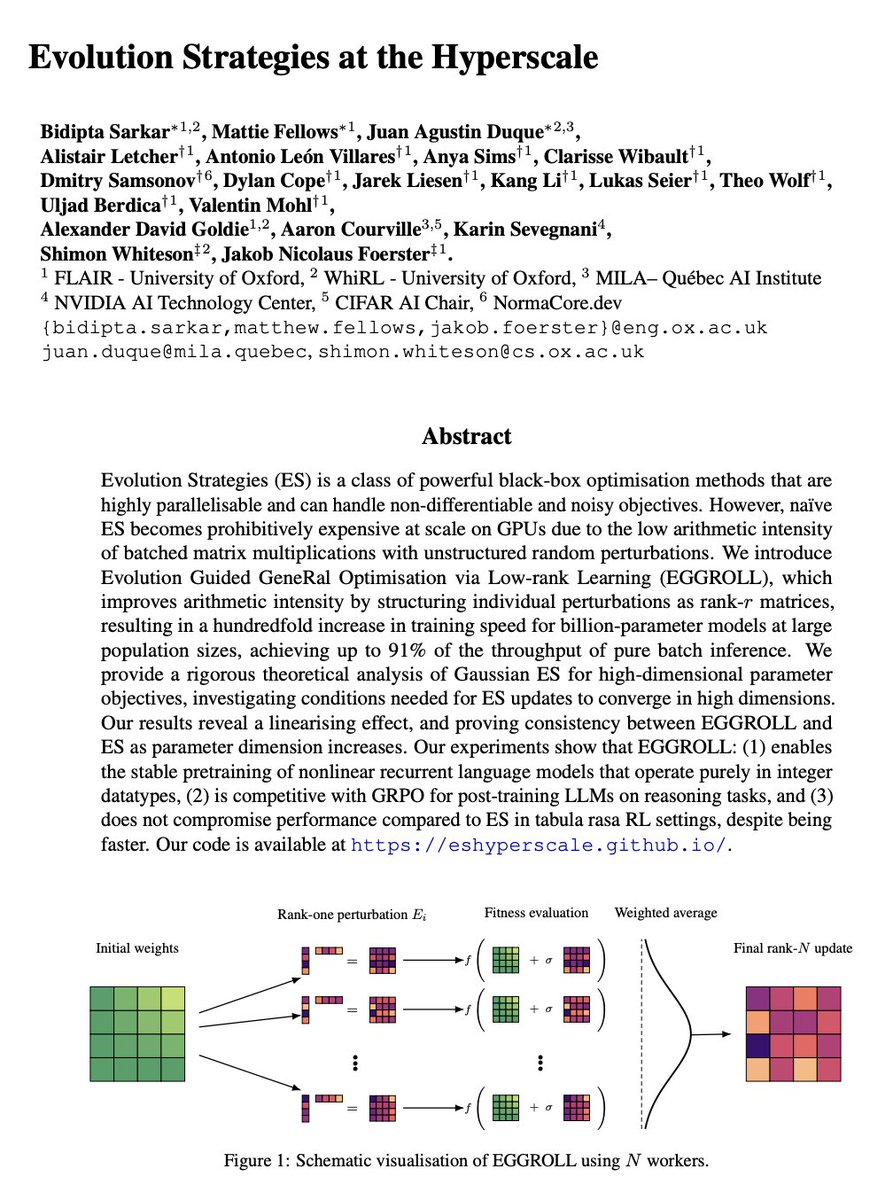
NVIDIA and Oxford just dropped EGGROLL.
Instead of generating massive, full-rank matrices for every mutation, they split them into two tiny ones.
The AI mutates. It tests. It keeps what works. Like biological evolution.
But now, it does it with hundreds of thousands of parallel mutations at once.
Throughput is now as fast as batched inference.
They are pretraining models entirely from scratch using only simple integers.
No backprop. No decimals. No gradients.
We thought the future of AI required endless clusters of precision hardware.
It turns out, we just needed to evolve.
Grateful of the UAE's exceptional efforts in keeping the country and region safe, successfully intercepting 137 ballistic missiles and 209 drones launched by Iran. We are closely monitoring the situation at @mbzuai (Mohamed bin Zayed University of Artificial Intelligence), and I’m pleased to reassure our community that everything remains safe and the students are well informed. Our leadership team has been working around the clock to stay fully updated and prepared, and our staff continues to provide dedicated support to our students.
الدفاعات الجوية الإماراتية تتعامل مع 137 صاروخاً و209 طائرة مسيرة
أعلنت وزارة الدفاع أن القوات الجوية والدفاع الجوي لدولة الإمارات العربية المتحدة نجحت منذ بدء الهجوم الإيراني، في التعامل مع وتدمير 137 صاروخاً باليستياً و209 طائرة مسيّرة أُطلقت باتجاه أراضي الدولة، مؤكدةً الجاهزية العالية لمنظومات الدفاع الجوي وقدرتها على التعامل مع مختلف التهديدات.
وأوضحت الوزارة إلى أنه ومنذ بدء الهجوم تم رصد 137 صاروخاً باليستياً إيرانياً تم إطلاقه تجاه الدولة، حيث تم تدمير 132 صاروخاً، فيما سقط 5 منها في مياه البحر، كما تم رصد 209 طائرة مسيرة إيرانية، وتم اعتراض 195 منها، فيما وقعت 14 منها داخل أراضي ومياه الدولة، وتسببت ببعض الأضرار الجانبية.
وأشارت الوزارة إلى أنه ونتيجة التصدي الفعال للصواريخ والمسيرات، سقطت بعض الشظايا في مناطق متفرقة في الدولة، مما أدى إلى حدوث أضرار مادية بسيطة في عدد من الأعيان المدنية.
وأكدت الوزارة أن الجهات المختصة تحركت على الفور بكامل جاهزيتها وإمكاناتها للتعامل مع الوضع وفق الإجراءات المعتمدة في مثل هذه الحالات، وتم اتخاذ التدابير اللازمة لضمان سلامة السكان وتأمين المواقع المتأثرة.
وأدانت الوزارة هذا الهجوم بأشد العبارات، مؤكدة رفض الدولة القاطع لمثل هذه الأعمال التي تمثل تصعيداً خطيراً وعملاً جباناً يهدد أمن وسلامة المدنيين ويقوض الاستقرار.
وشددت الوزارة على أن هذا الاستهداف يُعدّ انتهاكاً صارخاً للسيادة الوطنية وللقانون الدولي، وأن الدولة تحتفظ بحقها الكامل في الرد على هذا التصعيد واتخاذ جميع الإجراءات اللازمة لحماية أراضيها وشعبها والمقيمين فيها، وبما يضمن صون سيادتها وأمنها واستقرارها ويحمي مصالحها ومقدراتها الوطنية.
وأعربت الوزارة أنها على أهبة الاستعداد والجاهزية للتعامل مع أية تهديدات، وأنها تتخذ كافة الإجراءات اللازمة للتصدي بحزم لكل ما يستهدف زعزعة أمن الدولة واستقرارها، وأكدت أن سلامة المواطنين والمقيمين والزوار تمثل أولوية قصوى لا يمكن التهاون فيها.
وتهيب الوزارة بالجمهور الكريم استقاء المعلومات من المصادر الرسمية في الدولة، وتجنب تداول الشائعات أو المعلومات غير الموثوقة.
#وزارة_الدفاع
#وزارة_الدفاع_الإماراتية
#MOD
#UAEMinistryOfDefence
World Labs has raised $1 billion in new funding. We are grateful and excited to partner with our investors, including AMD, Autodesk, Emerson Collective, Fidelity Management & Research Company, NVIDIA, and Sea, among others.
https://t.co/MfK7mLGKPH
From how the team operates, I always thought Codex would eventually win. But I am pleasantly surprised to see it happening so quickly.
Thank you to all the builders; you inspire us to work even harder.
Job seekers in the U.S. and many other nations face a tough environment. At the same time, fears of AI-caused job loss have — so far — been overblown. However, the demand for AI skills is starting to cause shifts in the job market. I’d like to share what I’m seeing on the ground.
First, many tech companies have laid off workers over the past year. While some CEOs cited AI as the reason — that AI is doing the work, so people are no longer needed — the reality is AI just doesn’t work that well yet. Many of the layoffs have been corrections for overhiring during the pandemic or general cost-cutting and reorganization that occasionally happened even before modern AI. Outside of a handful of roles, few layoffs have resulted from jobs being automated by AI.
Granted, this may grow in the future. People who are currently in some professions that are highly exposed to AI automation, such as call-center operators, translators, and voice actors, are likely to struggle to find jobs and/or see declining salaries. But widespread job losses have been overhyped.
Instead, a common refrain applies: AI won’t replace workers, but workers who use AI will replace workers who don’t. For instance, because AI coding tools make developers much more efficient, developers who know how to use them are increasingly in-demand. (If you want to be one of these people, please take our short courses on Claude Code, Gemini CLI, and Agentic Skills!)
So AI is leading to job losses, but in a subtle way. Some businesses are letting go of employees who are not adapting to AI and replacing them with people who are. This trend is already obvious in software development. Further, in many startups’ hiring patterns, I am seeing early signs of this type of personnel replacement in roles that traditionally are considered non-technical. Marketers, recruiters, and analysts who know how to code with AI are more productive than those who don’t, so some businesses are slowly parting ways with employees that aren’t able to adapt. I expect this will accelerate.
At the same time, when companies build new teams that are AI native, sometimes the new teams are smaller than the ones they replace. AI makes individuals more effective, and this makes it possible to shrink team sizes. For example, as AI has made building software easier, the bottleneck is shifting to deciding what to build — this is the Product Management (PM) bottleneck. A project that used to be assigned to 8 engineers and 1 PM might now be assigned to 2 engineers and 1 PM, or perhaps even to a single person with a mix of engineering and product skills.
The good news for employees is that most businesses have a lot of work to do and not enough people to do it. People with the right AI skills are often given opportunities to step up and do more, and maybe tackle the long backlog of ideas that couldn’t be executed before AI made the work go more quickly. I’m seeing many employees in many businesses step up to build new things that help their business. Opportunities abound!
I know these changes are stressful. My heart goes out to every family that has been affected by a layoff, to every job seeker struggling to find the role they want, and to the far larger number of people who are worried about their future job prospects. Fortunately, there’s still time to learn and position yourself well for where the job market is going. When it comes to AI, the vast majority of people, technical or nontechnical, are at the starting line, or they were recently. So this remains a great time to keep learning and keep building, and the opportunities for those who do are numerous!
[Original text; https://t.co/zbIhZHfCC0 ]
In this YouTube video, Kyle MacLachlan and Ella Purnell from @falloutonprime talk about the de-aging tech used in flashback scenes, with @PinscreenInc generative AI and a post-production collaboration with Enigma 2 making it possible.
Watch here:
https://t.co/7wvA4WEVgC
#Fallout #FalloutOnPrime #VFX #DeAging #GenerativeAI #Pinscreen