🚨 HERE’S WHY BITCOIN IS NONSTOP DUMPING RIGHT NOW
If you still think $BTC trades like a supply-and-demand asset, you MUST read this carefully.
Because that market no longer exists.
What you’re watching right now is not normal price action.
It’s not “weak hands.”
It’s not sentiment.
And it’s definitely not retail selling.
Most people are completely unaware what’s happening.
And by the time it becomes obvious, the damage is already done.
This move didn’t start today.
It’s been building quietly under the surface for months.
And now it’s accelerating.
Here’s the truth:
The moment supply can be synthetically created, scarcity is gone.
And when scarcity is gone, price stops being discovered on-chain and starts being set in derivatives.
That is exactly what happened to Bitcoin.
And it’s the same structural break that already happened to:
→ Gold
→ Silver
→ Oil
→ Equities
Once derivatives took over.
The original Bitcoin thesis is broken.
Bitcoin’s valuation was built on two ideas:
→ A hard cap of 21 million
→ No rehypothecation
That framework died the moment Wall Street layered this on top of the chain:
→ Cash-settled futures
→ Perpetual swaps
→ Options
→ ETFs
→ Prime broker lending
→ Wrapped BTC
→ Total return swaps
From that point forward Bitcoin supply became theoretically INFINITE.
Not on-chain.
But in price discovery, which is what actually matters.
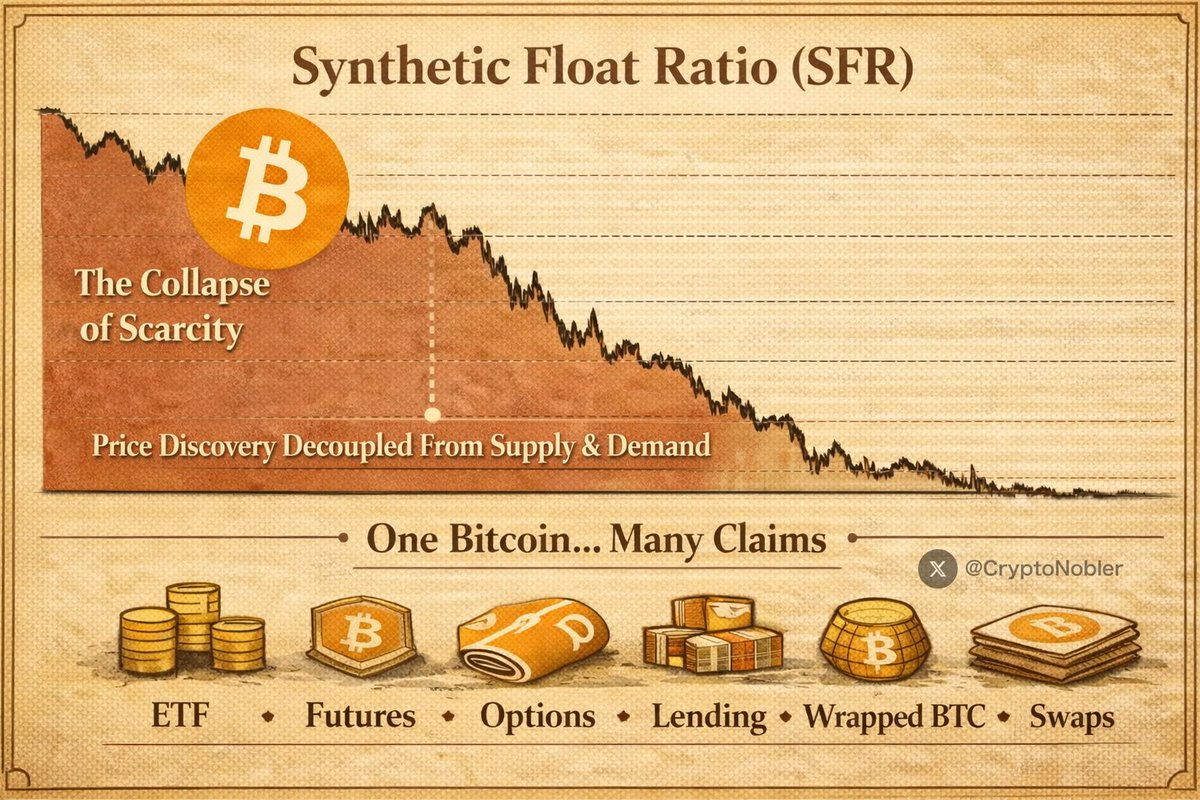
Synthetic Float Ratio (SFR).
The metric that explains everything.
Once synthetic supply overwhelms real supply, price no longer responds to demand.
It responds to positioning, hedging, and liquidation flows.
Wall Street can now trade against Bitcoin.
They’re not guessing direction.
They’re doing what they do in every derivatives-dominated market:
1⃣ Create unlimited paper BTC
2⃣ Short into rallies
3⃣ Force liquidations
4⃣ Cover lower
5⃣ Repeat
This isn’t “betting.”
It’s inventory manufacturing.
One real BTC can now simultaneously back:
→ An ETF share
→ A futures contract
→ A perpetual swap
→ An options delta
→ A broker loan
→ A structured note
All at THE SAME TIME.
That’s six claims on one coin.
That is not a free market.
That is a fractional-reserve price system wearing a Bitcoin mask.
Ignore it if you want, but don’t pretend you weren’t warned.
I’ve been calling Bitcoin tops and bottoms for over a decade now, and I’ll do it again in 2026.
Follow and turn on notifications before it's too late.
There have recently been some discussions on the ongoing role of L2s in the Ethereum ecosystem, especially in the face of two facts:
* L2s' progress to stage 2 (and, secondarily, on interop) has been far slower and more difficult than originally expected
* L1 itself is scaling, fees are very low, and gaslimits are projected to increase greatly in 2026
Both of these facts, for their own separate reasons, mean that the original vision of L2s and their role in Ethereum no longer makes sense, and we need a new path.
First, let us recap the original vision. Ethereum needs to scale. The definition of "Ethereum scaling" is the existence of large quantities of block space that is backed by the full faith and credit of Ethereum - that is, block space where, if you do things (including with ETH) inside that block space, your activities are guaranteed to be valid, uncensored, unreverted, untouched, as long as Ethereum itself functions. If you create a 10000 TPS EVM where its connection to L1 is mediated by a multisig bridge, then you are not scaling Ethereum.
This vision no longer makes sense. L1 does not need L2s to be "branded shards", because L1 is itself scaling. And L2s are not able or willing to satisfy the properties that a true "branded shard" would require. I've even seen at least one explicitly saying that they may never want to go beyond stage 1, not just for technical reasons around ZK-EVM safety, but also because their customers' regulatory needs require them to have ultimate control. This may be doing the right thing for your customers. But it should be obvious that if you are doing this, then you are not "scaling Ethereum" in the sense meant by the rollup-centric roadmap. But that's fine! it's fine because Ethereum itself is now scaling directly on L1, with large planned increases to its gas limit this year and the years ahead.
We should stop thinking about L2s as literally being "branded shards" of Ethereum, with the social status and responsibilities that this entails. Instead, we can think of L2s as being a full spectrum, which includes both chains backed by the full faith and credit of Ethereum with various unique properties (eg. not just EVM), as well as a whole array of options at different levels of connection to Ethereum, that each person (or bot) is free to care about or not care about depending on their needs.
What would I do today if I were an L2?
* Identify a value add other than "scaling". Examples: (i) non-EVM specialized features/VMs around privacy, (ii) efficiency specialized around a particular application, (iii) truly extreme levels of scaling that even a greatly expanded L1 will not do, (iv) a totally different design for non-financial applications, eg. social, identity, AI, (v) ultra-low-latency and other sequencing properties, (vi) maybe built-in oracles or decentralized dispute resolution or other "non-computationally-verifiable" features
* Be stage 1 at the minimum (otherwise you really are just a separate L1 with a bridge, and you should just call yourself that) if you're doing things with ETH or other ethereum-issued assets
* Support maximum interoperability with Ethereum, though this will differ for each one (eg. what if you're not EVM, or even not financial?)
From Ethereum's side, over the past few months I've become more convinced of the value of the native rollup precompile, particuarly once we have enshrined ZK-EVM proofs that we need anyway to scale L1. This is a precompile that verifies a ZK-EVM proof, and it's "part of Ethereum", so (i) it auto-upgrades along with Ethereum, and (ii) if the precompile has a bug, Ethereum will hard-fork to fix the bug.
The native rollup precompile would make full, security-council-free, EVM verification accessible. We should spend much more time working out how to design it in such a way that if your L2 is "EVM plus other stuff", then the native rollup precompile would verify the EVM, and you only have to bring your own prover for the "other stuff" (eg. Stylus). This might involve a canonical way of exposing a lookup table between contract call inputs and outputs, and letting you provide your own values to the lookup table (that you would prove separately).
This would make it easy to have safe, strong, trustless interoperability with Ethereum. It also enables synchronous composability (see: https://t.co/9jy6v1X6Fw and https://t.co/gZmu3YjebM ). And from there, it's each L2's choice exactly what they want to build. Don't just "extend L1", figure out something new to add.
This of course means that some will add things that are trust-dependent, or backdoored, or otherwise insecure; this is unavoidable in a permissionless ecosystem where developers have freedom. Our job should make to make it clear to users what guarantees they have, and to build up the strongest Ethereum that we can.
Helen Toner (@hlntnr), former OpenAI board member, is finally going on record about firing Sam Altman:
😱 “He gave us inaccurate information about the small number of formal safety processes that the company did have in place.”
😱 “When ChatGPT came out, the board was not informed in advance about that. We learned about ChatGPT on Twitter.”
😱 “Sam didn't inform the board that he owned the OpenAI startup fund.”
My two cents:
This was inexcusable behavior on Sam's part, the old board was right to fire him, and the new board should fire him again.
Seems like everyone wants to know more about how large language models work, but existing explainers often:
-Are too shallow or too technical
-Focus on how LLMs predict the next word, which is only part of the story
So we wrote 3 explainers of our own! 🧵
https://t.co/s7C8Ml7WZl