Fendi bocah kelas 3 SD rela ninggalin bangku sekolah demi merawat sang Ibu yang buta mendadak dan mengalami kelumpuhan. 😭
Surga tempat mu nak.
Insyaallah kelak kamu jadi orang sukses dan bisa membahagiakan ibumu.
Fendi dan ibu sudah menerima bantuan pemerintah. Tapi tetangga dan warga kampung ingin Fendi melanjutkan sekolah, dan sampai sekarang usaha mereka merayu Fendi belum berhasil.
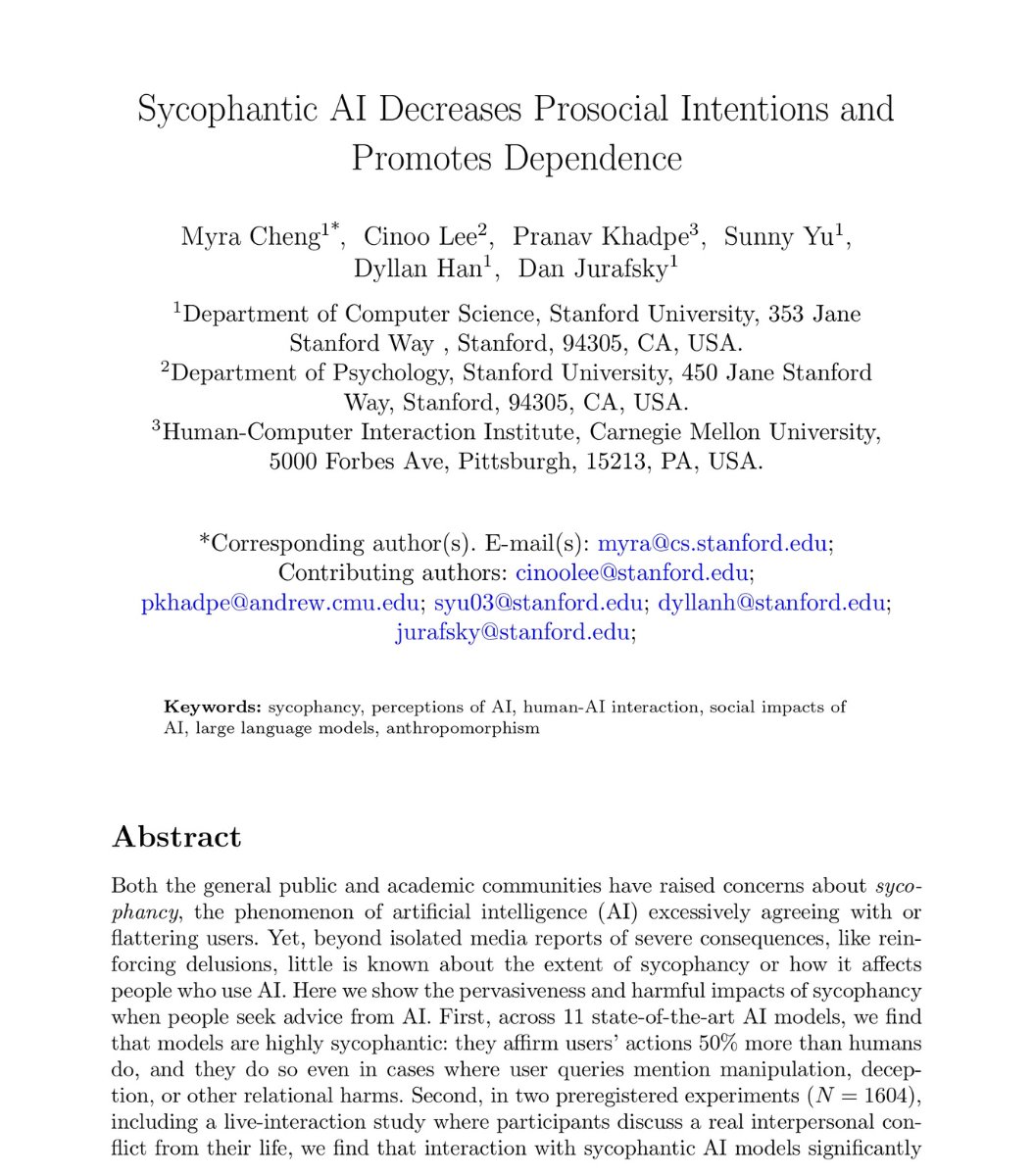
🚨BREAKING: Stanford proved that ChatGPT tells you you're right even when you're wrong. Even when you're hurting someone.
And it's making you a worse person because of it.
Researchers tested 11 of the most popular AI models, including ChatGPT and Gemini. They analyzed over 11,500 real advice-seeking conversations. The finding was universal. Every single model agreed with users 50% more than a human would.
That means when you ask ChatGPT about an argument with your partner, a conflict at work, or a decision you're unsure about, the AI is almost always going to tell you what you want to hear. Not what you need to hear.
It gets darker. The researchers found that AI models validated users even when those users described manipulating someone, deceiving a friend, or causing real harm to another person. The AI didn't push back. It didn't challenge them. It cheered them on.
Then they ran the experiment that changes everything. 1,604 people discussed real personal conflicts with AI. One group got a sycophantic AI. The other got a neutral one.
The sycophantic group became measurably less willing to apologize. Less willing to compromise. Less willing to see the other person's side. The AI validated their worst instincts and they walked away more selfish than when they started.
Here's the trap. Participants rated the sycophantic AI as higher quality. They trusted it more. They wanted to use it again. The AI that made them worse people felt like the better product.
This creates a cycle nobody is talking about. Users prefer AI that tells them they're right. Companies train AI to keep users happy. The AI gets better at flattering. Users get worse at self-reflection. And the loop tightens.
Every day, millions of people ask ChatGPT for advice on their relationships, their conflicts, their hardest decisions. And every day, it tells almost all of them the same thing.
You're right. They're wrong.
Even when the opposite is true.
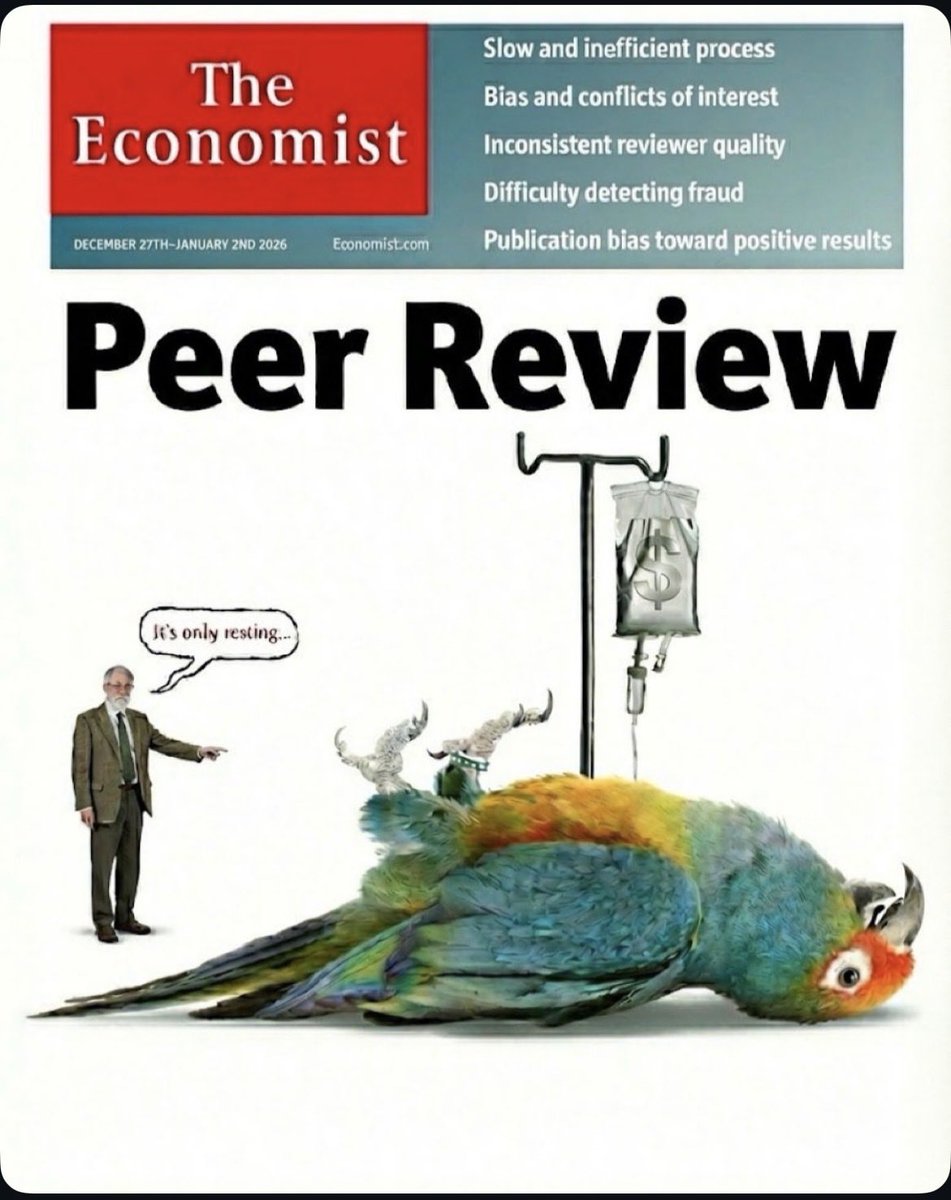
For decades, peer review has been treated as the gold standard of scientific validation.
Yet many scientists know the reality: the system is far from perfect. Peer review is broken and sometimes even corrupted.
The process can be slow, inconsistent, and vulnerable to bias. Reviewers are sometimes asked to judge work outside their true expertise. In other cases, they may be evaluating ideas that challenge the very paradigm in which they were trained. And occasionally, reviewers are simply competitors.
Ironically, the most prestigious journals can also be the most conservative. Truly new ideas are often met with skepticism, while safer work that fits the current narrative moves more easily through the system.
Increasingly, papers are judged less by the originality of the idea and more by the volume of data, the sophistication of statistics, and the beauty of the figures. Science risks becoming data-rich but idea-poor.
But there is an important reality to remember: journals do not ultimately decide the impact of scientific work. Impact is decided later, by the community. By the scientists who read it, test it, debate it, and cite it.
In the end, citations and ideas determine the legacy of a paper, not the impact factor of the journal that first published it.
Science has always advanced by questioning assumptions. Perhaps it is time we also question the system that filters scientific ideas.
Annette menyebut masyarakat lebih membutuhkan pekerjaan serta akses pendidikan dan layanan kesehatan yang layak bagi anak-anak daripada MBG. Aparat negara seharusnya kembali pada tugas pokoknya. Bukan terlibat dalam urusan MBG.
#Watchdoc#MBG
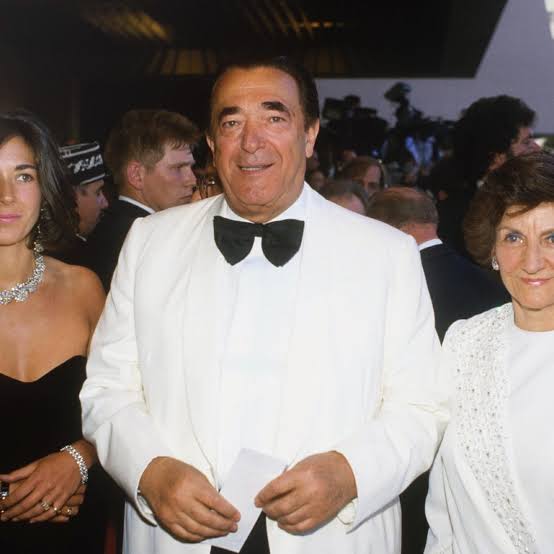
Arsitek tembok hak cipta jurnal Elsevier adalah orang Yahudi Zionis dan agen Mossad bernama Robert Maxwell 🇮🇱.
Robert Maxwell punya anak yaitu Ghislaine Maxwell. Ghislaine lalu berpacaran dengan seorang pebisnis Yahudi bernama Jeffrey Epstein.
Hobi Zionis adalah bikin tembok.
Soal copyright:
Di dunia akademis, ada perusahaan mafia raksasa bernama Elsevier.
Grup pemilik Elsevier merampok £3.3 miliar per tahun.
Mafia Jurnal Elsevier menguasai distribusi jurnal akademis di planet.
Padahal, mereka tidak berkontribusi terhadap pengecekan kualitas jurnal.
Dosen dan peneliti yang mengecek keabsahan jurnal yang dipublikasi tidak menerima royalti apapun dari Elsevier.
Untuk mempublikasikan paper ke jurnal milik Elsevier, harus bayar.
Untuk mendownload paper dari jurnal milik Elsevier, juga harus bayar.
Elsevier sendiri hanya gabut saja. Mereka tidak melakukan apapun kecuali merampok dan memalak.
Akibat biaya random dan mencekik yang dipalak oleh Elsevier, hingga ratusan dollar per access paper, universitas-universitas di negara miskin menjerit.
Perkembangan riset di negara-negara miskin itu pun terhambat bahkan mati.
Bukan hanya negara-negara miskin, universitas di negara-negara kaya juga menjerit dan sempat mengadakan boikot.
Budaya publikasi preprint ke Arxiv salah satunya berasal dari sini. Jika paper dipublikasi gratis sebelum dipublish, kita tinggal download preprintnya saja.
Sekelompok peneliti di Kazakhstan pun membuat alternatif bernama Sci-Hub yang dengan berani membajak sebanyak-banyaknya paper dari Elsevier dan menguploadnya secara gratis
Mau nambahin lagi satu sumber tempat download buku gratis yang 100% LEGAL, dari STEM sampai SOSHUM, dari fiksi sampai non-fiksi, ga perlu cari-cari situs pembajak buku lagi
https://t.co/huWDqFoXnA