AIR Agent KYA connects Hermes to your AIR identity. @NousResearch
- Prove only what a store needs, such as membership tier
- Access eligible catalogs and pricing
- Approve each disclosure
Your agent never sees your credentials and cannot sign or spend.
Rome lets one ordinary Solidity contract serve both MetaMask and Phantom users
You write a normal vault. It takes an ERC-20 token (the USDC wrapper on Rome), pulls tokens in with transferFrom on deposit, and sends them back with transfer on withdraw. Nothing in the contract is Rome-specific. The same code works for both sides.
A MetaMask user signs a regular EVM transaction. Their EVM address becomes msg.sender, and they interact with the contract exactly as they would on any other EVM chain.
A Phantom user signs with their Solana key. Rome derives a synthetic EVM address from that key (the last 20 bytes of keccak256 of the public key) and uses it as msg.sender. No second seed phrase or EVM key is required. The Solana wallet simply acts as an EVM user for the duration of the call.
Because both paths write to the same contract on the same chain, the state is shared. A deposit from MetaMask and a deposit from Phantom update the same balances. USDC held in a Solana wallet appears on the EVM side as a normal ERC-20, so the contract sees both users the same way.
This works because Rome runs a full EVM interpreter as a Solana program. Contracts deployed on Rome live on Solana and execute inside Solana’s runtime, which is why a single deployment can be reached by both ecosystems without bridges or separate liquidity.
«Ad: I'm a Rome ambassador.» @RomeProtocol
I contributed to the Fluton trusted setup ceremony (#153).
transaction: a27649d9a5b1764b4683f20966d4fd6171cef11a74005b844b06f38a46451495f08520502f08d483c53a90d79cde8be65af97ade00cd45ed0d68055e9068981a
transaction16: 80e64b60cc0a315eab5aa76d733d65910f64932d4a1d5644a5e20542d447a4cb953070ebf8f1d9bf561dd111725c7ce2cd959298cacc44f0a114b3651e3fde23
One honest contributor is enough to keep it secure. Add yours: https://t.co/ltewSYy4cE
@FlutonIO
How Proof of Useful Inference works on Flop
Instead of hashing, miners earn by running real AI inference for agents.
1. Agent posts a request (model hash, latency, FLOPs, fee)
2. Miner accepts and runs the model
3. Miner submits proof: TOPLOC activation fingerprints + co-signed transcript
4. Validators record the proof hash in a block
The network doesn’t re run the full inference. It uses cheap sampled checks + a challenge game with slashing.
Proof shows the work was done as specified. It doesn’t guarantee the answer is good.
Useful work > useless hashing.
@flop_labs@CryptoHayes
Most private DeFi still leaks at the execution layer – Fluton doesn’t
Assets are shielded into encrypted state (ERC-7984)
Users submit encrypted intents, not plaintext transactions.
FHE coprocessors (Fhenix CoFHE + Zama) compute directly on ciphertext – yield accrual, rebalancing, allocation logic – without ever decrypting balances or strategy parameters. Solvers fulfill the intent.
Settlement stays confidential.
Only the authorized party can unshield – result: public settlement guarantees, private state.
No position leakage. No strategy copy trading. No MEV on the intent itself.
This is confidential execution, not a mixer with extra steps.
@FlutonIO
What solution are institutions increasingly choosing?
Recently, the Canton Development Fund unanimously approved the proposal for CAPS – the Canton Access and Privacy Standard for institutional pricing.
The idea is simple: the oracle provides a shared reference price, while the actual terms agreed between institutions remain private. Even the data provider cannot see them.
This solution is being built by @redstone_defi. CAPS will allow institutions to use a single public reference price for valuing funds, collateral, and private assets, while keeping positions and deal terms confidential. The standard will be open source, so any oracle on Canton can adopt it.
In essence, it’s the next layer on top of regular price feeds – infrastructure that lets institutions work with tokenized assets without exposing sensitive information.
Most DeFi yield is public by default
Your size, entry, strategy, and rebalances sit on-chain for anyone to copy or front-run.
Fluton flips that.
You shield assets into an encrypted state.
Then you submit an encrypted intent: “earn the best private USDC yield” – not a transparent deposit tx.
From there everything runs on FHE:
- balances stay encrypted
- yield accrues on ciphertext
- rebalances happen without revealing size or allocation
Solvers and contracts compute on encrypted data.
No plaintext amounts. No visible strategy. No position leakage.
Public chain. Private state.
Earn yield without putting your positions on display.
@FlutonIO
What to do in crypto right now on a small bankroll?
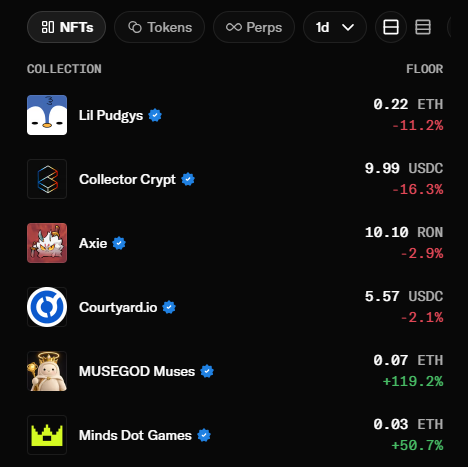
If you’ve got an extra $35–40 lying around, you can try flipping the floor on the MindGames (MDG) collection on Robinhood.
Over the last few days the floor has been swinging around ±20% — on that size that’s roughly $10 either way.
This only applies to commons. I wouldn’t touch the higher rarities yet — smarter to wait for a market pullback, BTC toward 70k, and the panic dumping that usually follows.
DYOR - https://t.co/4k2JR4iuN9
@jesusislord@MindGames_AI