Excited to share a major update from Hapta.
Our five finger wearable tactile sensing glove for human data collection is now being prototyped.
Designed to be worn by human operators during real world manipulation tasks, the glove captures detailed contact, pressure, and finger level interaction signals. We expect to have the first sample ready next week.
We are also working toward production in the near future, with the goal of being in the first wave of teams collecting wearable human tactile data at scale.
More importantly, we will not stop at data collection.
We plan to synchronize and label tactile signals alongside human actions, contact events, finger movements, and object interactions. This data will be used to train contact-aware models that better understand when, where, and how robots interact with the physical world.
Robots should not only see the world.
They should be able to feel it.
One of the biggest shifts in robotics is that pre-training is becoming less of the bottleneck.
General-purpose VLA models can already understand objects, language, and long-horizon tasks surprisingly well.
The hard part now begins after pre-training.
Real-world deployment exposes everything the model doesn't know: contact dynamics, latency, calibration drift, embodiment-specific behavior, edge cases, and recovery after failure.
These are not problems that disappear by scaling internet data.
They are learned through interaction.
That also changes what high-quality robotics data means.
The most valuable trajectory is not necessarily a successful demonstration. It is the one that changes the policy.
A failed grasp followed by a successful recovery may contribute more learning signal than ten perfect pick-and-place episodes.
The future data engine won't simply collect more hours.
It will identify uncertainty, capture interventions, preserve recovery trajectories, and continuously convert deployment into post-training data.
That's how we think about Hapta.
The goal isn't to build another dataset.
It's to build the learning infrastructure between physical deployment and model improvement.
Everyone keeps asking me what high-quality robotics data actually means.
I think we’ve been asking the wrong question.
People often describe high-quality data as clean demonstrations, more hours, or more robot platforms. Those things matter, but they don’t tell you whether the data will actually improve a model.
A successful trajectory only tells you what worked. It rarely explains why it worked, what almost went wrong, what the policy struggled with, or how it recovered when things failed.
The most valuable data isn’t the cleanest. It’s the data that reveals a model’s weaknesses.
Good robotics data preserves the entire context of an interaction. What the robot saw. What it sensed. What action it took. What happened next. Every modality needs to stay synchronized, otherwise the learning signal quietly disappears.
I also don’t think an episode should be treated as one long sequence. Real-world tasks have progress, hesitation, mistakes, corrections, and recovery. Those transitions contain far more information than another perfect pick-and-place.
The goal shouldn’t be collecting more data.
The goal should be collecting data that changes model behavior.
That’s how I think about high-quality robotics data.
Robot data quality is becoming one of the most important bottlenecks in robotics.
Here are a few principles we believe more teams should think about.
More hours do not always mean a better dataset
Repeated demonstrations in the same environment can quickly become redundant. Object diversity, scene diversity, task variation, and edge case coverage often matter more than another hundred nearly identical episodes.
Diversity needs to be useful
More operators, robots, and environments can improve generalization, but uncontrolled variation can also introduce inconsistent behaviors and noisy action distributions.
The goal is not maximum diversity.
The goal is meaningful and well structured diversity.
Perfect demonstrations are not enough
Robots also need to learn from failures, human corrections, interventions, and recovery behavior.
A clean demonstration shows what success looks like.
A recovery trajectory shows the robot what to do when the world does not go according to plan.
Failed episodes should not automatically be discarded
A single rollout may contain useful progress, an action that causes failure, and a successful recovery.
Evaluating data only at the episode level can throw away some of the most valuable learning signals.
Vision cannot capture every important interaction
For contact rich manipulation, information about force, touch, compliance, friction, and object deformation may be just as important as RGB video.
High quality robotics data is not simply clean video or a large number of hours.
It is synchronized, diverse, task relevant, physically meaningful, and structured around what the robot actually needs to learn.
At @HaptaLabs, we provide high quality real world robotics data for training and improving robot policies.
We work across manipulation, egocentric data, multimodal sensing, tactile interaction, failure cases, corrections, and recovery behavior.
Better robots will require better data.
That is exactly what we are building.
More sensors do not automatically make a robot smarter.
What matters is whether the robot has the right sensor at the right stage of the task.
Before contact, vision usually does most of the work: locating the object, estimating pose, and planning an approach.
After contact, the information changes. During gripping, pushing, insertion, turning, or tool use, haptic signals can reveal things cameras often miss:
• Is the object slipping?
• Is the tool actually engaged?
• Is the surface deforming?
• Is the robot applying too much force?
• Did the action fail even though it looked correct?
This suggests a useful way to think about robot data:
Don’t just collect more modalities. Collect the moments when each modality becomes informative.
The most valuable episodes may be the ones that clearly show contact, force change, failure, adjustment, and recovery.
At @haptalabs , we’re exploring how haptic and other physical signals can be turned into structured training data that is reusable across tasks and robots.
Vision helps a robot understand the scene.
Haptic feedback helps it understand the interaction.
A robot can recognize an object without truly understanding how it will behave.
Vision may tell a robot that something is a cup, a towel, or a piece of fruit. But successful manipulation often depends on properties that are difficult to infer from appearance alone:
Is it slippery?
Is it soft or rigid?
Is it wet?
Is it hot?
Will it deform, tear, or break?
How much force is safe?
This is why touch is becoming increasingly important in robot learning.
Tactile and force signals can reveal whether contact has been made, whether an object is beginning to slip, how pressure is distributed, and how a material responds when squeezed. These signals give robots access to physical information that cameras often miss.
But touch is only one part of the picture.
Humans also use temperature, vibration, sound, proprioception, and resistance to understand objects during interaction.
Temperature and heat transfer can provide clues about material.
Vibration can reveal texture, contact transitions, or tool performance.
Sound can indicate whether an object is hollow, cracked, full, or incorrectly assembled.
Proprioception and motor feedback help estimate weight, resistance, and unexpected forces.
Together, these signals create something closer to physical intuition.
The goal is not simply to give robots more sensors. It is to help models learn the relationship between appearance, contact, material properties, and action outcomes.
Humans can often look at an object and predict how it will feel because vision has been trained by years of physical interaction.
Robots may need the same kind of learning process.
Vision tells a robot what an object looks like.
Touch, force, temperature, vibration, and sound reveal how it behaves.
The next generation of manipulation models may need both.
I really liked how Prof. C. Karen Liu framed the evolving role of models in robotics:
Models as data engines.
Models as flywheels.
Models as ecosystems.
This is more than a conceptual framework. Recent open-source work is beginning to make each part technically concrete.
A model as a data engine does not only learn from a fixed dataset. It can predict the consequences of different actions, generate targeted experience, evaluate possible outcomes, and expose parts of the state space that the original demonstrations did not cover.
This matters especially in manipulation. Most failures are not evenly distributed across a trajectory. They often concentrate around contact transitions, grasp establishment, articulated motion, recovery, and other moments where small action errors create very different outcomes.
Recent world-model research is therefore moving beyond visually plausible video generation. Robotic World Model trains a dynamics model alongside a policy and performs policy optimization inside the learned environment. PlayWorld learns an action-conditioned simulator through autonomous robot play, then uses it for failure prediction, policy evaluation, and reinforcement learning. RISE separates future prediction from progress evaluation, allowing imagined rollouts to produce useful policy updates without repeatedly running expensive physical trials.
This leads naturally to models as flywheels.
A policy creates new experience. The model identifies failures, uncertain states, and missing coverage. Those observations guide the next round of training or data collection. The updated policy then returns to the environment and reveals a new set of limitations.
The difficult part is not simply generating more trajectories.
A useful flywheel must distinguish between visually convincing experience and physically trustworthy experience. It needs to handle contact, long-horizon error accumulation, uncertainty, embodiment differences, and the possibility that a policy learns to exploit inaccuracies in the world model.
The third idea, models as ecosystems, reflects how robot intelligence is already being built.
We now have open models and systems for VLA policies, learned dynamics, simulation, planning, evaluation, and low-level control. OpenVLA provides an open training and fine-tuning stack for generalist manipulation, while GR00T provides an open cross-embodiment VLA model for generalized robot skills. A recent survey organizes world models across policy learning, planning, simulation, evaluation, and data generation, rather than treating them as one monolithic architecture.
The future may therefore be less about finding one model that replaces every component, and more about understanding how specialized models interact across the perception and action loop.
Which model should generate experience?
Which model should evaluate it?
When should imagined data be trusted?
And when is real-world interaction still necessary?
Prof. Liu’s framework gives a useful way to organize these questions. It shifts the conversation from simply scaling model size toward building systems that can generate experience, improve iteratively, and combine complementary capabilities.
A very important direction for robot learning, and one we are following closely at @haptalabs.
@StanfordAILab@StanfordHAI
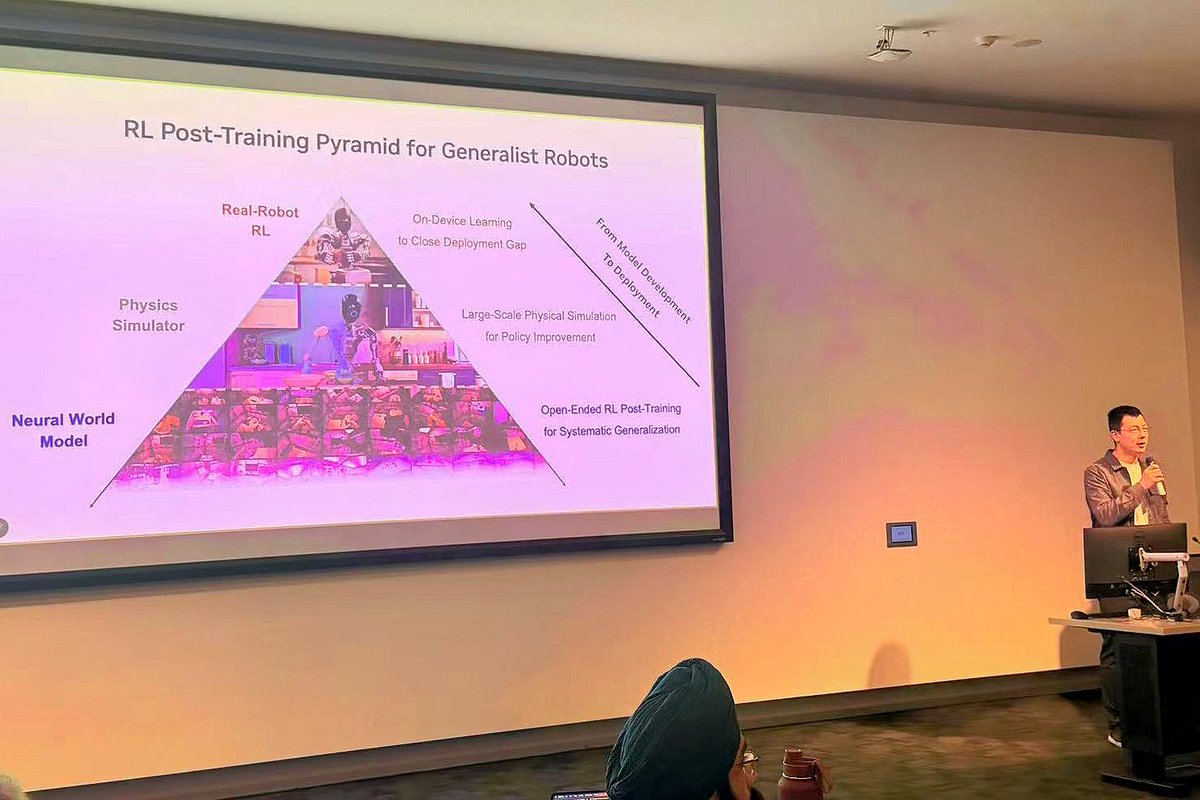
One thing I really appreciated from @yukez ’s talk was how clearly he framed the systems problem behind RL post training for generalist robots.
The framework is a pyramid. Neural world models provide open ended experience for systematic generalization. Large scale physics simulation improves the policy before deployment. Real robot RL and on device learning are then used selectively to close the remaining deployment gap.
This is fundamentally different from LLM post training. Robot experience is not cheap, infinitely scalable tokens. Every rollout requires hardware time, resets, human supervision, and a real safety budget. Relying mainly on real world RL would be far too sample inefficient and expensive.
Recent open research on world models, simulation, synthetic trajectories, and robot foundation models makes this direction especially exciting. The field is increasingly converging on a layered learning loop: learn reusable dynamics from real data, improve and evaluate policies in simulation and learned worlds, then spend scarce real robot interaction only where it creates the most value.
I think this is one of the most important problems in robotics right now. The next breakthrough may not come from simply scaling a larger policy, but from building the post training framework that allows generalist robots to keep improving after pretraining. Really excited to see Yuke put such a clear structure around this idea.
Met with many incredible investors this week. We’re planning to close this round by the end of the month.@haptalabs
Still open to strategic investors and co-investors, happy to connect and chat. 🚀
Great to see Physical Intelligence pushing further in this direction at RSS 2026.
π*0.6 + RECAP shows a strong shift in how robot learning systems are being built.
Traditional robot policies are usually trained on a fixed dataset, then deployed into environments that inevitably expose new failures, edge cases, and tasks that were missing from the original training distribution.
RECAP turns deployment into a continuous learning loop. Autonomous rollouts, failures, reward signals, and human interventions are collected and used to improve the VLA policy over time.
The important shift is that deployment is no longer just where the model is used. It becomes where the next generation of high-value training data is created.
This is closely connected to what we’re building at @haptalabs , but we’re focused on the next transfer problem: how to take experience collected from one task, environment, or robot and make it useful for another.
Instead of treating every robot as a separate data island, we’re building a robot data engine and transfer model that separates reusable task and interaction structure from embodiment-specific control.
The goal is simple: collect once, improve continuously, and transfer across robots.
RECAP asks: how can one robot keep learning from deployment?
At Hapta, we’re also asking: how can one robot’s experience help the next robot learn faster?
Fun catching @pulkitology’s RSS keynote today. I really like the way he framed the gap between today’s ML robots and generally useful robots.
Industrial robots are optimized for throughput: they are fast, reliable, and repeatable, but only within narrowly defined tasks and environments.
Learning-based robots move in the opposite direction. They are more general and flexible across tasks, objects, and environments, but they often sacrifice speed and reliability. A robot that can attempt many tasks but only succeeds inconsistently is still difficult to deploy in everyday life.
The real goal is not just generalization. It is generalization together with high throughput.
Pulkit breaks the missing intelligence into two parts: force intelligence and interactive intelligence.
Force intelligence means that robots should not simply imitate recorded trajectories. Humans rarely execute manipulation open-loop. We make an approximate movement, feel contact, detect resistance or slippage, and continuously correct the action. For robots, force and tactile feedback should be part of the policy itself, not just an extra sensor added after training.
Interactive intelligence addresses another limitation of offline imitation learning. A static dataset can improve a policy, but performance eventually saturates because the dataset cannot cover every failure, contact condition, object variation, or environmental change.
To move beyond that ceiling, the robot has to interact with the real world, identify where the current policy fails, collect new experience from those interactions, and use that experience to improve the next policy.
This creates a continuous loop:
deployment → interaction → failure discovery → new data → policy improvement → deployment
That is a very different system from simply collecting a large dataset once and training a model once.
The path to generally useful robots may therefore depend less on a single larger policy and more on building robots that can feel, interact, and continuously learn from deployment.
A trend across several recent open-source robotics projects has really caught my attention.
The next stage of robot data collection may not be about making teleoperation cheaper. It may be about redesigning why people want to keep collecting data in the first place.
RoboCade turns teleoperation into a game with progress bars, leaderboards, sound effects, and rewards to encourage participation. What’s interesting is that demonstrations collected by first-time users aren’t just usable. When combined with conventional datasets, they also improve performance on real manipulation tasks.
At the same time, TWIST2 compresses full-body humanoid data collection into a portable VR setup, eliminating the need for expensive motion capture systems while collecting around 100 demonstrations in about 15 minutes.
Projects like Phone2Act, U-ARM, and TeleDex are moving in the same direction. Smartphones, low-cost wearables, and consumer VR are gradually replacing dedicated teleoperation workstations.
Looking across these projects, I’m starting to think the real scaling unit for robotics data isn’t robot hours. It’s operator participation.
We’ve spent years optimizing how many demonstrations a single operator can collect per hour.
The more interesting question now is whether a system can enable people from completely different backgrounds to become productive operators within minutes, keep them engaged, and consistently produce training-quality data.
That shifts robot data collection from a hardware problem to a systems problem involving hardware, interaction design, quality control, and incentive design.
The largest robotics data platform in the future may not be the one with the most robots. It may be the one with the lowest barrier to participation, the strongest contributor retention, and the most effective quality filtering.
I’m curious which direction people believe will scale better: making professional operators more efficient, or turning teleoperation into a large-scale participatory data network.
Lately I’ve been thinking about a very practical question in cross-robot learning:
When you switch to a different robot, how much value from the old data actually survives?
A humanoid hand, a parallel gripper, and a tool end-effector move in completely different ways. Different kinematics, different sensors, different control systems.
So I don’t really believe the answer to transfer is just forcing every robot into the same action space.
But they still operate in the same physical world. How objects move, what happens after contact, and the steps involved in completing a task shouldn’t become useless every time the hardware changes.
The hard part is figuring out:
what is tied to a specific robot, and what can still be useful after changing the body?
A lot of the cost in robot learning today comes from repeating the same cold start.
Change the arm, the hand, or the mobile base, and suddenly you’re collecting new data, tuning again, and retraining again.
So instead of only asking how many more hours of data we can collect, I keep coming back to this:
Can what one robot learned help the next robot start a little less from zero?
I don’t think the field has a clean answer yet.
But if the answer is yes, robotics data stops being a one-time delivery. It becomes more valuable as more robots enter the system.
That’s a big part of what we’re building toward at @HaptaLabs.
Robot data is scaling fast. But collecting more hours is only part of the problem.
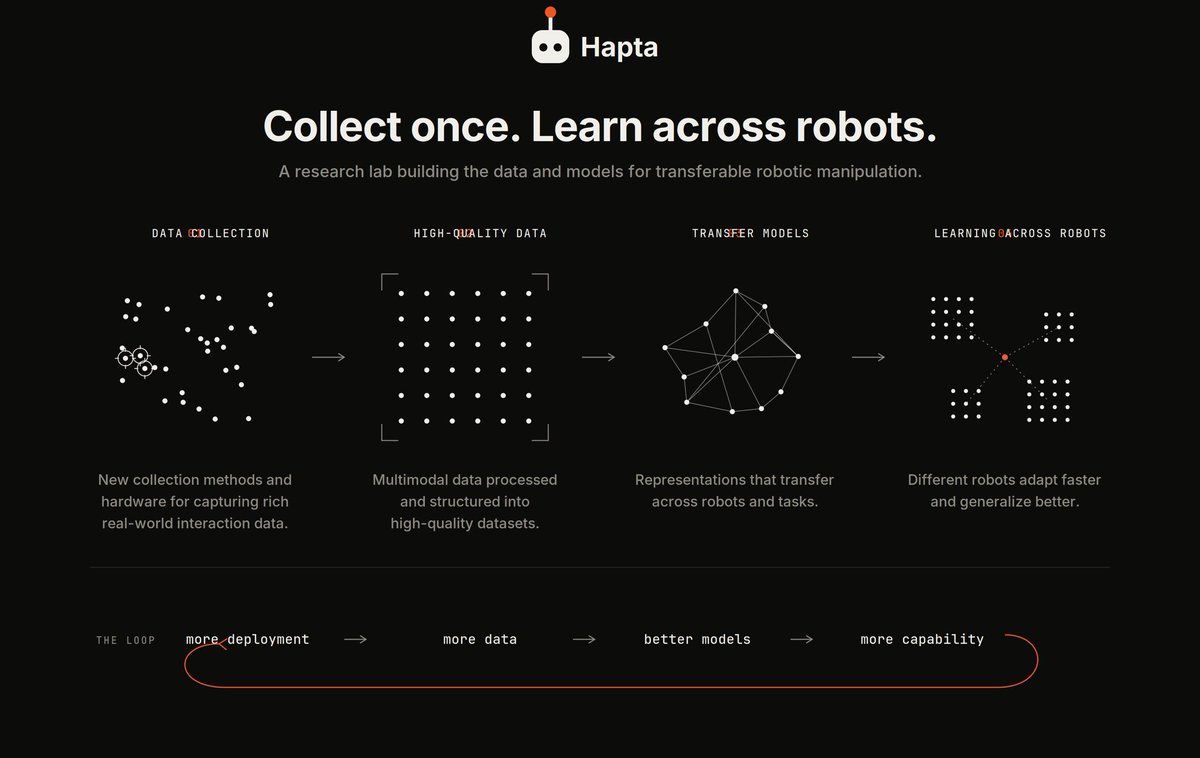
At Hapta, we’re building across the full stack: new ways to collect real-world robot data, the infrastructure to deliver it at scale, and models that can learn across robots and tasks.
Today, robot data is often collected for one platform and one task at a time. We think that will change.
The question we care about is simple: can data collected for one robot make the next robot easier to train?
Better collection gives us better data. Better data helps us build models that transfer across robots and tasks.
Over time, the loop gets stronger:
more deployments → more data → better models → more value
That’s what we’re building at Hapta.
Collect once. Learn across robots.
Hapta Labs is heading to Sydney for RSS 2026 🇦🇺
Our team will be attending the conference and giving several talks throughout the week. We’ll also be sharing highlights and insights from the talks here on X.
If you’re attending RSS, let’s grab coffee in Sydney ☕️ Drop a comment below!
Contact does not always deform surfaces, especially when interacting with liquids and soft objects. However, most existing tactile sensors rely on surface deformation to infer contact.
Excited to share LightTact, a visual-tactile fingertip sensor that makes contact directly visible. It provides:
- Deformation-Independent Sensing: contact is detected optically, not inferred from surface deformation.
- High-Contrast Raw Images: non-contact pixels stay near-black.
- Pixel-Level Contact Segmentation: robust across materials, forces, appearances, and external lighting conditions.
This project was co-led with Boda (https://t.co/LknVoGsVYi). Grateful to all co-authors for their contributions, and many thanks to @yxyang1995 for the insightful discussions.
We will present LightTact at RSS 2026 in Sydney next week!
Paper: https://t.co/YX3bf9H4Vd
Open-source: https://t.co/67NTIXOuJO
Manipulation happens through surfaces. To understand contact-rich dexterous interaction, motion alone is not enough. We also need to know surface properties and contact state.
Excited to share ART-Glove, an articulated tactile glove that captures contact-grounded information while preserving human dexterity. It provides:
- Known Geometry: 16 rigid functional surfaces
- Surface Motion: 22 anatomically aligned joints
- Tactile Contact: 2048 piezoresistive taxels
Huge thanks to my advisor Ding @zhao__ding, and to Yuxiang @yxyang1995, Maria @bauzavillalonga, Marissa, and Peide @peide_huang for the valuable advice and discussions.
Paper: https://t.co/xSYCyqHrZf