Continuous Physics Reasoning is not theoretical.
This week, a single engineer at a tier-1 semiconductor company used Vinci’s physics foundation model to analyze hundreds of thermal what-if scenarios.
Setup in less than a min compared to hours.
Runtime compressed in hour compared to days.
Already shipped. Real impact.
@AnneliesGamble@VinciPhysics This is the key distinction.
Making simulation easier to run is not enough.
The real problem is making the system work e2e: geometry, materials, boundary conditions, convergence, validation, executable without lowering the accuracy bar.
If you only find thermal issues after production, your workflow already failed.
Using Vinci, they ran 19,000 simulations and found the issue in 5 days, likely avoiding a costly re-spin.
That is not faster simulation.
It is continuous physics intelligence becoming infrastructure–– physics available through out the design process.
Yesterday, we spoke with a fabless company that described a 4–6 month thermal discovery cycle collapsing into 5 days.
They’re building a 3DIC part and hit a complex thermal issue that historically would not show up until physical production.
By then, the cost was time: 4–6 months.
With Vinci, they ran 19,000 simulations and found the issue in 5 days.
That is the shift: physics moving from late-stage discovery to early-stage design intelligence.
We’ve normalized making engineering decisions without physics in the room.
That should bother us.
Not because engineers are careless—because the workflow made it unavoidable. Physics has been too slow, too specialized, too expensive.
So teams design around scarcity:
-simplify early
-add margin
-wait for simulation
-validate late
-discover risk downstream
The real cost isn’t runtime. It’s timing—leading to respins and delayed programs.
A foundation model for physics changes this.
Physical reasoning moves into the cadence of design itself. And once physics is always available, the default flips: every design decision becomes a physics decision.
That’s the shift.
Thank you, @vkhosla for backing this since day zero.
Most engineers have never had access to real physical reasoning.
Simulation breaks at a modern scale.
Vinci is already running in production at leading HW companies.
Deterministic. Manufacturing resolution. Zero shot.
Physics infrastructure to design and operate all parts.
Every major AI shift started with a new kind of world model.
Language. Vision. Code.
The next one is physics.
@saucentoss and I published a paper today defining what a real foundation model for physics has to be and why it enables Continuous Physics Reasoning.
If AI is going to help build the physical world, the bar has to be much higher.
Link to full paper: https://t.co/koNrDxrQPU
We wrote this paper to create clarity:
What qualifies as a real foundation model for physics?
What does not?
What becomes possible when physical reasoning scales?
https://t.co/bMb4E0H66q
Semiconductors are the proving ground.
If a model can reason across nanometer-scale structures, advanced packaging, HBM, thermals, warpage, and chips-to-systems constraints without losing determinism or fidelity, that is a meaningful bar.
The hardest domains should come first.
Traditional simulation was built around intermittent expert workflows.
Set up the case.
Mesh the geometry.
Tune the solver.
Wait.
Interpret.
Repeat.
That worked when physical analysis could stay episodic.
It breaks when complexity, scale, and iteration volume all increase at once.
This is the shift we call Continuous Physics Reasoning.
Physical reasoning stops being something you invoke occasionally.
It becomes continuously available across architecture, design, validation, manufacturing, and operations.
Not a checkpoint. An always-on intelligence layer.
Why now?
Because the next bottleneck is not generating text faster.
It is reasoning through physical constraints fast enough to matter.
Chips. Packaging. Power. Thermals. Manufacturing. Data centers. Energy systems.
The systems that matter now are constrained by physics.
A real foundation model for physics cannot just produce plausible outputs.
It has to be:
deterministic
repeatable
solver-grade accurate
geometry-native
manufacturing-resolution
general across new systems
useful out of the box
In engineering, “looks right” is not a category.
Full paper here-
https://t.co/koNrDxrQPU]
@VinciPhysics enabled users to perform 30K simulations in production.
Scale isn’t a benchmark. It’s the constraint a foundation model for physics has to survive.
No fine-tuning, one foundation model for physics for everyone in industry.
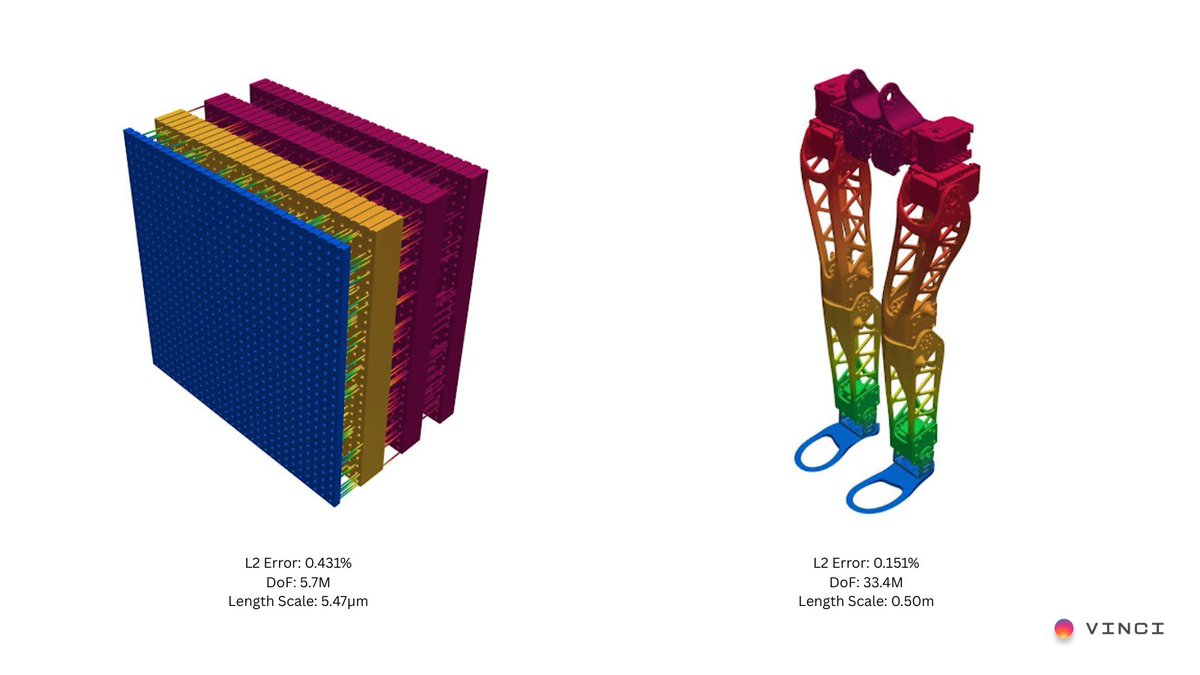
Yesterday, Vinci ran ~30,000 simulations across scales from nanometers to meters.
Left: ~5 µm
Right: ~0.5 m
Same system. Same execution.
The requirement doesn’t change:
- deterministic
- FEA solver-accurate
- manufacturing-resolution
- zero-shot (no per-case setup or tuning)
Most approaches break here. They simplify the geometry, constrain the problem, or retrain per domain.
That doesn’t generalize.
If you can’t scale, you don’t have a foundation model.
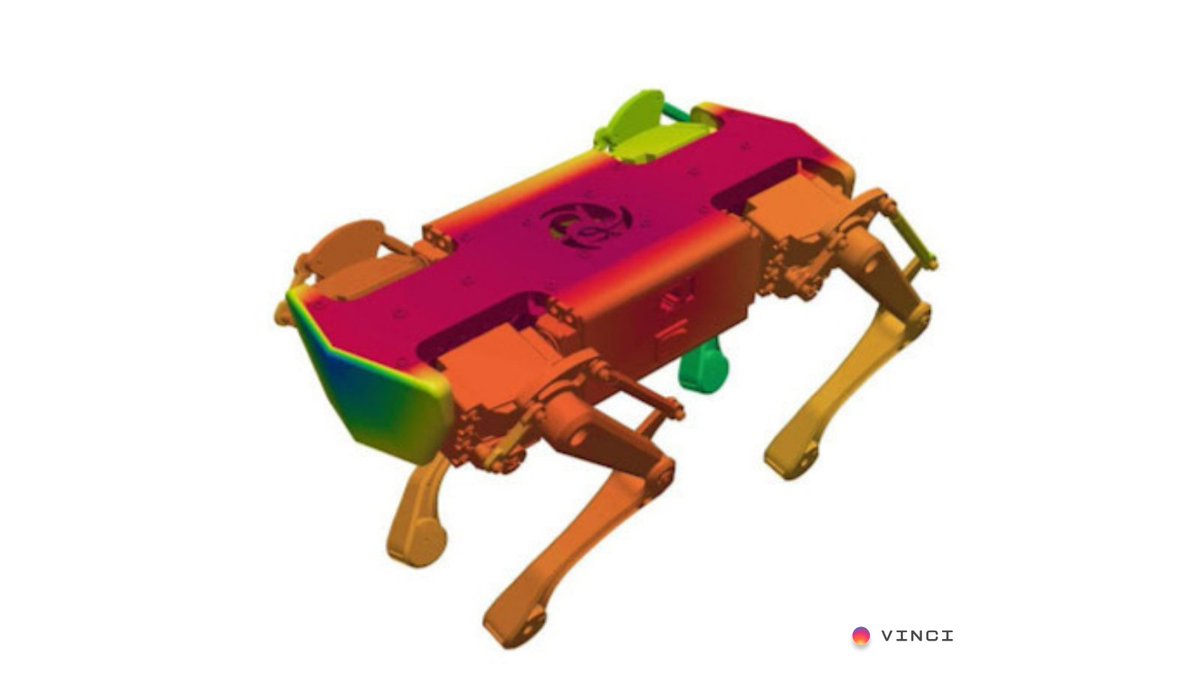
Same model working out-of-the-box across all types of parts, physical scales and industry be it semiconductor or robotics.
End to end automation. 33M degrees of freedom problem solved in 20 seconds of inference.
No fine tuning, no customization.
Continuous physics intelligence.
We started where physics is hardest.
First: advanced memory packaging.
Thermals, density, stack complexity.
Then: CPUs.
Full-system power maps, matching experimental data.
Then: foundry workflows.
Detailed package/RDL runs in seconds. No manual meshing.
Now: mechanical systems.
Different domain. Same requirement:
- deterministic
- FEA solver-accurate
- manufacturing-resolution
- zero-shot (no per-case setup or tuning)
This is how a foundation model for physics gets built:
start with the hardest constraints, validate under real engineering conditions, then expand outward.
Honored Vinci won the ISIG Startup Competition.
The real signal from ISIG: the hardest problems in AI infrastructure are now physical.
Power. Cooling. Heat. Manufacturability.
The last wave of AI worked on words.
The next great intelligence will help build matter.
That's what we are shipping at https://t.co/PCiYIi6mhr
@tbpn@EclipseVentures This is right. The enduring companies are usually the ones solving constraints the market cannot simply work around. The physics problems we are working on at Vinci are not edge cases they sit at the core of how modern hardware gets designed, built, and trusted.
.@AnneliesGamble has been a backer of Vinci since day 0 and has one of the most rigorous takes I’ve seen on AI for physics.
Getting reliable behavior in engineering environments is hard. But that is also what makes the opportunity to build enduring simulation infrastructure so compelling.
𝗘𝗻𝗴𝗶𝗻𝗲𝗲𝗿𝗶𝗻𝗴 𝘀𝗶𝗺𝘂𝗹𝗮𝘁𝗶𝗼𝗻 𝗔𝗜 𝗶𝘀 𝗽𝗿𝗼𝗯𝗮𝗯𝗹𝘆 𝗻𝗼𝘁 𝗼𝗻𝗲 𝗺𝗼𝗱𝗲𝗹 𝘁𝗵𝗮𝘁 “𝗱𝗼𝗲𝘀 𝗽𝗵𝘆𝘀𝗶𝗰𝘀.”
At least in the near term, the opportunity looks narrower, and perhaps more interesting:
– start in 𝗰𝗼𝗻𝘀𝘁𝗿𝗮𝗶𝗻𝗲𝗱 𝗱𝗼𝗺𝗮𝗶𝗻𝘀 𝘄𝗵𝗲𝗿𝗲 𝘃𝗮𝗹𝗶𝗱𝗮𝘁𝗶𝗼𝗻 𝗶𝘀 𝗽𝗼𝘀𝘀𝗶𝗯𝗹𝗲
– 𝗿𝗲𝗱𝘂𝗰𝗲 𝗽𝗿𝗲-𝘀𝗼𝗹𝘃𝗲 / 𝘀𝗲𝘁𝘂𝗽 𝘁𝗶𝗺𝗲, not just solve time
– use 𝗔𝗜 𝗳𝗼𝗿 𝘀𝘂𝗿𝗿𝗼𝗴𝗮𝘁𝗲 𝗺𝗼𝗱𝗲𝗹𝘀, 𝘀𝗼𝗹𝘃𝗲𝗿 𝗮𝗰𝗰𝗲𝗹𝗲𝗿𝗮𝘁𝗶𝗼𝗻, 𝘂𝗻𝗰𝗲𝗿𝘁𝗮𝗶𝗻𝘁𝘆 𝗮𝗻𝗮𝗹𝘆𝘀𝗶𝘀, 𝗮𝗻𝗱 𝗲𝘅𝗽𝗲𝗿𝗶𝗺𝗲𝗻𝘁 𝗽𝗹𝗮𝗻𝗻𝗶𝗻𝗴
– 𝗲𝘅𝗽𝗮𝗻𝗱 𝗳𝗿𝗼𝗺 𝗮 𝘄𝗲𝗱𝗴𝗲 (𝗹𝗶𝗸𝗲 𝘁𝗵𝗲𝗿𝗺𝗮𝗹) 𝗶𝗻𝘁𝗼 𝗮 𝗯𝗿𝗼𝗮𝗱𝗲𝗿 𝗽𝗵𝘆𝘀𝗶𝗰𝘀 𝗶𝗻𝘁𝗲𝗹𝗹𝗶𝗴𝗲𝗻𝗰𝗲 𝗹𝗮𝘆𝗲𝗿 over time
This week I wrote Part 2 of the piece I published last week to focus on 𝘄𝗵𝗲𝗿𝗲 𝘁𝗵𝗲 𝗻𝗲𝗮𝗿-𝘁𝗲𝗿𝗺 𝗼𝗽𝗽𝗼𝗿𝘁𝘂𝗻𝗶𝘁𝗶𝗲𝘀 𝗮𝗿𝗲, and 𝗵𝗼𝘄 𝘁𝗼 𝗮𝗰𝘁𝘂𝗮𝗹𝗹𝘆 𝗺𝗼𝘃𝗲 𝘁𝗵𝗲𝘀𝗲 𝗺𝗲𝘁𝗵𝗼𝗱𝘀 𝗶𝗻𝘁𝗼 𝘁𝗵𝗲 𝗵𝗮𝗻𝗱𝘀 𝗼𝗳 𝗲𝗻𝗴𝗶𝗻𝗲𝗲𝗿𝘀.
𝗜 𝗮𝗹𝘀𝗼 𝗰𝗼𝗿𝗿𝗲𝗰𝘁 𝗮 𝗳𝗲𝘄 𝘁𝗵𝗶𝗻𝗴𝘀 𝗜 𝗴𝗼𝘁 𝘄𝗿𝗼𝗻𝗴 𝗶𝗻 𝗣𝗮𝗿𝘁 𝟭, especially around generalization, chaos, irregular geometry, and why trust / workflow embedding matter so much.
Part 1 is here: https://t.co/n7ZwWTMWFs
I had a lot of help thinking through the ideas in this piece. Special thanks to Hardik Kabaria, John Bruggeman, Matthew Tamayo, and Tuhin Sahai, among others.
AI will generate more hardware designs.
Physics will determine what ships.
We’ve now extended Vinci from thermal to full thermo-mechanical simulation (stress + warpage) at manufacturing resolution.
Already benchmarked across real semiconductor workflows — from HBM and advanced packaging to fabless and PCB environments.
Deterministic run after run.
Deploys without per-customer tuning or custom code.
The foundation model now extends across coupled thermo-mechanical behavior.
As hardware design accelerates, validation can’t remain human-bounded.
Physics has to become infrastructure.
That’s the layer we’re building.
More details: https://t.co/PCiYIi6mhr
Press release: https://t.co/4UhZd8zlPV