99% of traders fail because they keep searching for the next setup.
The top 1% get rich by mastering one setup.
You don't need 20 indicators.
You don't need 100 scanners.
You don't need to trade every day.
You need one repeatable edge executed with discipline.
This setup has appeared in some of the biggest market winners for decades.
Study it.
Backtest it.
Wait patiently.
Attack only when everything aligns.
The market doesn't reward people who know the most.
It rewards people who execute the best.
Master one setup.
Master your emotions.
Master your risk.
Everything else becomes easier.
📈 Price is God.
📊 Volume is Power.
🛡️ Risk Management is the Holy Grail.
If you're serious about becoming a consistently profitable trader, follow @ChartMantra_ for institutional-quality price action, stage analysis, and momentum investing.
❤️ Bookmark this.
🔄 Repost it.
💬 Tell me: What's the ONE setup you trust the most?
The day I stopped trying to predict the market was the day my trading improved.
Mark Douglas taught that successful trading isn’t about being right.
It’s about managing risk, thinking in probabilities, and executing your edge without fear.
One of the biggest lessons from studying thousands of winning #stocks is this:
Stock selection solves a lot of trading problems before the trade even starts. 👇
Most traders spend enormous amounts of time trying to improve their entries. They focus on finding the perfect pivot, the perfect stop, or the perfect risk-reward ratio.
I understand why.
Entries feel important.
But when I review my biggest winners over the last two decades, I rarely think about the entry first.
I think about the stock.
Was it a leading stock?
Did it have exceptional sales or EPS growth?
Was it part of a powerful theme?
Was institutional money clearly accumulating shares?
Was Relative Strength already telling me something important?
The best stocks make trading easier.
Not easy.
But easier.
When you own a true leader, pullbacks are easier to sit through. Conviction is higher. The stock often gives you multiple opportunities to manage the position correctly.
Average stocks do the opposite.
They constantly force you to make difficult decisions because the quality simply isn't there.
That's why I spend much more time looking for exceptional stocks than looking for trades.
In my experience, many traders could improve dramatically by doing one thing:
Take fewer trades.
Become much more selective.
Reject more opportunities.
The market gives us thousands of stocks.
Our job is not to trade many of them.
Our job is to find the few that can make a meaningful difference.
Most traders are looking for cheap stocks.
I look for strong stocks. 🚀📈
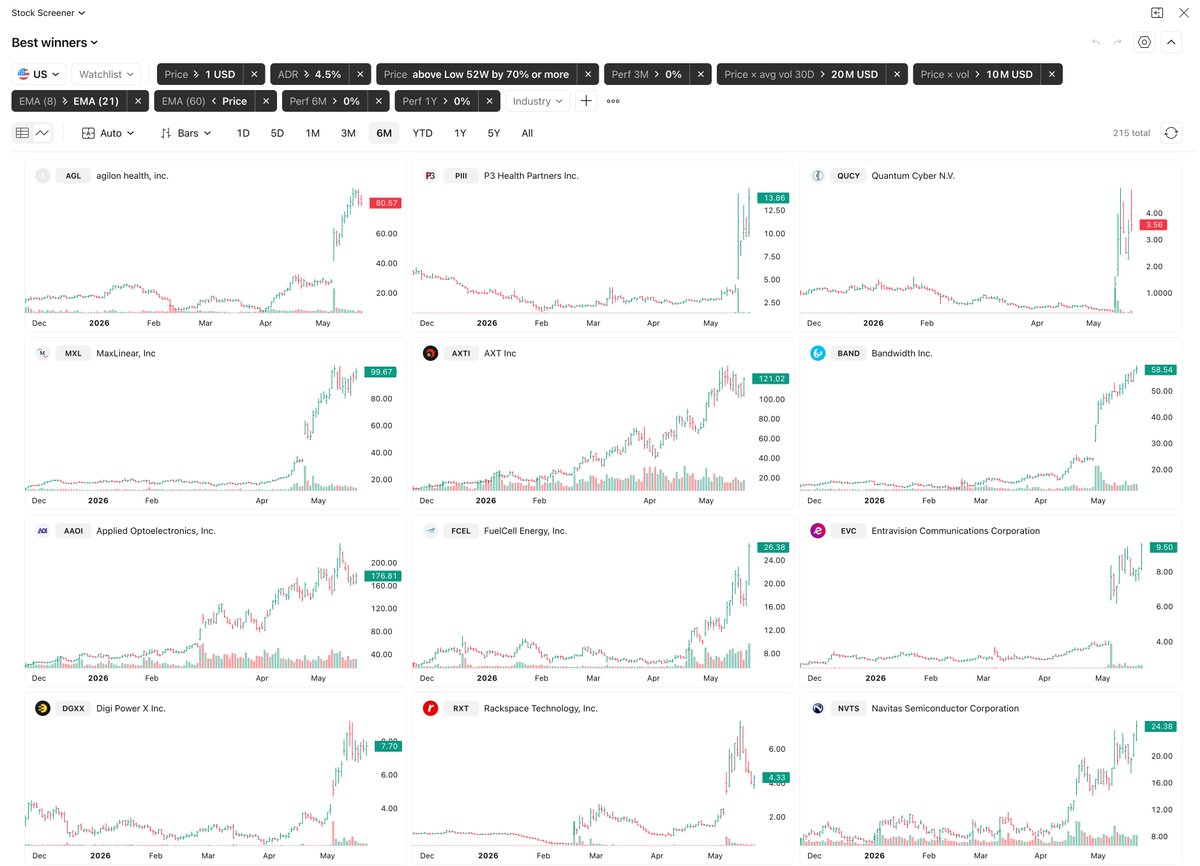
Every single one of my biggest winners came from this free screener.
Not because the screener finds winners.
Because it finds stocks with the characteristics of past winners.
Here’s what I look for 👇
1. Massive Relative Strength: The stock should already be outperforming the market. Strong stocks tend to get stronger.
2. Clear Uptrend: EMA8 above EMA21 and both moving higher. I want institutions already pushing the stock higher.
3. Fast Movers: ADR% above 4.5. Big winners rarely move 1% per day.
4. Huge momentum: At least 70% above the 52-week low. Most monster winners start from positions of strength.
5. Consistent Performance: Positive performance over the last 3 months, 6 months, and 12 months. I want proven leadership.
6. Liquid Stocks: Enough volume to allow institutions to build meaningful positions.
The screener is only the first step.
Now the real work begins:
• Study the chart
• Research the story
• Look for accumulation
• Wait for a tight setup
• Buy only when the risk/reward is attractive
The goal is not to buy every stock in the screener.
The goal is to find the next exceptional winner.
📎 Free Screener for TradingView: https://t.co/FfuBt33xQb
These patterns repeat.
I've taught this process to thousands of traders.
You can learn it too.
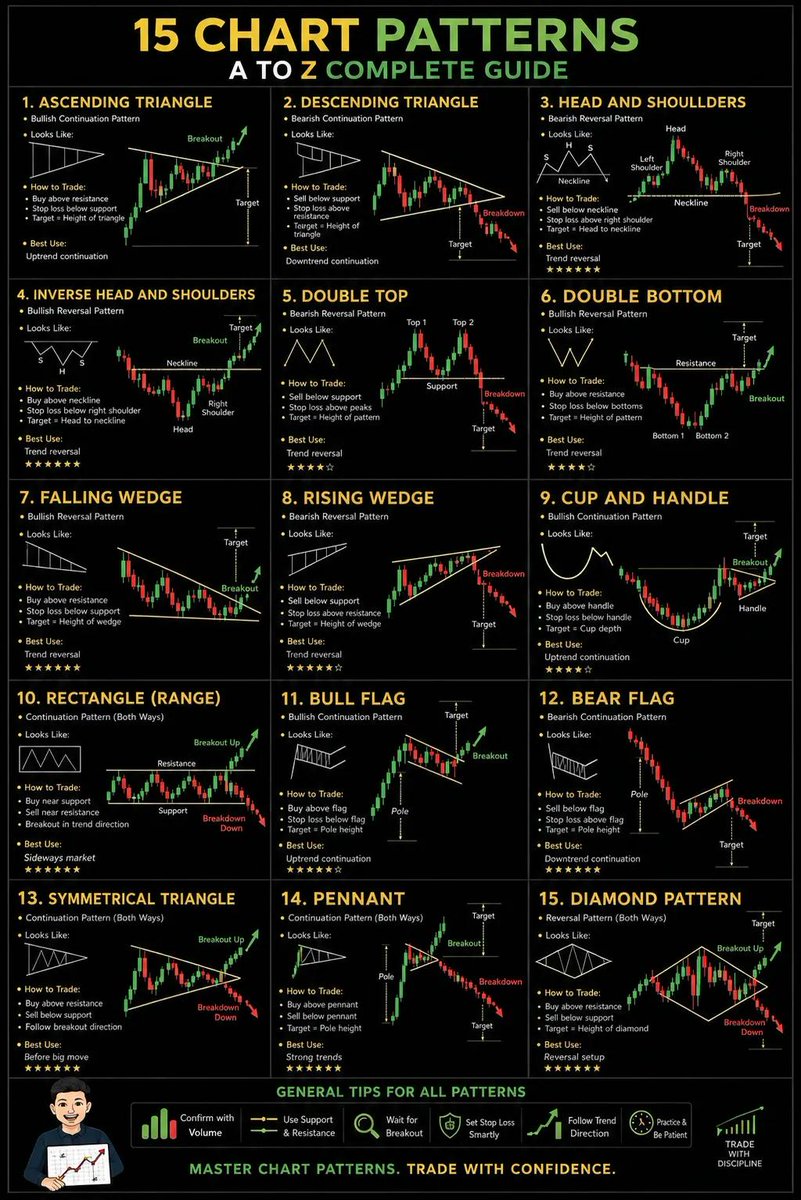
William O'Neil spent 50 years studying the market's biggest winners
— the stocks that ran 100%, 500%, even 1,000%.
Almost all of them launched from just 8 chart patterns.
And amateurs get shaken out of every one, right before the move.
Here's how pros read them —
and stop leaving that money on the table ↓
🚨 My Market Trend Model just switched to RED.
NASDAQ is my elite index.
When it turns red, I pay attention.
Most traders react by trading more.
I do the opposite.
Here is what I do:
1. Reduce my trading frequency dramatically.
2. Stop looking for average setups.
3. Wait for exceptional opportunities only.
4. Spend more time preparing than trading.
5. Let the market prove itself again.
My statistics are very clear:
Trading during red market conditions is a losing game over time.
You may catch a winner here and there.
But if you continue trading aggressively while the market is red, the odds are working against you.
That's why I don't feel any pressure to trade right now.
It takes my Market Trend Model about 18 days on average to switch from red back to green.
Until then, patience becomes a position.
Some of the biggest drawdowns I avoided during my career came from respecting these signals.
The goal is not to trade every day.
The goal is to protect capital so you're ready when conditions improve.
No predictions.
No opinions.
No hero trades.
Just process.
Let the trend tell you what to do.
David Ryan won the US Investing Championship 3 years in a row.
No insider edge.
No prediction magic.
Just leaders, timing, pyramiding, and brutal discipline.
Here are 8 lessons from how he traded. 🧵
COMPLETE SWING TRADING STRATEGY (BEGINNER → PRO)
Timeframe: 4H (4 Hour)
Tickers: $TSLA $AAPL $META $MIRM $HIMS:
INDICATORS USED
•200 EMA – Main trend direction
•20 EMA – Pullback & entry timing
•RSI (14) – Momentum confirmation
TREND IDENTIFICATION
•Uptrend: Price above 200 EMA
•Downtrend: Price below 200 EMA
•No Trade Zone: Price moving sideways around 200 EMA
RULES FOR BUY ENTRY
1.Price must be ABOVE 200 EMA (uptrend confirmed)
2.Wait for a pullback to 20 EMA
3.Look for a bullish rejection candle at 20 EMA:
•Pin Bar
•Bullish Engulfing
4.RSI must be ABOVE 50
5.Entry on candle close after confirmation
RULES FOR SELL ENTRY
1.Price must be BELOW 200 EMA (downtrend confirmed)
2.Wait for a pullback to 20 EMA
3.Look for a bearish rejection candle at 20 EMA:
•Pin Bar
•Bearish Engulfing
4.RSI must be BELOW 50
5.Entry on candle close after confirmation
STOP LOSS & TAKE PROFIT
BUY TRADE
•Stop Loss: Below the pullback low
•Take Profit:
•TP1 = 1:2 Risk–Reward
•TP2 = Previous high / resistance
SELL TRADE
•Stop Loss: Above the pullback high
•Take Profit:
•TP1 = 1:2 Risk–Reward
•TP2 = Previous low / support
1. Market Structure
•Buy only Higher Highs & Higher Lows
•Sell only Lower Highs & Lower Lows
2. Avoid These Conditions
•❌ Trading during major news (NFP, CPI, FOMC)
•❌ Trading when price is too far from 20 EMA
•❌ Overtrading (max 1–2 trades per day)
3. Volume Confirmation (Optional but Powerful)
•Rising volume on rejection candle = strong entry
•Weak volume = skip the trade
4. Risk Management
•Risk 1–2% per trade
•Never move stop loss emotionally
•Consistency > Big wins
TRADER MINDSET
•Trading is waiting, not chasing
•No setup = no trade
•Protect capital first, profits come second
Most traders make stock screening way too complicated.
I use the same simple screener in TradingView every single day. That’s it.
Just a process that helps me find the strongest momentum stocks in the market. 🚀
And then the real work starts 👇
1. I look for extreme relative strength.
I want stocks already outperforming the market. The biggest winners rarely come from weak charts.
2. I look for tight patterns.
Bull flags, VCPs, tight consolidations near EMA8 or EMA21. Tight price action tells me institutions are holding shares.
3. I study the catalyst.
Why is the stock moving? Earnings? AI infrastructure? Semiconductors? Rare earth metals? Data centers? Big money needs a story.
4. I focus on high-potential stocks only.
I’m not interested in random low-volatility stocks moving 5%. I want stocks capable of making huge moves over weeks or months.
5. I wait for confirmation.
This part is important. Strong stocks alone are not enough. I wait for proper entries and clear breakout signals.
That’s the benefit of having a simple process.
You stop chasing random stocks.
You stop overcomplicating everything.
You start focusing only on what really matters.
The best traders I know are usually very simple in their execution.
They know exactly:
* what they trade
* why they trade it
* when they enter
* when they exit
And honestly, most traders already have too much information.
What they really need is a repeatable process they can trust.
📎 The screener I use is completely free: https://t.co/FfuBt33xQb
Learn to screen for strength.
Learn to recognize clean patterns.
Learn to understand catalysts.
These patterns repeat.
I’ve taught this to thousands of traders.
You can learn this too.
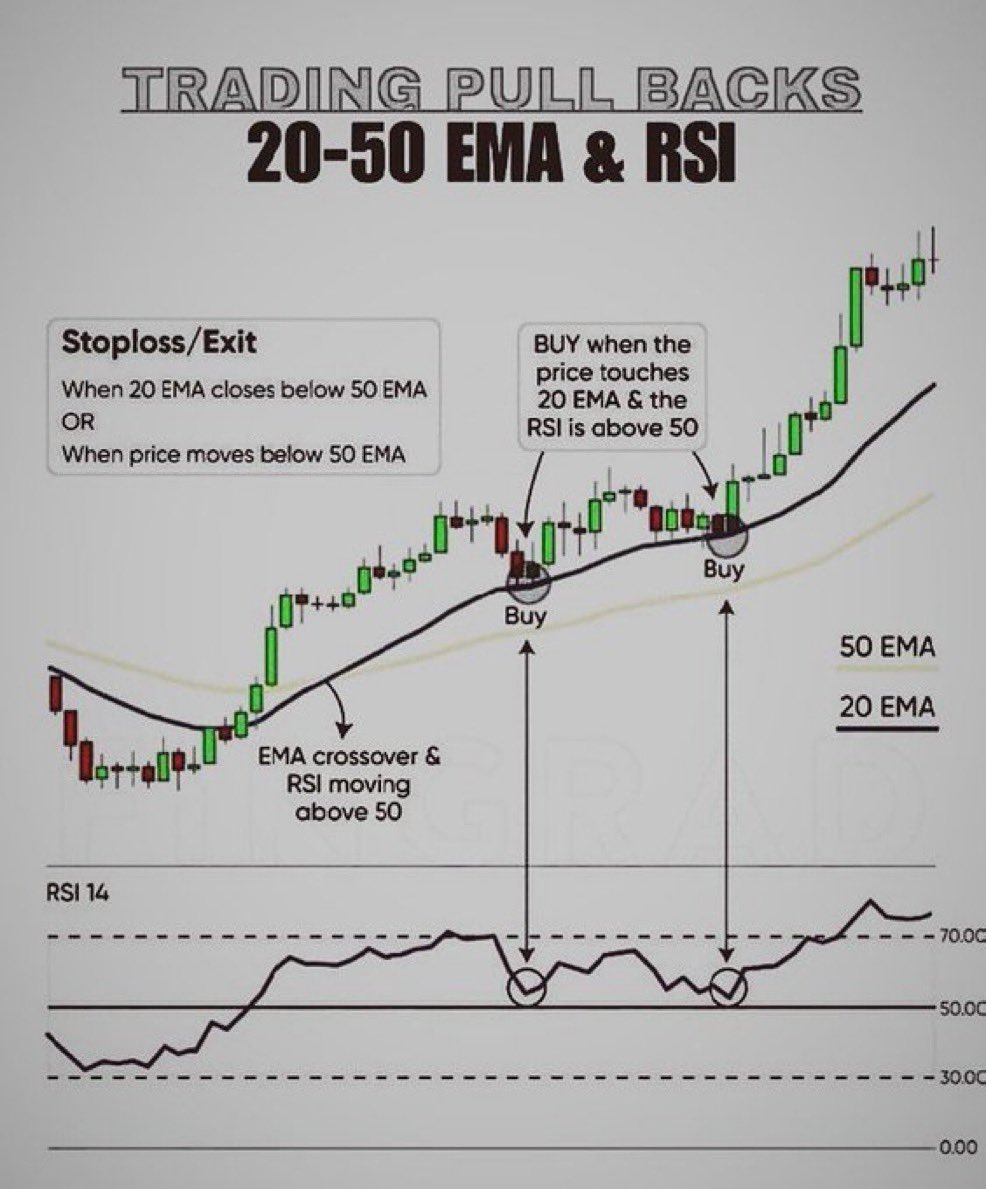
Entry Buy Rules:
Wait for the 20 EMA to cross above the 50 EMA.
Ensure RSI (14) is above 50.
Buy when the price touches the 20 EMA and RSI is still above 50.
Exit Stoploss Rules:
Exit if the 20 EMA crosses below the 50 EMA or if the price drops below the 50 EMA.
This strategy helps traders catch pullbacks in an uptrend with confirmation from the RSI.
#StockMarket