PesaLink has every ingredient to challenge M-Pesa.
every M-Pesa outage is a reminder that Kenya needs a serious alternative.
IPSL and KBA have the infrastructure, the interoperability and the institutions.
ship a standalone app, open the API and let the market decide.
AI psychosis is real.
You have a clanker generating a 10-page PRD since you don't love writing.
You can read all that to review, so you skim or ask another clanker to summarise and "find holes".
You then upload that PRD to an agentic clanker to plan the work, which you approve immediately because at this point you are too far off and too unskilled to know what's going on.
You tell yourself you are more productive because you generated 2k words in a PRD, 10k lines of boilerplate. You forget one important rule in software – ownership. You do not own any part of that, not the business, not the technical, nothing. Even on the business side, you asked your clanker to "roast" you, and that's the point where the idea stopped being yours.
In aviation, we have a concept called "falling behind the plane"; it is when, instead of telling the flight computers what to do, you are reacting to things. You hear "bank angle," you jump on it, "too low terrain" now you react to this... and so on. It is a very dangerous place to be. You need situation awareness. That is what being in an AI-induced psychosis feels like. You are not productive; you are just busy.
6 THINGS YOU MUST START DOING If You Want To Hear God Clearly
1. CREATE QUIET TIME DAILY
God's voice is often gentle, not loud. If your life is constantly filled with noise - phones, conversations, distractions - it becomes difficult to discern His leading. Intentionally create moments of silence where your heart can be still before Him.
📖 Psalm 46:10 - "Be still, and know that I am God."
📖 1 Kings 19:12 - "A still small voice..."
2. SPEND TIME IN GOD'S WORD CONSISTENTLY
God primarily speaks through His Word. The more you read and meditate on Scripture, the more familiar you become with His voice and His ways. Without the Word, it becomes easy to confuse your thoughts with His direction.
📖 Psalm 119:105 - "Your word is a lamp to my feet..."
📖 Hebrews 4:12 - "The word of God is living and powerful..."
3. DEVELOP A CONSISTENT PRAYER LIFE
Hearing God is connected to talking with Him. Prayer is not just about speaking - it's also about listening. When you build consistency in prayer, you become more sensitive to His voice.
📖 Jeremiah 33:3 - "Call to Me, and I will answer you..."
📖 1 Thessalonians 5:17 - "Pray without ceasing."
4. OBEY WHAT YOU ALREADY KNOW
Sometimes we ask God for direction while ignoring what He has already told us. Obedience sharpens your ability to hear Him. The more you act on His instructions, the clearer His voice becomes.
📖 James 1:22 - "Be doers of the word..."
📖 John 14:23 - "If anyone loves Me, he will keep My word..."
5. REMOVE DISTRACTIONS THAT COMPETE FOR YOUR ATTENTION
Too many voices can confuse your spirit. Social media, opinions, and constant noise can drown out God's voice. Be intentional about limiting what pulls your focus away from Him.
📖 Luke 10:41-42 - "You are worried and troubled about many things..."
📖 Hebrews 12:1 - "Lay aside every weight..."
6. BE SPIRITUALLY SENSITIVE AND DISCERNMENT-FOCUSED
God doesn't always speak in obvious ways. Sometimes He uses impressions, convictions, and that inner peace that confirms His direction. Learn to recognize how He speaks to you personally. 🗣️👂🏻
PRAYER
Father, quiet every noise in my heart and mind. Sharpen my ears to hear Your voice clearly and give me the courage to obey instantly. Remove every distraction and make me sensitive to Your Spirit today. In Jesus’ name, Amen.
This was shared by an Ex Yoga teacher .I hope it will enlightened someone
⚠️ YOGA IS DEMONIC ⚠️
As an ex-Yoga Teacher, I feel extra convicted to warn people about the spiritual ramifications of this occult practice. Yoga is NOT “just stretching”. Yoga is a spirtual practice first & foremost. Yoga literally means to “yoke to” the spirits behind yoga. Yoga was designed by ancient pagans to be used as an embodied form of spiritual worship to 33 million small “g” Hindu gods (aka: “demons”). Yoga is a gateway drug into hardcore witchcraft!
These are pics from my BC life as a yogini. Yoga was my whole world, my utter passion, before Jesus radically saved me in February 2021 & made me a new creation! Prior to that, for almost a decade, I was completely obsessed with my daily yoga & meditation practice. I spent 4 strait years living in a yoga ashram in France, qualified as a yoga teacher in Bali, taught classes & retreats all over the world.
I loved yoga! At the peek of my personal practice I would spend between 5 to 7 hours a day on the mat. I got to the point where I could enter such deep states of meditation that I could leave my body at will & astro-project all over the universe opening portals & communicating with unclean spirits. Once I levitated a foot off the floor (suspended by demons). I thought Yoga was my superpower & my salvation! It made me feel powerful & gave me a temporary bliss that I became extremely addicted to. But no matter how much yoga & meditation I did, I always needed more to feel balanced & to keep the anxiety & depression at bay. More was never enough. I swiftly graduated into deeper, darker spiritual narcotics.
As a direct result of doing yoga, I began to channel spirits & do energy work & chakra healing, which lead to divination, manifestation, & other forms of witchcraft. Before long, I had a Kundalini awakening (full demonic possession) & began operating in the serpentine spirit. I got into womb wisdom, sound healing, spiral dynamics & astrology, which ultimately lead me into goddess worship & satanic rituals. Within a year I became a fully demon-controlled blood witch. I used blood offerings & elemental magic to cast spells & manifest anything I wanted. I was activated by my spirit guides (galactic federation of light) as a psychic medium Starseed & I began speaking in demonic tongues (light-language) & opening portals (grid work).
When God pulled me out of the false-light deception of new age spirituality, Jesus opened my eyes to see the dark truth about yoga. I immediately repented for practicing witchcraft and renounced yoga permanently and God has delivered me from the many demons I got through practicing yoga for so many years.
Yoga is not only EXTREMELY spiritually dangerous for ANY human to be practicing in any capacity, but for those who claim to know the God of the Bible yoga is also a direct violation of the 1st & 2nd Commandments of our Lord. TRUE FOLLOWERS OF JESUS CHRIST CANNOT PRACTICE YOGA! Yoga is, by biblical definition, pure IDOLATRY & WITCHCRAFT !
Anyone (believer or unbeliever) who has ever practiced yoga needs to REPENT & RENOUNCE the Kundalini spirit (which comes in through yoga), and close that demonic door firmly shut for good!🚪
If you want to know more follow the links below & watch the ‘Dark Side of Yoga’ podcast episodes that myself and Angelamarie Scafidi & I recently recorded with our brother @demonerasors on Heaven & Healing Podctast.
PART ONE: https://t.co/fb526QLDOg
PART TWO: https://t.co/zpWAWbE9wm
In this detailed two-part podcast we FULLY breakdown exactly WHY and HOW yoga is an anti-Christ practice that opens participants up to demon possession. We expose the dark truth about yoga in FULL and explain how it is NOT and NEVER will be “just stretching”…
YOGA IS LITERALLY DEMONIC TO THE ROOT❗️Don’t believe me? Watch our podcast and we’ll prove it to you. 🙏🏽
May all who are blind see, May all who are bound be made free! In Jesus name! ❤️🔥🕊✝️
I learned an interesting fact the other day about Jesus’ lineage.
Some of you know this, but one of his ancestors was Ruth, the Moabite, and heroine of her own book.
What I had forgotten was this verse:
““No Ammonite or Moabite may enter the assembly of the Lord. Even to the tenth generation, none of them may enter the assembly of the Lord forever,”
Deuteronomy 23:3 ESV
NO Moabite could enter the assembly of the Lord? This harsh punishment was a result of Moab’s many sins against their cousin, Israel (sons of Lot and born of incest) when they tried to hire Balaam to curse the Hebrews, when they refused to help their cousins, when they invaded, and when their wicked religion butchered infants to their pagan gods.
So why was Ruth able to not only become Hebrew, but to be a proud member of the line of David, and later, Jesus?
“But Ruth said, “Do not urge me to leave you or to return from following you. For where you go I will go, and where you lodge I will lodge. Your people shall be my people, and your God my God.”
Ruth 1:16 ESV
Ruth the Moabite did more than pledge loyalty to Naomi; she rejected her culture, her gods, and her old life, choosing the true God instead. Ruth was not subject to the curse against Moab because she was penitent, humble, and a convert.
God punished the host who violently opposed him and embraced sin even when they knew a better way. Moab knew about God; Lot was a follower, but they chose wickedness instead. Yet God forgave anyone who abandoned wickedness and returned to Him.
More than just a love story; Ruth is a reminder that God forgives all who seek His face.
Junior PM: My manager keeps micromanaging me.
Senior PM: What are they trying to protect?
Junior PM: I think they just don't trust me.
Senior PM: Maybe. What do they know about your work?
Junior PM: I send updates.
Senior PM: Updates are not the same as judgment.
Junior PM: What do you mean?
Senior PM: Your manager spends a few hours a week thinking about your work. You spend all week inside it.
Junior PM: So they have less context.
Senior PM: Much less. Which means they either trust your judgment or compensate with control.
Junior PM: That sounds exactly like what's happening.
Senior PM: Then stop trying to "manage up."
Junior PM: What should I do instead?
Senior PM: Create leverage for both of you.
Junior PM: That sounds like a slogan.
Senior PM: Then make it concrete. When you bring a problem, what do you bring with it?
Junior PM: Context. Risks. Maybe options.
Senior PM: Bring a proposal.
Junior PM: Even if I'm not sure it's right?
Senior PM: Especially then. A bad proposal teaches your manager how you think. A naked problem gives them more work.
Junior PM: So I should lead with my recommendation.
Senior PM: Lead with the decision needed. Then the context. Then the details if they ask.
Junior PM: I usually start with all the background.
Senior PM: Most PMs do. They make their manager reconstruct the point from raw material.
Junior PM: And then wonder why the manager jumps in.
Senior PM: Exactly.
Junior PM: What about escalation? I never know when to pull them in.
Senior PM: Escalate when multiple teams are affected, critical metrics are at risk, political capital is needed, or the issue points to a system problem.
Junior PM: And if none of those are true?
Senior PM: Solve it. Document it. Inform them.
Junior PM: That feels risky.
Senior PM: Autonomy always feels risky before it feels earned.
Junior PM: How do I stop guessing what I own?
Senior PM: Write decision boundaries.
Junior PM: Like RACI?
Senior PM: Simpler.
Green: I decide and inform after.
Yellow: I decide after alignment.
Red: You decide, I propose.
Junior PM: And we agree on which decisions go where?
Senior PM: Yes. Then revisit quarterly.
Junior PM: So the goal is to expand green over time.
Senior PM: Now you're thinking.
Junior PM: What should I do in 1:1s?
Senior PM: Send a short brief the day before.
Junior PM: What's in it?
Senior PM: Topics, decisions needed, context they should know, questions you'll ask, and one progress update tied to outcomes.
Junior PM: That would make the meeting faster.
Senior PM: It makes the meeting useful.
Junior PM: I also struggle with technical updates. I explain the architecture and they glaze over.
Senior PM: Start with business impact.
Junior PM: Before the technical details?
Senior PM: Always. "This affects activation by 8%" lands faster than a system diagram.
Junior PM: So speak their language first.
Senior PM: Speak the language of the decision.
Junior PM: What questions should I ask them?
Senior PM: Ask what battles they're fighting that you don't see.
Junior PM: That's good.
Senior PM: Ask what would make their job easier. Ask what you're missing. Ask how your work connects to exec priorities.
Junior PM: Most PMs don't ask that.
Senior PM: Most PMs want their manager to be less involved without making the manager more confident.
Junior PM: That's the real issue.
Senior PM: Yes. Your manager manages risk. If you reduce the risk, you reduce the management.
Junior PM: So the more I help them succeed, the less they'll need to control me.
Senior PM: Not because you're being obedient. Because you're removing problems before they become theirs.
Junior PM: That changes the whole relationship.
Senior PM: Junior PMs execute their manager's vision.
Junior PM: Mid-level PMs?
Senior PM: They connect dots the manager might miss.
Junior PM: Senior PMs?
Senior PM: They bring insight the manager doesn't have.
Junior PM: Staff?
Senior PM: They shape the vision with them.
Junior PM: So managing up is the wrong frame.
Senior PM: The better frame is mutual leverage.
Junior PM: Manager gets more impact. PM gets more autonomy.
Senior PM: Company gets better decisions.
Junior PM: And the system is proposals, conclusion-first communication, clear decision boundaries, good escalation, and business translation.
Senior PM: That's the playbook.
Junior PM: I thought autonomy came from trust.
Senior PM: Trust helps. Leverage compounds it.
The lesson: your manager becomes a multiplier when you stop treating them like an obstacle and start designing the relationship around better decisions.
Every PM learns this eventually. Better to learn it before frustration becomes your operating system.
You know what DIDN’T shock me when I came to Christ as a Muslim?
Jesus, the real Jesus. He didn’t shock me at all.
What shocked me was how consistent He was with the God I was reading about in the Torah.
I’m reading the Bible for the first time and thinking: “Wait a second. This God, Yahweh, is always stepping into humanity.”
He’s not distant.
He walks in the garden.
Adam and Eve hear Him.
He wrestles with Jacob.
He appears as the angel of the Lord.
He speaks to Moses face to face.
So when Jesus shows up, it doesn't feel random. It felt like the next step.
People act like the Incarnation came out of nowhere. It didn’t. It’s progressive revelation. God revealing more of Himself, culminating in Christ.
The Trinity isn’t random theology. It’s God with us. God for us. God among us.
Isaiah said it 700 years before—Emmanuel, God with us. That’s prophecy.
So here’s where I got stuck: Why is it easier to believe God walked, spoke, appeared, wrestled—
but suddenly He can’t enter His own creation?
That logic doesn’t make sense.
For me, recognizing Jesus as God wasn’t a leap. It was the most natural next step.
And once I realized the Torah was revelation from God, not the Quran, I knew where I had to stand.
Do you know you can tell the economic situation of a country by looking at the type of petty crime thieves it has. Kenya is in very bad state. These days people stealing from you are even dressed better than you. Akikuibia alafu ushout Mwizi! Nayeye ashout Mwizi! Ni wewe watu wa piki piki watakimbilia kupiga mawe. Thieves are dressed like bankers buana,mwizi amevaa suti na sharp shooter amekuja town kuiba Tecno. Na ukiona mwizi akivaa hivo inamaanisha amejaribu njia zote imeshindikana
These days we even have Lightskin thieves buana. Unajua kitambo wakati economy ilikua msuri kidogo,lightskin men had jobs,ilikua ngumu sana kuona a jobless lightskin man. Kazi ya wizi ilikua watu weusi,sisi wenye tukipita pale Odeon tunaulizangwa kama tunaenda Migori ama siaya. Sisi ndio tulikua kwa gafment. Sahii unaibiwa na mwizi lightskin with a babyface. Mwizi anafanana KrG the donkey. Na anakudunga kisu ukiona kama ni mchezo.
Nataka muombee hii nchi,manake nikiangalia naona tuko katika hali ya atari. Sababu ata sasa imefika mahali ata Rais wetu Uliam Samoei,anaibia mpaka wagonjwa wenzake. Anawaambia muweke pesa mahali inaitwa SHA,nayeye anapita nayo Shwa! Akimalizana hapo aanze kuibia wale mtakua mmekufa. Awaambie Anataka kuwajengea bara bara ya kuenda binguni na aweke toll. Mlipange kama expressway. Mnajua kuna watu watadhani hii ni meme. Ni mbayaaa!
AI actually isn’t moving that fast.
It just feels like it is because you’re watching the surface layer.
It’s not Claude vs ChatGPT.
It’s whether your product creates real business value.
It’s not OpenClaw vs Claude Cowork.
It’s whether AI can actually take actions on behalf of users.
It’s not vector databases vs Postgres.
It’s whether your system gets the right context at the right time.
It’s not which model is “best.”
It’s whether the model is embedded into a workflow people already use.
The biggest mistake people are making right now: Optimizing for demos instead of outcomes.
We’ve had:
- Impressive copilots that no one opens twice
- Agents that work until they hit real-world edge cases
- Dashboards powered by AI that don’t change decisions
Claude isn't killing anything unless we actually trust it to!
I got curious about Safaricom’s privacy policy so I did some digging.
Check section 4: https://t.co/kncu14DJ95
1. Safaricom will give your collected information to government agencies etc… This includes KRA BTW.
2. That’s cool until you see auctioneers in the list of the people that can request your information.
3. There’s also CRB not bad.
Part 4.5 stood out for me.
At first, they’ll ask for consent before sharing my information… cool?
Until I saw that 4.5 is talking about for marketing purposes not law enforcement.
This means… I don’t even want to imagine what this means. Because in section 4.2 (e) they can share your information with auctioneers?
What are they sharing? I hope it is just transaction details because Telcos know exactly where you are at a given time. Well they might be off by a few hundred metres but that’s enough to determine that you’re at a coffee shop.
I feel like I should be notified every time my information is requested. Even if it’s law enforcement. I know it’s not that easy. Picture this, law enforcement using this feature to track known terrorists. Notifying them would be unwise so it’s a good move. Now picture the other side of the coin. You’re just a government critic and the state uses law enforcement to track you down… yeah we’ve all seen how that ends. This requests should at least be backed by a court order.
I don’t know man, we might have to use mesh networks to communicate in the near future if this trend continues.
NOT ALARMING: The Brain Doesn’t Store What It Doesn’t Use
A neuroscientist told me something recently: the brain is ruthlessly efficient at pruning what it doesn’t use.
Neuroscientist David Eagleman calls it the “use it or lose it” principle active engagement literally builds the neural architecture needed for skill and knowledge, while passive exposure simply doesn’t create the same physical changes in the brain. 
The strength of a memory depends less on how many times you’ve seen something and more on how you’ve processed it. Deep processing thinking about meaning, making connections, generating information creates fundamentally different neural signatures than shallow processing like mere exposure. 
When you actively engage with something, you’re not just consuming it you’re constructing it. That involvement stimulates memory retention, critical thinking, and problem-solving simultaneously, strengthening your ability to retrieve and apply knowledge in different contexts. 
Passive learning creates what psychologists call the illusion of knowledge the feeling of understanding without the substance of it. The brain treats unapplied knowledge as “low priority.” Re-reading or re-listening creates familiarity, not mastery.  You finish the video, the article, the podcast and feel informed. But we forget 50% of new information within an hour if we don’t engage with it.

This is exactly where AI has introduced an invisible cost.
AI is extraordinary at doing things for you. It drafts your email, summarizes your document, solves your problem, explains your concept. And in doing so, it systematically removes the friction that learning requires.
The friction involved in active learning is exactly what cements knowledge in the brain.  The struggle to retrieve, articulate, and apply an idea is not a bug in the learning process it is the process. When AI removes the struggle, it removes the learning.
Agency, novelty, curiosity, and self-evaluation improve retention. The best educational approaches engage the reinforcement learning circuit.  Every time you let an AI think for you, that circuit goes quiet.
The question isn’t whether AI is useful. It clearly is. The question is whether you’re using it as a tool or as a replacement for thinking. One amplifies your mind. The other slowly atrophies it.
Do. Engage. Struggle a little.
Your brain is only as sharp as what you demand of it.
Data Engineers,
You’ll understand this when full load starts hurting. I once inherited a pipeline that did full processing daily.
At ~10k users, no problem.
Then the business grew to ~500k users in 2 years.
AWS analytics cost started raising questions… and I was the one being asked what’s going on.
I checked the architecture.
We were reprocessing data that would never change… every single day.
At that point:
~1M+ cooking session records daily.
I redesigned it:
• Introduced incremental load
• Partitioned data properly on S3
Cost dropped significantly after this update.
Big O is not a joke.
It’s the economics of systems.
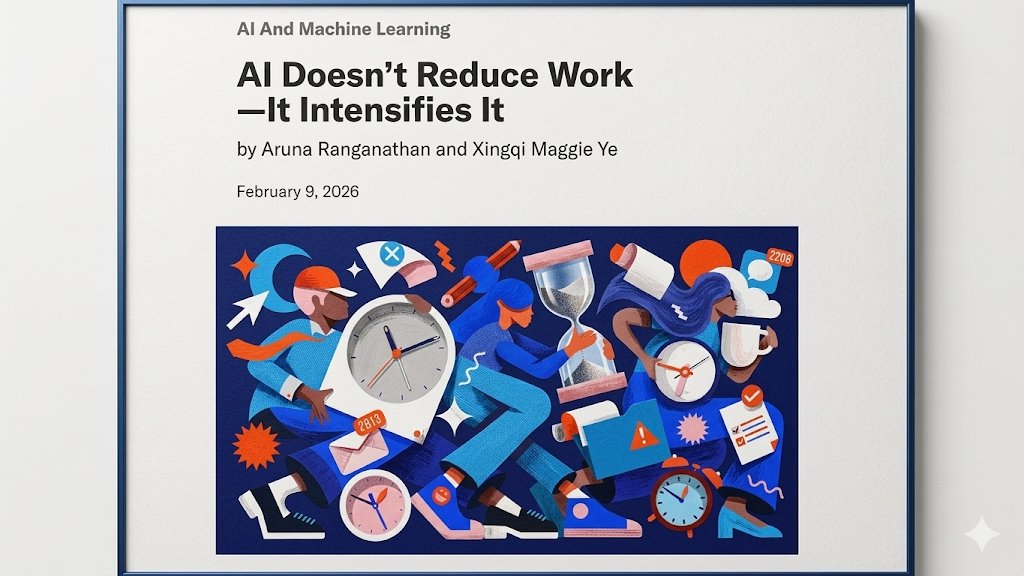
🚨BREAKING: Berkeley researchers spent 8 months inside a tech company watching how employees actually use AI.
The promise was simple: AI will save you time. Do less. Work smarter.
The opposite happened.
Workers didn't use AI to finish early and go home. They used it to take on more. More tasks. More projects. More hours. Nobody asked them to. They did it to themselves.
The researchers sat inside the company two days a week for 8 months. They watched 200 employees in real time. They tracked work channels. They conducted 40+ interviews across engineering, product, design, and operations.
Here's what they found. AI made everything feel faster, so people filled every gap. They sent prompts during lunch. Before meetings. Late at night. The natural stopping points in the workday disappeared. People ran multiple AI agents in the background while writing code, drafting documents, and sitting in meetings simultaneously.
It felt like momentum. It felt productive. But when they stepped back, they described feeling stretched, busier, and completely unable to disconnect.
83% said AI increased their workload. Not decreased. Increased.
62% of associates and 61% of entry-level workers reported burnout. Only 38% of executives felt the same strain. The people doing the actual work absorbed the damage while leadership celebrated the productivity numbers.
Then came the trap nobody saw coming. When one person uses AI to take on extra work, everyone else feels like they're falling behind. So the whole team speeds up. Nobody formally raises expectations. But the new pace quietly becomes the default. What AI made possible became what was expected.
The researchers gave it a name: workload creep. It looks like productivity at first. Then it becomes the new baseline. Then it becomes burnout.
AI was supposed to give you your time back. Instead it's eating more of it. And the worst part? You're doing it to yourself. Voluntarily.
the most underrated hire right now is a great product person.
when i say product person i'm def not talking about a product manager. perhaps i think there has to be somewhat of a new role. i don't have a good name for it yet but maybe something like "product thinker".. someone with an intuitive grasp of the product as it exists, where it's soft, where it sings, & how to iterate it toward something even sharper. in some sense, this person has to cohesively hold in their head where this product should be 2 years from now & work backwards from that.
i say this cuz when building was hard, engineering was the bottleneck & the status hierarchy often reflected that. building is no longer hard. which means the variance in outcomes has shifted almost entirely to judgment on what to build, how to sequence it, & how to talk about it.
& the story matters as much as the thing. internally, it organizes the team around a shared model of why. externally, it shapes the interpretive frame users bring to their first experience. you can't retrofit narrative onto a product & expect it to land, it has to be load bearing from the start.
the rarest version of this person sits at the intersection of culture & deep technology. someone genuinely bilingual. they know what's technically possible & they know which cultural currents are real vs. ephemeral. that combo is what separates products that feel inevitable from products that feel assembled.
before ppl clap back with this person has always been valuable, i know.. i am just saying now they might be the most *important* person in the room. their value compounds like never before.
Let’s talk about the beating of Jesus 🩸
Not the soft version many people imagine.
The real one.
Because the cross did not start at Calvary.
The suffering began long before the nails ever touched His hands.
When Jesus was handed over to be crucified, the Roman soldiers first scourged Him.
This was not a simple whipping.
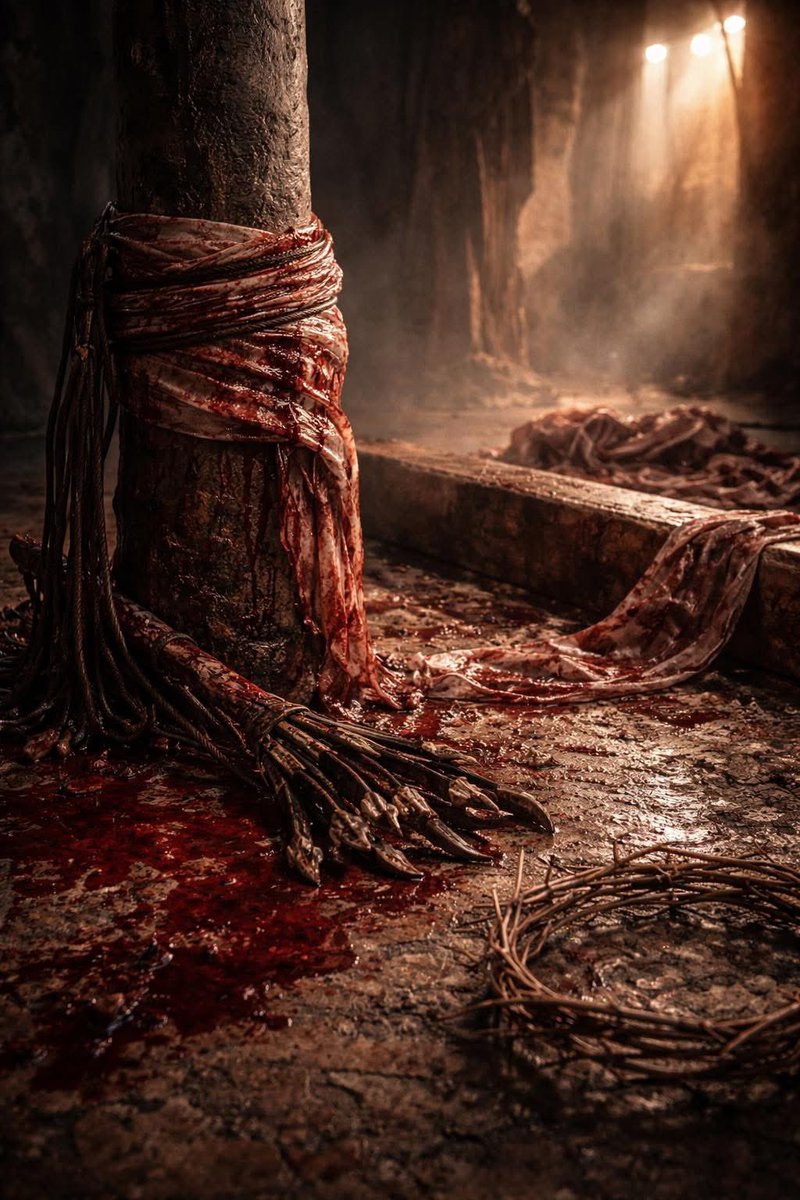
The Romans used a weapon called a flagrum or flagellum. It was a whip with multiple leather strands. At the end of each strand were pieces of bone, metal, and sharp hooks designed to tear flesh.
The purpose was not just punishment.
It was destruction of the body.
The victim was tied to a post, stretched so the back was exposed. Each strike caused the metal and bone to dig into the skin. When the whip was pulled back, it ripped flesh away from the body.
Early historians and medical researchers describe that Roman scourging often exposed muscle tissue and sometimes even bone.
Isaiah prophesied this hundreds of years before it happened.
Isaiah 52:14 says
“His appearance was so disfigured beyond that of any human being.”
Think about that.
The prophet is saying the Messiah would be beaten so severely that He would hardly look human anymore.
Isaiah 53:5 says
“By His stripes we are healed.”
Those “stripes” were not symbolic.
They were literal lashes that tore open His body.
Medical analysis suggests that after such scourging a person would experience hypovolemic shock, which means severe blood loss causing the body to begin shutting down. Blood pressure drops. Organs begin failing. Breathing becomes shallow.
And Jesus had not even been crucified yet.
After the scourging, the soldiers mocked Him.
They twisted together a crown of thorns and pressed it into His scalp. The scalp is one of the most vascular areas of the body, meaning it bleeds heavily when punctured.
Blood would have run down His face.
They struck Him with a staff.
They spat on Him.
They mocked Him as King.
Then they placed the crossbeam on His already torn shoulders and forced Him to carry it through the streets.
Why does this matter?
Because many people talk about the cross without understanding the price that was paid before the cross.
Jesus did not casually walk to Calvary.
He was crushed, torn, humiliated, and beaten so that the debt of sin could be paid in full.
The lashes were not random.
They were substitution.
The punishment that belonged to us was placed on Him.
Our rebellion.
Our sin.
Our shame.
Our guilt.
The wrath that justice demanded was poured onto the body of Christ.
This is why the gospel is not just a story about love.
It is a story about sacrifice.
It is a story about atonement.
It is a story about a King who took the beating meant for His people.
When Jesus cried “It is finished,” He was declaring that the payment for sin had been completed.
Not partially.
Not temporarily.
Completely.
The blood that flowed from those wounds became the price of redemption.
1 Peter 2:24 says
“He Himself bore our sins in His body on the tree, that we might die to sin and live to righteousness. By His wounds you have been healed.”
So when we talk about salvation, we cannot treat it casually.
Freedom cost Him His flesh.
Grace cost Him His blood.
Redemption cost Him His life.
And the question every believer must face is this:
If Christ was willing to endure that for our salvation,
how can we treat sin like it is small?
The lashes were real.
The suffering was real.
The blood was real.
And the salvation purchased through it is real.
Never forget the price that was paid.
Citizen TV has just done a really disturbing story on Grade 10 students, something I warned about earlier this year.
Their report shows many Grade 10 students, including the ones in the pic below, are now stuck at home after mid-term because schools will not allow them back due to the fees.
In January, I warned about what this Ruto government was playing parents. I said the priority seemed to be getting the students to schools registered as “transitioned” in their systems, so the numbers could be presented to the World Bank for more loans.
After that, the real struggle of these students would quietly be forgotten. No one would care whether they had been chased back home for fees or dropped out.
Sadly, this is exactly what we are now seeing.
The students dropping out are not from wealthy families. They are the children of poor households who simply cannot keep up.
Why can’t we make education truly free?
Why build a system where the poorest children are the ones pushed out?
My heart bleeds for these students.
Well, since I have always updated this thread since my internship days, let me update it.
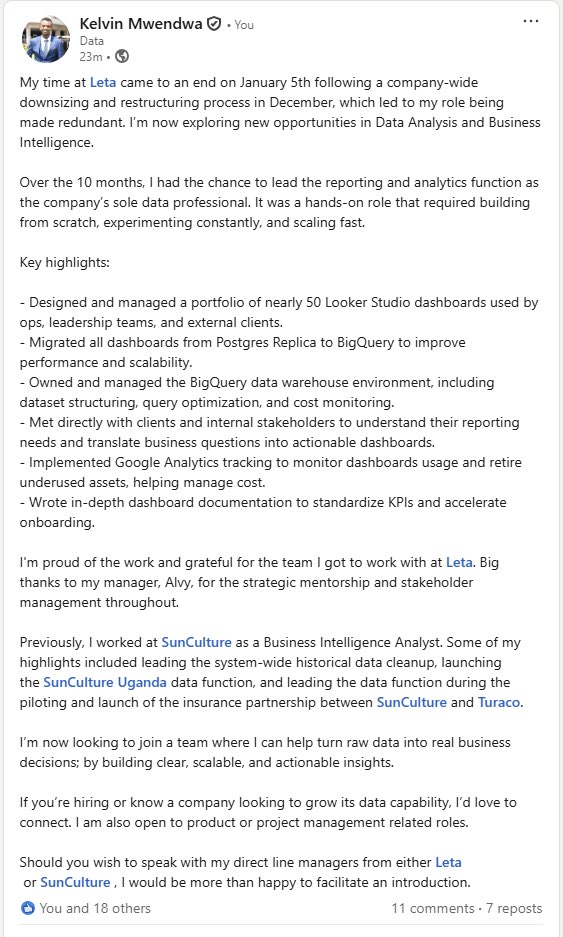
My chapter at Leta closed two months ago following a redundancy of my role as a result of company restructure. At Leta, I lead the reporting and analytics function as the company’s sole data professional.
I’m now looking to join a team where I can help turn raw data into real business decisions; by building clear, scalable, and actionable insights.
If you’re hiring or know a company looking to grow its data capability, I’d love to connect. I am also open to product related roles.