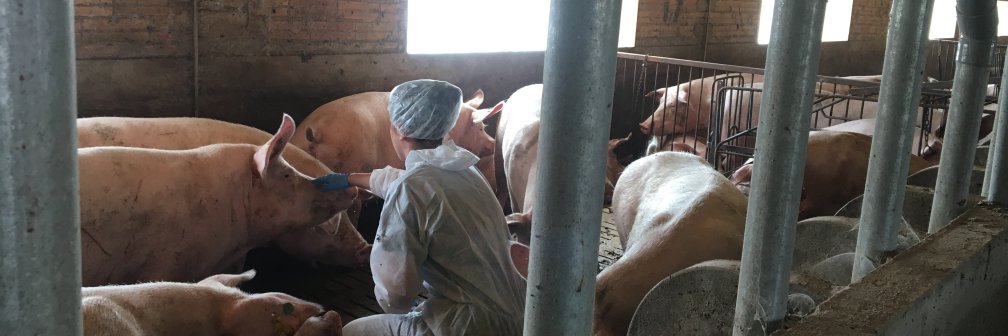
🐷New paper in Nature Food🐷
THE BAD NEWS: overall, we found trade-offs. Farms with lower GHGs had lower land use, but higher antimicrobial use and poorer welfare.
THE GOOD NEWS: trade-offs weren't inevitable. Several farms performed well in all four ways. 1/5
Exciting new interdisciplinary Doctoral Training Programme launching with the October 2025 intake (ie recruiting now). Please spread the word to potential applicants, we are committed to an inclusive and welcoming experience for all! https://t.co/FTlKD5brkg
📢New Publication Alert!📢
What should we consider when evaluating the animal welfare impacts of foods and diets? We’ve just published a conceptual framework to guide these important decisions. 🧵👇
5/ Big thanks to lead author Sebastian Richter and co-authors: Laura Scherer, @marge_heg, Leonie Nora Bossert, Anita Frehner, and Christian Schader! 🙏Check out the open-access paper here: https://t.co/ABCZ1qshoC
In a recent pre-print, @Tom_B_White, Talitha Bromwich and colleagues outline the risks and opportunities of using LCA approaches for biodiversity footprinting.
Read more here: https://t.co/e6pbu3X3eX
🚨Big news🚨 You can now apply for SCCS 2025! https://t.co/ZOtybsel9Z Please tell your friends and colleagues. Come along to the biggest conference on conservation biology aimed entirely at students @TropicalBiology@CCI_Cambridge@CamZoology
This is THE best conference for conservation science students. There are brilliant plenaries and workshops and of course fabulous talks from other students about the cutting edge (and a fabulous party). It's the highlight of my year (I'm privaledged to be on the committee).
We’re delighted to see @HarrietBartlett’s new study in @NatureFoodJnl featured in Our World in Data!
The study explores the complex relationship between pig farming practices, animal welfare, environmental impacts and antibiotic use. 1/4 https://t.co/qaFHmGMiCZ
We’re delighted to see @HarrietBartlett’s new study in @NatureFoodJnl featured in Our World in Data!
The study explores the complex relationship between pig farming practices, animal welfare, environmental impacts and antibiotic use. 1/4 https://t.co/qaFHmGMiCZ
Want to work with farmers to help them improve their sustainability at scale? Come work with us!
Super cool job for a post-doc or research assistant at @UniofOxford@oxmartinschool@OxfordBiology with @hestiaToolkit, @EJMilnerGulland and me.
Want to work with farmers to help them improve their sustainability at scale? Come work with us!
Super cool job for a post-doc or research assistant at @UniofOxford@oxmartinschool@OxfordBiology with @hestiaToolkit, @EJMilnerGulland and me.
@Rob_Percival_@NatureFoodJnl Thanks, Rob. The extended data has a plot of GHGs by label excluding forgone sequestration - https://t.co/XYcHFBSe2e and Figure 1 in the SM https://t.co/9D0iADrvNQ
We visited UK and Brazilian pig farms responsible for the production of >1.2 million pigs/yr. We collected primary data and carried our welfare assessments to quantify each farm’s GHG emissions, land use, animal welfare and antimicrobial use. 4/5
@HarrietBartlett (who lectures for our food systems, health and environment series) was interviewed on @BBCFarmingToday about her new study published in Nature Food that evaluates different methods of pig-farming. Listen at https://t.co/ZZOZHiFlgv
Did you ever wonder if the choices we make about farming and eating are based on solid evidence or just assumptions? @HarrietBartlett 's latest research dives into this question, revealing surprising findings. @NatureFoodJnl research briefing:
https://t.co/4sdMEXSDUf