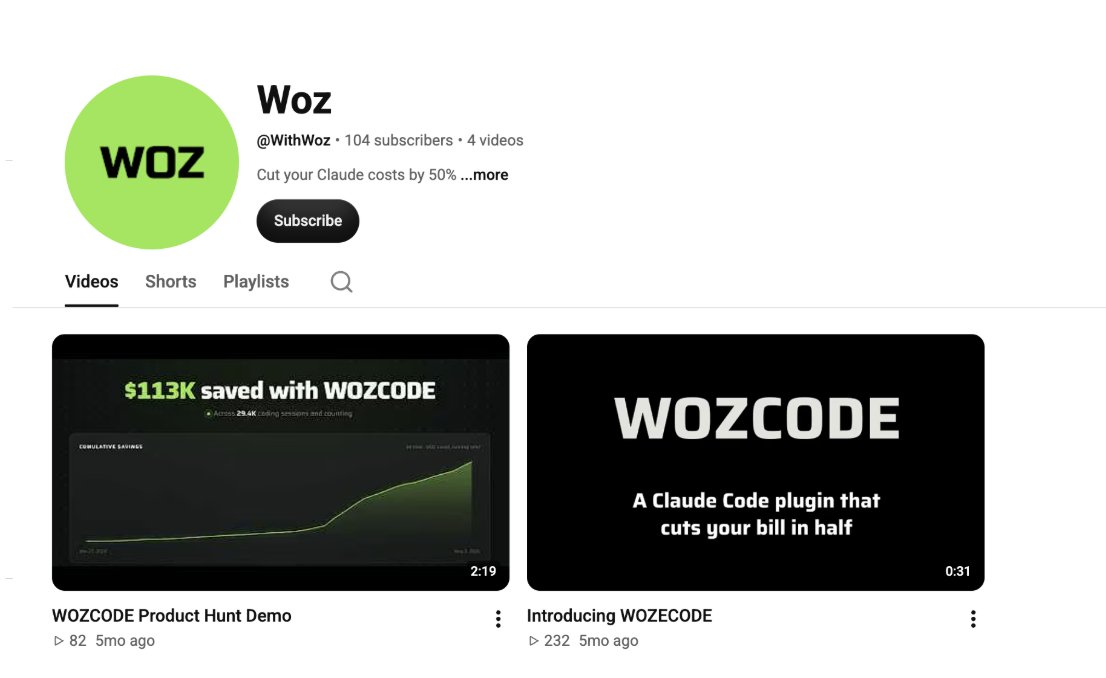
WOZCODE is losing a lot of reach that should be theirs.
A rival making the same promise got 141K views on one video. WOZCODE's own intro video has 232 in 5 months.
The gap is distribution, and it's fixable.
WOZCODE is a plugin that makes Claude Code, Anthropic's AI coding tool, cheaper to run. It could be the plugin every Claude Code user installs first, and three things would get them there.
1. The demand is already there. 141K views on the same promise says developers want this.
Pick the 3 formats where that demand shows up and run them through what I call Variable Lock. 500+ videos a month, each one keeping the exact variables that made the original go viral and changing everything else. In the 141K video you can see all of them in one frame. The promise across the top, the before and after on screen, a finger on the difference.
2. Duncan Rogoff, a Claude Code educator, got 127K views in 4 months with "6 Claude Code Plugins Nobody Uses." WOZCODE belongs in videos like that. Views show the demand. Developers talking about you without being asked is what turns it into pull, and that starts with creators they already trust.
3. Then push. Every video goes to people already using Claude Code, and whatever hits gets more volume the next month. That tests the market faster than any polished plan. If 500 videos a month still pull nothing, that's a product/market fit problem, and no marketing plan will fix it.
Virality is predictable. WOZCODE just hasn't cracked it yet.
If they understand the distribution game, they could end up bigger than the rival beating them today.
(First in a series breaking down one brand's distribution at a time.)
@WithWoz1@BenjaminT007@ChefEckert
When does expanding a product line become a mistake?
If customers love your brand for one particular product, does launching 10 more products strengthen the brand?
Or does it dilute the very reason people trusted it in the first place?
@ambermccollum That's a great example of how much emotional attachment can influence brand loyalty. Sometimes customers aren't looking for something better; they just want the product they already trust
What is harder for a consumer brand?
Convincing someone to try a product they’ve never heard of.
Or convincing someone to replace a product they’ve been buying for 10 years?
Both require distribution, but the second requires changing an existing habit.
Which is the bigger challenge?
If your brand stopped running ads tomorrow, how would new customers discover it?
Would your existing distribution bring them in?
Would customers recommend it?
Or would your growth simply stop?
Who is your biggest competitor?
Another brand selling the same product?
Or a completely different product solving the same problem?
A customer looking for a quick meal could choose a frozen pizza, instant noodles or a takeaway.
You're competing for the same decision without selling the same thing.
How many brands underestimate their real competition?
@aishanitwts Interesting perspective. Category creation definitely requires more education, but I think replacement has its own challenge: you’re asking consumers to abandon something they already trust. Both require changing behaviour, just at different stages.
@its_saubhagya Exactly. Trying something new is a decision. Replacing something familiar means giving up a habit that’s already working. That’s a much bigger psychological barrier.
@ufuoma_raymond Exactly. You’re not just selling them a new product; you’re asking them to abandon something they already trust. The new product has to offer a compelling enough reason to make that switch.
@bb833dong That's an interesting distinction. A lot of brands focus on making their product look better, but forget that consumers also need a reason to feel comfortable leaving what they already know.
@jeremybasham That’s a really interesting way to look at it. A new product competes with an unmet need, whereas an existing product has already earned a place in someone’s routine. Breaking that habit is a much bigger challenge.
@AakashA54940018 That's a good example of how geography and consumer demographics can completely change product-market fit. Sometimes the product isn't wrong; it's simply being introduced to the wrong audience.
Would you expand into a new market where nobody knows your brand, or go deeper into a market where customers already love your product?
Most founders want to be everywhere.
But is geographic expansion always the smartest next move?
If a retailer gives you only one advantage, which would you choose?
Prime shelf placement.
Or exclusive access to customer purchase data.
One helps you get noticed.
The other helps you understand what actually sells.
What's more valuable?