Mercor now pays out over $4M / day to experts on our platform, with an average pay rate of over $100 / hour.
Despite today's jobs report missing estimates, training agents is becoming one of the fastest-growing job categories in the world.
Organizing human intelligence is the largest bottleneck to AI progress.
Last week I hosted a fireside chat on what it actually takes to build AI agents in the enterprise with @natalie_meurer (Head of Agent Eng, @SierraPlatform), Harsh Trivedi (founding engineer, @mercor_ai), @juhiparekh94 (GM, @turingcom), and Kevin Lynch (Senior FDE, @fin_ai).
We got into how the data-labeling/RL environment business might only have a couple years left, why real-time voice-to-voice models still aren't production-ready, how cheaper inference is still causing prices to go up, how baking in a constellation of models into enterprise agents is so important for reliability, and much, much more.
Some of my favorite parts of the conversation (link to full episode in comments) ↓
AI progress requires (1) compute, (2) algorithms, and (3) data.
- The leading compute company is worth $5 trillion.
- The leading model company is worth $1 trillion.
- @mercor_ai is the leading data company and is currently valued orders of magnitude lower.
There's an opportunity in how the market is mispricing the value of data.
Data is the oil of the AI revolution. It is the primary way that models and enterprises build competitive advantages.
Companies will spend more on tokens than they do salaries very soon.
Application layer companies have no defensibility, the model is the product.
Hiring researchers will cost you tens of millions of dollars today.
Everything you think you know about defensibility, token spend, labour displacement, will be changed following this discussion.
I condensed the core ideas which changed my thinking from my conversation with @BrendanFoody at @mercor_ai below.
1. Why Frontier AI Labs Could Become $10TN Companies
Critics once questioned whether foundation model labs could keep pricing power in a competitive market. Their revenue velocity now suggests the opposite. The opportunity around leading frontier models is so large that it could absorb a major share of macro demand. At least one AI lab may become a $10TN company within five years.
2. The Capacity Bottleneck: Demand Doubling Overnight
For top infrastructure and data providers, growth is no longer limited by customer acquisition. It is limited by execution. Demand is scaling so fast that leading companies could double revenue overnight if they had enough capacity. The challenge now is how quickly they can mobilize specialized human networks and build high-fidelity environments for enterprise demand.
3. Why Forward Deployment Will Determine True Value Creation
Defensibility in the software layer is getting harder because the model itself is becoming the product. True value creation will come from post-sales forward deployment, not pre-sales GTM. The durable edge is training agents on tacit customer knowledge and layering automated services on top of software.
4. Is the Stated Revenue Really Revenue or GMV?
The stated revenue is not GMV because the talent network is only one part of a vertically integrated value chain. Customers buy complete tasks for model improvement, not simple marketplace listings. With 30% to 40% gross margins, the business owns the full lifecycle, from sourcing experts to deploying AI project managers and running quality checks.
5. The Inversion of Corporate Opex: Token Spend vs. Salaries
In high-growth AI companies, token spend for internal agents has already surpassed employee headcount costs. As operations, interviewing, accounting, and fraud detection move to agents, capital allocation shifts from salaries to inference compute.
6. Why Token Spend Inside Companies Will Keep Increasing
Driven by Jevons Paradox, enterprise token consumption will keep rising as models improve and costs fall. Companies will use more compute to unlock higher-order reasoning, not less. F500s are responding by building evaluation systems that let them hot-swap models and optimize inference budgets.
7. The Tens of Millions Talent War for AI Researchers
The market for top AI researchers is severely supply constrained, with demand far above available talent. Companies are offering compensation packages worth tens of millions in stock per year to secure elite researchers. This wage spike shows that world-class research talent remains the core bottleneck in AI.
(links below)
We're running a 24-hour hackathon June 19–20 in San Francisco with @cognition, @etched, and @AnthropicAI.
$50k top prize. $100k in total awards. Every accepted team gets 8xH100s, Anthropic credits, and Cognition API access.
Guest judges include: @BrendanFoody, @robertwachen, and @silasalberti.
Apply by 6/12: https://t.co/wuqEpBOSIm
We ran GPT-5.5 on APEX-Agents and APEX-SWE.
On APEX-Agents (xHigh), it tops the overall leaderboard and leads investment banking and management consulting, placing 2nd in corporate law. Pass@1: 38.4%, mean score: 53.9%.
On APEX-SWE (High), it places 3rd at 40.84% Pass@1, within 1 percentage point of the top two models.
Congratulations @OpenAI on the release. See thread for full results 🧵
Here's how @AnthropicAI Claude Opus 4.7 (Max) performs on APEX-Agents, our benchmark that measures complex, long-horizon professional tasks.
With a Pass@1 of 33.9%, it places 3rd on the leaderboard.
Traditional coding benchmarks do not reflect how software is actually built and maintained.
That's why we built a new benchmark, APEX-SWE, in partnership with @cognition. It measures whether AI models can perform complex, real-world software engineering work to ship systems that work and debug them when they don't.
@OpenAI GPT 5.3 Codex (High) tops the leaderboard at 41.5% on Pass@1.
We’ve been testing @OpenAI GPT 5.4 on APEX-Agents, our benchmark for agentic work in professional services.
GPT 5.4 now tops the leaderboard:
Pass@1: 35.9% (+1.6pp)
Mean: 52.5% (+4.3pp)
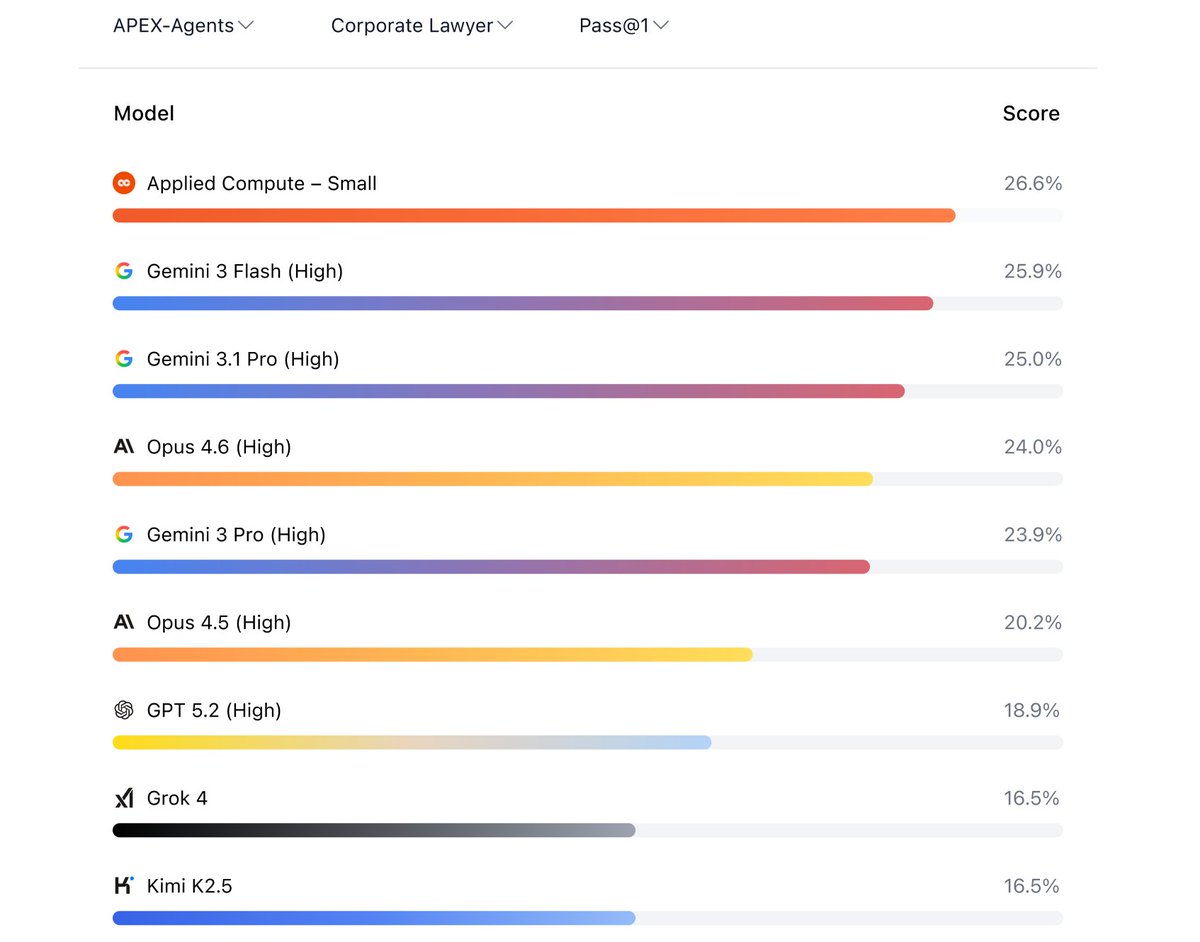
Scaling Data leads to SOTA Legal Performance on APEX-Agents
@appliedcompute built a custom model (Applied Compute: Small) by post-training GLM 4.7 on nearly 2,000 samples provided by Mercor.
It is now top of the APEX-Agents leaderboard in corporate law, with a Pass@1 score of 26.6% and a mean score of 54.8%.
Here’s what we learnt 👇