Introducing Shift-1, a frontier coding router trained on AC2 that reduced coding agent cost by up to 55% with no noticeable drop in quality. Try it at https://t.co/089IMPbtAl.
Meta’s Muse Spark Open is now live on AC2 for training and inference.
In early testing, we've found it to be a strong base model candidate because of its broad capabilities and inference efficiency.
Post-train it in your own harness with your own environments and graders, using full-parameter async RL.
Overall the factors that allowed us to train Shift-1 successfully were: 1) labels built from terminal outcomes, 2) scaling data on real-world usage, 3) scoring quality and cost separately, and 4) using decision models on AC2. Try Shift-1 today at https://t.co/401AG4aH7n.
https://t.co/gjd8Rd2DfE
On Wednesday, we launched Shift-1: a model router that can reduce coding agent spend by up to 55% while preserving performance. Today we are sharing more details about the research that went into this release.
To scale labels, we graded developer feedback across 118k internal coding turns. Judges use full-turn hindsight to locate where things went wrong, calibrated against continuation outcomes. Judging isolated steps was much less effective.
We’re thrilled to be featured on the GTC keynote stage alongside so many incredible teams!
We want enterprises to have a unified platform to post-train open models like @NVIDIAAI Nemotron on their own data, serve them in production, and continuously improve them through real-world use. We can’t wait to keep building that future together.
Introducing Shift-1, a frontier coding router trained on AC2 that reduced coding agent cost by up to 55% with no noticeable drop in quality. Try it at https://t.co/089IMPbtAl.
We were especially impressed with Beam’s inference efficiency during post-training. The architecture supports 1M context and stores minimal KV cache state per token, enabling training on long horizon tasks at high concurrency.
Thanks to @reflection_ai for the early access and for contributing a key open model to the Western ecosystem!
Reflection AI’s Beam 1.0 is out today, a 501B MoE with 23B active under Apache 2.0. We ran a brief RL post-training run on it in AC2 that tripled its score on a challenging long-horizon agentic coding task in 40 steps, 0.07 to 0.215.
We’re offering day 0 support in AC2 for inference and post-training.
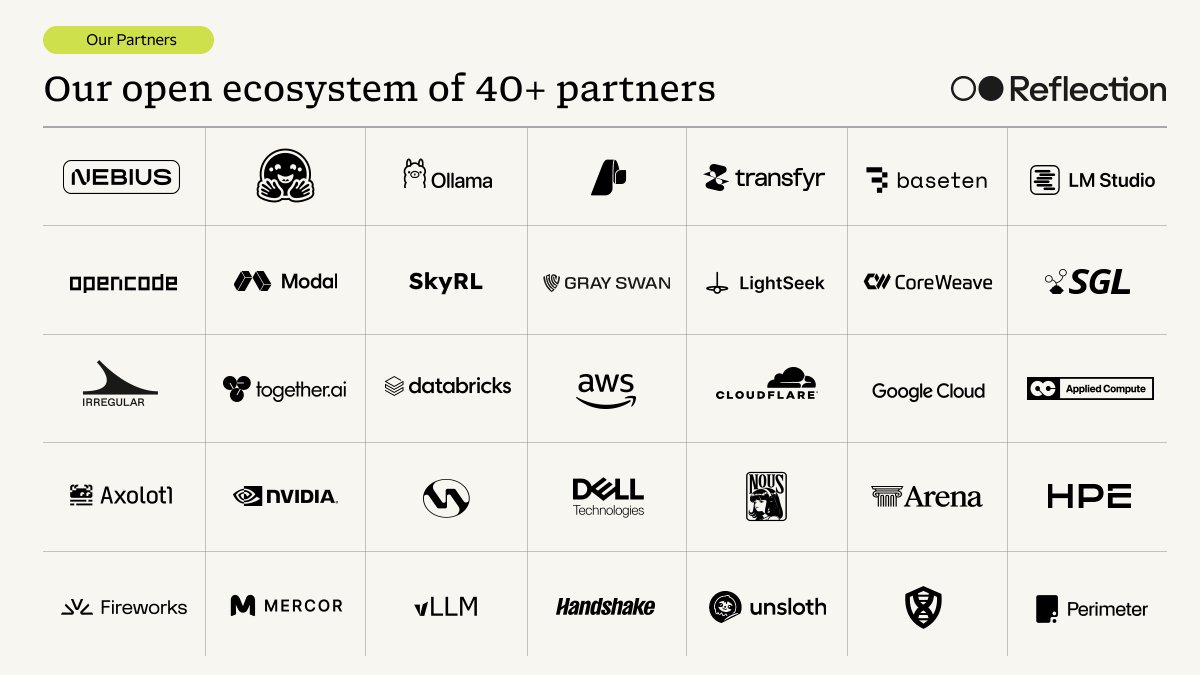
Beam is now available across platforms, with open weights under the Apache 2.0 license - in collaboration with an ecosystem of 40+ partners.
We're releasing:
- Weights, tokenizer, and reference implementation
- BF16, FP8 and NVFP4 weights and a DFlash2 drafter
- The open source harness we built and trained Beam on: Mirror CLI
Weights and model card on Hugging Face: https://t.co/tPqWpk9RXL
Beam is now available across platforms, with open weights under the Apache 2.0 license - in collaboration with an ecosystem of 40+ partners.
We're releasing:
- Weights, tokenizer, and reference implementation
- BF16, FP8 and NVFP4 weights and a DFlash2 drafter
- The open source harness we built and trained Beam on: Mirror CLI
Weights and model card on Hugging Face: https://t.co/tPqWpk9RXL
Nemotron 3.5 Super VL by @NVIDIAAI is now supported for both training and inference on AC2.
In early post-training runs for our customer, we've been impressed with the quality of the base model for its inference efficiency.
Like chess puzzles, many of the enterprise tasks that we train on at Applied Compute have low pass rates on existing frontier models. Spork serves as a new post-training paradigm to overcome these challenges. Read the full report.
https://t.co/w0dos096uz
Introducing Spork, an efficient post-training recipe which increases our solve-rate on chess puzzles by 100% when compared to our best GRPO setup.
It uses a GRPO warmup, splits task-specific datasets further into partitions, trains specialists, and then uses multi-teacher on-policy distillation. Like a Spork, it leverages gains by simply consolidating specialists.
We find that most of the gains over GRPO (91% of the total jump) can be achieved with only 2 partitions and thus 2 specialists. In an additional experiment, we find that more divergent partitioning improves final performance over random partitions.
AC2 now supports decision model training. Teams can build custom Jev-like models for use cases like request routing, content classification, and anomaly detection.
Reach out to get started with your own classification task!
You can now train your own decision model in our platform AC2! Jev-like models, custom fit for your use case :)
We implement decision models through a language-model backbone with a small learned output layer called a decision head. The backbone processes the input, question, and answer choices, and the head produces scores which are softmaxed to produce a probability distribution over answer choices.
Our software interface makes it easy to add a variable-sized decision head to frontier open-weight models. Choose any open source model, and train it as a decision model using Brier loss or cross-entropy loss. Training updates both the decision head and the language backbone.
We tried it on 50k sampled training datapoints from the Civil Comments dataset, starting from Perplexity’s pplx-decider-v1-27b, and F1 for detecting toxic comments increased from 0.482 to 0.677 on 20k sampled eval datapoints. The training job took less than an hour on four B300 GPUs.
Reach out to get started with your own classification task: https://t.co/D6ArdYexnb
Super excited to share this work we've been doing at AC (major kudos to @AtharvNaphade)!
It allows us to take a legitimate step towards taking our hands of the wheels during model training. Looking forward to sharing more about how we were able to use it for automating a full end to end training loop 👀