🚀 I’m building MindStash in public.
A personal AI knowledge base that unifies all my scattered saves — Twitter bookmarks, Instagram reels, YouTube Watch Later, pasted links — into one searchable, AI-powered system.
12 weeks. Python to deployed RAG backend.
Follow the journey 🧵👇
#buildinpublic #Python #GenAI
🚀 Personal Link Saver — Development Update
I've made some significant improvements to my Python CLI project!
What started as a simple link-saving application now supports:
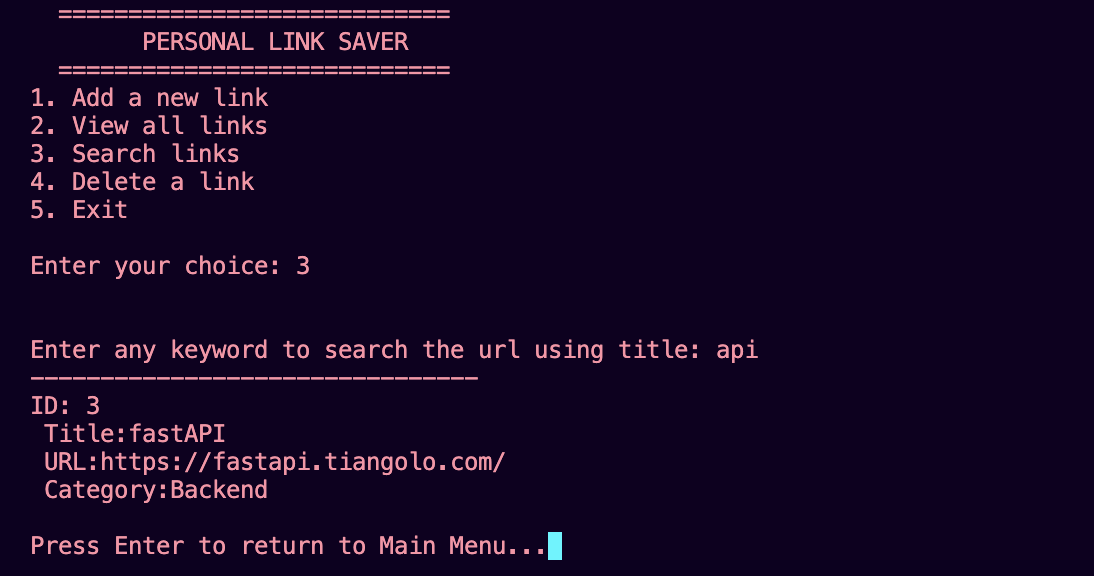
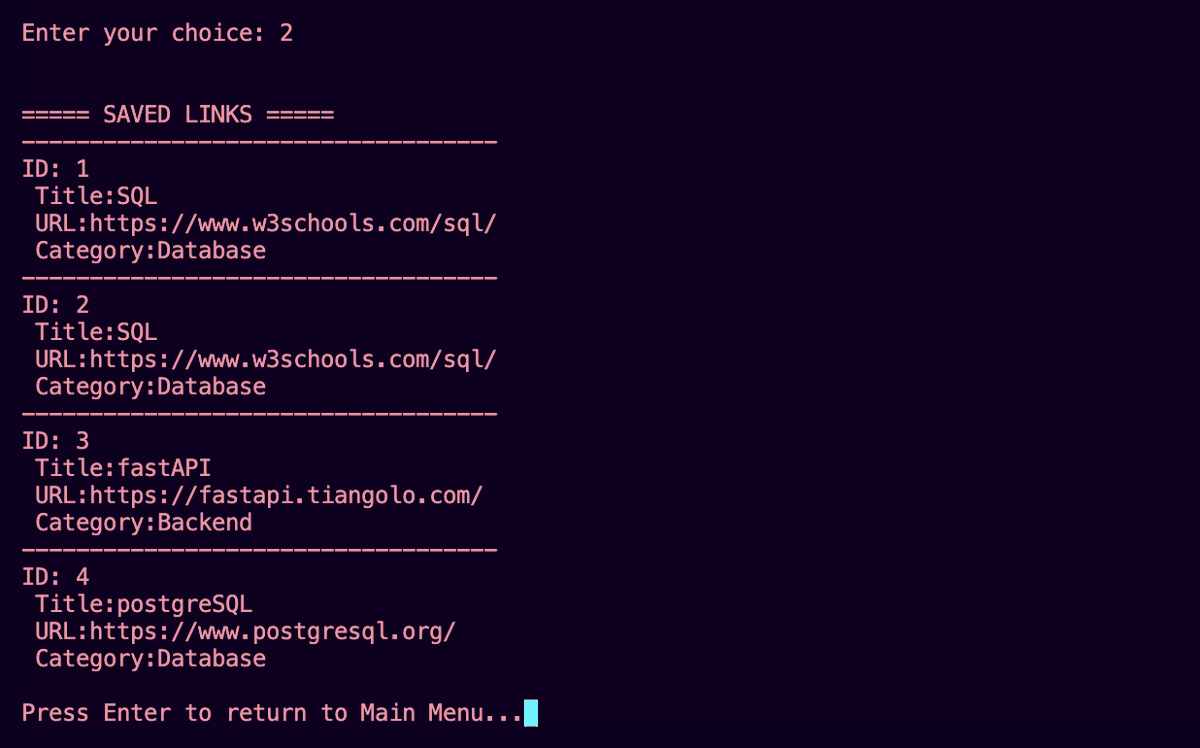
🔹 Add, view, search & delete links
🔹 JSON-based data persistence
🔹 Automatic unique ID generation
🔹 Input validation & URL validation
🔹 Error handling for missing or invalid JSON files
🔹 Improved CLI navigation with pause functionality
🔹 Better code organization using functions and parameters
🔹 if __name__ == "__main__" for controlled execution
Things I learned along the way:
Python's pathlib and json modules
URL parsing with urllib.parse
Exception handling
Managing dependencies through function parameters
Structuring a Python application
The next milestone: Automated testing with pytest. 🧪
Still learning, building, breaking things, and improving one step at a time.
🔗 GitHub Repository: https://t.co/rs6WOBvT2a
#Python #100DaysOfCode #BuildInPublic #LearningByDoing #GitHub
Mini - Project : "CLI personal-link-saver"
A beginner-friendly Python command-line application to save and manage useful URLs.
- Add new links with title, URL, and category.
- View all saved links.
- Search links using title keywords.
- Delete links using their ID.
- Automatically assign IDs to new links.
- Menu-driven command-line interface.
git repo: https://t.co/rs6WOBvT2a
#Python #100daysofcode #project
🐘 PostgreSQL: GROUP BY vs HAVING
Two important clauses for working with grouped data.
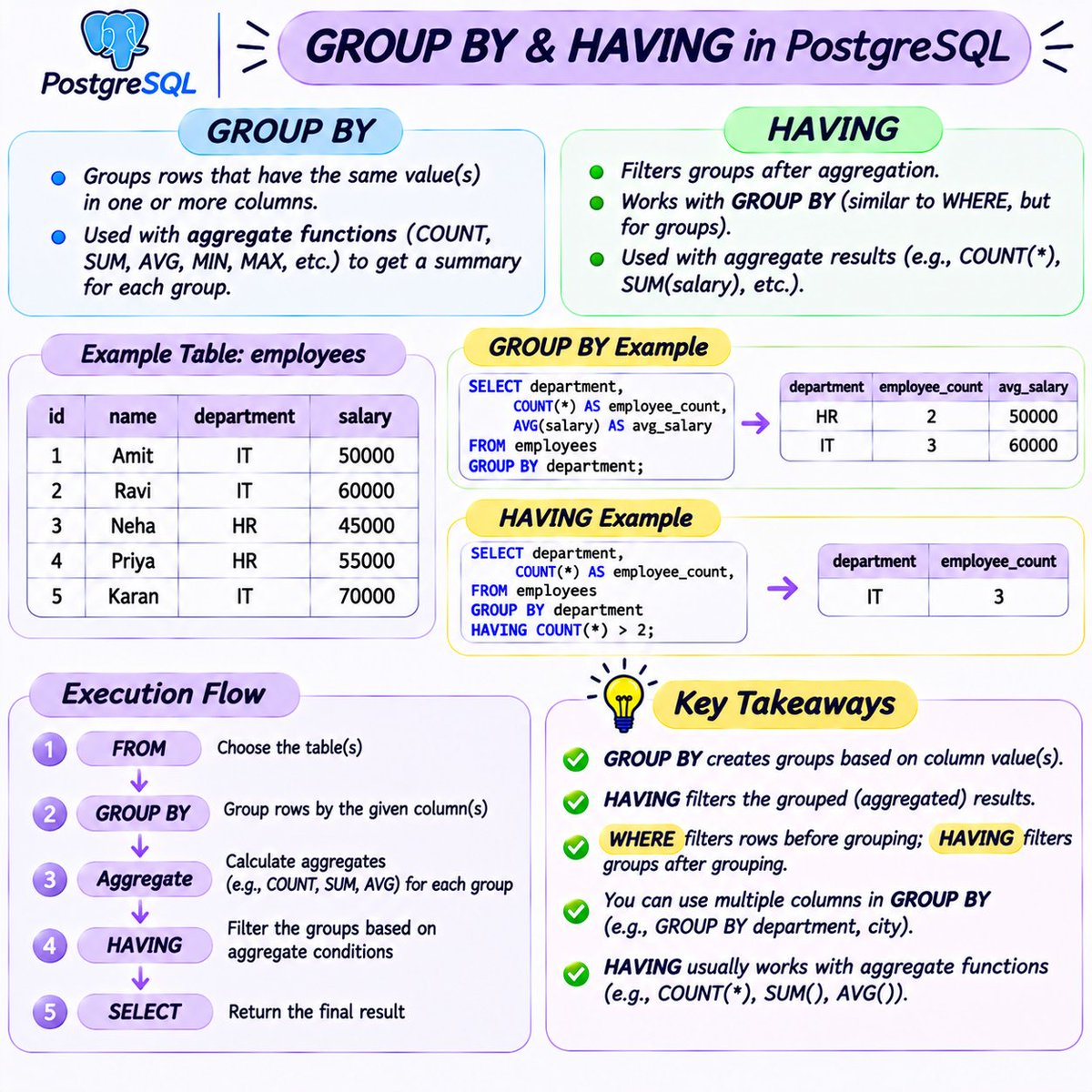
🔹 GROUP BY — Groups rows with the same values and calculates aggregates for each group.
🔹 HAVING — Filters groups based on aggregate conditions.
💡 Remember:
WHERE filters rows before grouping.
HAVING filters groups after aggregation.
#PostgreSQL #SQL #Database #LearnSQL
🐘 PostgreSQL: Aggregate Functions
Aggregate functions summarize data from multiple rows into a single result.
Some commonly used functions:
COUNT() – Count
SUM() – Total
AVG() – Average
MIN() – Minimum
MAX() – Maximum
💡 Combine them with GROUP BY and HAVING to perform powerful data analysis.
#PostgreSQL #SQL #Database #LearningSQL
🐘 PostgreSQL: SQL JOINs — Quick Summary
A quick revision of the five main JOIN types:
🔹 INNER JOIN
🔹 LEFT JOIN
🔹 RIGHT JOIN
🔹 FULL OUTER JOIN
🔹 CROSS JOIN
💡 The key is understanding which rows each JOIN preserves.
#PostgreSQL#SQL#Database#DSA
🐘 PostgreSQL: FULL OUTER JOIN & CROSS JOIN
🔹 FULL OUTER JOIN — Returns all rows from both tables, including unmatched rows.
🔹 CROSS JOIN — Combines every row from the first table with every row from the second.
💡 Remember: CROSS JOIN produces a Cartesian product (n × m rows).
#PostgreSQL #SQL #Database
🐘 PostgreSQL: LEFT JOIN & RIGHT JOIN
🔹 LEFT JOIN — Keeps all rows from the left table and matching rows from the right.
🔹 RIGHT JOIN — Keeps all rows from the right table and matching rows from the left.
💡 Unmatched rows appear with NULL values.
#PostgreSQL#SQL#Database
🐘 PostgreSQL: INNER JOIN
INNER JOIN returns only the matching rows from two tables.
💡 It helps combine related data using a common column.
#PostgreSQL#SQL#Database
🐘 Learning PostgreSQL: Introduction to JOINs
What if the information you need is stored across multiple tables?
That's where JOINs come in!
A JOIN combines related rows from two or more tables using a common column.
The four main types:
🔹 INNER JOIN
🔹 LEFT JOIN
🔹 RIGHT JOIN
🔹 FULL OUTER JOIN
💡 JOINs help us retrieve connected information without keeping everything in a single table.
Next: Understanding each JOIN with practical PostgreSQL examples!
#SQL #PostgreSQL #Database #LearningInPublic
🐘 Learning PostgreSQL: Working with SELECT Queries
Today's focus: Four essential SQL concepts.
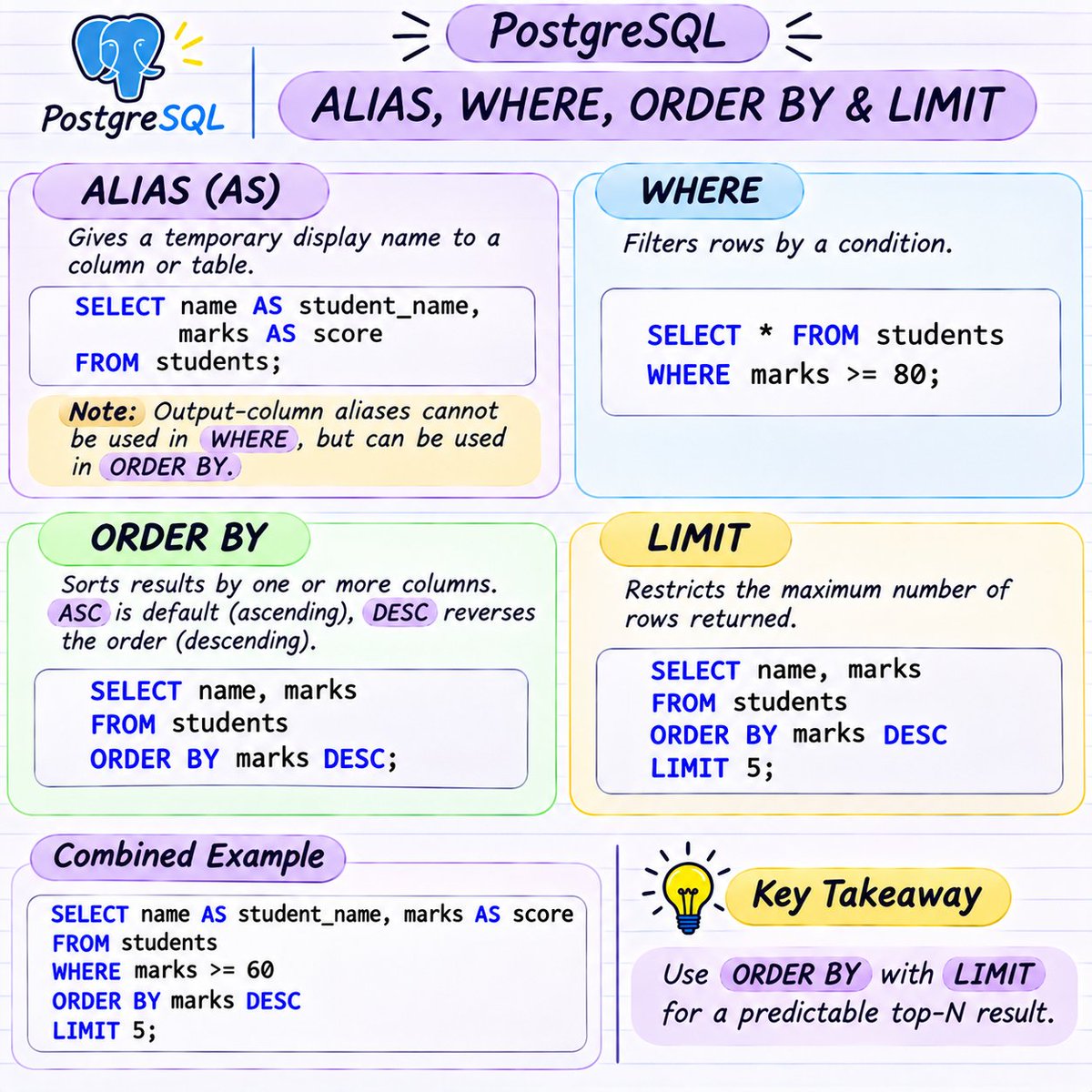
🔹 AS — Give columns or tables temporary aliases.
🔹 WHERE — Filter records using conditions.
🔹 ORDER BY — Sort results using ASC or DESC.
🔹 LIMIT — Restrict the number of rows returned.
💡 Combine them to retrieve exactly the records you need.
One important detail: Use ORDER BY with LIMIT when you need predictable results.
#PostgreSQL #SQL #Database #LearningInPublic
🐘 Learning PostgreSQL: String Pattern Matching
How do you search for text when you don't know the exact value?
PostgreSQL provides three useful pattern-matching approaches:
🔹 LIKE — Case-sensitive matching
🔹 ILIKE — Case-insensitive matching
🔹 POSIX Regex — Advanced pattern matching
💡 These are especially useful with WHERE when filtering text data.
Understanding when to use each one makes writing flexible SQL queries much easier!
#SQL #PostgreSQL #Database #LearningInPublic
🐘 Learning PostgreSQL: Logical & Quantified Operators
Today's concepts:
🔹 AND, OR, NOT — Combine conditions
🔹 Subqueries — Queries inside queries
🔹 ANY / SOME — Match at least one value
🔹 ALL — Match every value
🔹 BETWEEN, IN — Range and membership checks
💡 Understanding these operators helps write more flexible queries using PostgreSQL.
#SQL #PostgreSQL #Database #LearningInPublic
🐘 Learning PostgreSQL: Comparison Operators
How do we compare values in SQL?
Comparison operators help evaluate two values and return TRUE or FALSE.
Some important operators:
🔹 = — Equal to
🔹 <> — Not equal to
🔹 > — Greater than
🔹 < — Less than
🔹 >= — Greater than or equal to
🔹 <= — Less than or equal to
💡 These operators are commonly used with WHERE to filter records.
#PostgreSQL #SQL #Database #LearningInPublic
🐘 Learning PostgreSQL: Introduction to Operators
What are operators, and why do we need them in SQL?
Operators are symbols or keywords used to perform operations on data and values.
They help us:
🔹 Compare values
🔹 Perform calculations
🔹 Combine conditions
🔹 Filter and match data
PostgreSQL supports different categories of operators, including arithmetic, comparison, logical, bitwise, and string operators.
💡 Operators are essential when writing queries, especially with SELECT and WHERE.
We'll explore each category with practical PostgreSQL examples in upcoming posts! 🚀
#SQL #PostgreSQL #Database #LearningInPublic
🐘 Learning PostgreSQL: DQL — Introduction
After DDL and DML, let's explore DQL!
DQL (Data Query Language) is used to retrieve and read data from database tables.
🔹 Main command: SELECT
🔹 Fetch specific columns or entire records
🔹 Filter results using WHERE
🔹 Query data from one or multiple tables
💡 Think of DQL as asking questions to your database and getting the required data back.
Next up: Exploring SELECT and its clauses in detail! 🚀
#SQL #PostgreSQL #Database #LearningInPublic
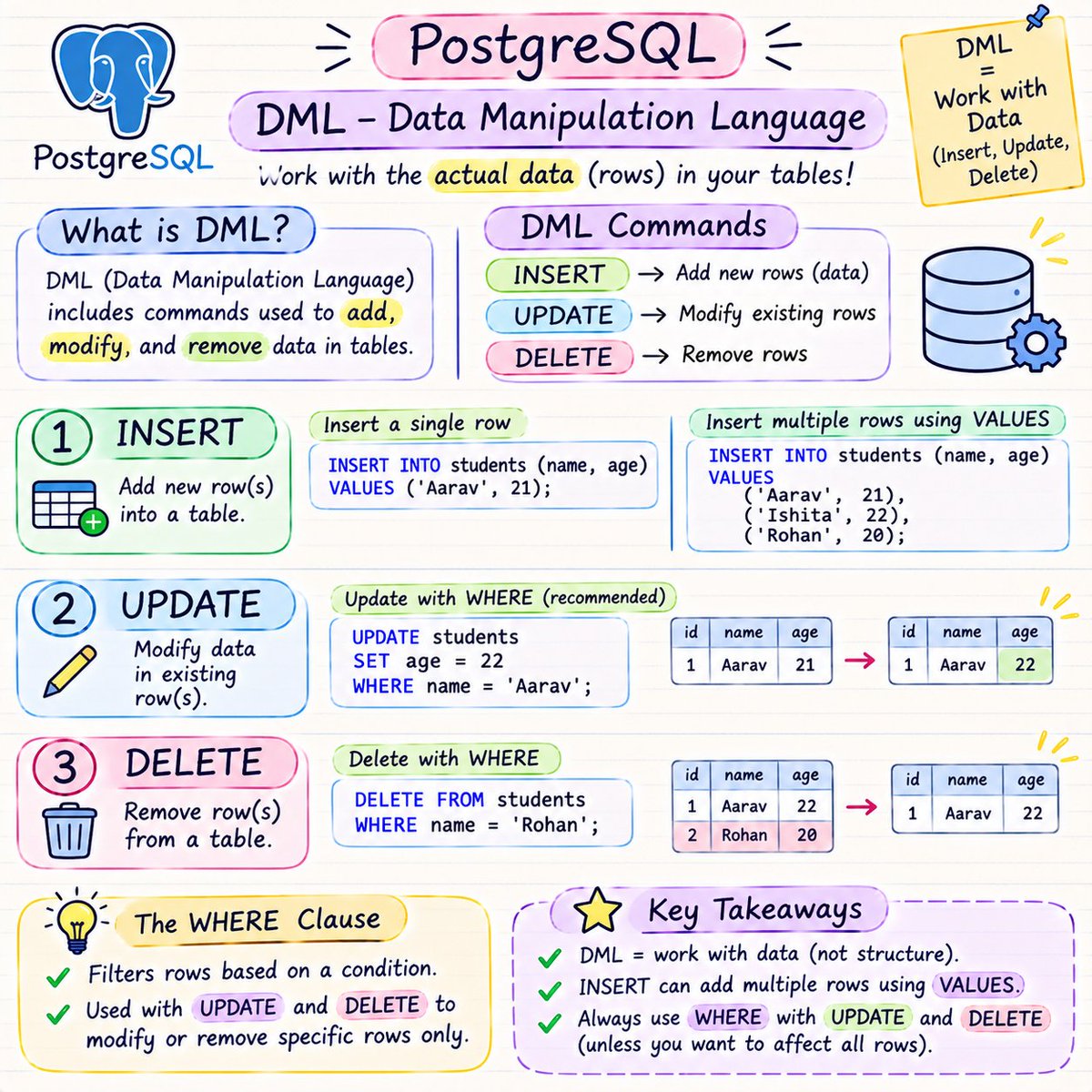
🐘 Learning PostgreSQL: DML — Data Manipulation Language
Today's topic: Working with actual data inside database tables.
Three essential commands:
🔹 INSERT — Add new records
🔹 UPDATE — Modify existing records
🔹 DELETE — Remove records
Also explored:
Inserting multiple rows using VALUES
Using WHERE to target specific records
💡 Important: An UPDATE or DELETE without a WHERE clause can affect every row in the table!
Building PostgreSQL fundamentals, one concept at a time. 🚀
#SQL #PostgreSQL #Database #LearningInPublic