Timepass talk on Sunday
1. Molbio Diagnostics
Molbio Diagnostics is an Indian diagnostics company that developed Truenat, a proprietary, battery-operated, portable molecular testing platform for infectious diseases that can function at remote healthcare settings. The company makes money through a two-component model: selling hardware devices (Uno, Duo, and Quattro versions) as one-time sales, and generating recurring revenue from consumables (test kits/reagents) that are exclusively compatible with their devices. They've scaled to ~12,500 machines across 90+ countries with over 40 million tests conducted to date. Recently, they've expanded beyond Truenat through acquisitions of Prognosys (digital X-rays, 70% stake) and OptraScan (digital pathology, 60% stake). In Q1 FY27, they delivered ₹408 crores in consolidated revenue with 75% now coming from recurring test kit sales, validating their business model. Molbio qualifies under the Medical Devices PLI framework for its indigenous diagnostic technology.
Key Growth Drivers
Growth will be driven by four pillars:
1) Geographic expansion for Truenat into Europe (with EU IVDR certification for CT/NG test) and USA (via OptraScan's recent FDA approval)
2) Disease portfolio expansion from 30 current tests to 52 total assays, particularly HPV which received government approval in India
3) Acquisition strategy through Prognosys and OptraScan
4) R&D-led development of new point-of-care platforms for non-communicable diseases, which management believes represents a market 10x larger than molecular diagnostics. The company spends 5-6% of revenues on R&D with 153 scientists and 207 patents.
FY27 Outlook
Management is guiding for ~25% top-line growth and 24-25% EBITDA margins for the full year. Q1 FY27 delivered ₹104 crores EBITDA (25% margin) and ₹52.7 crores PAT. While Prognosys should maintain ~19% EBITDA margins similar to last year, OptraScan will remain unprofitable in FY27 but is expected to contribute meaningfully from FY28 onwards. Export revenue, which just started scaling three years ago and contributed ₹67 crores (16%) in Q1, is expected to become a major growth driver. The TB tendering cycle (their largest current business) has a newly signed two-year rate contract, providing revenue visibility.
Of course, valuations aren't cheap!
2. Big Tech Enters Pharma
The Transformation and Key Players
In 2026, a fundamental shift has occurred as frontier AI companies, Anthropic, OpenAI, Google DeepMind, NVIDIA, Microsoft, and Meta, have moved beyond passive technology partnerships to become strategic participants embedded across the entire drug development value chain. Rather than simply providing cloud infrastructure or generic AI tools, these companies are now acquiring wet labs, developing custom biological foundation models, and establishing internal drug pipelines. Google/DeepMind focuses on structural biology through Isomorphic Labs and AlphaFold 3, NVIDIA provides the computational infrastructure backbone via BioNeMo and generative chemistry platforms, Microsoft emphasizes ambient clinical intelligence and multimodal pathology, Meta contributes open-source protein modeling tools (ESM-2, ESMFold), and OpenAI powers enterprise health workflows and clinical trial optimization.
Anthropic's Distinctive "Lab-in-the-Loop" Strategy
Anthropic has emerged with the most aggressive approach, acquiring Coefficient Bio for ~$400 million, hiring Nobel laureate John Jumper from DeepMind, and launching Claude Science, a specialized research platform that natively renders 3D protein structures and manages secure compute clusters for sensitive biological datasets. Within 100 days in 2026, Anthropic moved beyond being an infrastructure provider to establishing an end-to-end drug discovery execution model. The company secured enterprise-wide deployments with major pharmaceutical firms including Bristol Myers Squibb, Novo Nordisk, AstraZeneca, and Sanofi. Claude for Healthcare & Life Sciences includes HIPAA-ready integrations and automates administrative bottlenecks from prior authorization appeals to regulatory filing reviews, positioning Anthropic as both a technology enabler and direct biotech operator.
Why This Shift Matters
Tech companies are racing into healthcare because of three convergent forces: unprecedented data scale from genomic sequencing and digital pathology that fuels massive foundation models, regulatory acceleration with clear FDA sandboxes for AI-native software and biopharma, and massive ROI potential from reducing drug discovery timelines from years to months. Unlike previous waves of tech-pharma collaboration that remained peripheral, today's integration is structural, companies are not simply selling tools but fundamentally reshaping how drugs are discovered, validated, and brought to market, making biotechnology one of AI's most high-stakes and lucrative application domains.
One segment that's going to enjoy this pace and scale - CDMO
3. Anup Engineering
This is the notes from June 28th, 2026, below, I have added current state
Incorporated in 1962, Anup is engaged in design and fabrication of process equipment which mainly includes heat exchangers, pressure vessels, centrifuges, columns/ towers and small reactors that find application in refineries, petrochemicals, chemicals, pharmaceuticals, fertilizers and other allied industries.
This is a well-known story, and many of you may have owned this stock in your portfolio a few years ago.
Over the last couple of years, however, the company has put in significant effort to diversify into newer product lines and business verticals. More importantly, those initiatives are now beginning to show encouraging results.
If they can scale these verticals well, Anup could be an interesting player in the years to come!
Technical Services: Has executed ~10 POs worth ₹4.5 Cr at a high ~40% EBITDA margin; it targets ₹200 Cr in 3 years, though its small current base limits FY27 expected contributions to <₹20-25 Cr.
Nuclear (Kaiga-5/6, NPCIL): The first order is currently under execution (margin undisclosed), representing a strategic entry point into the SMR and conventional nuclear sector.
Thermal Power (NTPC EPC): The company has bagged its first order (margin undisclosed), which is part of a larger 14 GW Indian thermal power pipeline highlighted by management.
Clean Energy Storage (European tech co.): Secured both initial and repeat orders with undisclosed margins; management highlighted this vertical's strong potential for generating recurring revenue.
Skid Packages (ADNOC, Middle East): Currently building its track record with a first order worth ₹30 Cr on a 12-month cycle; management expects to secure 4–5 more orders per year once delivered.
Air-Cooled Heat Exchangers: Secured its first export and air heater orders this week; it is a volume-driven, short-cycle business with a ~15% EBITDA, making it margin-dilutive compared to legacy levels (~21%+).
What's the latest
Anup Engineering posted poor Q1FY27 (weakest quarter in three years) and stock naturally tanked.
Management clarified that the low revenue in Q1 was due to delayed order intake last year and supply chain challenges, pushing revenue recognition to later quarters.
Management projects a consolidated revenue growth of 5-10% and an EBITDA margin of approximately 15%. These numbers didn't inspire the market and added to more fall in the stock price.
Management noted that revenue and profitability will be skewed towards the second half of the year due to project execution timelines.
Even though Q1 was a disappointment, they still secured new orders worth ₹538 crores from April to date, marking the best-ever start to a financial year.
A bit more fall, this could become an interesting bet fir value players.
Good thing here is, management was quite honest and transparent. Analysts questioned the conservative 5-10% growth. Management clarified they would rather under-promise and over-deliver given global macro uncertainty.
4. Aegis Logistics
Aegis Logistics is India's leading energy and chemicals logistics infrastructure company, operating across the full value chain from sourcing, logistics, storage, to distribution. The company has three main segments: LPG (largest), Liquids storage at ports, and Gas Distribution. Their vertically integrated model, presence across all links from sourcing to final distribution, is their core competitive advantage, enabling supply reliability, operational flexibility, and stronger customer value propositions.
In Q1 FY27, they delivered record results: revenue of ₹2,357 crores (37% YoY), normalized EBITDA of ₹727 crores (184% YoY), and PAT of ₹545 crores (212% YoY). The LPG segment EBITDA was ₹591 crores (296% YoY), while the Liquids segment posted ₹136 crores EBITDA (28% increase). Distribution margins reached ₹7,000 per metric ton, representing a structural improvement from the historical ₹4,000 baseline. Of course, some of these numbers could be one-off beneficiaries of the damage caused by the Iran war.
Key Growth Drivers
Growth is being driven by four pillars:
1) Distribution volume scaling, distribution achieved record 280 kt with 91% YoY growth, with management targeting 2 million tons (from 750k last year, targeting 1 MT this year, 1.5 MT next year), representing closer to 50% growth potential
2) Port infrastructure expansion across seven major terminals, major capex programs at JNPA (₹1,675 crores), Pipavav (ammonia terminal commissioned, VLGC jetty and rail gantry in progress), Kandla, Kochi, Mangalore, and a ₹20,000 crore MOU at Vadhavan Port
3) Pipeline connectivity enablers, Jamnagar-Loni complete, Kandla-Gorakhpur expected H1 FY27, which will drive throughput enhancement and evacuation efficiencies
4) New product diversification, ammonia terminal at Pipavav now operational with 15-year Hindustan Zinc agreement and 10% ITOCHU partnership (targeting 25% in 3 years), creating a new high-margin distribution platform beyond storage revenues.
FY27-28 Outlook
Management is guiding for 25% baseline volume CAGR growth in logistics with upside potential from infrastructure enablers driving step-up growth beyond 25%, particularly in distribution targeting 50% growth.
Distribution margins are expected to sustain at ₹7,000-plus through procurement efficiency gains as volumes scale, freight costs will decline with larger vessel usage and better rates as distribution reaches 2 million tons.
The company is targeting cumulative capex of approximately $1.2 billion in FY27 with a $5 billion pipeline through 2030-31, maintaining disciplined funding through equity, internal accruals, and debt targeting 0.6x gearing.
EPS CAGR of 25%-plus is expected to continue despite a larger base, supported by strong cash generation.
Multiple port capacity expansions are expected to come online through FY27-28, and with ammonia distribution ramping immediately, the company projects a transformational year for Pipavav with significantly improved operational efficiency positioning Aegis as the leading logistics player across energy transition opportunities.
5. Shivalik Bimetal Controls
The challenge & OLA's earlier struggles
India's 2W EV market exploded in 2022-23 but lacked domestic infrastructure for battery pack assembly. The critical weak link was electrical bus bars, precision connectors that carry current between battery cells. OLA and competitors either imported complete packs (slow, expensive, foreign-designed) or assembled locally using suboptimal soldered/brazed connections prone to resistance buildup and thermal failures. Early fire incidents in 2023-24 (likely caused by poor electrical connections generating localized heat and thermal runaway) destroyed consumer trust, cratering 2W EV demand. OLA's rapid scaling backfired because they lacked access to a domestic, specialized supplier of precision battery connection components, forcing them to choose between expensive imports or risky low-quality assemblies. The root cause wasn't intentional negligence but ecosystem immaturity.
What SBCL is offering
SBCL is filling this gap by localizing EB (Electron Beam) welded bus bars, the global gold-standard for precision electrical connections that minimize resistance, heat generation, and failure risk.
Rather than selling commodity components, SBCL is offering integrated cell-connecting systems (CCS) and bus bar assemblies that OEMs can directly plug into battery packs.
SBCL is the first domestic supplier capable of producing these at volume and scale, creating instant value for OEMs. Incremental cost is immaterial (₹100-300 per pack in a ₹25,000-40,000 battery), OEMs will prioritize safety certification and supply security.
Management explicitly framed this: "Safety was the biggest concern... when an EB-welded component adds this dimension of safety, cost doesn't drastically go up." Once an OEM qualifies SBCL's design, switching becomes costly and risky, creating durable competitive moats.
Growth Prospects (3-5 Year Horizon)
SBCL has multi-year revenue visibility from customer order pipelines. The Pune facility's Phase 1 targets ₹30-50 crores in FY27 (year 1) from a single OEM; Phase 2 capacity additions will enable 2-3 additional OEM programs, scaling to ₹150-200 crores in FY28 (year 2) and ₹300+ crores by FY29 (year 3).
All of these estimates may change significantly if SBCL is able to onboard large OEMs!
Management has 2-3 new OEM designs in qualification pipeline expected to commercialize by late FY27, and the long-term 4W EV opportunity could be 3-5x larger. Capex required is modest (₹20-25 crores incremental), and customer concentration has improved from 35-40% to projected <20%, providing earnings stability.
That's all for this edition. Have a great Sunday!
Disclaimer: None or buy or sell recommendations. This publicly available information is shared for learning and education purposes.
Your family was not given to you. It was assigned. Based on debts from a previous birth.
Karma does not forget. It cannot. It waited multiple lifetimes to reach you. And it is not done yet.
All you need to know about KARMA AND REBIRTH - 1/N 🧵
AMCHI MUMBAI. THEIR BALANCE SHEET.
The untold story of how Gujarati and Jain merchant communities built the financial architecture of Bombay while politics later perfected the art of claiming it.
Read only in @BWBusinessworld
https://t.co/LmNbN8JL43
Google which is cash surplus, just announced an additional capital raise of $80 bn.
Google annual profit is $160 bn, last quarter $62 bn, and market cap $4.5 trillion. That is close to total profits and market cap of all Indian listed companies put together.
It’s a wake up call to all companies to invest into the future, whatever the present maybe.
Now that IPL is done and dusted, time for India to focus on business of business.
Jugesh paid 100% for a new Pune flat from her own bank account.
But she added her husband's name on the sale deed.
So the tax officer disallowed ₹1.24 crore in Sec 54 deduction.
Took 10 years of legal battle to fix it. Here are the 7 rules every property buyer must know 🧵👇
Your 30s do something devastating to you. They make you forgive your parents. Not because you suddenly forget what hurt. Not because the difficult memories dissolve or the complicated feelings untangle themselves neatly. 1/n
@1shankarsharma@bsindia@Dhananj89102936@kaul_vivek Amazing to see the difference between the difference in earnings growth and understanding reason for movements in both the bull markets. Just one q sir, isn't it logical that as companies get bigger growth slows down and eventually returns also mirrors?
Finally we sold our Bangalore property. Being an NRI the process is tedious. I will give all the steps here so that it might be useful. Below are the main steps
1. Power of Attorney - this is first step if you don’t want to go to India for registration. Take 2 witnesses 1/7
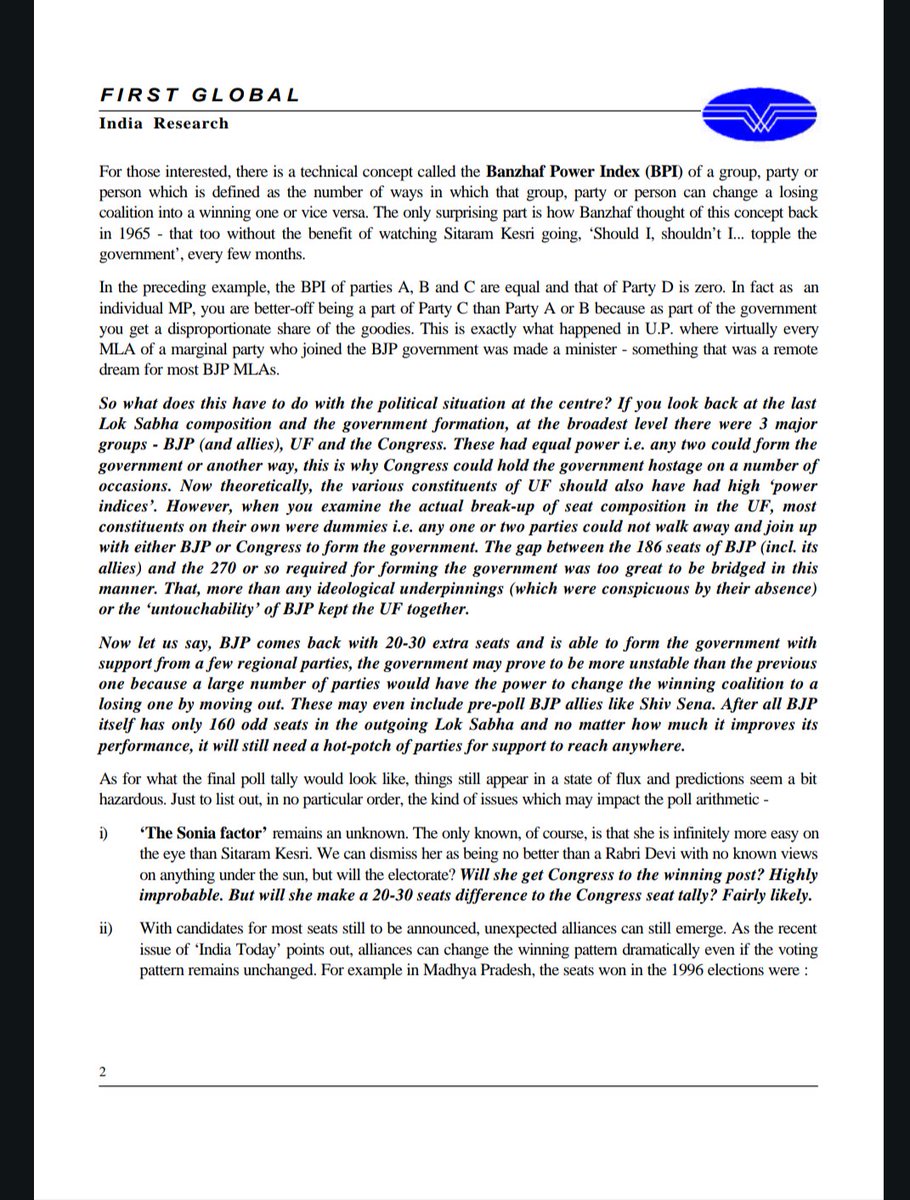
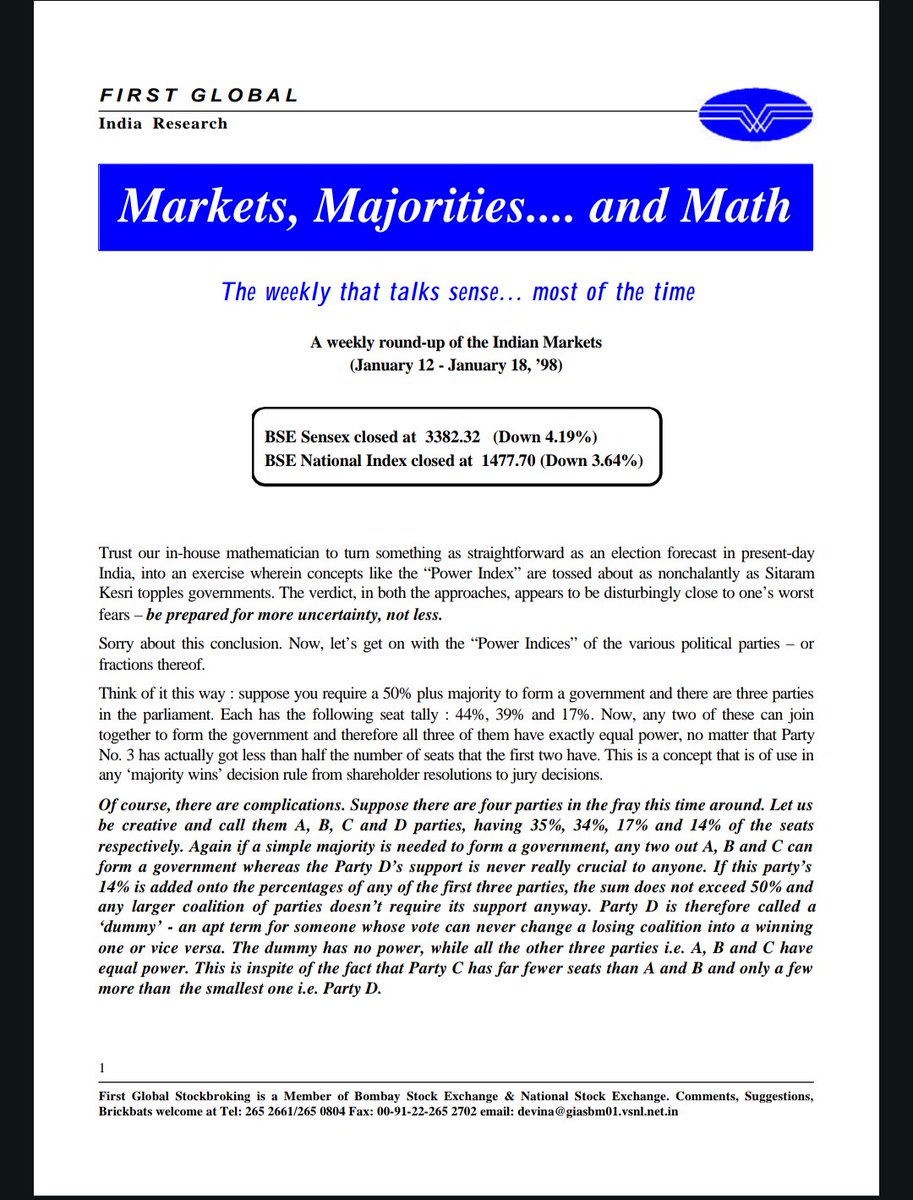
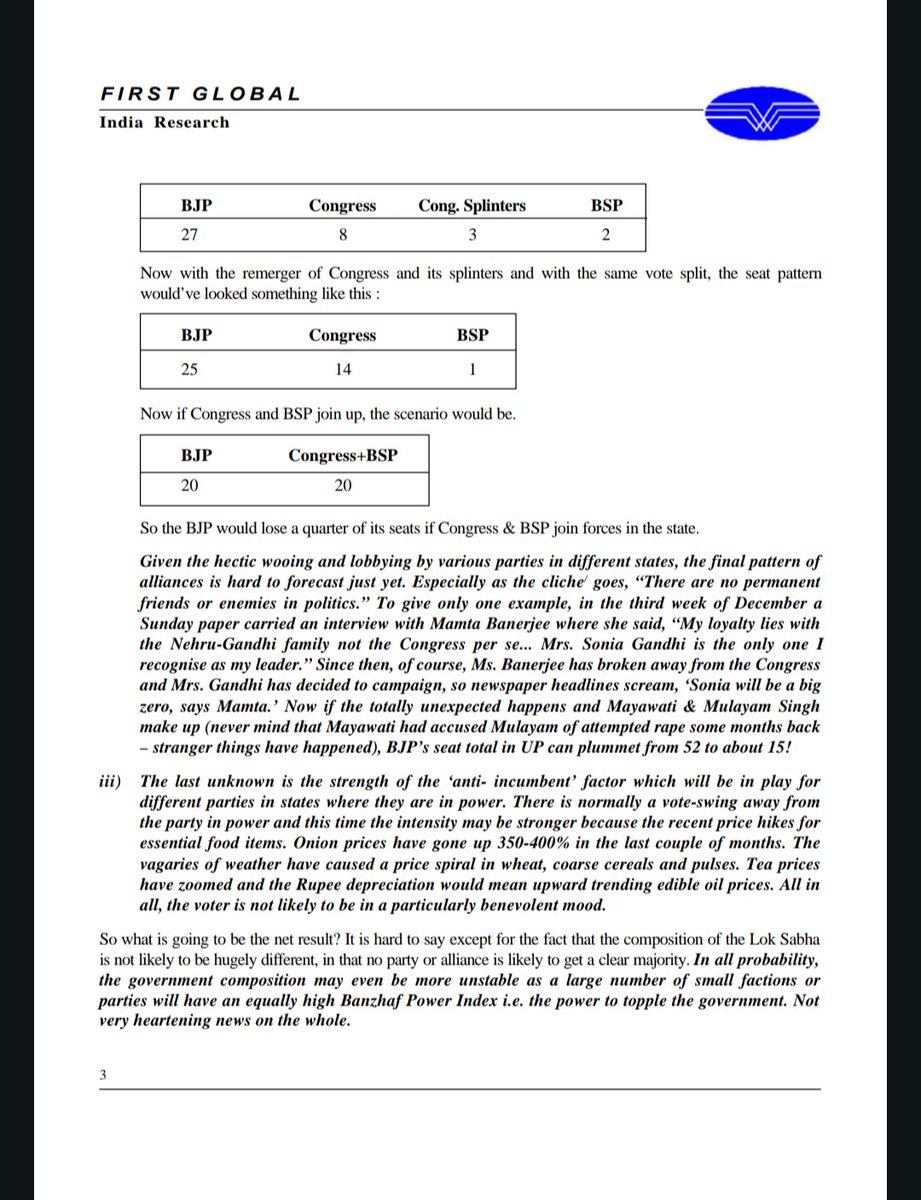
The mathematical index that explains what is happens in electoral democracies...currently playing in Tamilnadu
The Tamil Nadu government formation permutation- combination speculation reminded me of something I wrote a long time ago before the 1998 general election results.
It is the Banzhaf Power Index* which explains that power is not equal to the number of seats.
Thus if you need a 50% majority to form a government and there are 3 parties with 45%, 40% and 15% seats, their power in not in this proportion.
They all have EQUAL POWER because any two can combine to form the government.
On the other hand, there are scenarios where a party can have seats and no power.
In the late nineties, we had Lok Sabha majorities that turned on a single vote.
A single independent candidate could have as much power as the party with the largest number of seats in the Lok Sabha.
That is what happened post the 1998 election that this weekly is anticipating. And that is why we had another election in 1999.
It is also an interesting blast from the past on the political scene back then, with some players still around... and some not.
* I read about this Index first in 'A Mathematician Reads the Newspaper' by John Allen Paulos