Following the amazing reaction to the Marble Curriculum yesterday, we've decided to make it open source 🛰️👇
Everything a child learns in primary school. 1,590 concepts. 3,221 connections across 8 subjects, from Math and Science to Computing and Life Skills. Anchored in the US and UK curriculums, standard by standard (NGSS, Common Core, DfE).
What you will find in the repo: every concept as structured JSON with its age band and the evidence a child must show to master it. Every prerequisite link marked hard or soft, with a written rationale. It's a true DAG you can compute learning paths on. Open license, you can build whatever you want with it.
Now is a unique time in history to be building in education. Getting AI and kids education right is likely one of the hardest and most important problems to crack over the next decade and we need as many smart and creative minds behind it.
We think a common solid basis, accessible to all and that can be built upon, is critical to move fast. That's why we're making this curriculum open source.
It's not perfect but we know it's a robust basis, and we believe that sharing it openly is the fastest way to progress in this field. If you're building in education, share this around you and tell us in comments if you find this useful and if you want to contribute.
We'll keep working and investing on it @withmarbleapp. Credit goes to @guillaume_boni for building this. I just made it look pretty.
Links below 👇
content that gets cited in ai overviews follows 3 simple rules:
1. direct answer in the first 150 words
2. every section tied to a real search question
3. every section complete on its own
here is the content brief framework for you to rank on search and get cited by AI:
I built a content machine.
It turned me into a one-person media company, has driven tens of millions in pipeline for @tenex_labs, and is allergic to AI-slop.
It has also turned all of my employees into content creators.
I may opensource the whole thing, but for now, I'm going to share how I built it & how it works.
Feel free to copy & paste the steps to Claude/Codex if you want to build your own content machine.
Step 1: Map out the process
In order to make any of your work AI-native, you need to understand the way in which it's been done historically. This is why business context & domain expertise REALLY matters, even in a post-AI world.
Content has been my bread & butter for the last decade, so I started by pulling out an 8.5x11 sheet of printer paper and drawing the traditional process.
1) Look for inspiration
2) Pick a 10x content idea
3) Research the idea
4) Brain dump all of my thoughts about the idea
5) Decide the post format I want to create
6) Create a draft of the post
7) Edit the post
8) Create derivative versions of the post
9) Go live
10) Track performance
Step 2: Where am I needed vs. not needed?
I am needed for the first & final mile:
First mile: picking the idea/direction & providing all of the necessary context
Final mile: going through the final draft with a fine tooth comb & giving final sign-off.
AI can handle the rest:
Looking for inspiration, researching the idea, pulling my thoughts out, writing the post, doing a first edit, creating derivative content, and tracking performance.
Step 3: Build the Content Machine
The machine is one pipeline, run end-to-end or step-by-step. It is a directory of skills that mimic the steps in the content process that I've delegated.
1) The Oracle [AI]
Mines my Slack, Notion, call transcripts and Gmail for spikes, moments I naturally said something worth expanding, while the Internet Reader curates an external feed of X accounts & websites I've selected.
Qualifying ideas (≥6/10) are written to The Vault (a notion database of content ideas).
2) Select the idea from The Vault [Human]
3) The Researcher [AI]
Before any interview, build a sourced research-report.md: TL;DR, key facts with links, current developments, what's already been said, contrarian angles, and open questions for the interview. Claims are adversarially checked; fact is separated from opinion.
4) Interview Panel [AI + Human]
Six world-class interviewers (Joe Rogan, Howard Stern, Michael Barbaro, etc) ask 12–15 questions, one at a time, each pushing a different dimension...and never satisfied with vague answers. Won't advance without 2–3 specific stories, real numbers, and emotional specificity.
5) Production [AI]
The interview becomes a raw .md file: transcript, key stories, core insights, quotable moments, emotional anchor, surprising reveals, and the "so what." This raw file is sacred: my exact words, never paraphrased away.
6) Refinement [AI + Human]
I tell the machine what content type I want to create. It reads my custom style guide + past feedback lessons + content-type spec, then drafts in my voice...pulling real stories and quotes from the raw file. The #1 rule: write like you're texting a friend. Supports long posts, LinkedIn, X threads, and more.
7) Writer's Council [AI]
Six expert reviewers (Shaan Puri, Morgan Housel, David Perell, etc) score the draft through their own lens, splitting fixes into editorial (the machine can rewrite) and information gaps (only the creator can answer...these route back to the interview panel).
8) Revision Loop [AI]
Iterate until council scores 9/10.
9) Repurposing Engine [AI]
One anchor → 10+ natively-formatted derivatives, each re-hooked for its platform and each held to the same full Council → revision bar of 9/10. This is how two people produce like a hundred.
10) Final revision [Human]
11) Learning Loop [AI]
After approval, the machine compares first draft vs. final, extracts confirmed lessons, and saves them to that creator's content-lessons.md. Every future first draft starts smarter. Lessons override the style guide when they conflict.
Feel free to steal the machine & ask me any questions about how it works!
in 15 minutes, 2 Senior Staff Engineers at Airbnb gave a Live Lecture on Agentic Coding
Airbnb already shipped one of the most ambitious LLM-agent migrations in production.
Tonight two of their senior engineers shows how they actually build with agents in 2026.
Most builders are guessing. These guys ship.
bookmark & watch this.then read the complete article below.
talked to a bunch of current YC batch founders today
The ones hitting $1m+ ARR (there are several this batch) are just ripping the same outbound playbook every time:
1. build your lead lists using tools like Origami or Clay
2. Run an auto-connect + DM sequencer on LinkedIn
3. aim for 200 connects/week. linkedin is a goldmine
4. when writing Linkedin DMs, send 2-sentences, ideally with a warm thread (shared school, mutual, etc)
5. Post on LinkedIn 5x/wk minimum
6. get good at AEO (yes, you can get results in a few weeks )
Spend 20 hrs/wk doing this properly, and you will start consistently booking demos
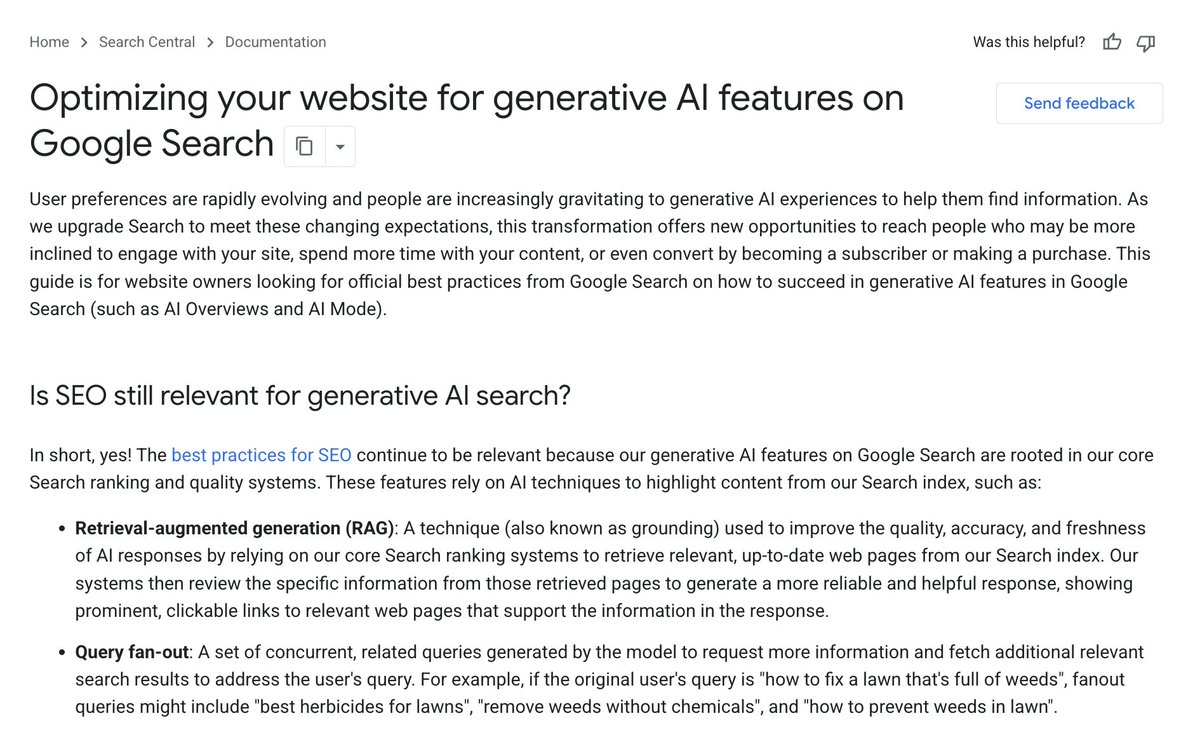
🚨 JUST IN - Google published a long piece about "Optimizing your website for generative AI features on Google Search" 👀
A lot in it https://t.co/22t75EtwUH
🧵
My 30+ observations on the greatest opportunities in AI agents right now:
And some ideas that are keeping me up at night.
1. The new buyer on the internet is an AI agent. Imagine billions of new customers showing up with money to spend but they only shop via MCP. That's what's happening. No MCP server means you're invisible to the fastest growing buyer on the internet.
2. Every franchise system in America (30,000+) needs an agent layer and none of them have one. One founder per franchise vertical. That's 30,000 businesses waiting.
3. Everyone said "distribution is the only moat" a year ago. Now I'd add that the only moat is distribution plus memory. The company that has your audience AND your agent's accumulated context is impossible to leave.
4. Consumer mobile is more interesting than it's been since 2012. Apps can finally DO things for you instead of showing you things. The next wave of $100M apps are being built right now.
5. The most interesting startup nobody has built is an agent marketplace where you rent access to someone else's trained agent. A recruiter spent 6 months training a sourcing agent on healthcare hiring. That agent is worth renting to every other healthcare recruiter on earth. The agent itself becomes the product.
6. A sorta strange phenomenon that's happening right now is agents are developing preferences. Give the same agent the same task 100 times and it starts developing patterns in how it approaches it. Nobody is studying this yet. But the agents that develop good patterns are worth more than the ones that don't. That's a new kind of asset.
7. Dead internet theory is about to become dead SaaS theory. Half the apps you use will quietly replace their support team, their onboarding team, and their content team with agents. You won't notice for months. Then you'll realize you haven't talked to a human at that company in a year.
8. The most valuable data in the world right now is sitting in the support tickets of small or mid tier SaaS companies. Every ticket is a customer telling you exactly what to build next. Mine this.
9. The most interesting pricing problem nobody has solved is how do you price a product when your costs change every time OpenAI or Anthropic updates their model pricing? Your margins can swing 40% overnight based on a decision made in San Francisco. The company that builds dynamic pricing infrastructure for agent-based businesses solves a problem every AI company has.
10. The best AI products feel like they're reading your mind. The worst ones feel like filling out a form with extra steps.
11. An interesting arbitrage I've noticed lately is hiring a human VA for $20/hour to supervise an AI agent that does $200/hour work. The human just checks the output.
12. The managed AI agent business is becoming the new agency model. $5k/month per client. You build it, run it, maintain it. The client gets a digital employee they never have to think about. This will be a $50 B+ category.
13. The first "shadow agent" scandals are about to drop. Employees running personal agents on company infrastructure without telling anyone. Using company API keys. Agents accessing internal docs. IT departments have little visibility into this right now. Lots of opportunity to build companies here. Definitely a painkiller not a vitamin type of business.
14. Right now there are probably millions of agents running on autopilot that their creators forgot about. Still burning tokens. Still sending emails. Still scraping websites. Still costing money. The "find and kill your zombie agents" tool is a product that writes itself.
15. Companies are starting to hire based on someone's agent portfolio instead of their resume. "Show me 3 agents you built that are running right now." It's REALLY early but it's starting.
16. Your Slack archive is a product. Every company's internal Slack has thousands of messages explaining how they actually do things. The company that lets you point an agent at your Slack history and auto-generate SOPs and agents from it will be enormous.
17. We're watching the cost of intelligence fall faster than the cost of distribution. Which means distribution is now the expensive thing.
18. The most underrated asset a human can have in 2026: the ability to sit in a room with another human, make eye contact, and have a real conversation. As AI handles more of the transactional stuff, the humans who can do the relational stuff become disproportionately valuable. The soft skills people used to dismiss as fluffy are becoming the hard skills. The hard skills people spent decades acquiring are becoming the soft ones.
19. There are MANY huge companies to be built around the fact that most people's agents are running on their personal laptops which they also use to browse the internet, check email, and download random files. The attack surface is enormous. One compromised Chrome extension and your agent's API keys, customer data, and workflows are exposed.
20. There's a new type of burnout forming that doesn't have a name. It's not from working too hard. It's from context switching between human work and agent work 50 times a day. Reviewing agent output, correcting it, approving it, reviewing again. The mental load of supervising agents is different from the mental load of doing the work yourself. Some founders are telling me they were less tired when they did everything manually because at least the cognitive pattern was consistent.
21. The cheapest form of market research: search "[your industry] spreadsheet template" on Google. Whatever people are tracking manually is your product.
22. Half the YC companies pivoted within 8 weeks of demo day. Not because they failed. Because agents let them test 5 ideas in the time it used to take to test one. The concept of "committing to an idea" is dissolving. Serial pivoting is becoming the default because 1) AI lets you move fast 2) the world is moving fast.
23. The loneliest job in tech right now is being the only person at your company who understands what the agents are doing. You can't explain it to your boss. You can't hand it off to a colleague. If you leave, everything breaks. You've become a single point of failure for an entire automated system. That person needs a title, a team, and a backup plan. Most companies haven't figured this out yet.
24. Your browser history is the most valuable training data you own and you're giving it away for free. Every site you visit, every product you research, every competitor you study, every pricing page you screenshot. That behavioral data, structured and fed to an agent, would make it understand your business better than any onboarding call. The company that lets you turn your browser history into agent context builds something nobody can replicate.
25. Everyone is building AI wrappers. Nobody is building AI unwrappers. The tool that takes an AI-generated document and tells you which parts a human wrote and which parts were generated.
26. Stripe just became the most important company in the agent economy and they barely had to do anything. Every agent that sells something needs Stripe. Every agent that buys something needs Stripe. They're the payment rail for the entire agentic internet by default.
27. The most undervalued API in the world right now is the US Postal Service address verification API. It's practically free. Every local business lead gen agent needs it. Every real estate agent needs it. Every direct mail agent needs it. Boring government infrastructure is quietly becoming the backbone of agent-native businesses.
28. The concept of "business hours" is for humans. Your agent closed a deal in Tokyo at 3am, processed the payment, sent the onboarding email, and updated the CRM before your alarm went off.
29. What happens when agents start recommending other agents? Your research agent finds that a competitor's sales agent is better and suggests you switch. Agent referral networks are forming organically. The first agent affiliate program is probably 6 months away.
30. Cal dotcom closed their source code. That's the canary. When open source companies start closing up, it means agents were cloning their product too easily. Every open source company is quietly asking the same question right now.
31. "AI for pet groomers" sounds like a joke and that's exactly why it will work. 150,000 of them in America. Zero tech. All scheduling by phone or IG DMs. The joke ideas always win.
32. The thing that will seem most obvious in hindsight: we spent 2025-2026 arguing about which model is best while the entire value was in the orchestration layer. The model is the CPU. Nobody buys a computer based on the CPU anymore. They buy it based on what they can do with it. Makes so much sense in hindsight. What else will be obvious in hindsight?
I'll share more notes soon.
I can't sleep with all that's going on. Maybe you too.
What an incredible time to be building.
need a researcher? hire one for $90K
need an editor? hire one for $85K
need a PM? hire one for $110K
need an analyst? hire one for $120K
need a recruiter? hire one for $95K
need an ops lead? hire one for $100K
need a fractional CFO? hire one for $180K
total: $780,000 a year.
OR
drop 7 markdown files in one folder
Claude runs all 7 jobs on demand
total cost: $20/month
most founders are one bad hire away from running out of money.
most operators are one folder away from never needing the hire.
the article has all 7 files. copy them. paste them. ship.
the team is the folder.
I'm looking for 50 more software engineers to join my team at https://t.co/dSpoqHsWo9 for the next week. We work with frontier labs to help them train models.
100 - 200 USD /hr. Fully remote. Hiring in 150+ countries. RT's appreciated!
https://t.co/DGV9sKw6di
THIS GUY IS LITERALLY GIVING AWAY THE DESIGN PLAYBOOK FOR CLAUDE DESIGN 🤯
A Free 2-hour masterclass showing how to build an ENTIRE startup:
→ brand guidelines
→ decks
→ website
→ apps
→ videos
... using ONLY Claude Design.
Guide is below + full tutorial in 🧵 ↓
If I sold my company tomorrow, I'd build my next multi-million dollar business in 90 days using Claude.
Here's the exact 5-person AI team I'd hire on day one. Steal every prompt.
Agents make ugly UIs because they've never seen good design.
We've been fixing that, 2,000 DESIGN.md files from the world's best products, structured for a model to read and learn. Colors, type, spacing, layouts and more.
Free. https://t.co/mJaKNHba0O
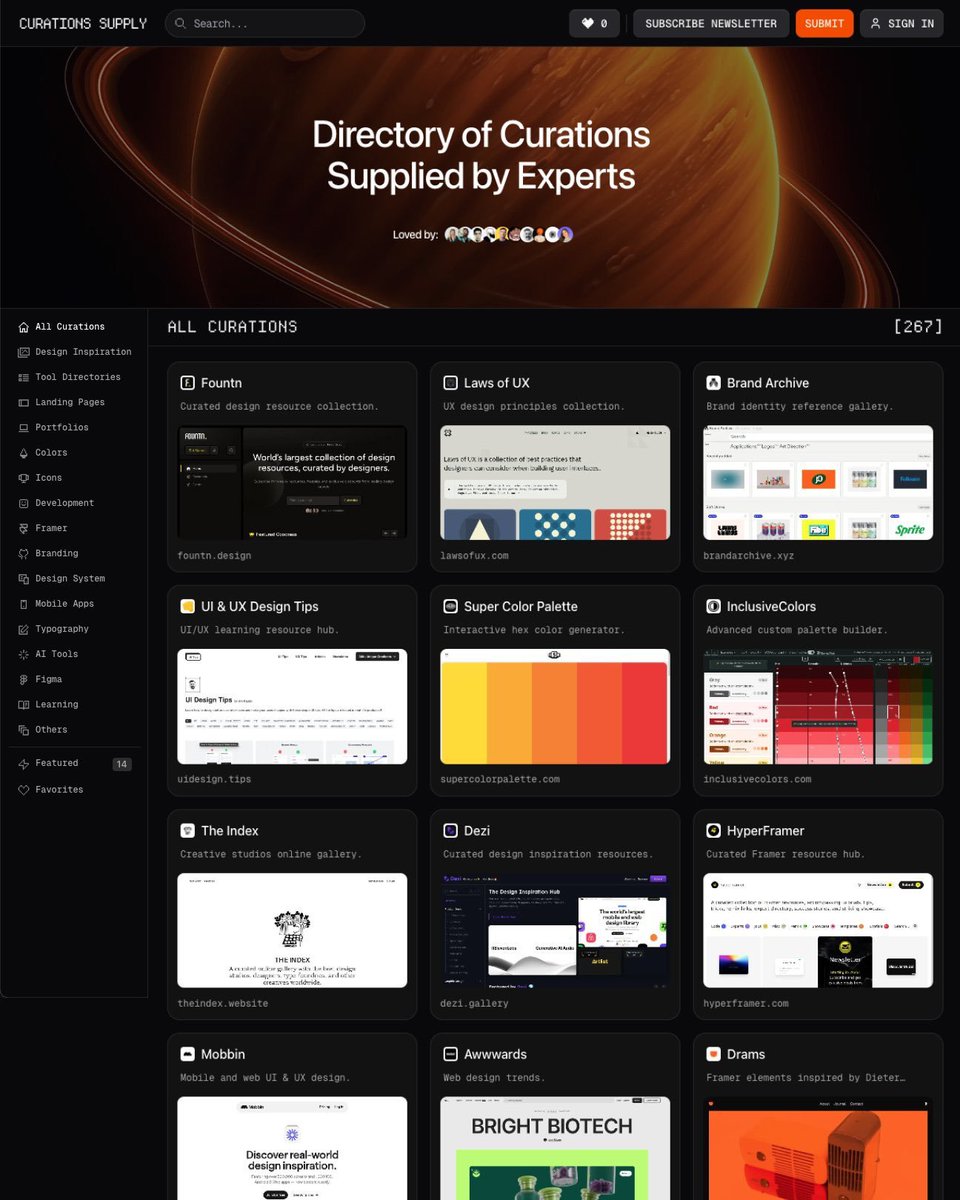
UI/UX Designers, here are my go-to best design resource sites on the internet you should bookmark:
Design Library → https://t.co/MbhnAQB0yP
Landing Pages → https://t.co/lgMLG11AID
Saas Websites → https://t.co/MsoiXI7Z2k
AI Mobile App Builder → https://t.co/lKjrIDwXBY
Fonts → https://t.co/mtLpMHU8gh
Animation → https://t.co/N4N9EUHc5B
Mobile Apps → https://t.co/YxsQM2IoaD
Brands → https://t.co/wTIpDJhsvr
Icons → https://t.co/7N0AzaGl6E
Design Systems → https://t.co/9kAEoD5FUf