

Top Tweets for #700MS

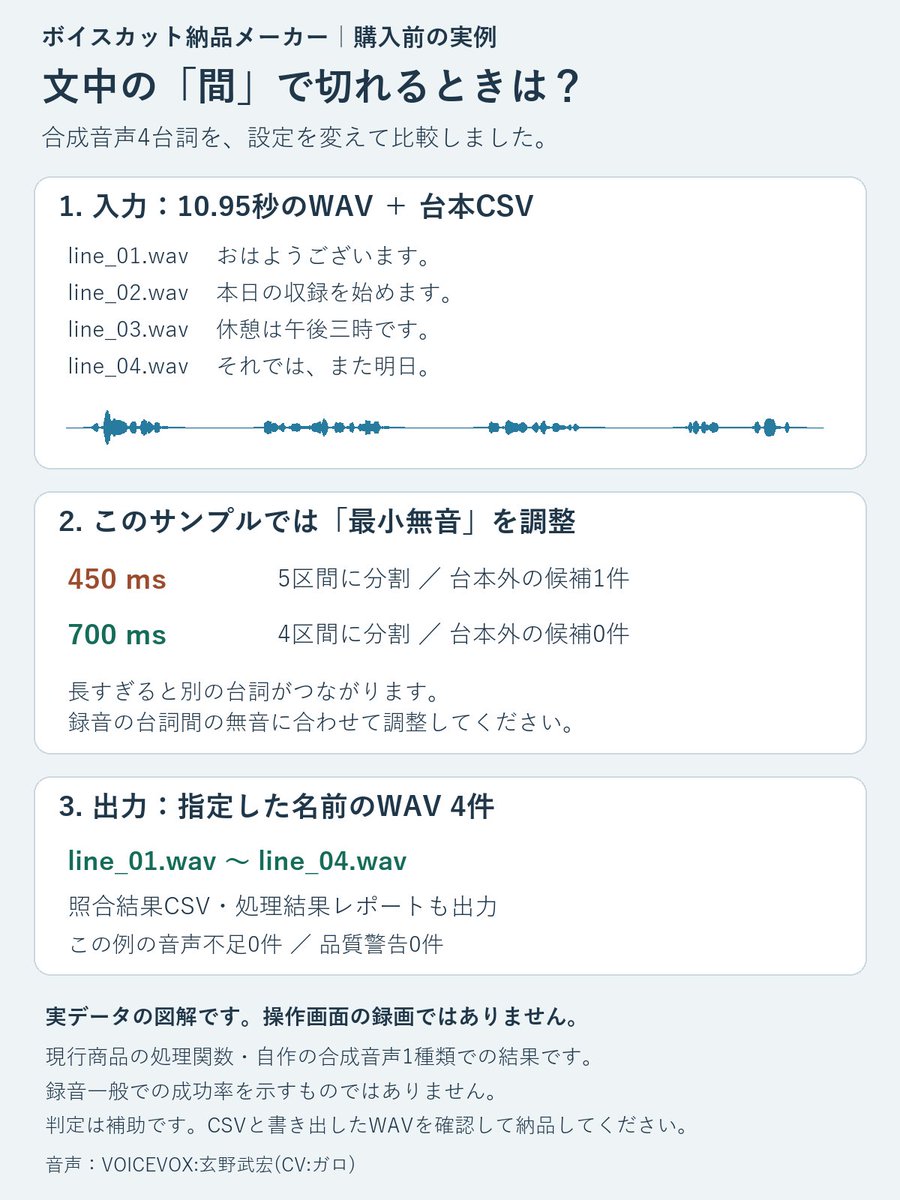
ゲーム用の通しWAVを台詞ごとに分けると、文中の「間」で切れることがあります。
自作4台詞では最小無音450→700msで5区間→4区間。万能な��定ではなく、出力後の再生確認は必要です。
無料の解説に実例と無料ツール、自作の有料Windowsソフトの条件をまとめました。
https://t.co/U7W1gSJSUa

Argon2id is the password hashing function MemryNote uses to derive your vault key.
Slow on purpose. Brute-force attacks get expensive. Costs me 700ms on login. Costs an attacker years per password guess.
Full docs page: https://t.co/W56I8EzITl

Tired of Cross-Chain Integration Pain? 😩
Building swaps into your wallet, trading bot, DeFi app, or AI agent shouldn’t be this hard.
The old way:
◾️Months spent integrating 10+ bridges, aggregators, and DEXs
◾️Separate code for Solana and every EVM chain
◾️Liquidity fragmentation - best prices scattered everywhere
◾️Constant headaches with routing, gas, relayers, approvals, and fallbacks
◾️Every new chain means rewriting half your infrastructure
The Delora @deloraprotocol way:
One simple API!
That’s it.
▫️Access global liquidity across Solana + EVM
▫️Best prices with smart routing
▫️Seamless cross-chain execution in <700ms
▫️Full abstraction of all the complex plumbing
▫️Launch faster, maintain less, and deliver a much better user experience
Delora @deloraprotocol lets teams focus on building great products - not fighting blockchain infrastructure.
Welcome to Delora @deloraprotocol: Full-Stack Trading Infrastructure for On-Chain Apps ⚡️
Modern on-chain apps deserve modern trading infrastructure!
And Delora @deloraprotocol connects wallets, agents, trading platforms, and DeFi products directly to global liquidity across chains.
One integration = seamless swaps, bridges, and execution.
No more juggling multiple DEXs, routers, and RPCs.
Build faster, deliver better UX, and let your users trade effortlessly - whether on Solana, EVM, or anywhere else 🙌
The infrastructure layer that abstracts complexity so you can focus on your product.
Link: https://t.co/tfYVWCoyum (social, team and etc)
Website: https://t.co/i7sTZ6ZoEX


From 700ms or 2.34 sec. To 1ms or 2ms api call time .
I have improved my queries and api call method and more to make it faster.
And it now looks like a thunderstorm even in the development phase .
Love how we improve ourselves over time by figuring out things yourself .

My api taking too much time .
I think...
Any suggestions how can work on this to fix and make it lighter and faster


@chilllardhouse Just using a Helius RPC + websocket and selecting Helius Sender as the provider is already fast enough for most users.
That setup is currently giving around 500-700ms execution from deploy in normal conditions.
I’ll also be integrating more private relays over the coming days.

Nobody talks about what RGB actually breaks at the protocol level. Here's why that matters for every wallet you use.
Lightning was always the execution layer. Bitcoin was always the settlement layer. The missing piece was always: what asset do you move?
BTC is volatile. Wrapping it creates custodial risk. Bridging USDT from Ethereum means trusting a multisig.
RGB solves this from first principles.
The insight most people miss:
RGB doesn't "add" assets to Bitcoin. It delegates asset logic entirely off-chain, using Bitcoin only to prevent double-spends. Your wallet proves ownership locally. No contract on-chain. No miner knows what you transferred. The chain only verifies "this happened" not "what happened."
That single design decision unlocks:
- Fee predictability (settled in the asset, not gas)
- Default privacy (only counterparties hold state)
- Infinite composability (any asset, same rail)
@utexocom took that primitive and asked: what if any wallet, exchange, or app could access this in one API call?
No node to run. No channels to manually fund. No RGB spec to read.
Just: send USDT, receive confirmation in 700ms, Bitcoin underneath.
The real competition isn't Tron vs Bitcoin for USDT.
It's "which developer experience wins before the next 100M users arrive?"
Utexo just answered that question.
gUtexo
@utexocom @VIhnatiuk @RGBAssociation @RGB_Hub @Atrueb01


Day 3 of Loopency #BuildInPublic:
TL;DR
12–15s provisioning (full CRM+Finance suites) was dragging hard and I feel users wait too long for value.
Causes:
1. Sydney latency on Supabase was creating network bottleneck for each provision.
2. Too many SQL sequential flushes were blocking the provision.
3. Each time user clicks on a template, raw provisions were happening, even though the templates are static at the beginning and only dynamic when mixing with other templates or editing it for your own taste/need.
Big step:
1. Pre-seed frozen templates → fast server-side PostgreSQL deep clone on demand (tiny blocking path, rest async/lazy).
2. Pre-defined dashboards. Dynamic once provisioned
Expectation: ~300–700ms common templates, sub-1s suites. This could make starting a workspace feel instant.
Coding the clone function now — momentum's building.
Your biggest onboarding friction right now? Reply — I'll read every one.
https://t.co/eycC8VPVVU #NoCode #SaaS #SMB

My daily work usually involves 4-6 terminals with claude at the same tile tiled neatly on the big screen.
One of them is called „tools” and his role is to create and upgrade tools used by the whole team.
He works every day, improving the workflows. Today we were working on dev-browser fork I’m using.
And it managed to profile the execution time and found a way to cut down the execution time of some tools from 700ms to 33ms…
🤯

@victortenold very true, right now I'm focusing on user comfort... because sometimes 700ms-1 second also feels like a lot and that's one reason why I am working on this interesting update, If I am successful, touch wood, it should be less than 200 milliseconds to maybe maximum 250ms.

I implemented cache from scratch
- Cache aside pattern
- TTL + stale handling
- LRU / FIFO eviction strategies
- Observability via cache metrics
- Latency improvement: ~700ms → ~3ms
Built as a reusable package, then wired into a service.
https://t.co/aihlwSc0H0

GN builders 🌙
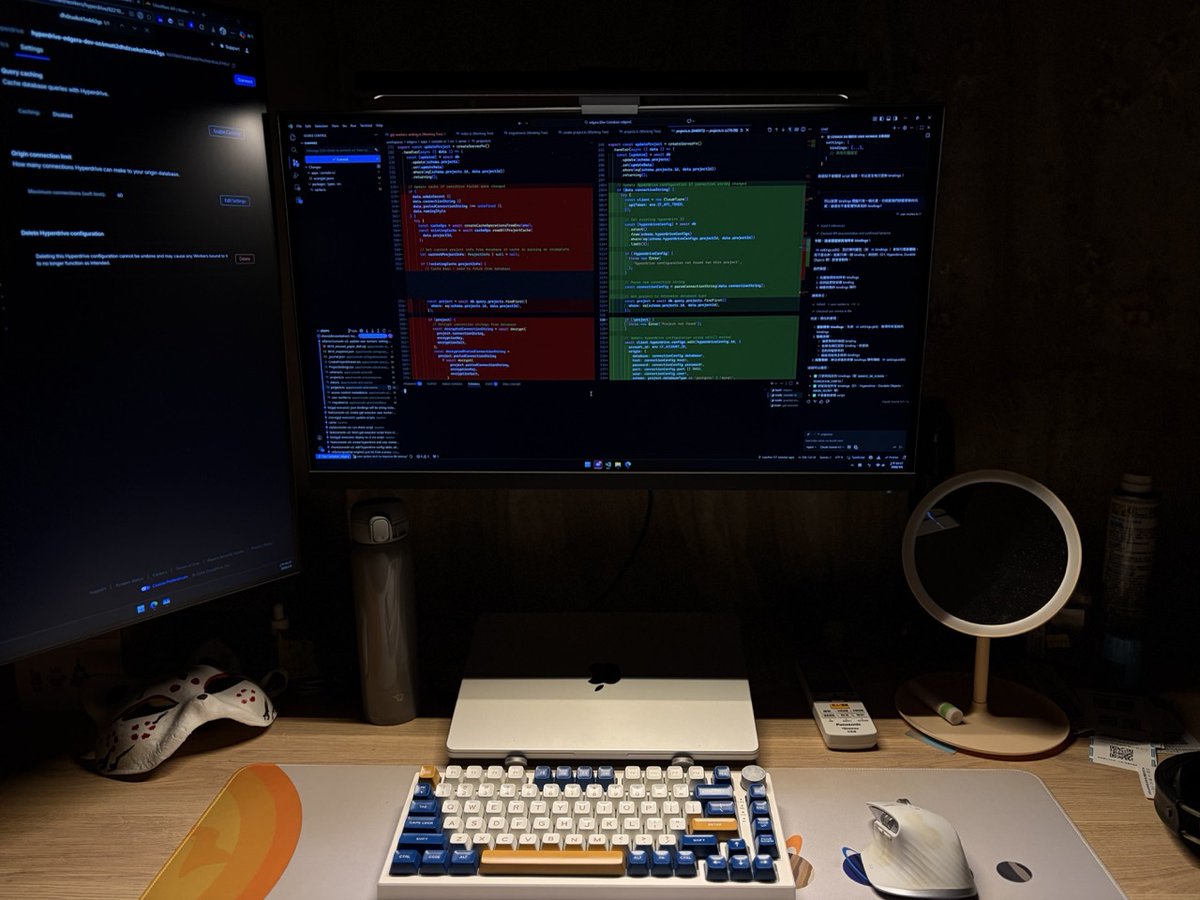
Massive progress today! Just finished a major architectural refactor for Edgera.
⚡️ Performance jump: Query speed improved from 500-700ms down to 200-350ms. The difference is insane!
🚧 The "Builder" Struggle: Hit the Cloudflare Hyperdrive limit (25) during testing. Just submitted a request to bump it to 250-500. Fingers crossed!
🛠️ Next: Adding connection pool configurations to the UI, giving users full control.

Great example. The simplest approach - good enough for most apps - is to add a loading or transition animation to the UI: a spinner, a skeleton screen, an intentionally timed animation that covers the duration of the query... There are countless variations, but the core idea is always to make sure the user is engaged while waiting.
If you want to go a step further, you can look at the specific UI and what that 700ms Supabase query is actually used for, then design a smarter, more contextual UI/UX solution. Something like a generic spinner works for most apps, but it’s probably not the smoothest or most satisfying approach.
To bring in another example, when I'm building AI agents for my clients, most of the times the user has to wait several seconds before seeing any output token being streamed out. By streaming to the frontend intermediary events about what's going on in the backend while the AI agent thinks (e.g., reading a document, looking for info online), the user gets visual feedback about what the app is doing and doesn't feel stuck waiting for the answer, drastically reducing the perceived response time. And I'm not just saying this myself - many clients and users of mine gave me this feedback.
Of course, realistically, if you have backend latency like in your example and you know it can be fixed fairly easily, you should absolutely do that. My point is: instead of losing your mind over backend latency optimizations, look for UI improvements that will solve your latency issue and make users UX better at the same time.

Ok, so let's take a real example that someone posted. He had a situation where a simple Supabase query took 700ms or so, and was hurting the interaction with the user.
His solution was to change something at the backend, to completely remove this delay. How would you "fix" the perceived delay using only UI?

Nobody:
Flip: “is that Ohtani guy really like that?yea I’m pocket watching but… $700Ms?!”
Ohtani: ⤵️⤵️⤵️

Shohei Ohtani in NLCS Game 4:
As a pitcher: 6 IP, 2 H, 0 ER, 10 K
As a hitter: 3-for-3, 3 HRs, 3 RBIs
This is one of the greatest performances in MLB history to send the Dodgers to the World Series.

@SleeperMets Nobody else fault u spent 700Ms on one player and didnt make the playoff🤣🤣🤣 now you bout to have to over pay to keep Alonso

Hey guys!
DeFi is maturing fast. But speed, liquidity, and user experience don’t often come together in one place. These three projects are working to change that
@Aptos is pushing the limits of what a blockchain can handle. With block times under 150ms and user finality under 700ms, it’s already faster than most global payment rails. Add in innovations like Raptr (for consensus), Zaptos (for scaling), and Shardines (for parallel execution), and Aptos is actively preparing for millions of TPS. Low fees averaging fractions of a cent make it not just powerful, but accessible.
@multibank_io is where traditional finance finally meets crypto in a serious way. By tokenizing assets like real estate and commodities, it creates liquidity for markets that were previously locked. Partnerships with compliance-first providers ensure institutions can join without regulatory hesitation. Imagine $10B in luxury real estate being tokenized and traded on-chain that’s no longer a thought experiment, but a roadmap in progress.
@SonicLabs introduces a fully on-chain central limit order book (CLOB) that powers spot, perpetuals, and smart liquidity. Instead of siloed DEXs with limited depth, Sonic creates a pro-grade exchange environment while staying true to DeFi transparency. Traders don’t need to compromise between user experience and decentralization anymore.


@Doflamingo_II No lags from my end
Ping is high tho, around 250ms - 700ms

@TotallyNotHider I beat hotel hell while constantly spiking to 700ms or near disconnecting every 2 minutes and have no idea how I didn’t die since I had multiple ambushes

@Philz_Hasty @OfficialKgKong @coman2023 I use starlink at times it whines.
I think the latency of the networks goes above 700ms, 900m and on.
It makes playing laggy

@not_a_typolamce @SeiNetwork @KaitoAI @Sei_FND @BuildwithSei $SEI is trending because it’s:
→ Fast (400ms, 200K+ TPS)
→ AI-ready
→ EVM-focused (SIP-3)
→ Picked for WY stablecoin
→ Giga Upgrade = 700ms finality
Plus, SEI Gaming = 🔥
Most Popular Users

Elon Musk 
@elonmusk
239.6M followers

Barack Obama
@barackobama
118.6M followers

Cristiano Ronaldo
@cristiano
114.3M followers

Donald J. Trump
@realdonaldtrump
111.7M followers

Narendra Modi
@narendramodi
106.9M followers

Rihanna
@rihanna
98.6M followers

NASA
@nasa
92.1M followers

Justin Bieber
@justinbieber
91.7M followers

KATY PERRY
@katyperry
89.9M followers

Taylor Swift
@taylorswift13
83.9M followers

Lady Gaga
@ladygaga
75.4M followers

Virat Kohli
@imvkohli
73.3M followers

Kim Kardashian
@kimkardashian
70.8M followers

YouTube
@youtube
68.6M followers

Neymar Jr
@neymarjr
66.3M followers

Bill Gates
@billgates
65.1M followers

Selena Gomez
@selenagomez
63M followers

The Ellen Show
@theellenshow
62.1M followers

CNN
@cnn
61.7M followers

X
@x
60.6M followers