

Top Tweets for #ARTICLE32

⚖️ क्या कोई आम नागरिक सीधे सुप्रीम कोर्ट जा सकता है? 🇮🇳
क्या सुप्रीम कोर्ट जाने के लिए पहले जिला अदालत और हाई कोर्ट जाना अनिवार्य है? 🤔
जवाब है – नहीं!
#GEOIAS #SupremeCourt #Article32 #IndianConstitution #IndianPolity #FundamentalRights #DrBRAmbedkar #UPSC #UPSCPreparation

⚖️ Article 32 empowers citizens to approach the Supreme Court to protect their Fundamental Rights through 5 constitutional writs.
📚 Essential Polity topic for UPSC & SSC!
#IndianPolity #Article32 #UPSC #SSC #Examlife


This is a misinterpretation of the constitution. #Article32 is an absolute right !
To exhaust the remedy under Art 226 before Art32, is just a matter of #practice proposed long back by the SC in its judgement of Union of India vs Paul Manickam, 2003. This case was decided by a division bench of #2judges
However the law remains clear,
That the mere existence of an alternative legal remedy cannot be a ground to throw out an Article 32 petition if a violation of a fundamental right is prima facie established. This was settled by a #5judges constitutional bench in K.K. Kochunni v. State of Madras, 1959.
Under judicial discipline, a smaller bench cannot bypass or override the binding precedent of a larger bench (Art 141). Also, there is no statutory or constitutional bar for a citizen to approach the Supreme court of india before the high court.
The Constitution of India nowhere states that a citizen must exhaust Article 226 remedy before invoking Article 32. By creating the"go to the High Court first" rule, the Supreme Court has essentially layered a filter over an absolute right.
Also, it is time to look how effectively have the HC's handle matters underArt 226.
The process becomes the punishment for the victim.

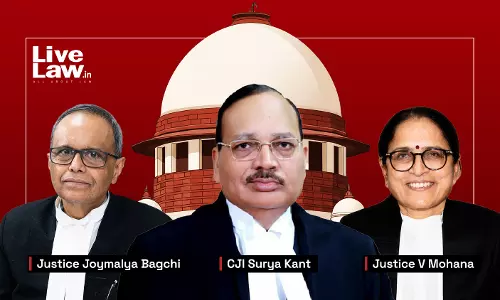
#BREAKING "Why can't #SupremeCourt entertain Article 32 petition for breach of #FundamentalRights?" - Advocate argues before CJI Surya Kant's bench
The bench noted that the petitioner had not approached the High Court first under Article 226
Adv: If I am coming under Article 32, Supreme Court can't [shy]
J Bagchi: Breach of fundamental rights is an overlap in Articles 32 and 226. We would always love court of first instance to take cognizance of violation of fundamental rights
Adv: It's guaranteed that Supreme Court can't suspend the rights...fundamental rights
J Bagchi: You're right. Neither can HC
Adv: Why question of HC ? If Parliament decided both Article 32 and Article 226
J Bagchi: You have a fundamental duty to enforce those rights
Petition disposed of giving liberty to approach HC.

भारतीय संविधान का अनुच्छेद 32 (#Article32):
#मौलिक_अधिकारों की रक्षा का संवैधानिक अधिकार
डॉ. भीमराव अंबेडकर ने अनुच्छेद 32 को संविधान का “हृदय और आत्मा” कहा था। यह अनुच्छेद नागरिकों को अपने मौलिक अधिकारों के उल्लंघन के विरुद्ध सीधे भारत के सर्वोच्च न्यायालय में जाने का अधिकार देता है।
🚨 अनुच्छेद 32 के प्रमुख बिंदु:
1. मौलिक अधिकारों की सुरक्षा:
यदि किसी व्यक्ति के मौलिक अधिकारों का उल्लंघन होता है, तो वह न्याय पाने के लिए सुप्रीम कोर्ट जा सकता है।
2. सीधे सुप्रीम कोर्ट जाने का अधिकार:
अनुच्छेद 32 मौलिक अधिकारों को लागू करवाने के लिए सर्वोच्च न्यायालय जाने का संवैधानिक अधिकार देता है।
3. पाँच प्रकार की रिट (Writs):
• बंदी प्रत्यक्षीकरण (Habeas Corpus): गैरकानूनी हिरासत से मुक्ति के लिए।
• परमादेश (Mandamus): किसी सार्वजनिक प्राधिकरण को उसका कानूनी कर्तव्य निभाने का आदेश।
• प्रतिषेध (Prohibition): अधीनस्थ न्यायालय या अधिकरण को अधिकार-क्षेत्र से बाहर कार्यवाही करने से रोकना।
• उत्प्रेषण (Certiorari): निर्धारित कानूनी आधारों पर अधीनस्थ न्यायालय या अधिकरण के आदेश को निरस्त करना।
• अधिकार-पृच्छा (Quo Warranto): यह जाँचना कि कोई व्यक्ति किस कानूनी अधिकार से सार्वजनिक पद पर बैठा है।
4. यह स्वयं एक मौलिक अधिकार है:
अनुच्छेद 32 केवल अधिकारों की रक्षा का साधन नहीं, बल्कि स्वयं भी एक मौलिक अधिकार है।
5. सरकार भी संविधान से ऊपर नहीं है:
यदि सरकार का कोई कानून, आदेश या कार्रवाई मौलिक अधिकारों का उल्लंघन करती है, तो उचित मामले में सर्वोच्च न्यायालय हस्तक्षेप कर सकता है।
6. अनुच्छेद 32 और अनुच्छेद 226 में अंतर:
• अनुच्छेद 32: मौलिक अधिकारों के प्रवर्तन के लिए सुप्रीम कोर्ट।
• अनुच्छेद 226: हाई कोर्ट मौलिक अधिकारों के साथ-साथ अन्य कानूनी अधिकारों के लिए भी रिट जारी कर सकता है।
7. क्या इस अधिकार पर रोक लग सकती है?
अनुच्छेद 32(4) के अनुसार, इस अधिकार को केवल संविधान में दिए गए प्रावधानों के अनुसार ही निलंबित किया जा सकता है। आपातकाल के दौरान अनुच्छेद 359 के तहत कुछ मौलिक अधिकारों के प्रवर्तन के लिए अदालत जाने के अधिकार पर निर्धारित सीमाओं के अनुसार रोक लगाई जा सकती है।
✅ निष्कर्ष:
अनुच्छेद 32 भारतीय लोकतंत्र की एक महत्वपूर्ण संवैधानिक सुरक्षा है। यह नागरिकों को अपने मौलिक अधिकारों के उल्लंघन के विरुद्ध सर्वोच्च न्यायालय से न्याय माँगने का अधिकार देता है। लोकतंत्र में सरकार की शक्ति असीमित नहीं होती; उसे संविधान और कानून के दायरे में रहकर कार्य करना होता है।
संविधान सर्वोपरि है, नागरिकों के मौलिक अधिकार अनमोल हैं और न्यायपालिका उनकी संवैधानिक रक्षा की प्रमुख संस्था है।
#Article32 #अनुच्छेद32 #भारतीयसंविधान #ConstitutionOfIndia #FundamentalRights #मौलिकअधिकार #RightToConstitutionalRemedies #SupremeCourtOfIndia #डॉभीमरावअंबेडकर #संविधानकीरक्षा #RuleOfLaw #लोकतंत्र #न्याय_और_संविधान #JantarMantar


సుప్రీంకోర్టు చరిత్రలో సంచలనం.. ఎన్నికల కమిషనర్ల నియామకాలపై పిటిషన్ దాఖలు
#SupremeCourt #QuoWarranto #CECGyaneshKumar #ElectionCommission #ECI #SukhbirSinghSandhu #VivekJoshi #Article32 #CECAppointment #ElectionCommissioners #2023Act #SuriPayala #WritPetition #UnilateralECI #LegalNews #Breaking
@ECISVEEP @rashtrapatibhvn @PMOIndia d
https://t.co/fCijB5ybJo

🙏🙏🙏🇮🇳❤️🤍💚⚖️✍️
IN THE #SUPREMECOURTOFINDIA
UNDER #ARTICLE32 OF THE #CONSTITUTIONOFINDIA
PUBLIC INTEREST LITIGATION
WRIT PETITION #CIVIL NO. _____ OF 2026
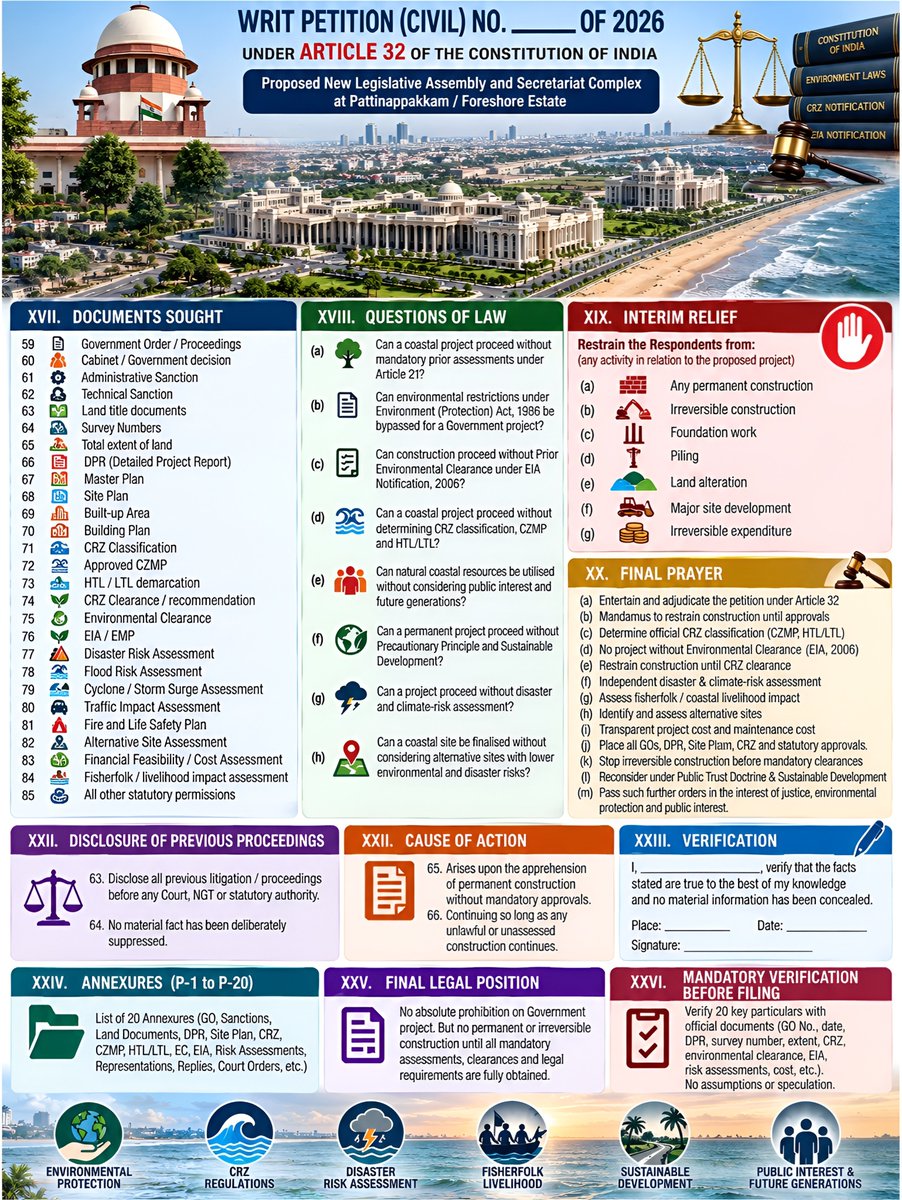
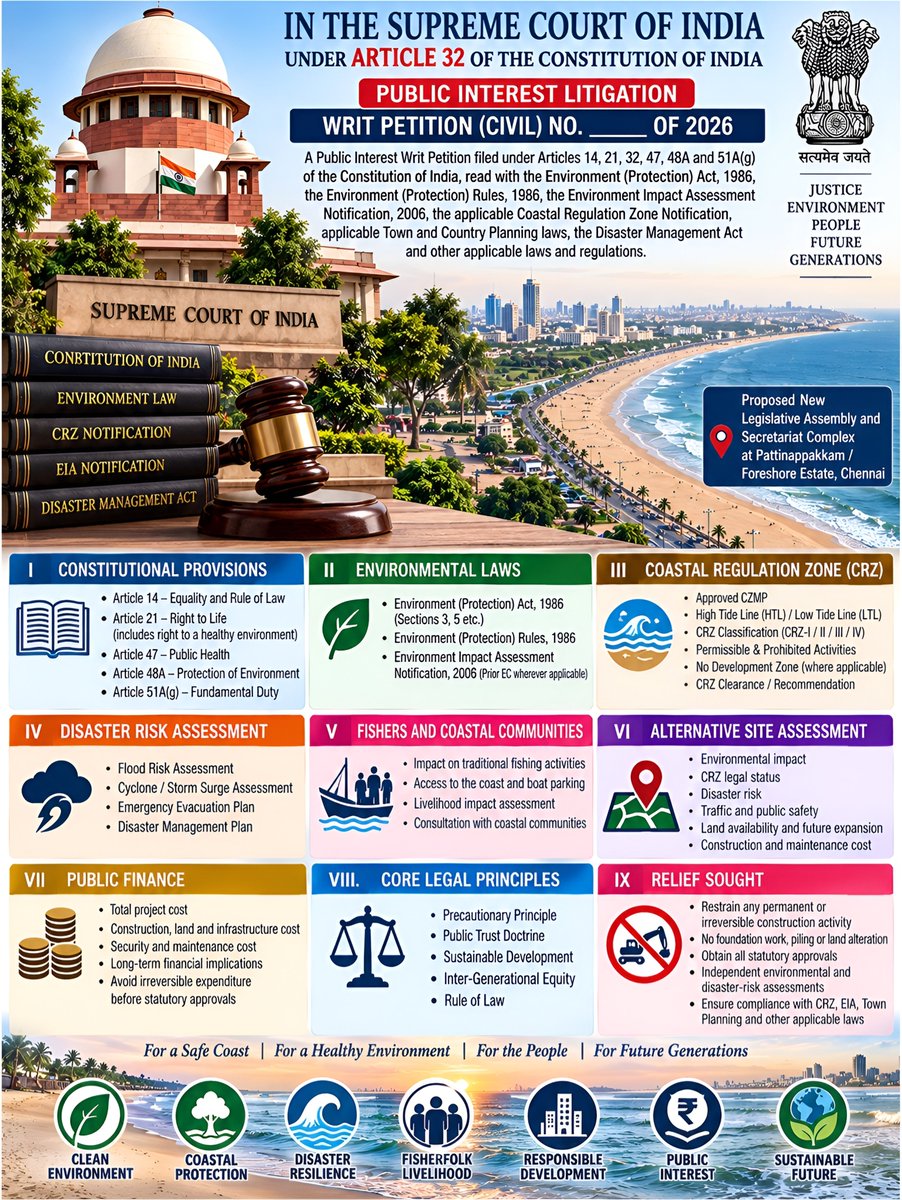
A Public Interest Writ Petition filed under Articles 14, 21, 32, 47, 48A and 51A(g) of the Constitution of India, read with the Environment (Protection) Act, 1986, the Environment (Protection) Rules, 1986, the Environment Impact Assessment Notification, 2006, the applicable Coastal Regulation Zone Notification, applicable Town and Country Planning laws, the Disaster Management Act and other applicable laws and regulations.
IN THE MATTER OF:
A Public Interest Writ Petition seeking to restrain any permanent or irreversible construction activity in connection with the proposed new Legislative Assembly and Secretariat Complex at Pattinappakkam / Foreshore Estate, Chennai, until all legally mandatory environmental, Coastal Regulation Zone (CRZ), town planning, disaster-risk, public-safety, coastal-community livelihood and public-finance assessments and approvals are fully obtained, and seeking enforcement of the Rule of Law, Precautionary Principle, Public Trust Doctrine, Sustainable Development and Inter-Generational Equity.
PETITIONER:
[Full Name of the Petitioner]
Address: ______________________________
VERSUS:
1. The State of Tamil Nadu, through its Chief Secretary, Chennai.
2. The Union of India, through the competent authority dealing with environment and related statutory matters, New Delhi.
3. The Competent Statutory Authority under the CRZ and Environmental Laws, through its authorised representative.
4. The Competent Statutory Authority responsible for Town and Country Planning / Land Use Planning, through its authorised representative.
5. The Competent Local Administrative Authority, through its authorised representative.
PUBLIC INTEREST WRIT PETITION
The Petitioner above-named, in the interest of the public, environmental protection, fundamental rights of the people guaranteed under the Constitution of India and protection of public funds, invokes the original writ jurisdiction of this Hon’ble Court under Article 32 of the Constitution of India.
I. NATURE AND MAINTAINABILITY OF THE PETITION
1. The present petition is not filed for any personal, political or commercial interest.
2. The protection of the public's rights under Article 21, environmental protection, protection of coastal areas, public safety, livelihood of traditional coastal communities and responsible utilisation of public funds constitute the core subject matter of the present petition.
3. Article 32 of the Constitution of India confers jurisdiction upon this Hon’ble Court to issue writs, directions and orders for enforcement of Fundamental Rights.
4. Public Interest Litigations concerning environmental protection and coastal regulation have been considered by this Hon’ble Court under Article 32 of the Constitution of India.
5. Accordingly, the present petition is maintainable for enforcement of the right to a healthy environment protected as part of Article 21 of the Constitution of India.
II. CONSTITUTIONAL PROVISIONS
A. Article 14 – Equality and Rule of Law
6. Every executive action of the State is subject to the Rule of Law.
7. A Government project cannot claim exemption from mandatory CRZ, environmental, town-planning or other statutory requirements merely because it is a Government project.
8. An administrative decision taken without applying the legally prescribed criteria or without considering relevant considerations is subject to scrutiny under Article 14 of the Constitution.
B. Article 21 – Right to Life
9. Article 21 is not confined merely to the right to physical existence.
10. The right to live in a safe, healthy and pollution-free environment forms part of the broader protection guaranteed under Article 21.
11. Coastal flooding, cyclones, storm surge, environmental degradation, loss of livelihood and public safety are matters directly
#ConstitutionofIndia
@rashtrapatibhvn
#ElectionCommissionOfIndia
#Article324
#SupremeCourtOfIndia
#JudicialReview
#ConstitutionOfIndia
#ElectionLaw
#ConstitutionalLaw
#ElectionCommission
#Article32
#Article136
🙏🙏🙏🇮🇳❤️🤍💚🗳️
#CONSTITUTIONALSUBMISSION REGARDING THE JURISDICTION OF THE HON’BLE #SUPREMECOURT
#CONSTITUTIONALPOSITION
1. The Election Commission of India is a constitutional authority functioning under Article 324 of the Constitution of India.The Commissioners of the Election Commission are given security of tenure and other safeguards by the Constitution and law.
2. The actions of the Election Commission are subject to judicial review within the limits of the Constitution and the law. However, the electoral roll, election process and election results are not ordinarily open to challenge except in the manner provided by law.
3. The Hon’ble Supreme Court exercises jurisdiction under Article 32 for enforcement of fundamental rights and under Article 136 through special leave petition. Judicial review can be exercised only on limited grounds such as violation of the Constitution, violation of law, mala fides, arbitrariness or exercise of power beyond jurisdiction.
4. The Hon’ble Supreme Court cannot directly inquire into or investigate the Election Commission or its Commissioners. A direct investigation against the Commissioners is not permissible except under the specific provisions of the Constitution and the law.
5. Any complaint against the Chief Election Commissioner or an Election Commissioner can be considered only in accordance with the constitutional procedure provided under Article 324(5) read with the Chief Election Commissioner and Other Election Commissioners (Conditions of Service) Act, 1991 and the rules made thereunder.
6. The removal of the Chief Election Commissioner can be made only in the same manner and on the same grounds as a Judge of the Supreme Court under Article 124(4) and Article 124(5). The removal of an Election Commissioner can be made only on the recommendation of the Chief Election Commissioner under Article 324(5).
7. Therefore, any investigation or inquiry against the Election Commission or its Commissioners can be undertaken only in accordance with the above constitutional provisions and the relevant law.
8. The Hon’ble Supreme Court can examine the legality and constitutionality of the actions of the Election Commission within the permissible limits of judicial review. However, a direct investigation against the Commission or its Commissioners is not permissible except under the specific constitutional and statutory provisions referred above only.
மாண்புமிகு உச்சநீதிமன்றத்தின் அதிகார வரம்பு தொடர்பான அரசியலமைப்புச் சமர்ப்பிப்பு
அரசியலமைப்புச் சட்ட நிலைப்பாடு
1. இந்திய தேர்தல் ஆணையம், இந்திய அரசியலமைப்புச் சட்டத்தின் பிரிவு 324-ன் கீழ் செயல்படும் ஓர் அரசியலமைப்பு அமைப்பாகும். தேர்தல் ஆணையர்களுக்கு அரசியலமைப்புச் சட்டம் மற்றும் சட்டத்தின் மூலம் பதவிக்காலப் பாதுகாப்பு மற்றும் பிற பாதுகாப்பு ஏற்பாடுகள் வழங்கப்பட்டுள்ளன.
2. தேர்தல் ஆணையத்தின் நடவடிக்கைகள், அரசியலமைப்புச் சட்டம் மற்றும் சட்டத்தின் வரம்புகளுக்குள் நீதித்துறை மறுஆய்வுக்கு (Judicial Review) உட்பட்டவை. இருப்பினும், வாக்காளர் பட்டியல், தேர்தல் செயல்முறை மற்றும் தேர்தல் முடிவுகள் ஆகியவை, சட்டத்தால் வழங்கப்பட்டுள்ள முறையைத் தவிர, பொதுவாக நேரடியாக சவால் செய்யப்படுவதில்லை.
3. மாண்புமிகு உச்சநீதிமன்றம், அடிப்படை உரிமைகளை அமல்படுத்துவதற்காக பிரிவு 32-ன் கீழும், சிறப்பு அனுமதி மனு (Special Leave Petition) மூலம் பிரிவு 136-ன் கீழும் அதிகார வரம்பைச் செலுத்துகிறது. அரசியலமைப்புச் சட்ட மீறல், சட்ட மீறல், தீயநோக்கம் (Mala Fides), தன்னிச்சையான செயல்பாடு அல்லது அதிகார வரம்பிற்கு அப்பாற்பட்ட அதிகாரப் பயன்பாடு போன்ற வரையறுக்கப்பட்ட காரணங்களின் அடிப்படையிலேயே நீதித்துறை மறுஆய்வு மேற்கொள்ளப்பட முடியும்.
4. மாண்புமிகு உச்சநீதிமன்றம், தேர்தல் ஆணையம் அல்லது அதன் தேர்தல் ஆணையர்களை நேரடியாக விசாரிக்கவோ அல்லது புலனாய்வு செய்யவோ முடியாது. அரசியலமைப்புச் சட்டம் மற்றும் சட்டத்தில் குறிப்பாக வழங்கப்பட்டுள்ள விதிகளின் கீழ் மட்டுமே

To the Hon'ble Chief Justice and Bench of the #SupremeCourtofIndia
#ChiefJustice
Regarding the specific facts, documentary evidence and necessity for an independent investigation in matters relating to #TASMAC in an #Article32 #Petition
The present matter is respectfully submitted for the kind consideration of the Hon'ble Chief Justice and Bench of the Supreme Court of India.
In Tamil Nadu, allegations of corruption, administrative irregularities, violations of rules, liquor sale practices, concerns relating to Government revenue and other allegations involving public interest have arisen in relation to TASMAC. These matters warrant appropriate judicial consideration under the Constitution of India.
1. Specific allegations and factual circumstances
If a petition is filed under Article 32, each material allegation concerning TASMAC should be presented not as a general allegation, but along with specific facts, incidents, relevant periods and available documentary evidence.
In particular,
alleged irregularities in the administration of TASMAC;
procedures relating to the procurement and sale of liquor;
matters relating to price determination and regulation;
possible loss to Government revenue;
actions or inaction on the part of administrative authorities;
alleged activities contrary to rules and Government Orders; and
specific allegations raised concerning corruption or irregularities;
should be examined separately and clearly.
2. Complaints already submitted
If complaints concerning irregularities and allegations of corruption relating to TASMAC have already been submitted before the Enforcement Directorate, Directorate of Vigilance and Anti-Corruption and other competent authorities, the following particulars should be placed before the Hon'ble Court with documentary evidence:
date of submission of the complaint;
complaint number / registration number;
designation of the authority to whom the complaint was submitted;
nature of the allegations made in the complaint;
documents enclosed with the complaint;
action taken on the complaint;
whether an investigation was commenced or not; and
the present status of the investigation, if any investigation was undertaken;
All such particulars should be brought to the attention of the Hon'ble Court with supporting documentary evidence.
If appropriate action has not been taken on complaints already submitted, that also constitutes an aspect requiring specific legal consideration.
3. Action or inaction of the concerned authorities
Complete particulars should be submitted regarding the actions taken by the concerned Government authorities or investigating agencies after the complaints were submitted, as well as any failure or omission to take action.
In particular, if, even after receipt of a complaint,
no investigation was undertaken;
the relevant records were not called for;
witnesses were not examined;
documents were not verified;
the truth or otherwise of the allegations was not examined; or
reasons were not communicated for closing or disposing of the complaint;
such circumstances should be specifically pointed out with appropriate documentary evidence.
4. Pending judicial orders
If cases relating to the aforesaid TASMAC matters are pending before the Hon'ble Madras High Court or any other court, the following particulars should be fully disclosed:
case number;
date of the order;
nature of the order;
scope of any stay order, if granted; and
any restrictions imposed upon investigation or administrative action;
All such particulars should be fully disclosed.
When passing any order, it is necessary for the Hon'ble Supreme Court to take into consideration the applicable legal position so that no conflict arises with any judicial orders already passed.
5. Necessity to explain why an investigation by the State authorities is inadequate
The request for a #CBI investigation should not be based merely on suspicion .


#ConstitutionofIndia
#SupremeCourt
#Article32
#chennaiHighcourt
#Article226
#MaduraiBench #Highcourt #Suemotu
#TamilnaduGovernment
#தமிழ்நாடுஅரசு
#செயலாளர் #TNHRCE
#ஆணையர் #TNHRCE
#ChiefSecretaryTamilNadu #TNGovt
#இந்துசமயஅறநிலையத்துறை
Hindu Religious and Charitable Endowments Department Temple Properties – Request for Judicial Action Regarding Audit and Uploading on the Website
It is highly essential that the movable and immovable properties, lands, buildings, idols, temple jewellery, vehicles, deposits, sources of revenue and other property details belonging to the temples under the control and administration of the Hindu Religious and Charitable Endowments Department be fully and properly subjected to due audit and uploaded on the internet for public access with transparency.
However, it is deeply regrettable that important information relating to several temples, including their property details, present status, title documents, revenue particulars, lease and rental records, and verification of idols and temple jewellery, has not so far been fully and transparently uploaded on the internet.
All temple properties are public trust properties which are required to be protected by the public with faith and devotion. Therefore, ensuring their protection, proper accounting, periodic audit and transparent administration is an important statutory responsibility of the Department.
Further, if the orders and directions already issued by the Hon’ble Courts are not properly and fully implemented, it would be a serious matter affecting public confidence in judicial orders.
Therefore, it is most respectfully prayed that this Hon’ble Court may consider this matter seriously and:
1. Direct that all movable and immovable properties of all temples under the Hindu Religious and Charitable Endowments Department be fully inventoried, duly verified and subjected to periodic audit;
2. Direct the preparation of a complete register of temple lands, buildings, leases, rentals, sources of revenue, idols, temple jewellery and other properties;
3. Direct that the audited and verified property details be transparently uploaded on the official website in a manner accessible to the general public;
4. Direct the concerned authorities to file a detailed Compliance Report to establish whether the relevant orders already passed by the Hon’ble Courts have been implemented;
5. If it is prima facie found that the concerned authorities have deliberately or continuously failed to implement the orders of the Court, consider initiating appropriate contempt of court proceedings against the concerned authorities in accordance with law;
6. If necessary, direct that an appropriate departmental inquiry be conducted into the responsibility and negligence of the concerned authorities and that action be taken in accordance with law;
7. Direct that, wherever necessary, immediate protective measures be taken in coordination with the District Administration and other concerned departments to ensure the protection of temple properties and records.
Therefore, we most humbly pray that this Hon’ble Court may be pleased to pass appropriate and stringent orders to ensure the protection of temple properties, transparency in administration, and full implementation of the orders of the Hon’ble Courts.
#Chiefjustice #Cji
#LiveLaw #Lawupdate


Went to a girl seeking Certiorari for my love ❤️
She issued Prohibition 🚫,
then used Mandamus on the police 👮♂️,
now they’re treating me like Habeas Corpus 😭
and I’m asking them — Quo Warranto? 😂⚖️
#Polity #Writs #UPSC #Article32 #Article226

📖 #अनुच्छेद_सीरीज़ | Day 21
🇮🇳 अनुच्छेद 32 — संवैधानिक उपचार का अधिकार
मौलिक अधिकारों का उल्लंघन हो, तो अपने अधिकारों की रक्षा के लिए सीधे सुप्रीम कोर्ट जा सकते हैं
#अनुच्छेद32 #भारतीयसंविधान #Article32

TO THE HON’BLE #CHIEFJUSTICEOFINDIA
#SUPREMECOURTOFINDIA , #NEWDELHI
#PILLETTERPETITION / #REPRESENTATION
UNDER #ARTICLE32 OF THE #CONSTITUTIONOFINDIA
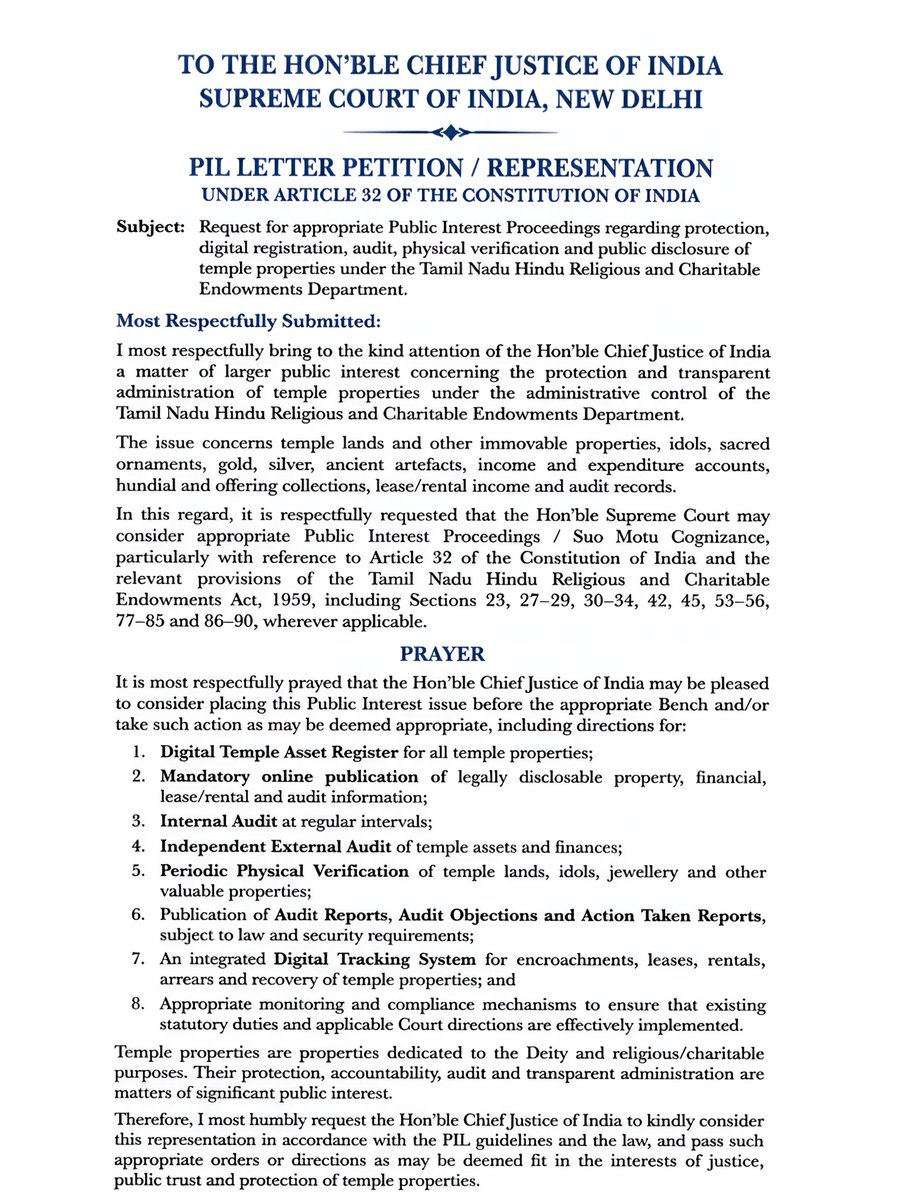
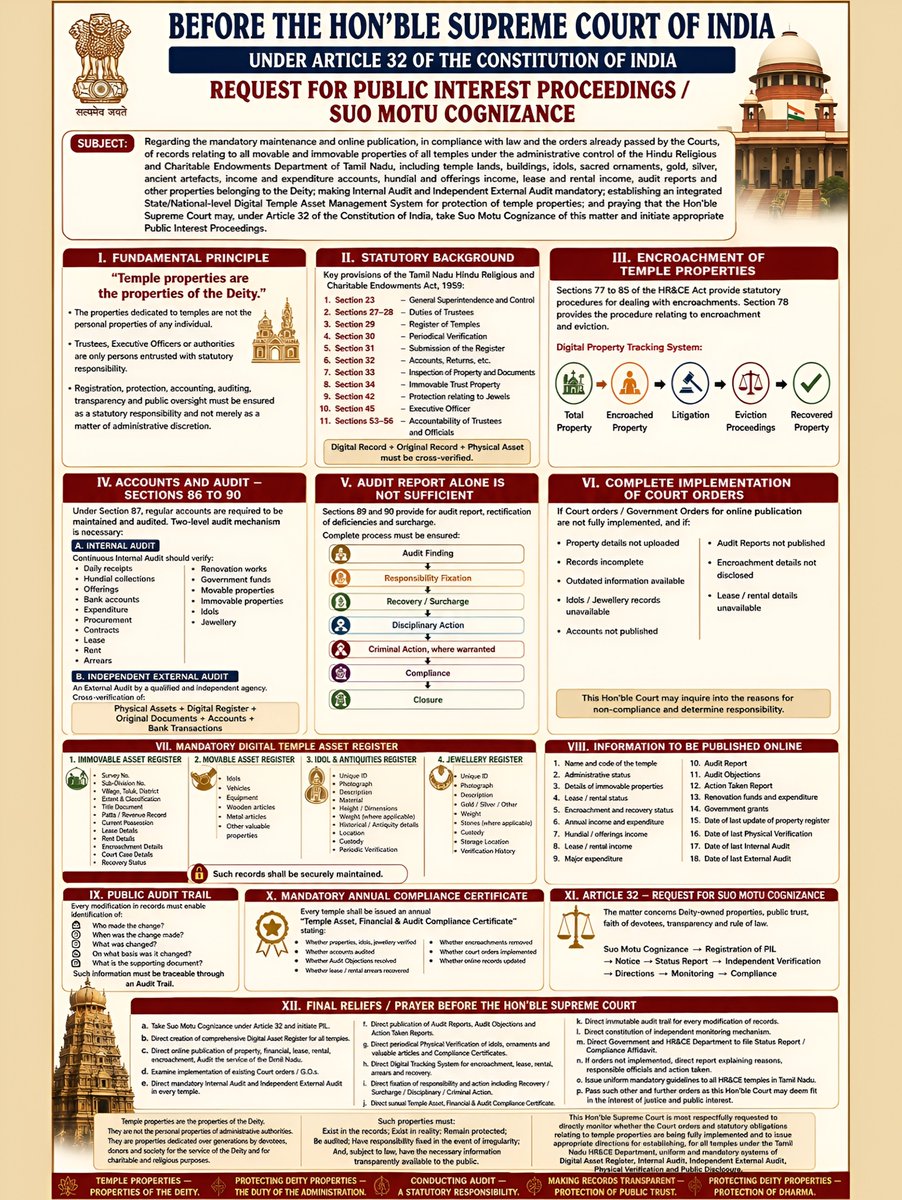
Subject: Request for appropriate Public Interest Proceedings concerning the protection, digital registration, audit, physical verification and public disclosure of temple properties under the administrative control of the Tamil Nadu Hindu Religious and Charitable Endowments Department.
Most Respectfully Submitted:
I most respectfully bring to the kind attention of the Hon’ble #ChiefJusticeofIndia a matter of larger public interest concerning the protection and transparent administration of temple properties under the administrative control of the Tamil Nadu Hindu Religious and Charitable Endowments Department.@tnhrcedept
The matter concerns temple lands and other immovable properties, idols, sacred ornaments, gold, silver, ancient artefacts, income and expenditure accounts, hundial and offerings collections, lease/rental income and audit records.
It is respectfully requested that the Hon’ble Supreme Court may consider appropriate Public Interest Proceedings / Suo Motu Cognizance under Article 32 of the Constitution of India, with reference to the relevant provisions of the Tamil Nadu Hindu Religious and Charitable Endowments Act, 1959, including Sections 23, 27–29, 30–34, 42, 45, 53–56, 77–85 and 86–90, wherever applicable.
Honourable PRAYER 🙏🙏
It is most respectfully prayed that the Hon’ble Chief Justice of India may kindly consider placing this matter before the appropriate Bench and/or take appropriate action for:
Digital Temple Asset Register for all temple properties;
Mandatory online publication of legally disclosable property, financial, lease/rental and audit information;
Periodic Internal Audit;
Independent External Audit of temple properties and finances;
Periodic Physical Verification of temple lands, idols, sacred ornaments and other valuable properties;
Public disclosure, subject to law and security requirements, of Audit Reports, Audit Objections and Action Taken Reports;
An integrated Digital Tracking System for encroachments, leases, rentals, arrears and recovery of temple properties; and
Appropriate monitoring and compliance mechanisms to ensure implementation of statutory duties and applicable Court directions.
Temple properties are dedicated to the Deity and religious/charitable purposes. Their protection, accountability, audit and transparent administration are matters of significant public interest.
Therefore, I most humbly request the Hon’ble Chief Justice of India to kindly consider this representation in accordance with the PIL Guidelines and law, and pass appropriate orders or directions in the interests of justice, public trust and protection of temple properties.
#chiefjustice #Cji
#Letter #PIL
#pilLetterpetition
#Representation
#NewDelhi
🙏🙏🙏🇮🇳❤️🤍💚⚖️🗒️
#Article32
#SuoMotuCognizance
#SupremeCourtOfIndia
#PublicInterestProceedings #Pil #LiveLaw
#PublicInterest
#ConstitutionOfIndia
#RuleOfLaw
#ConstitutionalRights
#JudicialAccountability
#ProtectDeityProperties
#ProtectTempleProperties
#TempleJewelleryProtection
#IdolProtection
#TempleHeritageProtection
#TempleEncroachment
#RecoverTempleProperties
#SaveTempleProperties
#Dharma
#ProtectionOfDharma
#PublicTrust
#DevoteesRights
#Sections21To34 #Section42 #Section45 #Sections53To56 #Sections77To85 #Sections86To90 #Sections97To99 #Section102 #Section115 #Section116
A Humble Request to the Hon’ble Supreme Court of India
#chiefjusticeofindia
#Chiefjustice
#Cji
Under Article 32 of the Constitution of India, and based on the statutory objectives of the relevant provisions of the Tamil Nadu Hindu Religious and Charitable Endowments Act, 1959, namely Sections 23, 27–29, 30–34, 42, 45, 53–56, 77–85 and 86–90, we most humbly and respectfully request that the Hon’ble Supreme Court may be pleased to appropriately inquire into whether the Deity properties, lands, idols, sacred ornaments, income and expenditure accounts, lease/rental details and audit reports of all temples in Tamil Nadu are being duly protected and maintained, and whether the same are being mandatorily uploaded online and transparently made available for public access in compliance with the orders already passed by the Courts.
We further most respectfully request that, wherever any deficiencies or non-compliance are found, necessary mandatory directions may be issued to rectify the same, and that the Hon’ble Supreme Court may be pleased to take Suo Motu Cognizance of the matter and undertake appropriate Public Interest Proceedings/inquiry, in the larger public interest.
We most humbly and respectfully request the Hon’ble Supreme Court to pass appropriate orders in the interest of justice, protection of Deity properties, transparency and public trust.
#chiefjustice
#HRCETN

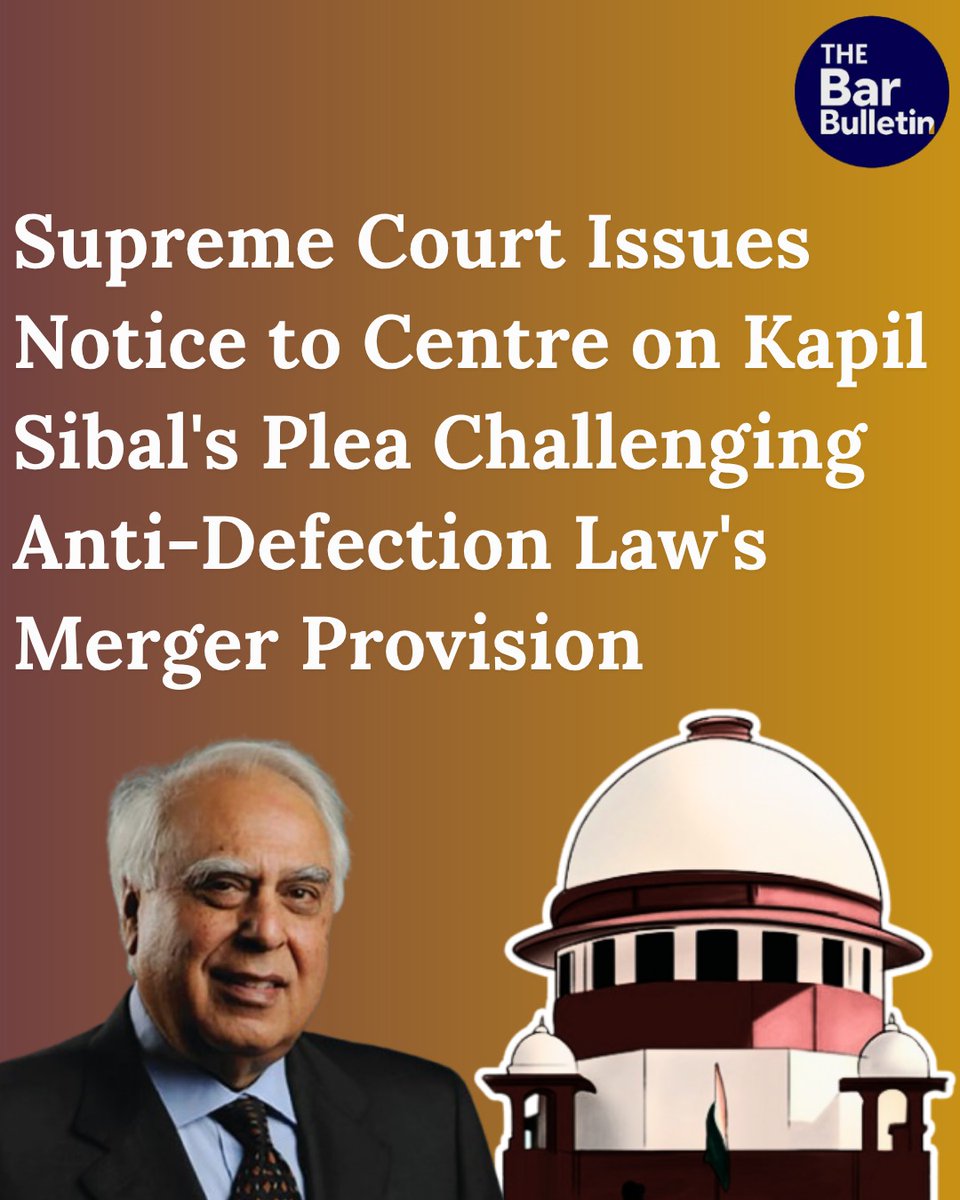
Supreme Court Issues Notice to Centre on Kapil Sibal’s Plea Challenging Anti-Defection Law’s Merger Provision
Read More Here- https://t.co/fqCRJMy1nR
#SupremeCourt #antidefectionlaw #TenthSchedule #mergerprovision #Article32 #constitutionalchallenge #legislativedisqualification #politicaldefections #constitutionallaw #democraticframework #thebarbulletin #legalupdates #legalnews

Article 32 = ? Fundamental Right?
Comment करो 🔥
Dr. Ambedkar ka favourite Right 👀
#MPPSC2026 #Article32
#kalexamhai

Article 32 is not a privilege. It's a constitutional guarantee.
When citizens seek justice and accountability, they are exercising their rights not choosing political sides.
The Constitution comes first. 🇮🇳
#Article32
#ReleaseInnocent
#CJPProtestUpdate
#RahulGandi
Supporting students demanding accountability is not politics, it's democracy.
Article 32 gives every citizen the right to seek justice when fundamental rights are violated.
Standing for constitutional rights isn't pro-government or pro-opposition it's pro-Constitution. #Article32

@kunalkamra88 #Article32
If the government, the police, or any other authority violates your fundamental rights, you can seek justice directly from the Supreme Court under Article 32. This right is itself a fundamental right. Is dead

@kunalkamra88 #Article32
If the government, the police, or any other authority violates your fundamental rights, you can seek justice directly from the Supreme Court under Article 32. This right is itself a fundamental right.


Last Seen Hashtags on Sotwe
รับงานเชียงราย
Seen from Thailand
incestoconmamá
Seen from United States
ชายเดี่ยว
Seen from Thailand
محارم_اخوات_حقيقى
randomchat
Seen from Chile
CleanUpStandardChartered
Seen from United States
Megarsi
Seen from Italy
mgai()**********************************************filter:videos
Seen from Singapore
sleep #mom
Seen from Malaysia
colegialas
Seen from United States
Most Popular Users

Elon Musk 
@elonmusk
240.8M followers

Barack Obama
@barackobama
118.7M followers

Cristiano Ronaldo
@cristiano
114.5M followers

Donald J. Trump
@realdonaldtrump
111.9M followers

Narendra Modi
@narendramodi
107M followers

Rihanna
@rihanna
98.7M followers

NASA
@nasa
92.2M followers

Justin Bieber
@justinbieber
91.8M followers

KATY PERRY
@katyperry
90M followers

Taylor Swift
@taylorswift13
84M followers

Lady Gaga
@ladygaga
75.5M followers

Virat Kohli
@imvkohli
73.4M followers

Kim Kardashian
@kimkardashian
70.8M followers

YouTube
@youtube
68.7M followers

Neymar Jr
@neymarjr
66.4M followers

Bill Gates
@billgates
65.2M followers

Selena Gomez
@selenagomez
63.1M followers

The Ellen Show
@theellenshow
62.2M followers

CNN
@cnn
61.7M followers

X
@x
60.6M followers