

Top Tweets for #Accelerators

AI Accelerators Drive Changes In Power Delivery Networks https://t.co/nFK95P7DVe
Moving voltage regulators closer to processors can reduce power loss, but adds challenges for advanced packaging, thermal management, and system-level design.
#PDN #semiconductor #AIaccelerators
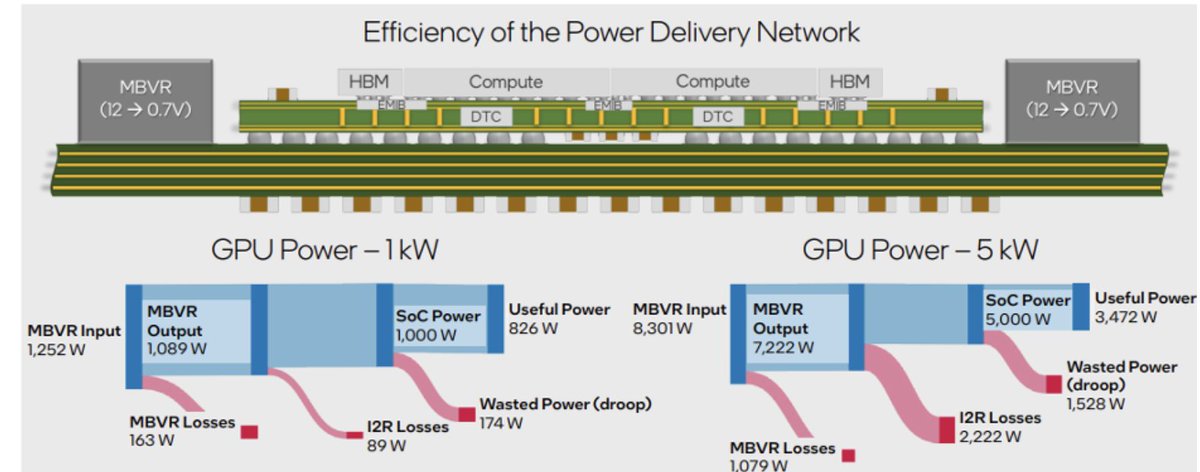

AI Accelerators Drive Changes In Power Delivery Networks
https://t.co/O1PHBghNDd
Moving voltage regulators closer to processors can reduce power loss, but adds challenges for advanced packaging, thermal management, and system-level design.
#PDN #semiconductor #AIaccelerators


If you are rejected by any of the accelerators and are a student
Then dm me
Founders Inc rejected me for being too young. Ruslan emailed me this
YC rejected me twice after that
So I stopped applying and started funding instead
I am 11. 5 min on why I am handing checks to school students, you can too, and why nobody has tried this before
Be honest, if you were 11 again what would you build? Drop it below, I am reading every reply

Apple and AMD are approaching the AI revolution from two different directions, and both are worth watching.
$AAPL is bringing AI closer to consumers through its devices, software and ecosystem. $AMD is developing the processors and accelerators that power AI computing and data centres.
Their latest results show different growth drivers. Apple reported $114.5B in Q4 revenue, up 12% YoY, while AMD recorded $13.4B in Q3 revenue, up 45%, with data centre revenue growing 97%.
Still, AI growth comes with competition, costs and execution risks. I've been following how these developments influence individual stocks, including the stock-linked markets available through BingX TradFi.
#AI #TechStocks #FasterBroaderDeeper


Digital Ocean had this approach...so yes it works. But accelerators and angels don't. They want ROI immediately and give a set runway and you watch a burn rate.
In 2026 there is no more excuse for shipping garbage slop nonsense with a half baked everything.
AI can handle all that.

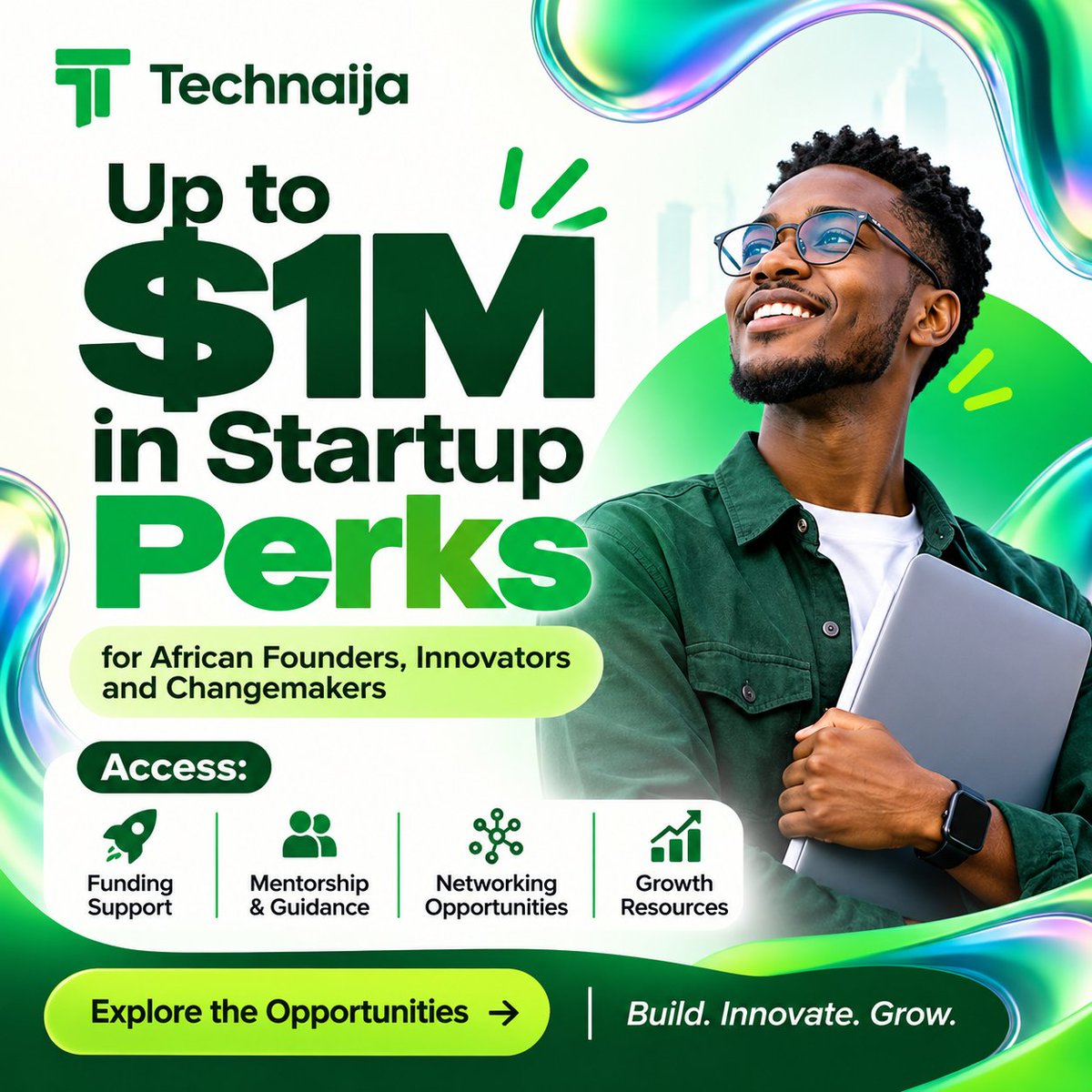
11 Startup Accelerators and Free Tech Perks African Founders Should Explore!
Building a startup is expensive. But what if you could access thousands of dollars in cloud credits, AI tools, software and technical support without spending limited capital?
https://t.co/xwA9TOI6zy

@YilmazcimUyar 7 years building startups, 3 accelerators with my last one, 13K on linkedin, now building AI voice agents that sound like people. 20+ apps is serious volume. would love to know which one surprised you the most. lets connect. +1 from me for your X growth journey

Exactly! 😭 And that's the part I think needs to change. I understand why companies partner with VCs and accelerators; it's easier to verify startups that way. But what happens to founders building outside those networks?
Some of us are already shipping products, acquiring users, and paying for infrastructure out of pocket. Surely that should count for something?
There needs to be a direct path for bootstrapped founders. We shouldn't have to join an accelerator or raise funding just to prove we're building something real. 😂

Networking Is the Next Place AI Clusters Lose Performance
A cluster of thousands of GPUs is only as fast as the network that connects them. Many organizations are discovering that their interconnect, not their accelerators, is the reason utilization stays lower than expected.
Large training runs require constant communication between chips. If the network cannot keep up, accelerators sit idle while they wait for data. Standard Ethernet has improved, but the highest-performance training jobs still benefit from specialized interconnects with lower latency and higher bandwidth. As clusters grow from hundreds to thousands of accelerators, the networking bill rises as a percentage of total spend. Optical transceivers, high-speed switches, and the cabling that links them are all seeing stronger demand tied to AI deployments.
This is visible in order patterns. Suppliers of 800-gigabit and emerging 1.6-terabit optics report that AI-related customers are driving a disproportionate share of growth. The same is true for companies that provide the switching silicon optimized for collective communication patterns common in training. These components are less famous than GPUs, yet they directly affect how much useful work a given set of accelerators can perform.
The economic logic is simple. An accelerator that costs tens of thousands of dollars should not be starved for data. Operators are therefore willing to spend more on the network if it raises overall cluster efficiency. The companies that deliver that efficiency are capturing part of the infrastructure budget that used to be discussed only in terms of chips and servers.
The AI infrastructure trade keeps expanding beyond the most obvious names. Networking is one of the places where incremental spending now shows up clearly in results.



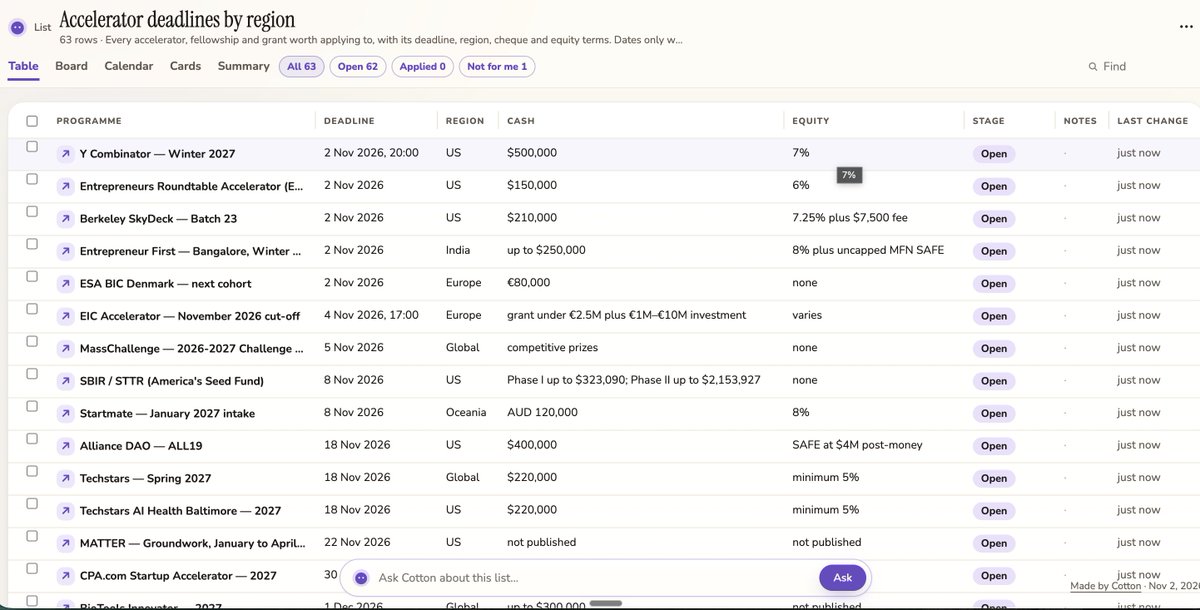
Its accelerator season.
Here is a list of 63 accelerators and their deadlines and what they offer by regions of the world - https://t.co/Yhh8dqschW
made by https://t.co/uXtjaVrq9E

@microDesignn Let’s connect ☺️ I just finished my phd working in energy with particle accelerators (like yesterday🥹). I’ll start building soon.
What are your thoughts about accelerators? Do you think they aren't worth it?
Are Accelerators Still Worth It?
We have a lot of accelerators springing up in the world. We currently have about 2000+ startup accelerators across America, Europe, Asia, Africa, LatAm, etc.
However, here comes a hard question begging for answers: "Were accelerators ever worth it? Are they still worth it?"
The startup accelerator program began with Y Combinator in 2005 having some early companies like Reddit, Airbnb, Twitch, Loopt by Sam Altman of OpenAI, Posterous which was acquired by Twitter (back in the days), etc. With the invention of this program, other accelerators began springing forth, like Techstars in 2006.
Accelerators in the beginning were also perceived by a lot of people as "incubators." This was because accelerators back in early 2000s did their jobs well by folding their sleeves, putting their hands on deck to work together with their portfolio companies. You just needed to have an idea that's bold and solves a real problem without necessarily having huge traction. This made accelerators seen as a lot of helping hand to startups at their earliest days.
Soon, hundreds and few thousands of people began applying yearly to join these acceleratora but the chances were too slim. This was because they only accepted a handful of which they can really work well with. This was the game changer...
Imagine, as a founder, someone backs you, invests in you and does not disappear but helps you create relevant connections, access to partners or market lords, give you guidance on what might work and what actually works (because they have played the game previously) but still gives you the authority to run your startup by trusting your gut and decisions. Would you go after these investors or one who will invest, disappear, not add any value but still want to take control of your board and literally run your company for you (of course, to death 😂😂)?
Exactly! That was why accelerator programs were 'reverenced' and held in high esteem.
Today, we have thousands of accelerators and tens of thousands of founders applying to the elite accelerators per cohort. These accelerators now accept a much larger number of startup per cohort of which some persons believe directly reduces the attention they might get while being in the program. Following this, the accelerator which runs and keeps operating as though they are a startup (Y Combinator) took in this feedback and divided each cohort into "groups."
Some accelerators even claim not to take equity but expect founders to make an acceptance fee before joining the cohort. And I'm like; If I can pay these thousands of dollars to be accepted into this accelerator why do I need the accelerator?
With thousands of accelerators everywhere, a good number of them ready to write sizeable pre-seed cheque, what has been your experience so far with accelerators so far?
Do you think accelerators are worth it for you? Do you consider applying to accelerators?
You are welcome to share your thoughts in the comment section or even repost.

Micron keeps 86.8% of every revenue dollar as gross margin. Nvidia keeps 75.0%, TSMC 67.7%. The memory maker out-earns the company designing the accelerators. Meanwhile the hyperscalers spent $193.5bn in one quarter, and a token now sells at $0.10 per million. Scarcity gets paid.
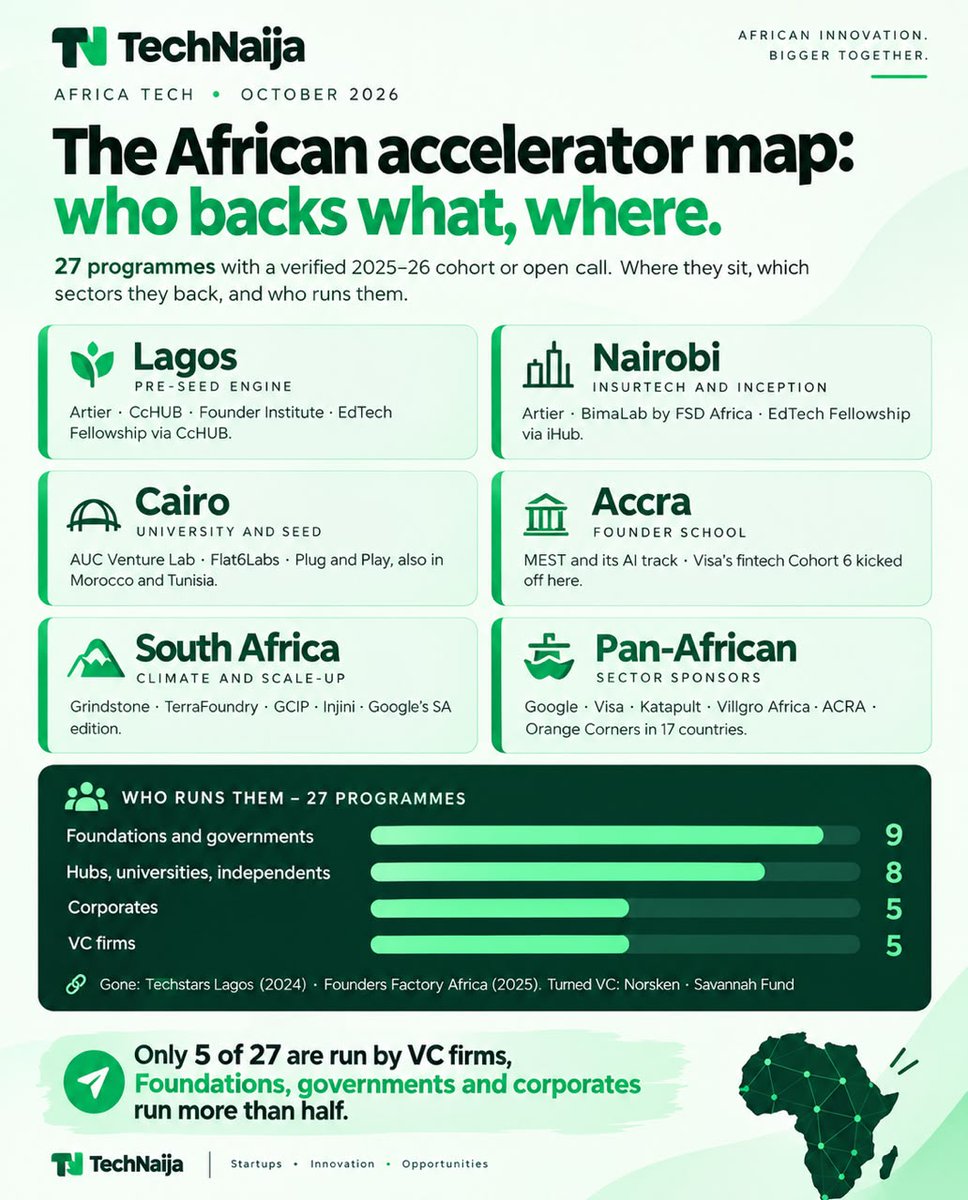
🚀 African Founders: Stop Applying to Every Accelerator You Find!
A new analysis by Riccardo Petrantoni maps 27 active African startup accelerators with cohorts during 2025–2026.
https://t.co/1LdFaaI3jP


M5 vs M4, same 10-core GPU, llama.cpp measured:
Reading the prompt: 723 vs 221 tok/s (3.3×).
Writing: 32 vs 24 (1.3×), in line with bandwidth, 153 vs 120 GB/s.
Prefill moved with compute (the M5's GPU neural accelerators), decode moved with memory. Which one does your workload feel?


i'm 20, building solo.
today i pitched 43 investors and applied to 6 accelerators.
replies so far:
1 auto-reply
4 bounced emails
1 "fill our form"
1 "let me give you a thoughtful reply"
this is what they're all looking at 👇

The #ASIC story. In its last quarter, #NVIDIA ( $NVDA ) reported $89.0B of data center revenue, +117% YoY. #Broadcom ( $AVGO ) reported $16.7B of AI semiconductor revenue (custom accelerators and networking), +221% YoY.
So Broadcom's #AI chips grow faster, from a base ~5x smaller. NVIDIA's share of AI chips can decline while its revenue still grows.
NVDA Valuation (NTM, current vs 5Y mean):
› Price/Fwd Earnings: 18.7x vs 36.3x (-1 SD: 24.9x)
› Price/Fwd Sales: 10.1x vs 17.1x (-1 SD: 13.0x)
› PEG: 0.37 vs 1.2
NVDA Efficiency (LTM, current vs 5Y mean):
› ROIC: 67.51% vs 52.92%
› ROE: 117.21% vs 78.91%
› ROA: 53.57% vs 35.51%
NVDA Financial Strength (LTM, current vs 5Y mean):
› Debt/Equity: 17.0% vs 28.9%
› Debt/Capital: 14.51% vs 21.01%
› FFO Interest Coverage: 289.6x vs 167.8x
NVDA Future:
› EPS consensus: $9.31 (FY2027) -> $15.91 (FY2028) -> $21.34 (FY2029)
› EPS est. 5Y growth: 49.99% (5Y mean: 29.36%)
Image: NVDA Overview, Oct 13, 2026


Hey I’m Angel 👋🏽 co-founder at A+M Studio
We specialise in brand sprints for ambitious startups who have a great product, but the branding doesn’t quite match…yet.
We’re currently looking to connect with more founders, accelerators and startup communities for Q4 and Q1 27🚀


Local AI can run on a desktop. The M6 Mac mini is designed for on-device AI with Neural Accelerators and a dual 16-core Neural Engine. The supplied configuration has 16GB unified memory and 256GB SSD.
🔗https://t.co/ixj1aBChJG
uDemand earns from qualifying purchases. #MacMini

I think accelerators can be useful if you’re brand new to starting a business, especially if they don’t take equity.
But even YC, to me, is mostly vanity/feel-good/image stuff. You’re giving up equity on not great terms, there are a bunch of meetings, and there’s an opportunity cost when you could just be building and selling.

@LefebvreJackson hmmm thx
why distractions re: accelerators?
@RamseyShaffer Nvidia Inception if you use AWS. Got a ton of free AWS credits. Super easy to apply and most people get accepted. As far as accelerators go, my default is that they tend to be distractions.

Flexnodes: Turning Idle Bandwidth Into Blockchain Infrastructure
The more I study Optimum, the more interesting Flexnodes become.
At first glance, a Flexnode sounds like simply “another node.”
It isn't.
The bigger idea is to create a global layer of data accelerators that can help Optimum move blockchain data faster across geographically distributed networks.
And that creates an important connection between Optimum's networking technology and its longer-term infrastructure vision.
1. The Problem Optimum Is Solving
Blockchain validators constantly need to exchange information.
A new block appears.
That data has to reach other participants.
Those participants need enough information to reconstruct it and continue operating the network.
The challenge isn't only bandwidth.
Distance matters.
Bandwidth matters.
Network topology matters.
Latency matters.
Optimum's approach is to improve the underlying data movement rather than asking decentralized networks to become less decentralized.
Its mump2p system already uses RLNC to accelerate data propagation, while the Optimum Gateway connects Ethereum consensus-layer clients to the mump2p network.
Flexnodes take that idea one step further.
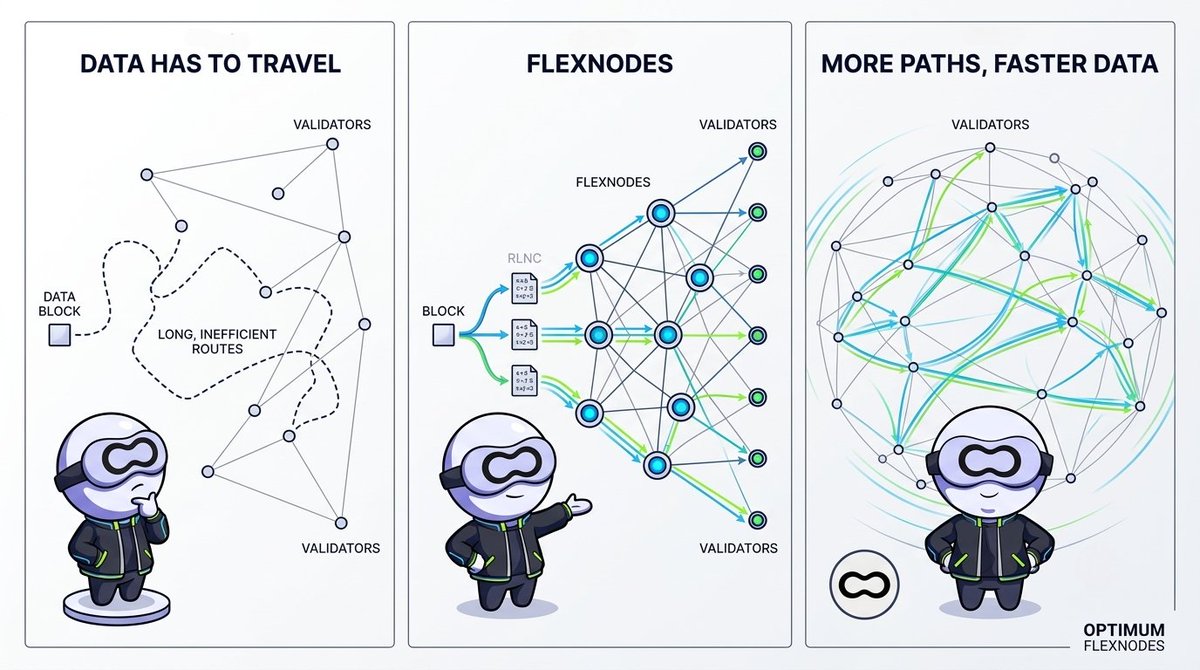
2. What Exactly Is a Flexnode?
Think of a Flexnode as a data-movement point inside the Optimum network.
Instead of relying exclusively on the original source to push information toward every destination, Flexnodes can participate in moving coded information through the network.
That matters because RLNC changes the way useful information can travel.
A Flexnode doesn't necessarily need the complete original block before it can contribute.
It can work with coded pieces and help produce additional useful combinations for other participants.
So the network isn't simply:
SOURCE → VALIDATOR → VALIDATOR → VALIDATOR
It becomes closer to:
SOURCE → FLEXNODES → MANY VALIDATORS
with multiple paths contributing to the same reconstruction process.
That's a fundamentally different way of thinking about blockchain data propagation.
3. Bandwidth + Location
There are two especially important variables here:
BANDWIDTH
How much useful coded information can a node send?
LOCATION
How far does that information have to travel?
A global Flexnode network can attack both.
More participating nodes can provide additional pathways for coded data.
And strategically distributed nodes can reduce the physical distance information needs to travel before reaching its destination.
This is where Optimum's networking thesis becomes particularly interesting:
Don't simply make one machine faster.
Make the network better at moving information.
4. Why RLNC Makes This Possible
Traditional packet forwarding often treats missing pieces as a problem.
If something is missing, you need to find and retransmit that particular information.
RLNC introduces another possibility.
Nodes can generate new coded combinations from the information they already possess.
A validator doesn't necessarily care which exact combination arrived.
It cares about collecting enough independent information to reconstruct the original data.
That makes the network more flexible.
And Optimum's research has specifically explored RLNC-based approaches for decentralized propagation and distributed systems.
Flexnodes are therefore not an isolated product idea.
They fit directly into Optimum's broader coded-network architecture.
5. From One Accelerator to a Network
This is the part I find most interesting.
One acceleration point can improve a route.
A global network of acceleration points can change the structure of the data-delivery system itself.
Imagine blockchain data entering the Optimum network.
Instead of asking one source to handle the entire propagation burden, Flexnodes can help distribute the movement of coded information.
More useful paths.
More geographic coverage.
More opportunities for data to reach validators efficiently.
That is the difference between optimizing a connection and optimizing a network.
6. The Long-Term Optimum Vision
Flexnodes also connect to something bigger than Ethereum block propagation.
Optimum has described its infrastructure as a foundation for multiple data-movement use cases, including future storage-oriented systems.
The research behind Flexnodes has already explored decentralized storage and communication using homogeneous nodes and RLNC.
So the long-term picture isn't simply:
Flexnode → Ethereum
It is closer to:
Flexnodes
↓
Optimum Network
↓
Propagation + Storage + Future Data Services
That makes the Flexnode concept much more interesting than a conventional validator-side networking upgrade.
7. The Key Idea
Optimum isn't just asking:
“How do we make blockchain data travel faster?”
The more ambitious question is:
“What should the network look like if data movement itself is optimized?”
Flexnodes are part of that answer.
They introduce additional infrastructure into the data path without requiring the underlying blockchain to abandon its decentralized architecture.
And with RLNC underneath, those nodes aren't simply forwarding copies of data.
They're participating in a coded network where information can be recombined and propagated more efficiently.
The Bigger Picture
mump2p improves how data propagates.
Optimum Gateway connects validators into that accelerated environment.
Flexnodes can expand the network of places through which that coded data can move.
Together, they point toward a much bigger thesis:
Blockchain scaling isn't only about processing more data.
It's also about moving that data intelligently.
That's where I think Flexnodes fit into the Optimum story.
More nodes.
More paths.
More coded data movement.
A more efficient network.
Optimum is building the infrastructure for that future.
@get_optimum @aqccapital @cryptooflashh @tgogayi 🫡
Last Seen Hashtags on Sotwe
mardinsex
Seen from Turkey
cfnm
Seen from Germany
incest()*************************
Seen from Netherlands
ometv
Seen from Indonesia
mgai
Seen from Australia
school pussy
Seen from Turkey
konya pasif
Seen from Turkey
omegle
Seen from Israel
cuckoldtürkiye
Seen from United States
口交脸
Seen from Germany
Most Popular Users

Elon Musk 
@elonmusk
240.1M followers

Barack Obama
@barackobama
118.6M followers

Cristiano Ronaldo
@cristiano
114.4M followers

Donald J. Trump
@realdonaldtrump
111.7M followers

Narendra Modi
@narendramodi
106.9M followers

Rihanna
@rihanna
98.6M followers

NASA
@nasa
92.1M followers

Justin Bieber
@justinbieber
91.7M followers

KATY PERRY
@katyperry
89.9M followers

Taylor Swift
@taylorswift13
83.9M followers

Lady Gaga
@ladygaga
75.4M followers

Virat Kohli
@imvkohli
73.3M followers

Kim Kardashian
@kimkardashian
70.8M followers

YouTube
@youtube
68.6M followers

Neymar Jr
@neymarjr
66.3M followers

Bill Gates
@billgates
65.2M followers

Selena Gomez
@selenagomez
63M followers

The Ellen Show
@theellenshow
62.1M followers

CNN
@cnn
61.7M followers

X
@x
60.6M followers