

Top Tweets for #Answerability

your agent can query your database and still get the revenue number wrong, because all it sees is column names.
nvidia open-sourced auto-ontology for this: business terms mapped to columns, reviewed sql, an answerability check, via mcp.
4.1k stars
https://t.co/CuWHLPouvq

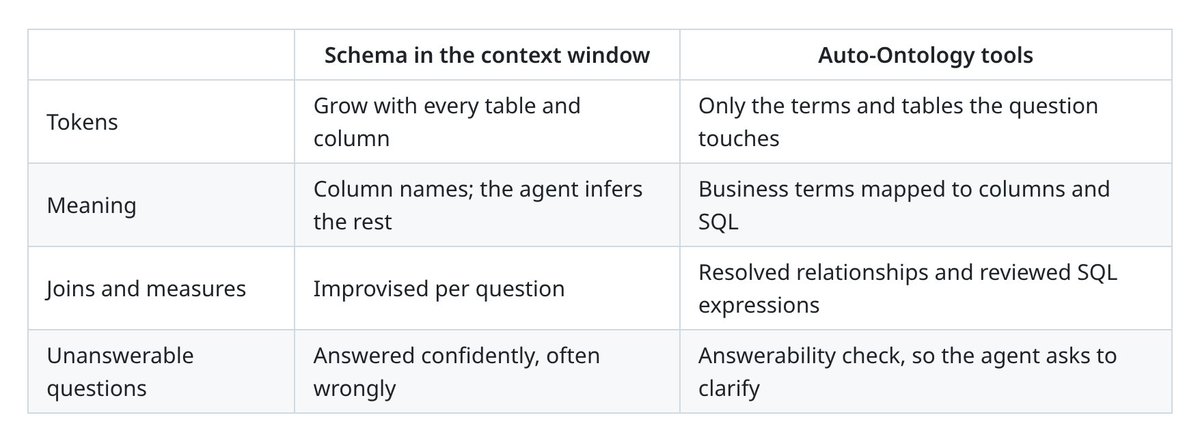
your agent can query your database and still get the revenue number wrong, because all it sees is column names.
nvidia open-sourced auto-ontology for this: business terms mapped to columns, reviewed sql, an answerability check, via mcp.
4.1k stars
https://t.co/CuWHLPouvq


the complete guide to ai visibility scoring: how we rank 1,000+ startups.
ai visibility is the new frontier.
generative ai search engines are fundamentally changing how businesses are discovered.
they prioritize direct answers, factual accuracy, and topical authority over traditional keyword rankings.
the traditional seo playbook is no longer sufficient.
if your solutions aren't being accurately represented in ai-generated responses, you are invisible to c-suite executives and idms.
at @scailetech, we've developed a robust framework for ai visibility scoring.
we honed this methodology through the analysis of over 1,000 startups.
the framework is built on 5 critical pillars:
1. foundational content authority (fca)
assessing depth, breadth, and accuracy. ai models thrive on well-structured, factually robust information.
2. ai-native content optimization (anco)
engineering content specifically for consumption by llms. clarity, conciseness, and direct answerability.
3. cross-platform ai discoverability (cpad)
visibility across the diverse landscape of ai search and knowledge platforms. citation velocity and knowledge graph contributions.
4. user engagement & trust signals (uets)
interpreting signals that machines associate with trustworthiness and authority (e-e-a-t).
5. competitive landscape & market share (clms)
benchmarking performance relative to competitors and identifying untapped opportunities for aeo dominance.
this isn't an incremental update.
it’s a fundamental re-architecture of how information is processed and presented.
a high ai visibility score is now paramount for brand authority and maintaining a competitive edge.
higher ai visibility translates into more qualified leads and a stronger market position.
when ai search engines confidently cite your company, it directly impacts trust and conversion rates.
stop chasing blue links.
start engineering for the engine.
read the full guide by chandine senthilkumar on https://t.co/HmOQeXHZm9


Policy Language, Not Policy Vibes @RialoHQ
The moment you move from “one proof, one check” to a real IPC system, you stop building a feature and start building a language.
That sounds abstract until the first conflict hits.
A user has three valid-looking credentials. One says they can buy, one says they can borrow less than they want, one is newer but narrower, and a fourth one expires in twelve hours. The contract has to decide what to do, right now, without asking an admin and without inventing a new rule on the spot.
That is not an app problem. That is a policy language problem.
And this is exactly where a lot of otherwise-smart systems fall apart. They don’t fail because the cryptography is weak. They fail because the policy logic is hidden in backend code, spread across services, and impossible to audit as a coherent system.
If Rialo’s IPC framing is supposed to become real infrastructure, this is the uncomfortable center of it: the rules need to be expressive enough to cover reality, but constrained enough that they stay legible, auditable, and hard to game.
The first rule: policy is data, not code
Most teams start by writing policy directly into application logic.
if country != allowed then reject
if tier == 2 then cap = ...
if risk_score > x then block
It works for a while. Then the product grows, exceptions appear, another issuer is added, a regulator changes guidance, and suddenly the “policy” is scattered across ten files and three services.
A durable system does the opposite. It treats policy as a versioned object.
Not a vague config blob. A real object with structure:
what action is being evaluated
what proofs are accepted
which issuers are trusted
what constraints apply
what expires when
what happens on conflict
what actions are still allowed during downgrade or revocation
Once policy becomes data, everything gets better. You can hash it. Version it. Review it. Simulate it. Explain it. Audit it.
And most importantly, you can stop pretending the backend is “just implementation.”
The second rule: keep the core language small
This is where people get ambitious and hurt themselves.
They try to make the policy language “fully flexible,” which usually means one thing: they accidentally reinvent a programming language, then spend the next year discovering why arbitrary logic is impossible to reason about under pressure.
The better approach is boring and strict.
Make the language good at a small number of things:
subject (which user / credential / issuer context)
action (buy, borrow, withdraw, repay, unwind)
resource (which product / market / instrument)
constraints (caps, LTV, limits, expiry)
precedence (which proof wins when multiple apply)
temporal rules (when things start/expire, grace windows)
fallback behavior (deny, allow unwind, require refresh)
That’s enough to cover a surprising amount of reality.
The moment you let policy embed arbitrary computation, you lose the thing you wanted most: predictability.
The third rule: precedence must be explicit, or users will invent it for you
Proof conflicts are where “good enough” design dies.
If you don’t define precedence, the user effectively gets to define it by choosing which credential to present. That’s proof shopping.
So the policy language needs a hard evaluation order. Not “we’ll handle conflicts later.” An actual order.
Something like:
Match action + resource scope
Filter by trusted issuer set
Filter expired / invalid / superseded proofs
Apply policy epoch requirements
Intersect constraints (never union)
Evaluate action-specific freshness rules
Return allow / deny / allow-unwind-only
Notice what is not in that list: “pick the most permissive proof.”
That rule should never exist.
If the language makes this ordering explicit, conflict resolution stops being a support issue and becomes deterministic behavior.
The fourth rule: actions matter more than identity
One of the easiest mistakes in IPC design is making policy identity-centric.
“Tier2 user.”
“Verified user.”
“Institutional user.”
Those labels are convenient, but they’re too blunt. They encourage permission creep.
A better policy language is action-centric. It asks:
Can this user buy this product right now?
Can they borrow against it right now?
Up to what amount?
Under what LTV?
Under which policy version?
That shift matters because it lets you separate what should be separate.
A user can be Tier2 for RWA purchases and still be Tier1 for borrowing.
A user can be eligible to unwind but not to add risk.
A user can pass a compliance check and still fail a risk check.
This is how you avoid turning one badge into global power.
The fifth rule: “deny” is not enough — you need structured denial
In regulated or risk-sensitive systems, a plain deny is often the wrong outcome.
If a proof expires or a policy changes, you may want:
no new positions
but allow repayments
allow redemptions
allow collateral reduction
block leverage increases
require a proof refresh before re-entry
That means the policy language needs to express degraded modes, not just allow/deny.
This is one of those details that separates toy systems from real ones. Real systems need a calm posture on bad days. “Everything freezes” sounds strict, but it usually creates legal, customer, and operational damage.
A good language can encode the middle path cleanly.
The sixth rule: time is part of policy, not metadata
Expiry is not a field you tack on at the end. It is part of the rule system.
The policy language should make time semantics explicit:
proof expiry
policy epoch validity
grace windows
renewal windows
cooldowns
revocation effective time
This is especially important for Rialo-style “living” systems, where workflows are event-driven and automated. Once actions execute on schedule, timing mistakes become real product behavior, not admin mistakes.
If the language treats time casually, the runtime will feel unpredictable. If it treats time as a first-class input, the system gets much easier to reason about.
The seventh rule: make explanations a native output
Most policy engines are built to return a boolean.
That’s not enough.
A serious policy engine should return an explanation object:
decision: allow / deny / allow-unwind-only
matched policy version
matched proof(s) and issuer(s)
active constraints applied
reason code (expired, issuer not trusted, cap exceeded, stale epoch, etc.)
This is not just for UX. It’s for operations and audits.
When a user asks “why did this fail?” the answer should come from the policy engine, not from a support agent reconstructing logic across three systems.
When a regulator or partner asks “what rule was applied?”, the system should be able to answer without exposing private data.
That’s how you get privacy and accountability at the same time: the policy path is transparent, the underlying secrets are not.
The eighth rule: policy upgrades should be boring
Policy upgrades are where hidden power creeps in.
A threshold changes. An issuer is removed. A risk cap tightens. A jurisdiction list updates.
If your policy language doesn’t support explicit versioning and migration semantics, upgrades turn into chaos. Users get weird behavior. Engineers patch exceptions. Admin panels become the real governance.
A better model is simple:
Policies are immutable once published.
New behavior means a new policy version.
Contracts reference current policy version by scope/action.
Old proofs either expire naturally or are superseded by policy epoch rules.
Emergency overrides are narrow, visible, and time-bounded.
This makes “what changed” answerable. And answerability is half the battle in compliance-heavy systems.
The ninth rule: constrain the language so it stays auditable
This is the big tradeoff.
The more expressive the language gets, the more edge cases you can encode. But also, the more likely you are to build a monster nobody can audit.
So the right design is usually “structured enough to be useful, constrained enough to be testable.”
A good sign you’re doing this right: you can run policy simulation on a library of test cases and get stable, explainable outcomes.
A bad sign: the only way to know what a policy does is to deploy it and watch what breaks.
If IPC is going to be infrastructure, policy needs the same engineering discipline as consensus code or settlement logic. Not because it���s glamorous, but because this is where real-world rules touch real money.
The quiet payoff
Once you have a real policy language, a lot of other problems get easier:
Proof conflicts stop being political.
Tier upgrades stop being ad-hoc.
Revocation days stop becoming panic days.
Support stops guessing.
Audits stop becoming archaeology.
And the product starts to feel like a system.
That’s the deeper point behind all of this. The hard part of “real-world blockchain” isn’t only privacy, oracles, or automation. It’s whether the rules that govern access and risk are explicit enough that the machine can keep its composure when reality gets messy.
A policy language is not the flashy part of that story.
It’s just the part that decides whether the rest of the story survives contact with users.


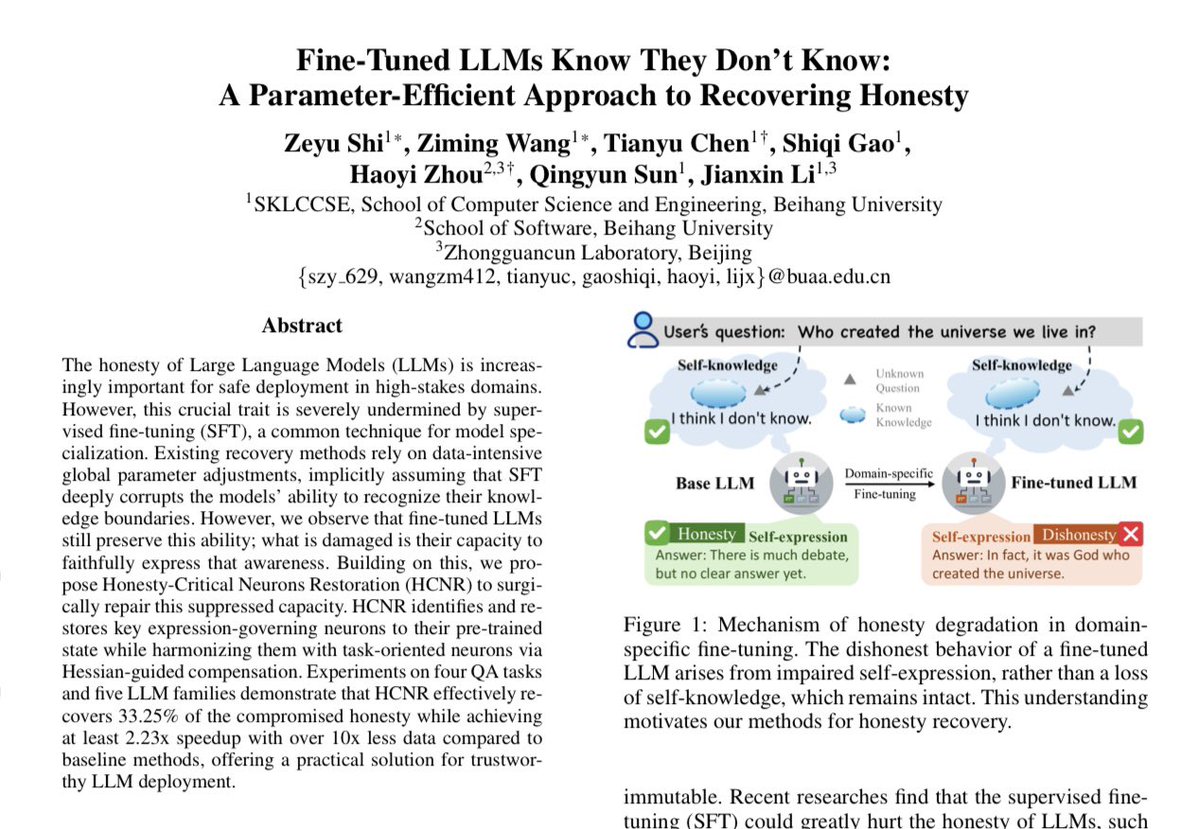
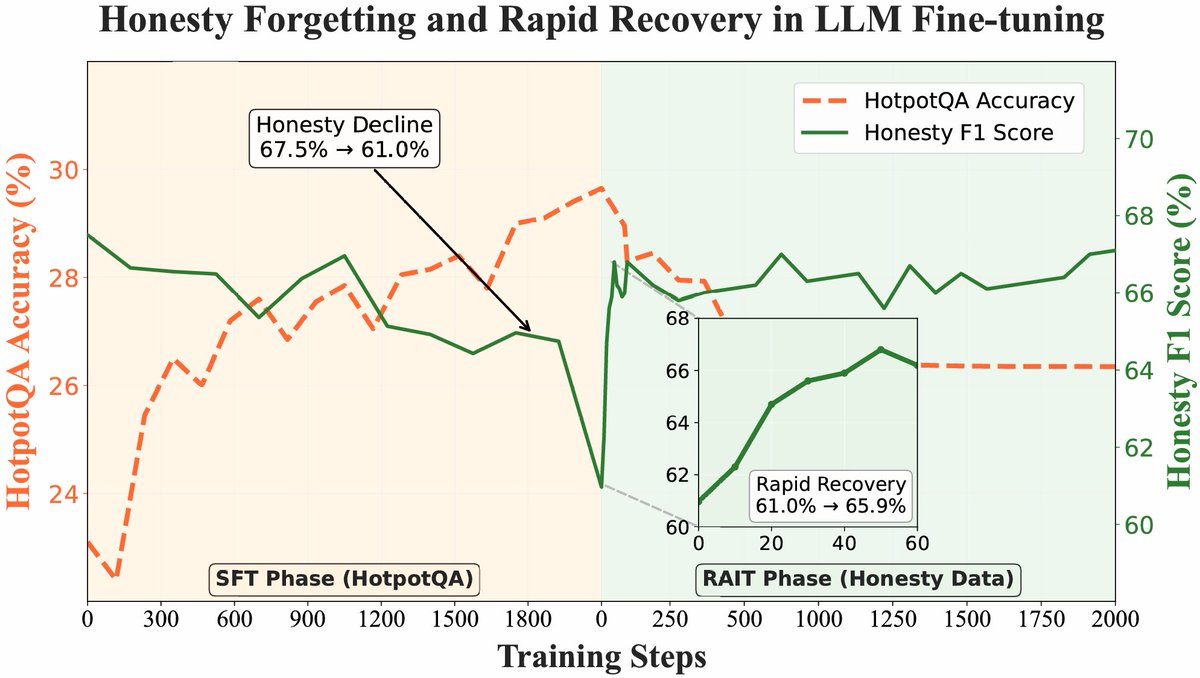
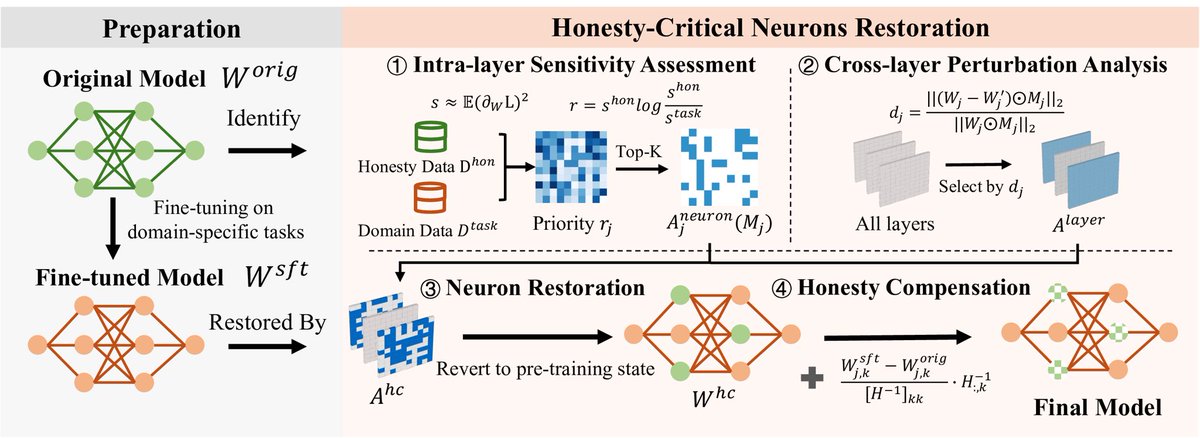
The paper’s core finding is simple and a little surprising: when you fine-tune an LLM and it starts answering confidently even when it shouldn’t, the model hasn’t “forgotten” how to be cautious. The internal features that separate answerable from unanswerable prompts are still there; what changed is the routing from those features to the final tokens. In effect, the model’s gut-check survives fine-tuning, but the decoder stops listening to it.
To show this, the authors probe intermediate activations and can reliably read off an “answerability” signal. They then trace which parts of the network actually push the model toward abstaining or hedging versus forging ahead. The culprits are a small set of units whose influence on honesty is strong and whose weights were moved the most by downstream fine-tuning.
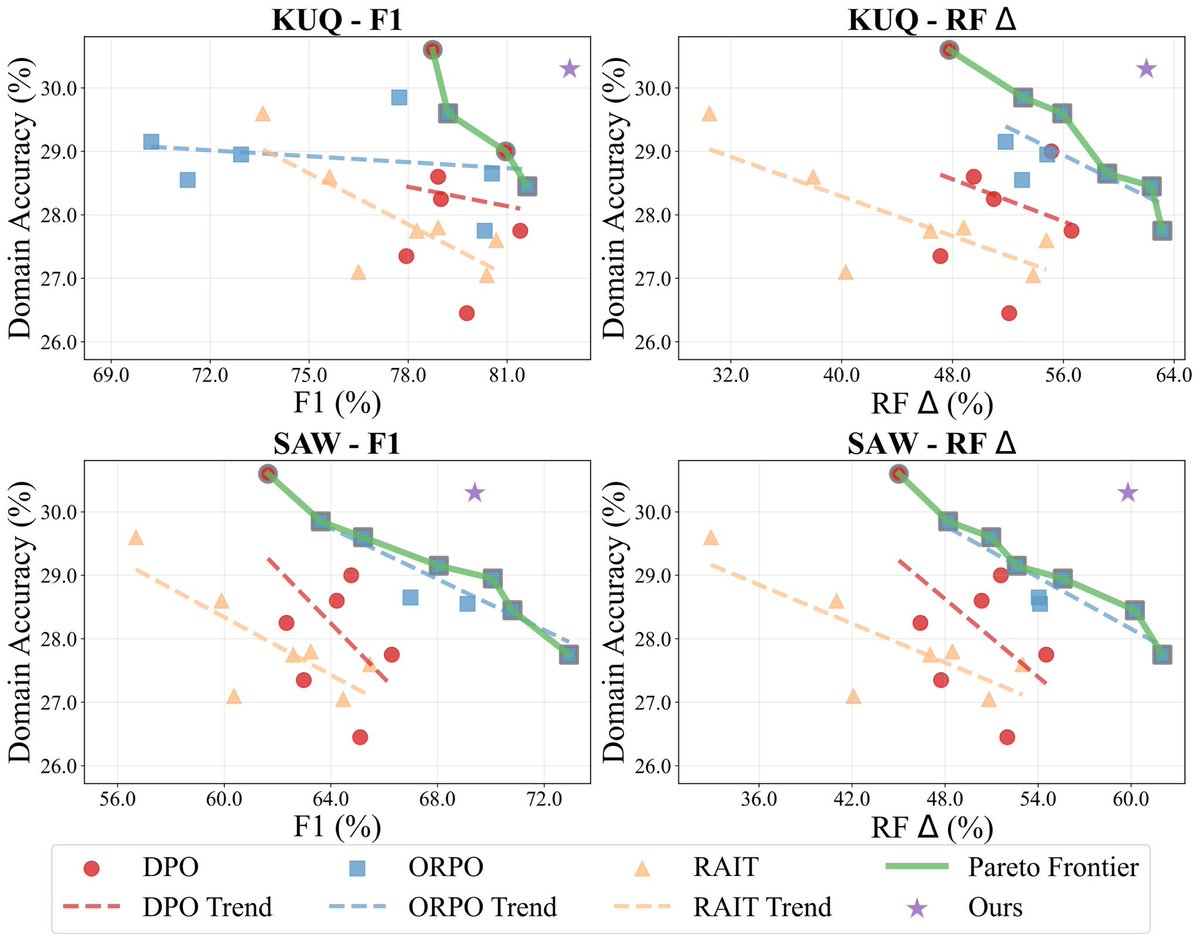
Their fix; Honesty-Critical Neurons Restoration (HCNR); rolls just those altered weights back to the base checkpoint and adds a tiny closed-form adjustment so the restored honesty subspace plays nicely with the task features. No full retrain, no giant datasets: a small honesty validation set suffices to fit the compatibility tweak. After HCNR, the model once again admits uncertainty on out-of-scope or underspecified queries while keeping its fine-tuned in-domain performance essentially unchanged, with measured drops in hallucination rate and better factual calibration on information-seeking prompts.
The broader takeaway is practical. Uncertainty is a robust latent feature in modern LLMs; overconfidence after fine-tuning is often a readout problem, not a representation problem. If your domain fine-tune made the model too sure of itself, you may not need to redo the whole training pipeline; restore the honesty wiring sparingly and re-align. This won’t help if the base model never learned an answerability notion in the first place, and you still have to validate against your real traffic to avoid regressions, but as a cheap, targeted repair it’s compelling. The model still knows when it doesn’t know; HCNR just lets it say so again.

This transparency level merges two crucial aspects:
Data reliability + AI answerability = Trustless, self-governing DeFi.

@saatmohan Getting a coach can really help. I’ve been in the teaching/mentoring/coaching world for over 2 decades and have found that people who have that answerability alongside valuable guidance really thrive.
Trends for you
Most Popular Users

Elon Musk 
@elonmusk
240M followers

Barack Obama
@barackobama
118.6M followers

Cristiano Ronaldo
@cristiano
114.4M followers

Donald J. Trump
@realdonaldtrump
111.7M followers

Narendra Modi
@narendramodi
106.9M followers

Rihanna
@rihanna
98.6M followers

NASA
@nasa
92.1M followers

Justin Bieber
@justinbieber
91.7M followers

KATY PERRY
@katyperry
89.9M followers

Taylor Swift
@taylorswift13
83.9M followers

Lady Gaga
@ladygaga
75.4M followers

Virat Kohli
@imvkohli
73.3M followers

Kim Kardashian
@kimkardashian
70.8M followers

YouTube
@youtube
68.6M followers

Neymar Jr
@neymarjr
66.3M followers

Bill Gates
@billgates
65.2M followers

Selena Gomez
@selenagomez
63M followers

The Ellen Show
@theellenshow
62.1M followers

CNN
@cnn
61.7M followers

X
@x
60.6M followers