

Top Tweets for #Awassi

Overview of the Paper: Kurdish Transhumance: Pastoral Practices in South-East Turkey
Michaël Thevenin’s study examines Kurdish pastoralism in southeastern Turkey. The paper is based on six field trips between 2005 and 2011, each lasting about fifteen days and focused on transhumance periods. During these visits, Thevenin lived with herders, documenting their migration routes, tribal affiliations, livestock breeds, economic practices, tent structures, and camp organisation.
The paper identifies two main pastoral systems in the region. The first is village-based sedentary pastoralism, characterised by small family farms, low mechanisation, household-level sheep and cattle breeding, and seasonal grazing around the village. Women undertake much of the daily milking, and traditional textile production such as carpet weaving has disappeared.
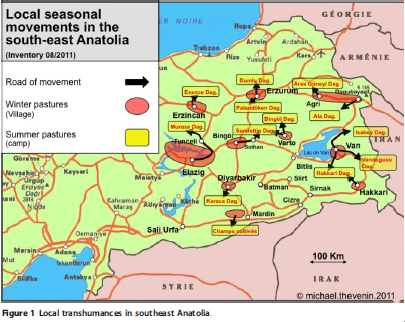
The second system involves various forms of seasonal movement. These include vertical transhumance between plains and mountain pastures, reverse transhumance by mountain villagers descending in winter, horizontal movements across high plateaux, and long-distance interregional migrations. These practices are maintained by both seminomadic families, who winter in villages and summer in tents, and fully nomadic groups who live in tents throughout the year.
Geography shapes this diversity. The Taurus mountains form an arc around Diyarbakir, while volcanic peaks such as Ararat and Süphan, high plateaux, semi-arid steppe regions, and alpine grasslands provide multiple ecological niches. Pastures make up roughly 27% of Turkey’s land surface and are divided into six ecological categories. Kurdish pastoralists utilise these varied environments according to seasonal conditions.
Kurdish pastoralism remains largely self-sufficient economically. The main products are meat, cheese, yoghurt, butter, and beverages such as Ayran/daw. Wool has little economic value today, though sheep breeding continues to contribute significantly to regional income. Flocks typically contain 400–500 animals and are guarded by shepherds and large dogs.
Thevenin describes four principal axes of Kurdish transhumance. Along the Elazig–Tunceli–Erzincan–Erzurum route, the Sawar (Shawaks), an Alevi Kurmanji-speaking tribe, practice vertical transhumance and maintain simple white cotton umbrella tents. Their flocks are primarily of the Qerkas/Karaman (white fat-tailed) type.
In the Hakkari region, the Erdusî and Peniyaniçî tribes operate permanent or semi-permanent camps combining stone walls, goatskin vellum, cotton, and nylon. They use distinctive water-management systems such as conduits channelled to each tent and small shelters over flowing water to cool dairy products. Their sheep include Hîmdanî and Qerkas breeds, often crossbred.
The most extensive movements involve the Beritan, Alikan, Mamadî, and Dudiran tribes. The Beritan migrate between wintering areas near Elazig, Diyarbakir, and Urfa and summer pastures in Bingöl. They are divided into clans such as the Kocî and Kerkulaxî, some travelling entirely on foot and others partially by truck. Traditional goat-hair black tents (kone res) remain symbols of identity, though many families now use cotton or nylon tents. Their sheep include Pezé Sipi, Pezé Zom, and Pezé Sor types.
The Alikan tribe of the Bitlis–Van region is notable for its “mosaic tents” constructed from patchwork fabrics and synthetic cloth. These tents preserve the structural concept of the traditional nomadic tent while adapting to modern materials. The Alikan herd the Cizirî/Himdanî sheep, an Awassi-type breed with long ears and brown heads. Some families have settled near Van but continue local seasonal movements.
The Mamadî winter near Batman and occupy fixed summer camps reinforced with large nylon-lined water tanks fed by snowmelt. Their flocks include Cizirî and Hûrik (Herik) sheep. The Dudiran tribe travel on foot for approximately forty-one days each spring and autumn between Sirnak and Hakkari, maintaining multiple specialised tents within their camps, including cooking, cheese-making, and women’s tents, as well as traditional tandur ovens.
The Igdir plain represents another axis. Historically, Kurdish shepherds moved from Igdir towards the mountain pastures of Agri, Kars, and Erzurum. Military closures during the PKK conflict forced many to alter their routes, become hired ox shepherds in Ardahan, or shift to villages with safer access. This has produced a new transhumance route between Igdir and Ardahan.
The paper also identifies several key sheep breeds associated with Kurdish pastoralists, including Qerkas (White Karaman), Pezé Sor (Red Karaman), Cizirî/Himdanî (Awassi-type), Pezé Zom, and Pezé Hûrik. All are fat-tailed breeds adapted to the region’s climate and altitude. Tent architecture varies by tribe, with black goat-hair tents serving as historic markers of nomadic identity, white cotton umbrella tents offering convenience, and mosaic tents reflecting innovative adaptation.
Thevenin situates these pastoral systems within broader socio-political dynamics, including Alevi and Sunni differences, Kurdish–Turkish tensions, heavy militarisation, and the persistence of tribal structures shaped by local clientelism and regional politics. Comparisons are drawn with the Turkmen Yörüks, whose pastoral culture has gained legal recognition and political visibility through national federations, support that Kurdish pastoralists lack.
Overall, the paper provides a detailed ethnographic account of the diversity of modern Kurdish transhumance, its tribal structures, its ecological adaptation, and the ways these systems continue to operate despite political, social, and economic pressures.



This filing is $IREN Limited’s Post-Effective Amendment No. 1 to its shelf registration statement.
Here’s what it means in plain terms:
Why it was filed:
IREN used to be classified as a foreign private issuer. As of July 1, 2025, it no longer qualifies and now has to follow the rules for a U.S. domestic company. So this amendment converts its old Form F-3 registration statement into a Form S-3 registration statement.
What’s included:
The amendment contains four separate prospectuses:
- Base prospectus – a “shelf” allowing IREN to issue ordinary shares, debt securities, warrants, subscription rights, purchase contracts, and units in the future.
- Sales agreement prospectus – allows IREN to sell up to $1 billion of ordinary shares “at the market” through brokers like J.P. Morgan, Citi, Cantor, etc.
- Loan-funded shares prospectus – registers 1,214,935 shares issued to certain lenders (so those lenders can resell them).
- Ordinary share resale prospectus – registers 2,000,000 shares that could be issued if Awassi Capital’s options (1M each from two trusts) are exercised and then resold to B. Riley Capital.
No new securities (except resale registration):
The amendment doesn’t authorize brand-new issuances beyond what was already planned. It mostly updates the legal structure and adds the resale rights for the specific share blocks above.
Effect on investors:
IREN has flexibility to raise up to $1B through its ATM (at-the-market) sales program.
Certain insiders/lenders now have a legal pathway to resell their shares.
It formalizes IREN’s transition to being treated like a U.S. domestic company for SEC purposes.
👉 In short: This filing updates IREN’s shelf registration to U.S. domestic rules, keeps its $1B at-the-market program alive, and registers about 3.2M additional shares for resale by lenders and option-holders.
Exactly — Awassi Capital Holdings 1 & 2 are trusts tied to Daniel and Will Roberts (the co-founders).
Here’s what the filing is saying about them and the “resale” option:
They already hold vested stock options
Each Awassi trust holds 1,000,000 fully vested and exercisable options that expire December 20, 2025.
These are options awarded long ago (likely as part of the founders’ incentive or retention package).
Those options can be exercised into ordinary shares
If exercised, they would create 2,000,000 new ordinary shares (1M per trust).
That’s potential dilution for existing shareholders.
The resale registration
Normally, insiders can’t just sell option-related shares freely into the open market — the SEC requires those shares to be registered (or exempt).
This filing creates a registered resale prospectus, which allows Awassi (or a buyer of their options, such as B. Riley Capital) to legally sell those shares into the market once exercised.
The mechanics
Awassi can either (a) exercise the options themselves and sell the shares, or (b) sell the options to B. Riley Capital, who could then exercise them and resell the underlying shares.
The filing explicitly notes that the resale prospectus is there to cover up to 2,000,000 shares from this process.
What it really means
The Roberts brothers have a clear exit/liquidity pathway for part of their personal holdings before December 2025.
They are not required to sell — but now they can if they choose, and B. Riley is positioned as a buyer/intermediary.
From an investor perspective, this is about potential insider selling pressure (founders taking some chips off the table), though it’s also standard corporate housekeeping: co-founders often want flexibility to monetize part of their awarded equity.
So, when you see “resale” here, it doesn’t mean IREN is issuing fresh equity to raise cash — it means the founders are setting up the legal ability to convert their already-awarded options into tradable stock and potentially sell them through B. Riley.

setelah denger omongan papa zara "mereka yang terlihat lemah akan aman" dan zara dipaksa ubah sikap jadi ovt aqeela juga sebenerny dia ga lugu dan heboh dia ad diri yang lain,inget kn dia suka notice ad yg ngawassin tapi dia terlihat biasa aj kya org yang gatau lagi di awassin
Trends for you
Most Popular Users

Elon Musk 
@elonmusk
240M followers

Barack Obama
@barackobama
118.6M followers

Cristiano Ronaldo
@cristiano
114.4M followers

Donald J. Trump
@realdonaldtrump
111.7M followers

Narendra Modi
@narendramodi
106.9M followers

Rihanna
@rihanna
98.6M followers

NASA
@nasa
92.1M followers

Justin Bieber
@justinbieber
91.7M followers

KATY PERRY
@katyperry
89.9M followers

Taylor Swift
@taylorswift13
83.9M followers

Lady Gaga
@ladygaga
75.4M followers

Virat Kohli
@imvkohli
73.3M followers

Kim Kardashian
@kimkardashian
70.8M followers

YouTube
@youtube
68.6M followers

Neymar Jr
@neymarjr
66.3M followers

Bill Gates
@billgates
65.2M followers

Selena Gomez
@selenagomez
63M followers

The Ellen Show
@theellenshow
62.1M followers

CNN
@cnn
61.7M followers

X
@x
60.6M followers