

Top Tweets for #BACKCROSS

The Chosen One.
Fellow MPB members, I'm excited to share this moment.
One of the hardest parts of a project like this is deciding what moves forward. I watch. I observe. I photograph. I compare. Over the years I've had to clone, backcross, and even develop the Back-Hybrid Reverberation (BHR) strategy "see post". Sometimes, after months of work, the final decision comes down to one small piece of data.
Going back through my notes, I rediscovered a post I had almost forgotten about....This one.... A single M8 seedling immediately grabbed my attention. It displayed a symmetrical striped two-tone cotyledon pattern unlike anything I had seen before. It didn't look random it looked intentional. So I photographed it, documented it, and kept watching.
I couldn't ignore it, so I searched specifically for this type of cannabis cotyledon. I found reports of albino seedlings and green/white variegation, but I could not find documented examples matching this symmetrical striped pattern. After germinating thousands of cannabis seeds over the years, this was a first for me.
Fast forward to today...
That little seedling is Nexus Male B.
Could those striped cotyledons be an early developmental marker linked to Nodal Floral Architecture (NFA)? I don't know. That's a hypothesis, not a conclusion. But when something unusual appears early in development, you don't ignore it you follow it.
The hardest part of Mutagenic Precision Breeding isn't making crosses. It's making decisions. You have to turn your love off for a moment. Stop thinking like a grower and start thinking like a scientist. Follow the evidence wherever it leads.
There are no favorites in MPB. There is no love. There is only observation, evidence, and the courage to move forward when the data points in one direction.
Welcome to M9, Nexus Male.


@BuddysBodegaCA imo I would love to see some old og orange driven stuff. some Cali O backcrosses and whatnot. enough of crossing good genetics with candy, I want that orangey orange mouth stain

One of the main starters in Traditional’s lineup
“Gelato” 🍧 (Gelato #33 backcross with Gelato #41)

🧵 MPB Group Exclusive: Breaking Down the Graph.
You may not understand this graph at first glance. Let me take a moment to explain what it is, what it represents, and what this now means for the cannabis community.
This is a histogram from LeafWorks Genetics showing the distribution of genetic deviations (SNPs/variants) from a consensus cannabis genome across thousands and thousands of documented samples. The big blue bell curve on the left? That’s where 99%+ of all known strains live tightly clustered, low divergence, because modern cannabis is heavily inbred and recycled.
Average deviations across ALL samples: 130.86.
Now look at the highlighted lines on the far right tail those are my X33:Genesis samples (M4–M6 twins and backcrosses):
Nebula Twin → 98.4 percentile (332 deviations)
Twin Male → 96.4 percentile (289)
Twin Sibling Survivor → 98.1 percentile
Nexus Twin → 98.9 percentile (351)
Nebula → 93.1 percentile (236)
Nexus Backcross → 99.3 percentile (368 deviations)
These aren’t just “unique.” They are statistical outliers — more genetically divergent than 93–99.3% of everything ever sequenced.
Through Mutagenic Precision Breeding and seven generations of ruthless mutant/twin-only selection (M1 → M7), X33:Genesis has reached territory almost no one else has touched. LeafWorks’ massive database confirms it: these samples are operating far outside the crowded gene pool everyone else is working in.
What this means for the cannabis community:
Real, measurable innovation is here backed by third-party genomics.
Mutagenic Precision Breeding (MPB) delivers results that stand out on a genome-wide scale.
When X33 crosses hit (and they will), expect instant novelty + visible seed markers that can’t be hidden or bred out.
The bar for breeding just got raised. Permanently.
This isn’t hype.
This is independent, genome-level proof.
We’re no longer playing in the same crowded space as everyone else.
X33:Genesis just opened a new ocean. If you are a cannabis grower and love growing Share & Repost 🌿🧬
#MPB #X33Genesis #CannabisBreeding #MutantInMyLab


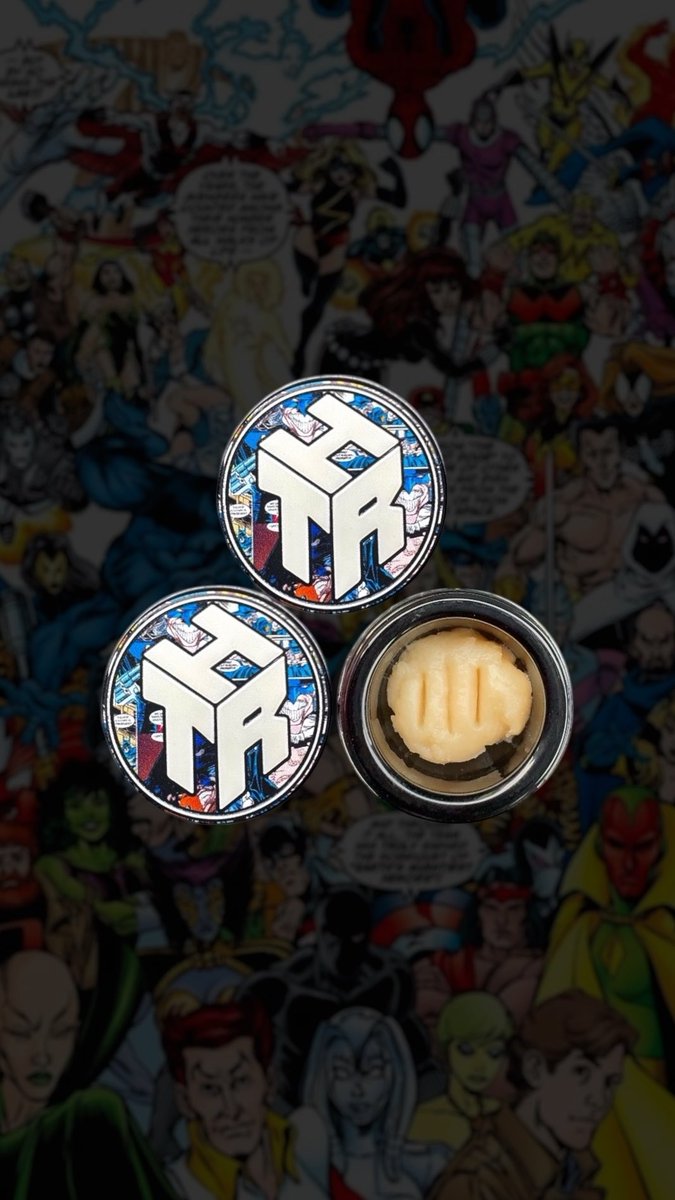
🍯🍌🌴: Tallymon BX1 (2 grams) (90-149u) by @Hightechrosin
🧬: Banana OG x Do-Si-Dos x Papaya (Backcrossed)
Setup: Reverendmorse (Rig), @jptoroglass TSA Terp Slide (Nail), Highly Educated (Pillar),Hash (Marble), @TheDabRite (Temp Reader), Disorderly Conduction (Heating Element)
Temp 🌡️: 550°F
🎵: Tally Mon by KIng Bali
👀: The appearance of this rosin was decent. It had a tan beige color with a nice terpy look upon opening, along with three packing marks in the center. The consistency was not the best, when I first went in to give it a stir, it was not too bad and would stay on the dab tool, but over time it became very dry and crumbly, which I did not enjoy and it was so crumbly it wouldn’t even stay on the dab tool. The jars used for this were cheap China microns rather than authentic ones with the “m” on the bottom, which could have contributed to the dryness, poor storage could also have been a factor.
The jar art was great though, the graphic designer did an amazing job. The top sticker featured the @Hightechrosin logo with the HTR combined over a comic book style background. The wraparound label displayed Tallymon BX1 in a bold black and white comic title font and continued the same comic theme background while also including additional jar information. 6.7/10
👃: The smell on this one was very nice and fairly loud. It opens with a sweet, fruity funk, followed by subtle dank notes that add depth. There is also a light hint of citrus in the background that helps brighten the overall profile. The longer you sit with the jar, the more those layers come together, making for a well balanced and complex nose that I really enjoyed. 7.9/10
👅: The taste wasn’t bad and had solid flavor, delivering a dank, sweet, fruity profile that really coated the mouth. However, there was a strange aftertaste that lingered pretty long. I also found it to be harsh and I coughed more than usual after dabbing it, especially at higher temperatures and it burned noticeably darker than most too, which you can see in the video. 6.6/10
Overall: This was my first time trying @Hightechrosin, and unfortunately, this jar did not impress me. I also wanna apologize for not having a better melt shot video uploaded as most dabs went in my @puffco I always hate giving a jar a bad review but at the end of the day honestly is what I'm about. The reason I decided to give the brand a try is because I tried a dab of Pakolo Papaya through a friend and thought it wasn’t bad so it was a single source drop, indoor grown, and organically cultivated using Vital Garden products, which I felt should represent the brand well.
I do not know a ton about @Hightechrosin, but I'm pretty sure they are a California based hash brand that focus on single source drops along with some collaborations. I wish I could provide more background, but that is all the information I know on the brand.
This jar did not check all the boxes for me. The smell and the high were alright, but the looks and taste fell short. The rosin dabbed harsh, became very dry over time, and burned slightly dark, which I did not enjoy. The high itself was nice and fairly potent, but the harshness took away from the overall experience and led me to dab it mostly through my Puffco rather than off a rig.
Sadly, I did not enjoy this jar and would not grab it again but I will not let one jar define the brand though, I would definitely be open to trying @Hightechrosin again in the future, but at the price point they demand for the quality hash its hard to wanna try again instead of grabbing something else. I wont say it's a horrible jar but it definitely is not one I'd recommend grabbing. Shoutout to @Hightechrosin hopefully the next jar is better! 6.6/10
#cannabis #rosin #coldcure #hightechrosin #tallymonbx1 #bananaog #dosidos #sweet #fruity #funk #dank #90u #toroquartz #torobanger #toro #toroterpslide #slide #reverendmorse #mmj #rosinreview #hash #sinsemillaville #stayhashy #terps #terpenes #terpchasing
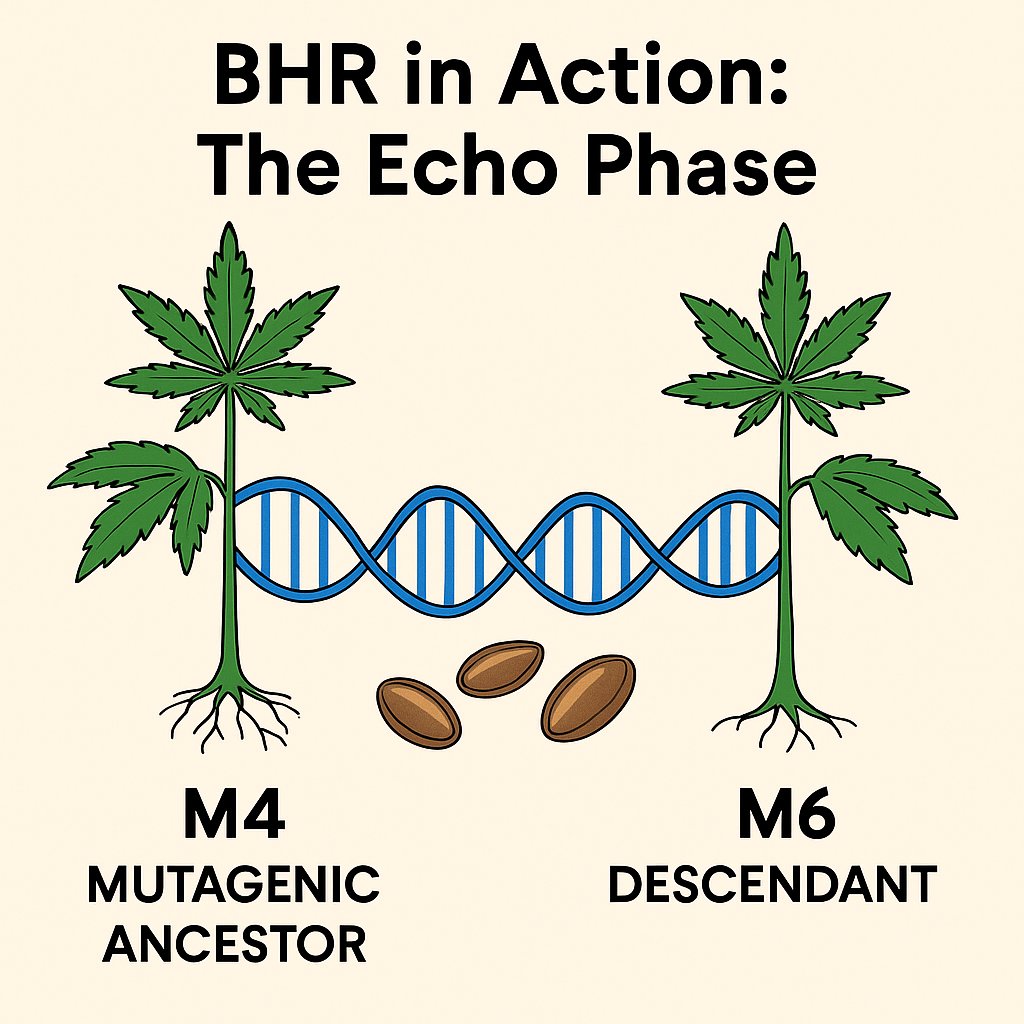
Most growers will never see BHR happen on its own and here’s why 👇
1️⃣ No time gap: Normal breeding cycles don’t create enough generational distance for the genome to diverge and then “echo” when re-crossed.
2️⃣ No contrast: Without mutagenic or deep environmental pressure, both parents are basically the same DNA there’s nothing new to reverberate.
3️⃣ Standard backcrossing = refinement, not reawakening. It stabilizes a line but doesn’t reconnect separate versions of it.
4️⃣ Why X33 pulled it off: Sodium azide created a true timeline split in early gens (M1–M3), the M4s expressed it, and by M6 the genome had adapted. When those two met again, the old and new versions of the same line finally talked that’s the echo no normal breeding room can reproduce.
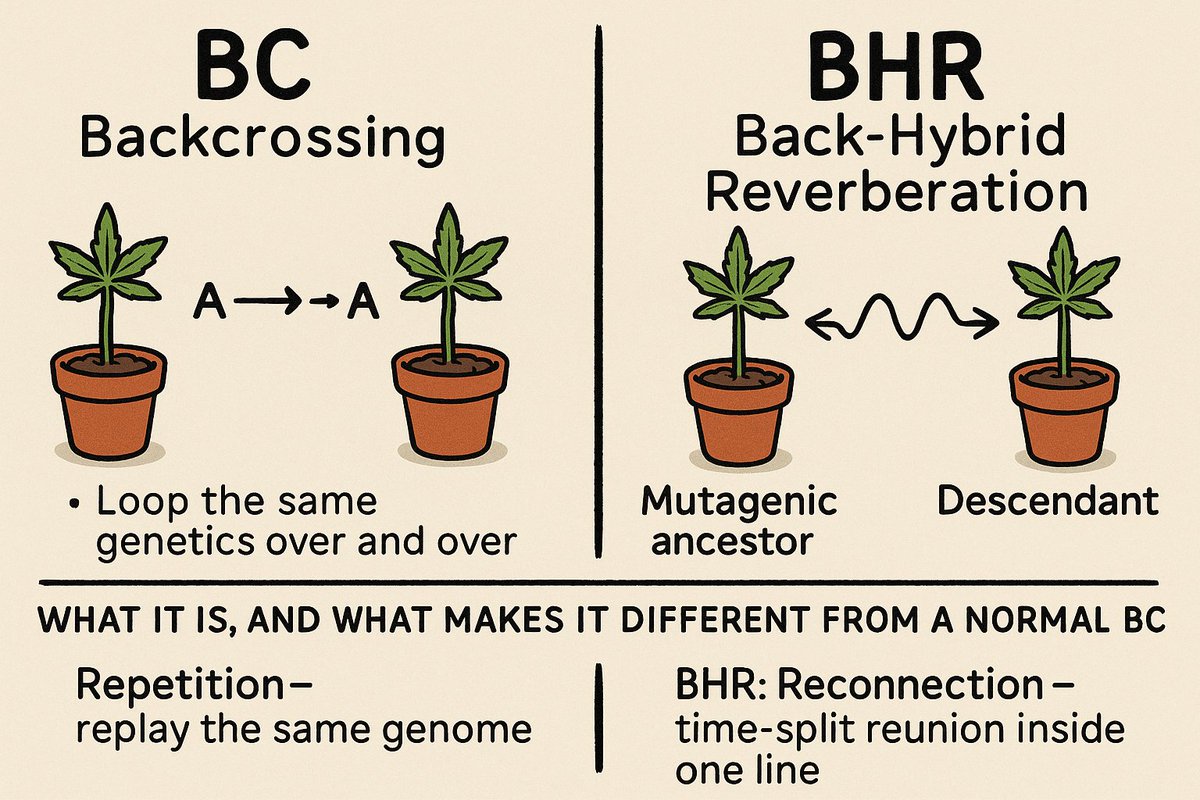
🔬 BHR — What It Is, and What Makes It Different from a Normal BC
Most breeders use BC (Backcrossing) to lock in a trait — flavor, yield, color by looping the same genetics over and over.
That’s fine, but it’s a closed circuit.
BC just replays the same genome:
A → A → A.
No new information enters the system, and no time gap exists between the generations being crossed.
BHR, or Back-Hybrid Reverberation, is different.
It’s not about repetition it’s about reconnection.
You take an original mutagenic ancestor (like the M4 Nexus or Nebula clones that survived sodium azide)
and cross it with its own descendant from several generations later (like the M6 Nexus male).
That creates a time-split reunion inside the same genetic line.
When those two versions meet, the genome doesn’t just mix it echoes.
Mutagenic memory from the past collides with evolved stabilization from the present.
Sometimes that echo re-awakens buried traits; other times it locks structure into a new, consistent form.
Either way, it reveals how the plant’s DNA learns and adapts over generations.
A normal backcross only repeats history.
BHR lets the past and future of the same line talk to each other.

@Bitxhimhigh Backcross it with Kimber

Happy Halloween - Unlock the Future of Cannabis Breeding with – 30% Off Now!
Phenohunters, breeders, and commercial ops – if you’re tired of cookie-cutter feminized seeds that lock you into someone else’s genetics, it’s time to level up with Landrace Bureau’s regular seeds. We’re talking pure fire: rare landrace and heirloom strains straight from the source, designed for you to hunt, select, and craft your own legendary originals. No bottlenecks, no bullshit – just tools to evolve cannabis on your terms.
Each drop is packed with vigorous, diverse expressions – think “lost terps” from ancient landraces crossed with modern polyhybrids. For phenohunters, it’s a playground: pop ‘em, scout those standout traits (vigor, resilience, flavor bombs), and lock in keepers that thrive in your microclimate. Commercial facilities? Scale it: select for stability in greenhouses or outdoor ops, then backcross to build proprietary strains that crush the market. We’re not just selling seeds; we’re handing you the keys to genetic sovereignty. Evolve heirlooms into custom cultivars that preserve biodiversity and crush uniformity.
•Vigorous AF: Paired with our free microbial inoculant (Bacillus subtilis + Trichoderma harzianum), germination hits 95%+ and seedlings pop with unbeatable root power.
https://t.co/iSpiRPr8nz.
🌱🔥 #LandraceSeeds #Phenohunting #BreedYourOwn #CannabisGenetics

🧬 MPB Update: X33: Genesis — The Hat Trick is Still in Play
I retracted a post recently. One of the M6 Nebula twins didn’t make it, and for a moment I thought the 3-generation streak was over.
But that’s not how genetics works.
Even when one embryo fails, the code that created the twin still exists and that surviving seedling carries the story forward.
📸 Photo: M6 Nebula twin survivor (conjoined seed case)
The tonal banding on the leaves, the paired serrations… all classic Nebula control-line traits still expressing two generations after the first twin seed was dissected.
Next stop: LeafWorks Laboratories.
Six samples M4 Nexus + Nebula clones, the M5 Kingmaker twin male, an M5 Nexus singleton, an M6 Nexus×M5 backcross, and this M6 Nebula conjoined case are being prepped for DNA analysis.
If the data show genetic linkage across M4 → M5 → M6, it would mark the first documented 3-generation twin sequence in cannabis a true “hat trick.”
And even if they find something unexpected methylation shifts, chloroplast timing alleles, or embryo-development signals it all pushes the field forward.
👉 Mutagenic Precision Breeding isn’t just about creating twins; it’s about opening doors in cannabis we didn’t even know were there.
Wish me luck! Scott
#MPB #X33Genesis #CannabisScience #LeafWorks #Genetics #Embryogenesis


West Coast OG Auto showing the first signs of reversing sex. We are reproducing seeds and backcrossing it with itself.

This backcross KICK ASS!!!!!!!
🚨 X33: Genesis Update – Nexus M4 Backcross × M5 Twin Male 🚨
These are the latest seeds pulled from the Nexus M4 backcross hit with pollen from the first-ever X33 M5 twin male (KINGMAKER).
Here’s what you’re looking at:
Exaggerated keel ridges sharp dorsal lines that cut across the seed body. Normal cannabis seeds do not develop keels this pronounced.
Polygonal compression & angularity seed shells are warped and faceted instead of smooth and ovoid. This is not normal.
Marbled surface patterning vein-like cracking across the testa, consistent with embryonic crowding. Again, not normal cannabis development.
Uniform abnormality – every seed from this group carries some version of these markers. This isn’t random mutation anymore it’s trending heritable.
For context:
The first Nebula M4 twin seed showed these same markers.
Now, after the M5 twin KINGMAKER hit, that look has spread across the entire seed set.
🔬 Hypothesis: These traits are external markers of polyembryony. What you see as compression and shell deformation may be embryos pressing against each other inside.
👉 Normal cannabis breeders will never show you seeds like this. These are not the product of crossing “flavors.” This is embryonic rewiring.


🌿 Redefining the Cannabis Genome: 🧬
Breakthrough Unveils new insight into Cannabis classification.
A novel finding is that hemp groups exhibit higher allelic diversity and more private alleles (unique genetic variants) than marijuana, likely due to less intensive selection pressure compared to THC-focused breeding. This adds to insights by showing hemp as a reservoir of untapped genetic potential, contrasting with prior views that treated it as genetically narrower.
This builds on and challenges traditional classifications like hemp vs. marijuana (based primarily on cannabinoid content, e.g., low-THC hemp for industrial use vs. high-THC marijuana for psychoactive effects) or the outdated Indica/Sativa/Ruderalis model (rooted in morphology and geography but lacking genetic support).
The four distinct lineages identified through genomic analysis represent a refined classification that goes beyond the traditional binary of hemp (fiber-focused) vs. marijuana (psychoactive-focused). These lineages reflect evolutionary divergences shaped by geography, human selection pressures, and natural hybridization events over millennia. For breeders, this framework is particularly insightful as it highlights genetic markers for desirable traits like cannabinoid profiles, terpene diversity, pest resistance, and growth habits—enabling targeted crosses to develop stable hybrids with enhanced yields, potency, or environmental adaptability. Below, I'll outline each lineage with key details and breeding implications.
Basal Lineage (Wild/Feral Ancestral Types): This group includes the most primitive, non-domesticated or escaped feral strains, often found in regions like East Asia (e.g., China), tracing back to the plant's origins around 12,000 years ago. Genetically, they exhibit low cannabinoid levels but high heterozygosity and resilience to harsh conditions. For breeders, this lineage is a treasure trove of untapped diversity—offering genes for drought tolerance and disease resistance that can be introgressed into commercial varieties via backcrossing, potentially creating robust outdoor cultivars without sacrificing modern traits.
Hemp Lineage (Fiber and Industrial Types): Characterized by tall, unbranched plants with minimal psychoactive compounds (low THC, high CBD in some), this lineage dominates industrial hemp for textiles, seeds, and biofuels. The survey noted exceptionally high genetic diversity here, with variants showing rapid growth cycles and fiber strength. Breeders can leverage this for polyhybrid programs, crossing with drug-types to boost CBD content in non-intoxicating strains, or selecting for auto-flowering traits to shorten harvest times—ideal for sustainable agriculture in varying climates.
Narrow-Leaf Drug Lineage (NLD, Sativa-Dominant Psychoactive Types): These are equatorial-origin strains with elongated leaves, high THC potency, and uplifting effects, often linked to Southeast Asian landraces. The analysis revealed moderate diversity but strong markers for terpene complexity (e.g., myrcene for earthy aromas). Insightful for breeders: This lineage's photoperiod sensitivity allows fine-tuning for indoor grows; hybridizing with hemp could yield high-THC varieties with improved fiber quality for dual-purpose crops, reducing waste and enhancing market value through novel entourage effects.
Broad-Leaf Drug Lineage (BLD, Indica-Dominant Psychoactive Types): Featuring compact, bushy plants from regions like Afghanistan or the Hindu Kush, this group has balanced or high THC/CBD ratios, emphasizing sedative properties and resin production.
The study highlighted hybridization hotspots within this lineage, showing recent admixtures that increase cannabinoid variability. For breeders, this means opportunities in marker-assisted selection (MAS) to isolate genes for high resin yields—perfect for extracts or pharmaceuticals—while crossing with basal types could mitigate inbreeding depression, leading to more vigorous, disease-resistant medical strains. 1/3 🧵
Source: https://t.co/pJjZggMA3S
📸 Kazakhstani Wild indigenous cannabis

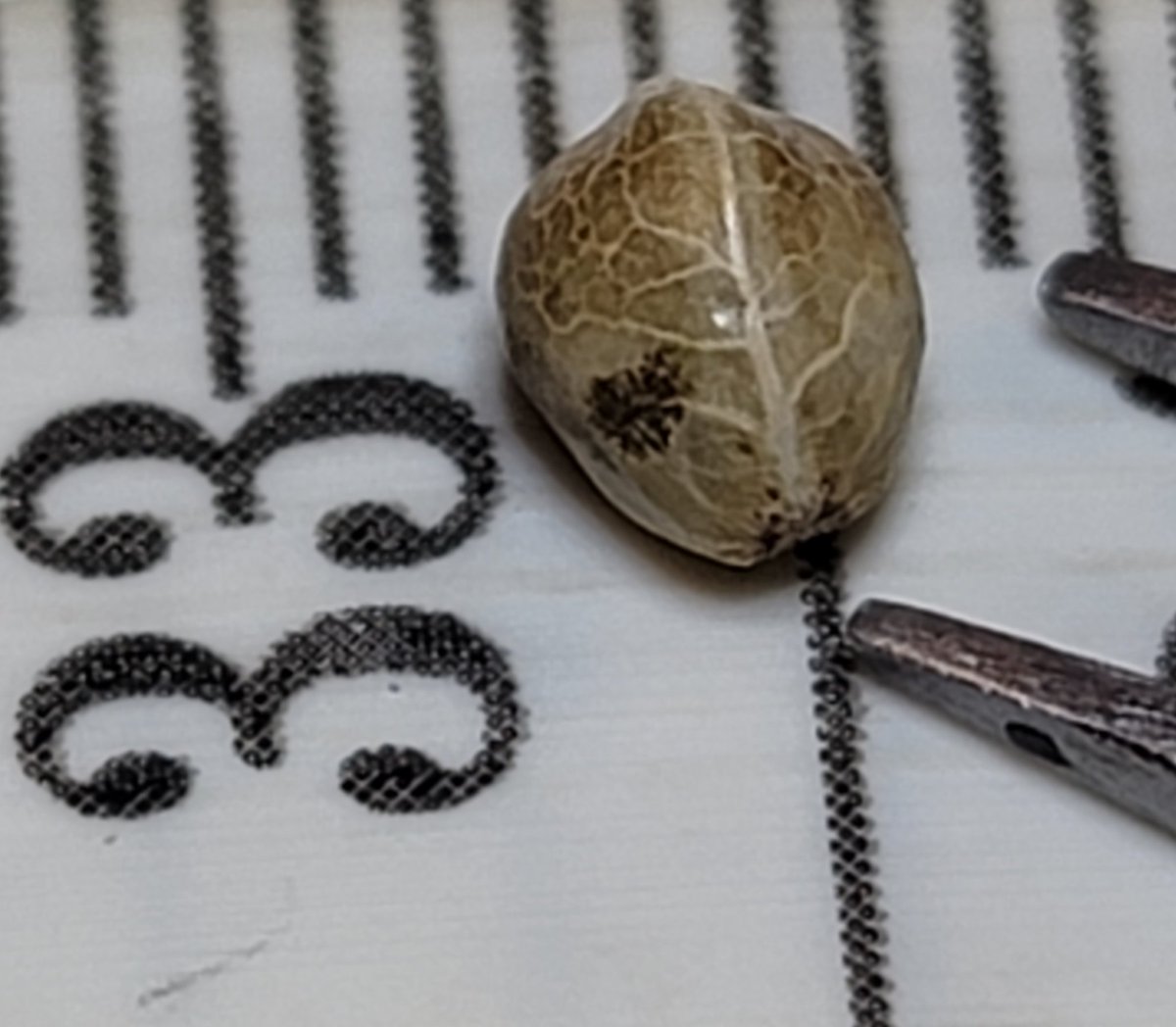
X33: Genesis – First Nexus Backcross Seed (M4 × M5 Twin Male)
From the M4 Nexus clone backcrossed by the X33 M5 twin male, a mature seed was collected and documented. This represents the first confirmed seed from this backcross.
Scientific Observations:
Morphology: The seed displays a pronounced keel ridge running longitudinally, with clear polygonal faceting and compression planes.
Size & Structure: Larger and more elongated than baseline Cannabis sativa seeds (3–4 mm, ovoid, smooth).
Uniformity: Not an isolated abnormality all seeds observed from this cross exhibit the same keel form, indicating genetic consistency.
Allele Alignment: The absence of normal Nebula-type morphology, combined with total keel convergence, strongly suggests allelic consolidation of polyembryony-linked traits.
Why This Is Monumentous:
Normal cannabis does not do this. Conventional seed lines produce round/ovoid seeds with broad variation. Here, an entire seed set has stabilized into an abnormal keel form.
This is the first clear evidence of fixation: polyembryony traits and abnormal morphology are no longer sporadic anomalies, but consistent heritable markers.
With hundreds more seeds from this backcross still maturing, this event marks the point where polyembryony in cannabis transitions from possibility to repeatable reality.
Implication for the Cannabis Community:
For the first time in cannabis breeding history, polyembryony is not only appearing but showing signs of stability across generations. This is not a pheno hunt, not a one-off mutation it is a fundamental rewrite of inheritance at the seed level.



Georgia Pie #FreshVibez @frshvibezflwrco
Overview: Georgia Pie is a slightly indica-dominant hybrid strain (60% indica/40% sativa) bred by Seed Junky Genetics @JBeezySJG , resulting from a cross between Gellati and Kush Mints. Known for its potent effects and dessert-like flavor, it has gained popularity among recreational and medical cannabis users, particularly in regions like Colorado, California, and Canada.
Genetics:
Parent Strains: Gellati (Gelato x Biscotti) contributes sweet, fruity notes, while Kush Mints (Animal Mints x Bubba Kush) adds minty, gassy, and earthy undertones. Some sources suggest possible influences from Georgia Pine and Cookies n’ Cream in certain phenotypes.
THC Content: Typically ranges from 20-27%, with some batches reaching up to 31.53% THC-A in crosses like Georgia Pie x Zkittles.
CBD Content: Low, usually 1-3%, focusing on psychoactive effects over non-intoxicating benefits.
Appearance:
Buds are dense, resinous, and visually striking, with colors ranging from mossy green to purple, accented by vibrant orange pistils and a thick layer of frosty, purple-tinted trichomes. The buds often resemble popcorn in shape and have a sticky, trichome-heavy texture.
Aroma and Flavor:
Aroma: Reminiscent of fresh peach cobbler, with sweet, peachy, and fruity notes blended with earthy, gassy, and nutty undertones. Some phenotypes emphasize creamy Kush or skunky gas, with hints of cherries, pine, or mint. Dominant terpenes include Limonene (citrusy, uplifting), Beta-Caryophyllene (earthy, spicy), and Myrcene (herbal, sedative).
Flavor: Sweet and creamy, like peach cobbler or baked fruit, with a smooth, velvety taste. Notes of cherries, nuts, citrus, and mint may also emerge, with a lingering gassy or earthy finish. The smoke is described as smooth and gentle on the lungs.
Effects:
Mental: Provides an uplifting cerebral high, sparking euphoria, happiness, and mental clarity. It enhances mood and creativity, making it popular among artists and musicians for focus and inspiration.
Physical: Delivers a relaxing, tingly body high that soothes muscles and eases tension without heavy sedation, though higher doses can induce sleepiness. Effects last 2-3 hours.
Best Use: Suitable for evening or nighttime use due to its calming effects, though its balanced nature allows daytime use for experienced users. Ideal for unwinding, socializing, or creative tasks.
Medical Benefits:
Commonly used for chronic pain, stress, anxiety, depression, insomnia, and appetite loss. Its calming properties help with muscle tension and inflammation, while its mood-boosting effects aid emotional distress. The strain’s appetite stimulation is notable for those with nausea or poor appetite.
Side Effects: Common side effects include dry mouth and dry eyes. Due to its high THC content, novice users should start with a low dose to avoid overwhelming effects.
Notable Variants:
Georgia Pie S1: A backcross of Georgia Pie, emphasizing creamy, gassy Kush flavors.
Georgia Pie F2: Crossed with Honey Buns, enhancing Kush undertones and growth stability.
Georgia Apple Pie: Crossed with Apple Fritter, adding sour apple and gelato-like notes.
Georgia Pie x Zkittles: Combines Georgia Pie’s gassy, nutty profile with Zkittles’ sweet, candy-like flavors, boasting high THC-A (31.53%).
Summary: Georgia Pie is a flavorful and potent hybrid celebrated for its peach cobbler-like aroma, balanced high, and therapeutic benefits. Its sweet, fruity, and gassy profile, combined with uplifting yet relaxing effects, makes it a versatile choice for stress relief, pain management, and creative pursuits.
X33: Genesis – Scale Check
Here’s one of the swollen seed pods on the M4 Nexus backcross × M5 twin Kingmaker cross. For scale, a U.S. penny is 19 mm across. The circled pod measures roughly 4.5–6 mm wide nearly double the size of a normal cannabis seed pod (2–3mm).
This isn’t just one oddball pod. Hundreds across the plant are showing the same swollen, resin-coated profile. Mutant or not, the numbers don’t lie — these pods are breaking past standard cannabis morphology and carrying the trait into new territory.1

X33: Genesis Observation Log
Gen: M4 Nexus backcross × M5 twin Kingmaker
Date: [8/20/2025]
Observation:
Hundreds of seed pods show consistent swelling with rounded, high-pressure calyx walls and dense trichome coverage. This morphology is uniform across the population rather than isolated to a few pods.
Interpretation:
The widespread expression strongly suggests the M5 twin Kingmaker male is transmitting polyembryony-linked alleles. This marks a generational shift from rare anomaly to potential stable trait.

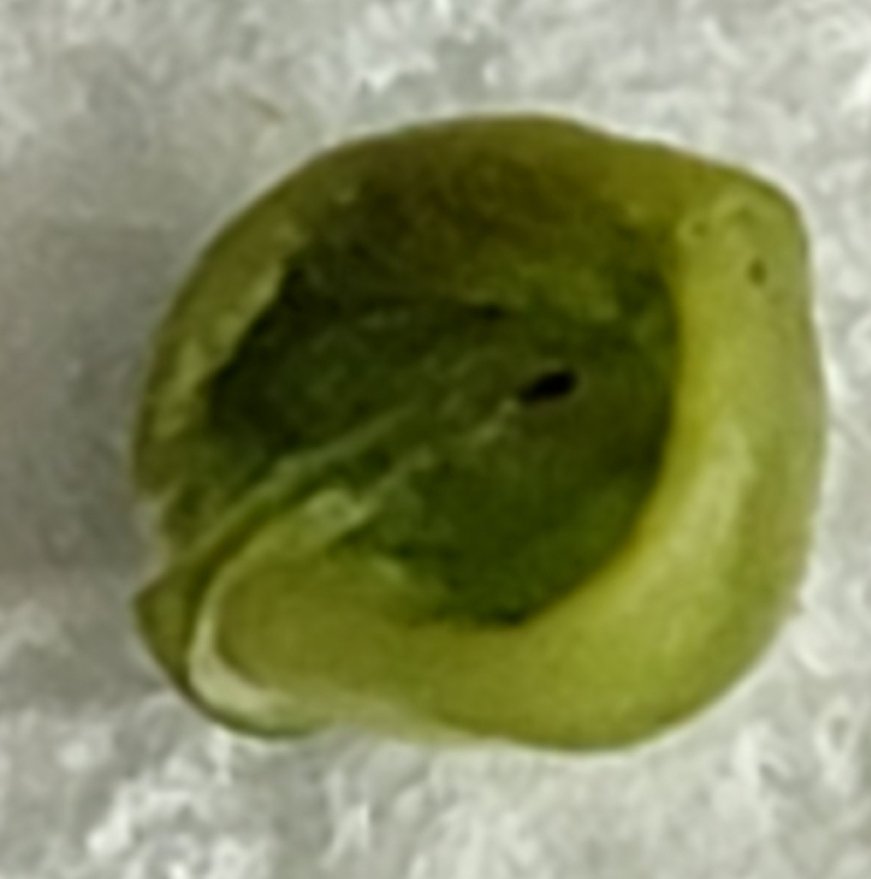
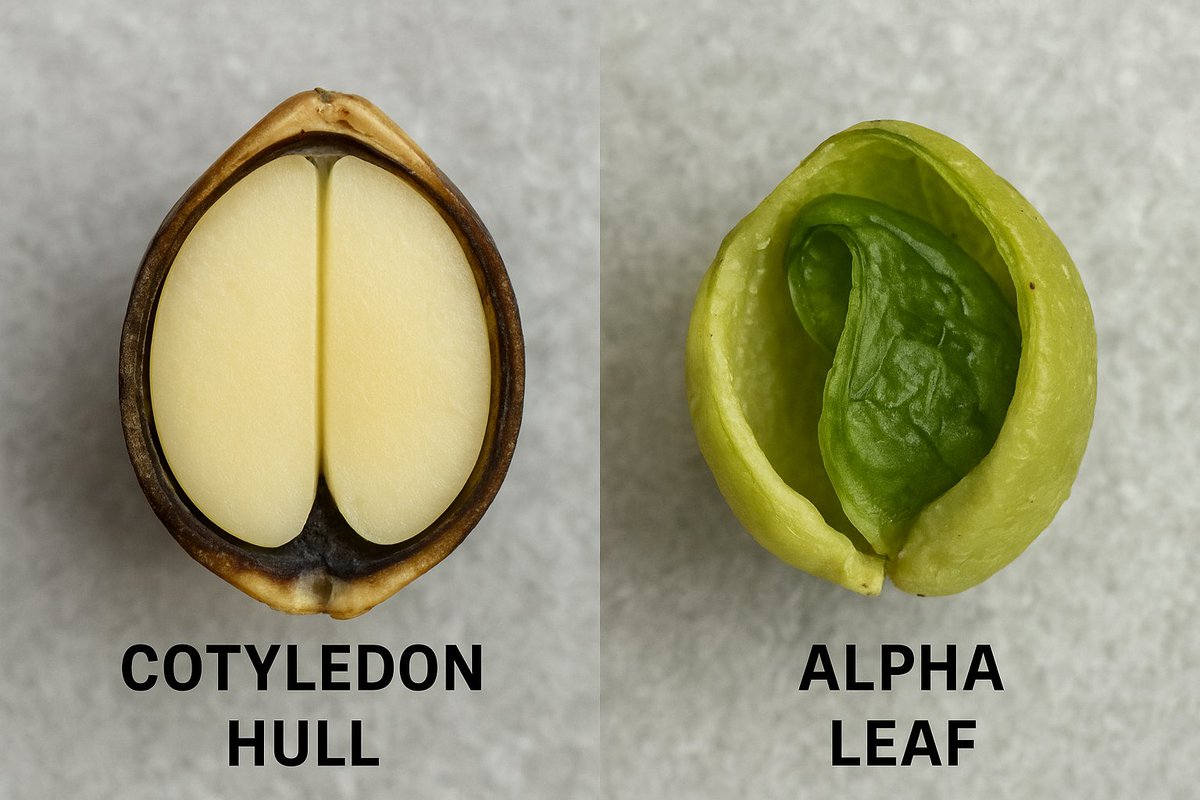
Alpha Leaf Emergence in X33: Genesis
During dissection of a immature M4 Nexus backcross seed, I observed a green laminar organ forming inside the seed cavity. This structure matches the profile of a precocious true leaf (“Alpha Leaf”), appearing before germination and prior to coat hardening.
Why this matters
In normal cannabis, the embryo matures with two cotyledons; the first true leaf emerges only after germination. In X33, that developmental program appears shifted forward. I have now documented dozens of seeds showing this same Alpha Leaf emergence.
One possible mechanism is DNA point breaks from Mutagenic Precision Breeding, which may have altered regulatory checkpoints at the shoot apical meristem. What normally stays dormant until germination is now firing inside the seed.
This raises evolutionary questions: could the Alpha Leaf be a relic survival mechanism from ancient cannabis? In harsh or unstable environments, a seed capable of unfurling a photosynthetic organ the moment it cracks soil would gain a survival edge. Mutagenic breeding may be reactivating this long-silenced pathway.
Scientific significance
This is likely the first time Alpha Leaf formation has been systematically observed and documented in cannabis.
The phenomenon is not isolated dozens of X33 seeds present this trait, making it a genuine line characteristic, not a freak mutation.
Alpha Leaf emergence demonstrates that mutagenic point shifts can unlock suppressed or ancient developmental programs within the cannabis genome.
Closing:
X33: Genesis is proving that cannabis still holds undiscovered embryonic behaviors. The Alpha Leaf trait is more than a curiosity it represents a new embryonic strategy in cannabis development, one that may tie back to survival adaptations lost to domestication.
The fact that we now see this trait consistently in X33 seeds suggests it is a true genetic signature of the line — a breakthrough in cannabis science.


Zkittlez BX1 #TornadoTerps @Tornado_Terpz
Zkittlez BX1 Strain Description
Zkittlez BX1 is an indica-dominant hybrid (80% indica/20% sativa) bred by Massive Seeds through backcrossing Zkittlez with Wildfire Zkittlez F2. This strain is renowned for its vibrant, candy-like qualities, delivering a potent and flavorful experience.
Lineage: Zkittlez x Wildfire Zkittlez F2
Aroma & Flavor: A terpene-rich profile bursting with sweet, tropical fruit, ripe berries, and candy-like notes, often with a hint of wild berry or grape. Dominant terpenes include caryophyllene (peppery), linalool (floral), and terpinolene (citrusy).
Appearance: Deep purple and vibrant green buds, densely coated in trichomes, with some phenotypes showing striking purple tips when exposed to cooler nighttime temperatures.
Effects: Offers a relaxing, dreamy high that starts with a gentle cerebral uplift, promoting creativity and social vibes, before settling into a soothing body buzz. Ideal for evening use, stress relief, or creative pursuits.
Medical Benefits: May help with chronic stress, anxiety, mild to moderate pain, and mood imbalances due to its calming and uplifting effects.
Zkittlez BX1’s robust genetics, vivid coloration, and mouthwatering flavor make it a standout choice for growers and users seeking a potent, terpene-heavy strain with excellent bag appeal.
🚨 Breeding Milestone Achieved: Polyembryony Now Expressing in Pure X33 M5 Twins
For the first time ever, we're observing autonomous twin seed formation in a pure X33 M5 twin female—not a clone, not backcrossed, and not pollinated by an M4 male. This female was pollinated by a twin-born X33 M5 male—marking the first recorded instance where both parents were twins, and the mutation carried through naturally.
🔬 Key Findings:
Twin seeds are now forming without chemical reinforcement.
The female expressing this was born a twin—this is M5 generation self-expression, not M4 residue.
The male was also a twin, and his pollen appears to activate or enhance the twin-seed trait.
🧠 Hypothesis: This strongly suggests that the original sodium azide mutation triggered a dormant developmental pathway in early generations (M1–M3), but full trait expression required the right allele pairing, which only occurred when both male and female were twin-born (M5 × M5). This may represent a functional polyembryony allele set.
🌱 What This Means: This isn’t a fluke. This is heritable, predictable, and now activatable with specific pairings. We’re no longer chasing mutations—we’re breeding them forward.
📸 Photos Attached:
1. X33 M5 twin female with confirmed dual seed sites
2. Macro of swollen calyx and irregular seed development
3. Visual evidence of structural anomalies in new M5 generation
🔄 Let this sink in: Other breeders find a twin seed and think they hit the jackpot. We created an entire system where twin plants make twin seeds that make twin seeds again.
This is not “chuck pollen and hope.”
This is DNA engineering by generational design.
This is X33: Genesis.


🧬 X33: Genesis – Backcross Complete, Mutation Locked
Posted by: Scott | Mutagenic Precision Breeding | X33 Project
This week marks a major milestone in the X33: Genesis project — and potentially in cannabis breeding history.
After generations of sodium azide–induced selection pressure, I’ve completed a full-spectrum backcross using a verified polyembryonic X33 M5 twin male. This male just released a massive, fertile pollen plume onto the following females:
M4 Nebula clone (twin origin)
M4 Nexus clone (twin origin)
M5 twin females from the original sodium azide run
A rare M5 Nebula twin set that displays the Nexus phenotype, despite originating from the Nebula line
---
🧬 Important Note on the M5 Nebula-Nexus Twin Set
One of the M5 twin sets that was pollinated came from a Nebula M5 seed but is visually expressing the M4 Nexus phenotype.
> This strongly suggests phenotypic fluidity or shared recessive trait layers between Nebula and Nexus — both of which originated from the same M4 twin seed.
This plant will be key for future mapping, especially if the Nexus expression becomes genetically dominant in M6 or beyond.
---
🌱 What to Expect from the M6 Generation
We’re entering a high-expression, high-resolution generation with the potential for:
✅ Polyembryony rates > 60–70%
✅ Star-shaped seed morphology stabilizing across more seeds
✅ Alpha Leaf appearing in both twins from the same seed
✅ First triplet seed emergence highly likely
✅ Sharp phenotypic divergence between twin sprouts
> For the first time, we’re not just seeing polyembryony — we’re breeding from it, with both sides of the cross carrying the trait.
---
📊 Next Phase: Trait Tracking
All M6 seeds will be dissected, cataloged, and scored for:
Embryo count per seed
Star-shaped ridge structure
Cotyledon and Alpha Leaf formation
Twin divergence (morphological and vigor)
Seed weight and surface architecture
---
The mutation has been locked. The next generation will reveal its full intent.
Updates will follow as soon as the first M6 twins emerge.
#X33Genesis #MPB #Polyembryony #StarSeed #CannabisMutation #SodiumAzide #AlphaLeaf #BackcrossComplete #M6Run #MutagenicPrecisionBreeding #NexusFromNebula

@kpm1234 That shoulder is what got me. It really looks like a habanada, but it could totally be a backcross habanada x habanero if it has heat. Who knows, but I’ve always been tempted to do it.
So.....This is my favorite plant out of the two twins. The leaf looks badass, the pontency was top grade, it smells like when you walk into a new tire store. But the twin trait is recessed in her😢😢😢😢😢😢😢😢😢😢😢she not good choice to move forward with😢😢😢😢😢😢So Im gonna backcross her and try and save some of her traits. The twin trait is in her still. Maybe she will backcross well with a Twin male. We will see the experiment go on. WOOT! WOOT!
Last Seen Hashtags on Sotwe
diapermessing
Seen from United Kingdom
存在感零
Seen from United States
omegl
微观角度
Seen from United Kingdom
reflins
Seen from Vietnam
Squirting
Seen from United Kingdom
jeddah_ladyboy
Seen from Saudi Arabia
可爱の男孩子
Seen from United States
köle
Seen from Austria
HappyDussehraWishes
Seen from United States
Most Popular Users

Elon Musk 
@elonmusk
239.7M followers

Barack Obama
@barackobama
118.6M followers

Cristiano Ronaldo
@cristiano
114.3M followers

Donald J. Trump
@realdonaldtrump
111.7M followers

Narendra Modi
@narendramodi
106.9M followers

Rihanna
@rihanna
98.6M followers

NASA
@nasa
92.1M followers

Justin Bieber
@justinbieber
91.7M followers

KATY PERRY
@katyperry
89.9M followers

Taylor Swift
@taylorswift13
83.9M followers

Lady Gaga
@ladygaga
75.4M followers

Virat Kohli
@imvkohli
73.3M followers

Kim Kardashian
@kimkardashian
70.8M followers

YouTube
@youtube
68.6M followers

Neymar Jr
@neymarjr
66.3M followers

Bill Gates
@billgates
65.1M followers

Selena Gomez
@selenagomez
63M followers

The Ellen Show
@theellenshow
62.1M followers

CNN
@cnn
61.7M followers

X
@x
60.6M followers