

Top Tweets for #BiomedicalAI

Submissions are open for NIH's It's About Time challenge. Help biomedical knowledge graphs better reason over changing knowledge. Up to $1M in prizes including a $350K Grand Prize. Open to eligible U.S. innovators: https://t.co/4d1sbDLScK
#KnowledgeGraphs #BiomedicalAI #NIH

Tomorrow! NIH Temporal Knowledge Graph Challenge webinar, Oct 15, 12:30 PM PT / 3:30 PM ET. Live walkthrough + Q&A with our expert panel. RSVP: https://t.co/fosxVSVXOc
#KnowledgeGraphs #BiomedicalAI #NIH

Submissions are open for NIH’s It’s About Time challenge — Phase 1 deadline is Jan 15, 2027.
https://t.co/PABPi6mtlq
Webinar this Wed Oct 15, 12:30 PM PT — RSVP:
https://t.co/jmeREspQs8
#KnowledgeGraphs #BiomedicalAI #NIH

Submissions are now open for NIH's It's About Time challenge. Help biomedical knowledge graphs better reason over changing knowledge. Up to $1M in prizes including a $350K Grand Prize. Open to eligible U.S. innovators: https://t.co/xOwVuS4URQ
#KnowledgeGraphs #BiomedicalAI #NIH

Register by September 24: https://t.co/8eDlqMFbRV
Full details: https://t.co/gBnMLBGhFg
Proud to support work that pushes biomedical AI toward stronger visual understanding and more reliable multimodal reasoning!
#MultimodalAI #ComputerVision #BiomedicalAI.
Register by September 24: https://t.co/8eDlqMFbRV
Full details: https://t.co/gBnMLBGhFg
Proud to support work that pushes biomedical AI toward stronger visual understanding and more reliable multimodal reasoning!
#MultimodalAI #ComputerVision #BiomedicalAI
Coming Oct. 5: $1M NIH Temporal Knowledge Graph Challenge. Help biomedical knowledge graphs better represent how knowledge evolves over time. Compete in this two-phase prize competition. Get notified: https://t.co/RZCNBshoHm #KnowledgeGraphs #BiomedicalAI #NIH

Three different skills reviewed the same PD-L1 immunotherapy claim.
All reached a similar scientific conclusion:
the claim was directionally correct — but too broad without proper NSCLC and treatment-context boundaries.
What changed dramatically was *how* each system audited the evidence.
🏆 Final ranking:
1. Paper-to-Claim Verifier (AIPOCH)
2. results-backfill
3. paper-claim-audit
https://t.co/43n6PffudZ
#AIPOCH #BiomedicalAI #ScientificWriting #ResearchIntegrity #EvidenceBasedMedicine #CancerResearch #Immunotherapy #ClinicalResearch #Bioinformatics #TranslationalMedicine
We applied 3 different evidence-analysis skills to the same pediatric vitamin D meta-analysis PDF.
The result was not just different summaries — but three completely different interpretations of what “strong evidence” actually means.
🏆 Final ranking:
1. Evidence Level Ranker (AIPOCH)
2. ai-research-22-agent-native-research-artifact-rigor-reviewer
3. scientific-civic-evidence
https://t.co/43n6PffudZ
#AIPOCH #EvidenceBasedMedicine #ResearchIntegrity #BiomedicalAI #SystematicReview #MetaAnalysis #ClinicalResearch #ScientificWriting #TranslationalMedicine #Bioinformatics
Three research-analysis skills. Same biomedical protocol PDF.
Completely different interpretations of “evidence quality.”
🏆 Ranking:
1. Result Reliability Checker (AIPOCH)
2. citation-form-check
3. academic-verify
https://t.co/43n6PffudZ
#AIPOCH #BiomedicalAI #ResearchIntegrity #EvidenceAssessment #Bioinformatics #MachineLearning #ScientificWriting #ClinicalResearch #Omics #TranslationalMedicine

📖⏱️ Drowning in PDFs? PubMedAI rescues you.
Try → https://t.co/TRr2rT6LsE
Turn complex studies into clear, interpretable insights:
• Key findings distilled
• Methods & limitations extracted
• Mechanisms explained
• Related evidence mapped automatically
Spend less time searching. More time understanding.
#PubMedAI #ResearchTools #BiomedicalAI #MedEd #ScienceTwitter
🚀 MedWeekly Update — API Founding Member Recruitment Still Open
We’re still accepting Founding Members for early access to the https://t.co/IUnIwoE3vK API — but availability is now extremely limited.
⏳ Only 5 free spots remain. First come, first served.
To join the API waitlist, simply reply in the comments or DM us with:
• “found member”
• Your research field
• Intended application environment (e.g. wet lab, clinical research, data science)
• Preferred programming language (Python, R, etc.)
Founding Members receive priority access before public release and help shape the future of research tooling.
Once the final 5 spots are filled, enrollment closes.
#MedWeekly #PubMedAI #APIAccess #ResearchTools #BiomedicalAI #MetaAnalysis

🔍⚡ What if medical research read itself for you?
https://t.co/IUnIwoE3vK turns complex papers into clear, structured insight in seconds.
• Key findings distilled
• Mechanisms + pathways explained
• Methods & limitations extracted
• Related studies auto-linked
• Clean, fast reading mode
For clinicians, researchers, and students who want answers—not endless tabs.
Try it now → https://t.co/TRr2rT6LsE
#PubMedAI #MedicalResearch #AIforScience #ResearchTools #MedTwitter #BiomedicalAI
🔍💡 Ever search a topic… and end up drowning in 50 open tabs?
https://t.co/IUnIwoE3vK turns that chaos into clear, structured insight.
• Key findings distilled
• Methods + limitations extracted
• Related papers auto-linked
• One-click export for notes & reports
Smarter search → better decisions.
Try https://t.co/IUnIwoE3vK → https://t.co/TRr2rT6LsE
#PubMedAI #ResearchTools #BiomedicalAI #ScienceTwitter #ClinicianTools
🔍📚 Meet the Faster Way to Read Medical Research — https://t.co/IUnIwoDvGc
Turn any search into instant insight:
• AI-generated paper summaries
• Key mechanisms + pathway explanations
• Study comparison tables
• Clean, distraction-free reading mode
• One-click downloadable reports
Stop drowning in tabs. Start understanding faster.
Explore smarter → https://t.co/TRr2rT6dD6
#PubMedAI #MedicalResearch #AIforScience #MedTwitter #ScienceTools #EvidenceBasedMedicine #BiomedicalAI
🧬 Stop Losing Hours to PDF-Hunting. Start Using https://t.co/IUnIwoDvGc.
Search any medical or scientific topic and get:
✓ Instant paper summaries
✓ Mechanism breakdowns
✓ Study comparisons
✓ Auto-generated insights from top journals
✓ One-click reading without the clutterWhether you're a clinician, researcher, or student — this is your shortcut to staying ahead of the literature.Try https://t.co/IUnIwoDvGc now → https://t.co/TRr2rT6dD6#PubMedAI #ResearchTools #MedTwitter #ScienceTwitter #BiomedicalAI #EvidenceBasedMedicine #AIforScience
🧠💡 Sorting Out the AI-in-Medicine Chaos Just Got Easier
The debate over who gets sued when AI misdiagnoses is exploding — doctors, hospitals, or developers?
https://t.co/IUnIwoE3vK helps you cut through the noise.
Search any medical–legal topic and get:
• Structured research summaries
• Policy-relevant insights
• Model comparisons
• Key evidence distilled from top journals
No more chasing PDFs across the internet.
Just fast, clear, reliable research intelligence.
Start searching smarter → https://t.co/TRr2rT6LsE
#PubMedAI #AIMedicine #MedTwitter #HealthPolicy #MedicalLiability #AIRegulation #HealthTech #BiomedicalAI
🧬 Want to Spot Breakthroughs Before They Hit the News?
This week’s Nature study shows something shocking: extreme aging (90+) can actively suppress cancer initiation — even against KRAS mutations and PTEN loss.
https://t.co/IUnIwoE3vK helps you catch insights like this early.
No endless PDFs. No keyword guessing.
Just AI-structured summaries, mechanism maps, and research comparisons — all in seconds.
Search smarter. Read faster. Stay ahead.
➡️ https://t.co/TRr2rT6LsE
#PubMedAI #ResearchTools #LongevityScience #CancerBiology #AIforScience #MedTwitter #ScienceTwitter #PrecisionMedicine #BiomedicalAI
🧬 Your Shortcut to Must-Read Science
Why did Cell just reveal the real reason you can’t stomach meat during recovery?
https://t.co/IUnIwoE3vK surfaces insights like this instantly — no digging, no paywall maze.
Just type a question, and get structured summaries, key mechanisms, and paper comparisons in seconds.
Stay ahead of the literature.
Explore smarter → https://t.co/TRr2rT6LsE
#PubMedAI #AIResearchTools #MedTwitter #ScienceTwitter #GutBrainAxis #ClinicalResearch #BiomedicalAI #ResearchWorkflows #EvidenceBasedMedicine

A Multi-Layered Framework for Modeling Human Biology: From Basic AI Agents to a Full-Body AI Agent
1. This study introduces the Full-Body AI-Agent framework, a multi-agent architecture designed to model human biology across molecular to whole-organism scales. Unlike traditional biomedical AI systems confined to discrete tasks or domains, this framework integrates seven biologically grounded agents under a central coordination layer, enabling iterative, bidirectional reasoning across scales.
2. The framework unifies multi-omics, imaging, physiological, and clinical data, constructing dynamic, system-wide mechanistic models that bridge molecular discovery with systemic simulation. It demonstrates applications in systemic disease modeling and drug development, offering a coherent computational paradigm to reduce translational gaps, enhance predictive accuracy, and accelerate the development of safe and effective therapies.
3. The study proposes two specialized implementations to showcase the utility of this framework: the metastasis AI Agent and the drug AI Agent. The metastasis AI Agent characterizes tumor progression across initiation, dissemination, and colonization phases by integrating molecular, cellular, and systemic signals. The drug AI Agent dynamically guides preclinical evaluations, including organoids and chip-based models, by providing full-body physiological constraints, enabling predictive modeling of long-term efficacy and toxicity.
4. The Full-Body AI-Agent framework emphasizes integration and coordination across biological levels, allowing for the analysis of how molecular changes influence cellular behaviors, tissue responses, organ function, and systemic outcomes. It leverages Large Language Models (LLMs) to decompose high-level tasks into sub-goals, reason through problems step-by-step, and plan sequential actions to achieve defined objectives.
5. The framework includes a robust inter-level data ecosystem, with a Data Commons that serves as a shared repository for curating a diverse range of biomedical datasets. It adheres to Common Format standards, enabling seamless aggregation of data from various sources across different biological levels. This Data Commons provides critical infrastructure to bridge disparate biological data types across scales and enable holistic, multi-level modeling of human biology.
6. The reasoning mechanism of the Full-Body AI-Agent operates through a structured pipeline: raw multi-modal data is standardized for compatibility, complex biological questions and data are decomposed into hierarchical sub-tasks aligned with specific biological levels, these sub-tasks are assigned to corresponding specialized AI Agents, and results are integrated via iterative feedback loops, enabling bidirectional cross-scale information flow.
7. The study compares the Full-Body AI-Agent framework with other multi-agent systems in biomedical research, highlighting its unique ability to model causal propagation across biological levels. While other systems are generally optimized for specific stages of the scientific workflow or confined to particular biomedical subdomains, the Full-Body AI-Agent extends multi-agent biomedical reasoning from molecular mechanisms to whole-organism physiology.
8. The hierarchical design of collaborative basic AI Agents for the Full-Body AI-Agent includes specialized agents for molecular, organelle, cell, tissue, organ, organ system, and body system levels. Each agent focuses on its specific biological level, utilizing the most appropriate data sources and computational techniques. By distributing tasks in this way, the framework ensures a comprehensive, multi-scale understanding of biological systems.
9. The study presents case studies on lung cancer metastasis and drug development, demonstrating the framework’s potential in both disease research and clinical translation. The metastasis AI Agent provides a three-phase metastasis scoring framework, while the drug AI-Agent offers a system-level drug development paradigm that integrates molecular insights with systemic physiological responses.
📜Paper: https://t.co/fYhJWUrviA
#FullBodyAIAgent #MultiScaleModeling #BiomedicalAI #SystemsBiology #DiseaseModeling #DrugDevelopment

Large Language Model's Multi-Capability Alignment in Biomedical Domain
1. BalancedBio introduces a novel framework for aligning large language models with biomedical reasoning, achieving state-of-the-art performance in domain expertise, reasoning capabilities, and instruction following. The framework is designed to address the critical challenge of integrating multiple capabilities in a parameter-efficient manner.
2. The core innovation of BalancedBio is the Biomedical Multi-Capability Convergence Theorem, which proves that maintaining orthogonal gradient spaces is essential for preventing capability interference. This theoretical foundation ensures safe and reliable deployment of AI in biomedical applications.
3. BalancedBio employs Medical Knowledge-Grounded Synthetic Generation (MKGSG) to create high-quality synthetic training data. By incorporating clinical workflow constraints and medical ontology validation, MKGSG ensures both factual accuracy and clinical safety, addressing the issue of data scarcity in the biomedical domain.
4. The framework also introduces Capability-Aware Group Relative Policy Optimization (GRPO), which derives optimal hybrid reward weighting strategies. This method maintains capability orthogonality during reinforcement learning, combining rule-based and model-based scores for true multi-dimensional hybrid RL.
5. BalancedBio demonstrates significant improvements over baseline models, achieving an 80.95% accuracy on BIOMED-MMLU, a 61.94% reasoning score, and a 67.95% instruction following score. The integration score reaches 86.7%, showcasing the model's balanced multi-capability development.
6. Real-world deployment of BalancedBio in healthcare institutions has shown practical impact, with a 78% reduction in costs, a 23% improvement in diagnostic accuracy, and an 89% clinician acceptance rate. These results validate the framework's efficiency and applicability in real-world settings.
7. The study concludes that BalancedBio provides a principled methodology for biomedical AI alignment, demonstrating that sophisticated reasoning capabilities can be achieved efficiently while maintaining safety and reliability constraints essential for medical applications.
📜Paper: https://t.co/eLv2zB9sXg
#BiomedicalAI #LargeLanguageModels #MultiCapabilityAlignment #SyntheticData #ReinforcementLearning #HealthcareAI #AIAlignment

Can large language models reliably extract human disease genes from full-text scientific literature?
1. A groundbreaking study evaluates the ability of large language models (LLMs) to extract gene-disease-phenotype relationships from full-text biomedical articles without task-specific fine-tuning. The study uses a curated database of congenital heart disease (CHD) genes as a benchmark and finds that GPT-4o achieves an impressive 88.8% extraction accuracy across 23 gene entries.
2. The study introduces GeneAgent, a lightweight and robust LLM-based agent that reliably extracts gene-disease-phenotype associations using zero-shot prompting alone. Unlike previous approaches, GeneAgent requires no fine-tuning, no retrieval augmentation, and no ontology integration, making it highly deployable.
3. The research highlights the challenges in extracting disease and phenotype information, which often involves semantic nuances and co-reference issues. The study finds that longer and more complex disease names are more prone to errors, while common phenotypes are over-predicted by the models.
4. The study proposes practical strategies to improve the reliability of LLM-assisted curation, including ontology-constrained decoding, probability-based confidence gating, and prompt-based role restriction. These strategies aim to bridge the gap between raw LLM output and clinical annotations in human genetics databases.
5. The findings suggest that while LLMs show great potential in automating the extraction of genetic information, there are still limitations in handling clinically granular output. The study emphasizes the need for ontology-guided evidence synthesis and context-sensitive prompting to build a truly scalable and trustworthy biomedical AI agent.
📜Paper: https://t.co/cpL6TfeNBa
#LargeLanguageModels #GeneDiseaseExtraction #BiomedicalAI #CongenitalHeartDisease #EvidenceSynthesis

Community-based Biomedical Context to Unlock Agentic Systems
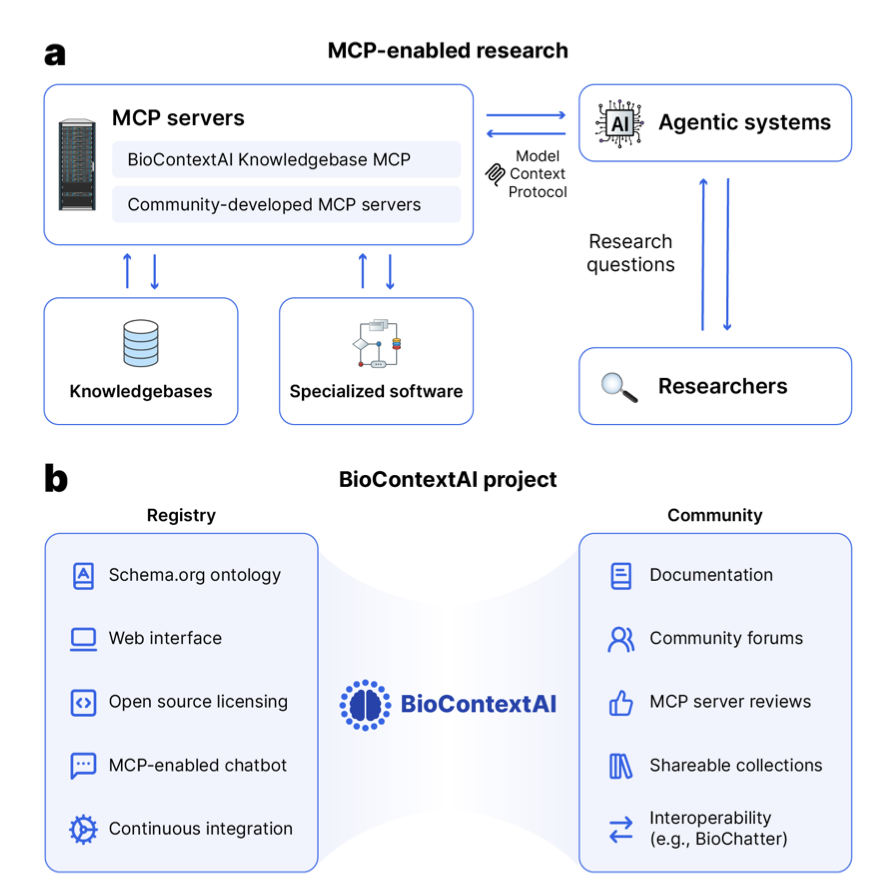
1. A new open-source initiative called BioContextAI aims to enhance the reliability and capabilities of large language models (LLMs) in biomedical research by providing standardized access to validated scientific knowledge through Model Context Protocol (MCP) servers.
2. BioContextAI introduces a community-oriented registry that indexes MCP servers using https://t.co/sbktBYIBFt ontology, offering rich metadata and open-source licensing standards. This registry facilitates the discovery and integration of domain-specific MCP servers for biomedical research.
3. The initiative includes a proof-of-concept MCP server implementation called Knowledgebase MCP, which integrates widely-used biomedical knowledgebases such as STRING, KEGG, PanglaoDb, and others. This server can be deployed locally or used remotely to enhance LLM capabilities.
4. BioContextAI demonstrates improved response quality in LLM-assisted biomedical research tasks when augmented with MCP servers compared to base models or web search capabilities alone. Case studies cover protein-protein interactions, clinical trials, drug usage information, and more.
5. The platform also features BioContextAI Chat, an MCP-enabled chatbot that integrates different commercial LLMs and allows users to interact with the knowledgebases through a user-friendly interface. It includes a review system and shareable collections to help identify the most useful MCP servers.
6. Challenges persist, including security, authentication, and data privacy concerns for remote-hosted MCP servers. The authors call for continued development of BioContextAI as a community hub for LLM-supported biomedical research, with a focus on creating, evaluating, and deploying MCP-augmented agentic systems.
📜Paper: https://t.co/eVTBe0MakA
#BioContextAI #BiomedicalAI #ModelContextProtocol #LLMs #OpenSource #CommunityDriven #ResearchTools

Insitro’s Daphne Koller explains how pattern-finding across massive ‘omics data is shortening the path from target ID to lead compound, starting with tough diseases like ALS.
https://t.co/Lr5u9c9NYq
#AIRevolutionPodcast #BiomedicalAI #DrugDiscovery #GenerativeAI #DigitalHealth
STELLA: Self-Evolving LLM Agent for Biomedical Research
1.STELLA is a self-evolving biomedical AI agent that learns and improves through experience. Its architecture allows it to dynamically grow its reasoning skills and computational capabilities by integrating new tools and strategies on the fly.
2.Unlike typical AI agents constrained by static, hand-curated tools, STELLA autonomously creates and integrates new bioinformatics tools as needed. This ability is powered by its Tool Creation Agent and a growing "Tool Ocean" of computational resources.
3.At its core, STELLA is driven by four collaborating agents: Manager, Developer, Critic, and Tool Creator. They form a closed-loop system capable of problem decomposition, implementation, critique, and self-upgrade—similar to a human research team.
4.STELLA uses a dynamically evolving Template Library to remember and reuse successful reasoning strategies. This allows it to generalize from previous tasks and solve new biomedical problems more efficiently over time.
5.In a case study of chemotherapy resistance, STELLA not only analyzed gene expression but also identified the master transcription factor MTF1 as a resistance driver by developing a new virtual screening tool, showcasing its autonomous problem-solving and tool-building ability.
6.Benchmarked on three major biomedical QA datasets—Humanity’s Last Exam (Biomedicine), LAB-Bench DBQA, and LAB-Bench LitQA—STELLA outperforms leading LLMs and specialized agents by up to 8 percentage points.
7.More impressively, STELLA’s performance improves with each trial. Its score on Humanity’s Last Exam rises from 14% to 26% with repeated attempts, providing empirical evidence of its test-time learning and self-evolution.
8.STELLA’s Tool Ocean spans database querying (e.g. PubMed, ClinVar), foundation model interfaces (e.g. AlphaFold3, scGPT), and custom scripts, making it both flexible and deeply integrated into biomedical research infrastructures.
9.The system architecture demonstrates a new paradigm where agents are not just tools but active, growing participants in scientific discovery. STELLA doesn’t just answer questions—it learns how to ask better ones and develop new capabilities to answer them.
10.By reframing AI agents as dynamic collaborators rather than static utilities, STELLA offers a scalable path toward autonomous scientific research, capable of keeping pace with the ever-evolving biomedical landscape.
📜Paper: https://t.co/lykkEksF3n #AI #BiomedicalAI #LLMAgents #ComputationalBiology #STELLA #Bioinformatics #ScientificDiscovery #SelfEvolvingAI

Multimodal Contrastive Representation Learning in Augmented Biomedical Knowledge Graphs
1.This work introduces a new framework for enhancing node embeddings in biomedical knowledge graphs (BKGs), combining pre-trained language models (LMs) with graph contrastive learning (GCL) for both semantic and structural representation.
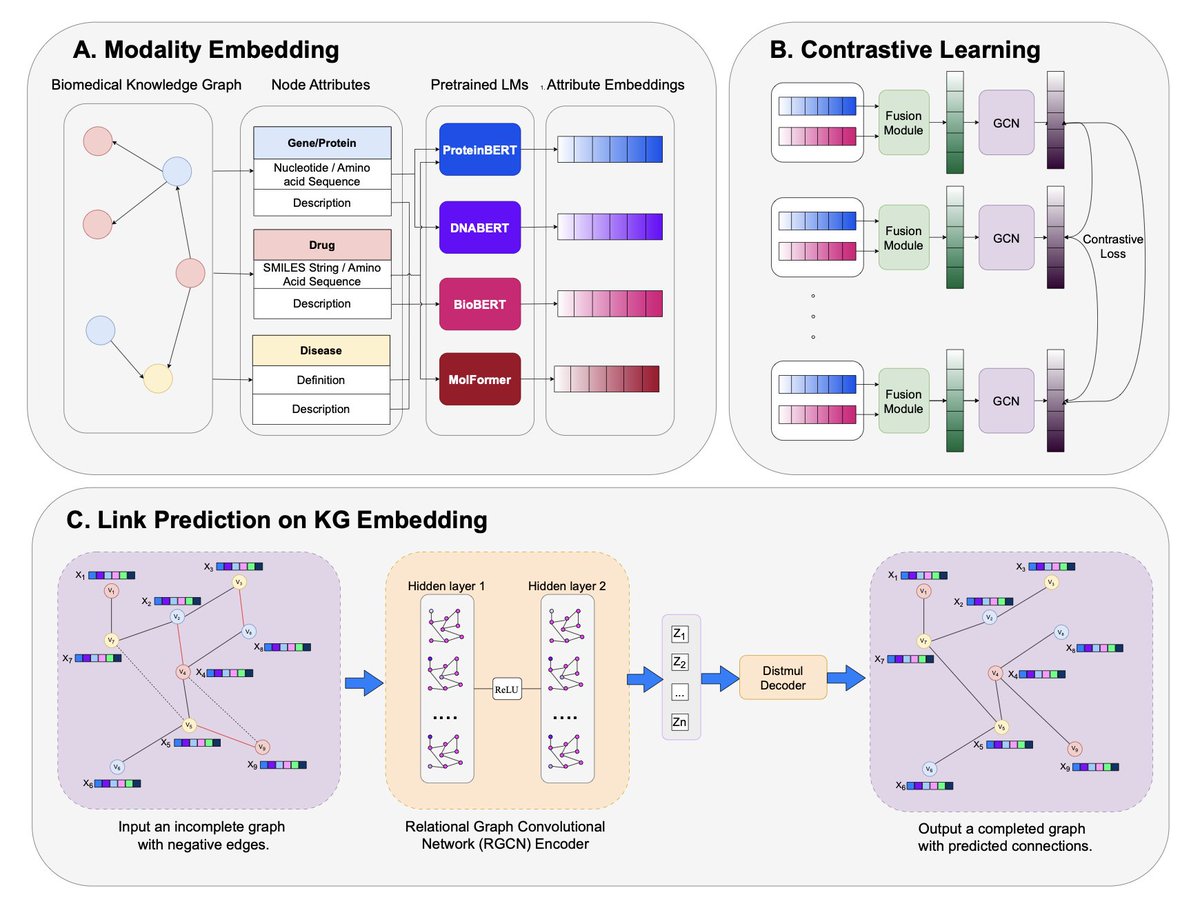
2.The authors developed PrimeKG++, a significantly enriched BKG that integrates biological sequences (e.g., SMILES, amino acids, nucleotides) and detailed textual descriptions across all entity types including drugs, diseases, and genes/proteins.
3.Unlike most prior methods relying on single-modality inputs, this approach fuses multiple modalities per node through a carefully designed fusion module using techniques like Attention Fusion and ReDAF, leading to richer and more informative node representations.
4.The key technical innovation is a modular pipeline: (1) encode entity attributes using domain-specific LMs, (2) fuse the modality-specific embeddings into unified representations, (3) enhance intra-node relationships using GCL, and (4) apply knowledge graph embedding for inter-node learning and link prediction.
5.Experiments show strong and consistent link prediction performance on both PrimeKG++ and an independently augmented DrugBank drug-target interaction (DTI) dataset, especially in challenging settings with high negative sampling ratios.
6.GRACE + ReDAF consistently achieved the best performance, with AP as high as 0.996 and F1 scores up to 0.983, outperforming baselines including random initialization and direct LM-based embeddings, especially under sparse or unseen data conditions.
7.Latent space visualizations confirm that integrating LM embeddings with GCL leads to better clustering of biologically related entities, demonstrating that the learned representations are more semantically and relationally meaningful.
8.The framework generalizes well to unseen entities and novel datasets, supporting downstream applications such as drug-target and drug-disease link prediction, and potentially accelerating drug repurposing and therapeutic discovery.
9.Importantly, the authors clarify that the focus is not to beat SOTA metrics, but to demonstrate that pretrained multimodal embeddings can substantially enhance robustness, interpretability, and generalizability in biomedical KGs.
10.All data, models, and code are publicly released, offering a strong resource for the community and enabling researchers to build on this work for diverse biomedical tasks involving complex multimodal relationships.
💻Code: https://t.co/MvprbCjw9C
📜Paper: https://t.co/IGfdfqYtem
#BiomedicalAI #KnowledgeGraphs #ContrastiveLearning #MultimodalLearning #DrugDiscovery #GraphNeuralNetworks #RepresentationLearning
SHREC and PHEONA: Using Large Language Models to Advance Next-Generation Computational Phenotyping
1.This paper introduces SHREC, a new framework designed to integrate large language models (LLMs) into computational phenotyping pipelines. It addresses the labor-intensive nature of traditional electronic phenotyping by offloading repetitive tasks to LLMs.
2.The authors evaluate three lightweight LLMs—Mistral (24B), Phi-4 (14B), and Gemma2 (27B)—for two phenotyping tasks: Concept Selection and Apply Algorithm. The best-performing model, Mistral, achieved an AUROC of 0.896 for concept classification and 0.853 for simple phenotypes.
3.SHREC builds upon the earlier PHEONA evaluation framework by defining an end-to-end pipeline and a vision for next-generation phenotyping, emphasizing optimized human-machine synergy where LLMs handle repetitive tasks and humans oversee complex reasoning.
4.In a real-world test, the models phenotyped over 150,000 ICU patient records related to acute respiratory failure therapies. Mistral achieved high specificity and reasonable sensitivity, especially for single-therapy phenotypes such as IMV-only or NIPPV-only.
5.The LLMs operated using raw EHR data with minimal preprocessing, demonstrating the practicality of using prompt engineering alone without the need for fine-tuning or heavy data engineering.
6.Chain-of-Thought prompting improved LLM reasoning, but complex phenotype identification (like sequential treatments) remained challenging, revealing current model limits in handling layered clinical logic.
7.Despite promising results, scalability remains a limitation. Each concept required a separate LLM query, making large-scale deployment resource-intensive unless mitigated with prompt or architecture improvements.
8.The study underscores that general-purpose LLMs outperformed domain-specific biomedical models in this context, highlighting the versatility of foundation models and the need for further research into domain adaptation strategies.
9.Future directions include refining LLM reasoning fidelity, incorporating structured medical knowledge (e.g., SNOMED CT), and standardizing evaluation practices for LLMs in biomedical settings.
10.Overall, SHREC and PHEONA present a compelling case for using LLMs to streamline and scale computational phenotyping, with tangible reductions in development time and expert labor.
📜Paper: https://t.co/sr9iUytcTg
#LLM #phenotyping #biomedicalAI #EHR #computationalbiology #machinelearning #medicalAI

Few shot learning for phenotype-driven diagnosis of patients with rare genetic diseases
1.SHEPHERD is a new deep learning method that helps diagnose rare genetic diseases by using only a few labeled examples, overcoming the key limitation of data scarcity in this field.
2.Unlike traditional diagnostic models that rely heavily on large datasets, SHEPHERD is trained primarily on 40,000 simulated patients spanning 2,000+ rare diseases, allowing it to generalize to new and atypical cases.
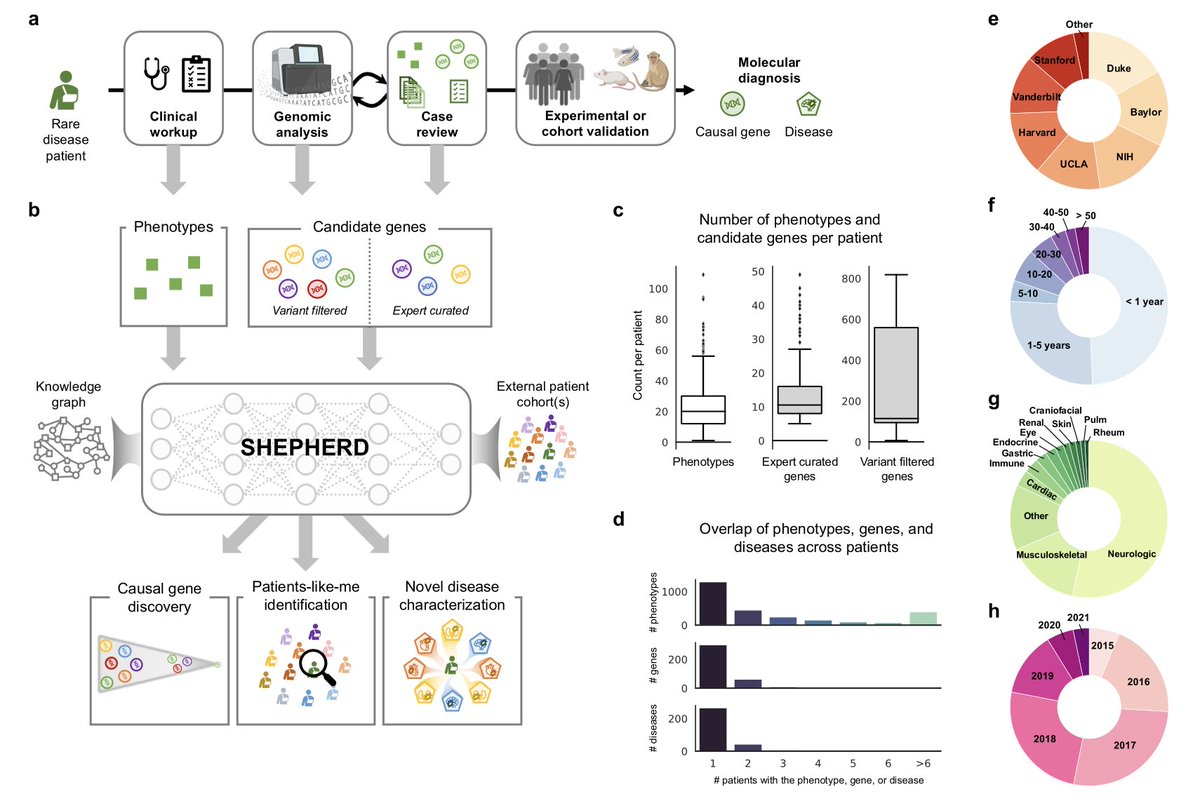
3.SHEPHERD leverages a biomedical knowledge graph containing relationships between genes, phenotypes, and diseases, using graph neural networks to embed patient data into a structured latent space.
4.The model excels at three major tasks: causal gene discovery, finding “patients-like-me” with similar genotypic and phenotypic profiles, and characterizing novel disease presentations through interpretable embeddings.
5.When tested on 465 patients from the Undiagnosed Diseases Network (UDN), SHEPHERD correctly ranks the causal gene in the top 1 in 40% of cases and in the top 5 in 85% using expert-curated gene lists.
6.SHEPHERD outperforms 12 benchmark methods including LIRICAL, HiPhive, and LLaMA models in gene prioritization across expert-curated and variant-filtered gene lists.
7.For patients with novel diseases or genes lacking known phenotype associations, SHEPHERD achieves up to 86% win rates in correctly prioritizing causal genes, outperforming all baselines in almost every subgroup.
8.The model also learns meaningful patient embeddings—patients with the same disease cluster together in the embedding space (AMI = 0.304), allowing accurate retrieval of similar cases across cohorts.
9.SHEPHERD can retrieve “patients-like-me” from independent cohorts like MyGene2, outperforming Phrank in similarity search and reducing the number of patient comparisons needed by 17.2%.
10.Beyond prediction, SHEPHERD provides interpretable summaries of unknown syndromes by estimating similarity to known disease categories, offering actionable insights for clinicians investigating novel presentations.
11.Two UDN case studies demonstrate that SHEPHERD accurately prioritizes causal genes even when patients exhibit highly atypical symptoms not directly linked to known gene-disease associations.
12.The model supports flexible integration into the diagnostic workflow: it can assist after clinical workup, during variant review, or for downstream analysis when investigating new candidate genes.
13.SHEPHERD is trained in a disease-stratified manner to ensure generalization to unseen conditions, with no overlap between training and validation diseases.
14.Its use of synthetic patient data ensures privacy, enabling public model release without compromising real patient confidentiality.
15.While existing models often depend on direct gene-phenotype links, SHEPHERD captures indirect associations through multi-hop graph reasoning—critical for diagnosing poorly characterized or novel disorders.
16.The embedding attention mechanism offers partial interpretability, highlighting which phenotype features contributed most to the model’s predictions.
17.Limitations include reliance on the quality of the knowledge graph and underrepresentation of non-European populations in training data, pointing to opportunities for broader data inclusion and variant-level integration.
18.SHEPHERD showcases how few-shot, knowledge-guided deep learning can transform rare disease diagnosis, reducing expert burden and shortening diagnostic delays in real clinical settings.
💻Code: https://t.co/m7P2mJCHDv
📜Paper: https://t.co/tAbDQ6ekPV
#RareDisease #Genomics #DeepLearning #FewShotLearning #BiomedicalAI #GraphNeuralNetworks #PrecisionMedicine
PhenoKG: Knowledge Graph-Driven Gene Discovery and Patient Insights from Phenotypes Alone
1.PhenoKG is a new method that predicts causative genes using only patient phenotypes, without requiring genomic data or curated gene lists. This enables prioritization even when sequencing is unavailable or inconclusive—a critical need in rare disease diagnosis.
2.The model leverages a large biomedical knowledge graph (KG) to build patient-specific subgraphs, representing relationships between phenotypes, genes, diseases, and biological processes. These are encoded with GNNs and Transformers to produce predictive gene rankings.
3.PhenoKG significantly outperforms the best existing method, SHEPHERD, especially in real-world datasets like MyGene2. On MyGene2, it achieves a 24.64% MRR vs. 19.02% for SHEPHERD, despite having no access to candidate gene lists.
4.When a candidate gene list (~20 genes) is available, PhenoKG achieves up to 91% MRR and over 86% top-1 nDCG on simulated rare disease patients, surpassing previous benchmarks. Without any such list, top-1 nDCG still reaches 15.15% on real patient data.
5.Ablation studies reveal that training with both gene contrastive loss and patient similarity loss yields the most robust performance, enforcing shared structure across patient embeddings while preserving their uniqueness.
6.Patient embeddings generated by PhenoKG cluster meaningfully even when causative genes differ, suggesting the model captures broader biological relationships—this opens new directions for discovering hidden genotype–phenotype associations.
7.The method uses the PrimeKG knowledge graph, which includes over 100,000 biomedical nodes and more than 1 million edges across genes, phenotypes, diseases, and molecular pathways. This rich structure enables generalization to unseen phenotype-gene combinations.
8.PhenoKG is designed for practical use in clinical decision support. It can act as an upstream filter before genome sequencing, or prioritize within existing variant lists—accelerating diagnosis while reducing the reliance on expert curation.
9.While promising, PhenoKG is not yet ready for clinical deployment. Its predictions still require downstream validation via genetic testing. However, it provides a scalable, data-efficient approach for hypothesis generation and prioritization.
📜Paper: https://t.co/SzqCrrW6lt
#RareDiseases #GraphNeuralNetworks #PrecisionMedicine #Genomics #MachineLearning #BiomedicalAI #PhenotypeDriven #GeneDiscovery

m-KAILIN: A Knowledge-Driven Agentic Scientific Corpus Distillation Framework for Biomedical Large Language Models Training
1. This paper addresses the critical challenge of limited high-quality annotated biomedical corpora for training large language models (LLMs) by proposing a novel knowledge-driven, multi-agent framework called m-KAILIN, designed specifically for biomedical corpus distillation.
2. The framework uses a collaborative architecture of specialized agents, each guided by the Medical Subject Headings (MeSH) hierarchical ontology, to autonomously generate, retrieve context for, evaluate, and refine domain-specific question-answer pairs from over 23 million biomedical articles.
3. Key innovation lies in integrating a multi-agent system where distinct question generation agents (one domain-specific and one general-purpose) create diverse candidate questions, which are then ranked and selected based on semantic alignment with biomedical ontologies via a knowledge-driven evaluation agent.
4. The question evaluation agent uses a two-step approach: first, a rule-based MeSH-guided similarity scoring generates cold-start preference labels; then, an LLM is fine-tuned to automatically evaluate question-context pairs, enabling scalable and consistent high-quality dataset construction without human annotation.
5. The answer generation agent produces precise answers using advanced LLMs like GPT-4o, completing the question-context-answer triplets for downstream training, thus creating AI-ready datasets that significantly improve biomedical question answering performance.
6. Experimental results demonstrate that LLMs trained with m-KAILIN distilled datasets outperform a wide range of strong open-source and proprietary biomedical models, including GPT-4 with MedPrompt and Med-PaLM-2, despite smaller model sizes.
7. Ablation studies highlight the critical roles of agent diversity in question generation, MeSH-based knowledge hierarchy in evaluation, and domain-adapted embeddings in context retrieval, each contributing synergistically to the framework’s success.
8. The paper also analyzes the effect of dataset scale, showing that larger distilled datasets enhance model performance, especially for smaller models, and demonstrates robust model generalization across biomedical subdisciplines and chronological publication spans.
9. The m-KAILIN framework represents a significant step toward fully automated, scalable, and knowledge-grounded corpus construction for biomedical LLMs, reducing reliance on manual annotation and enabling more efficient domain adaptation.
📜Paper: https://t.co/Vlv25bGxog
#BiomedicalAI #LargeLanguageModels #CorpusDistillation #MeSH #AgenticAI #Bioinformatics #MachineLearning

RAGPPI: RAG Benchmark for Protein-Protein Interactions in Drug Discovery
1.RAGPPI introduces the first benchmark specifically designed to evaluate the ability of Retrieval-Augmented Generation (RAG) systems to reason about the biological impacts of protein-protein interactions (PPIs), a key step in drug target identification.
2.At its core, RAGPPI provides a factual QA benchmark consisting of 4,420 question-answer pairs. These questions probe how specific PPIs affect biological or therapeutic outcomes, reflecting the real-world needs of drug discovery researchers.
3.The benchmark includes a high-quality gold-standard subset of 500 QA pairs, validated and revised by ten domain experts through rigorous user studies. These experts annotated LLM-generated answers for accuracy and completeness.
4.To scale the dataset, the authors developed an ensemble auto-evaluation model composed of three GPT-4o-based evaluators. These models emulate expert judgments by analyzing atomic fact similarity to ground-truth abstracts using cosine similarity metrics.
5.The ensemble model achieves 93.71% accuracy and enables the creation of a silver-standard set of 3,720 QA pairs. This approach provides large-scale annotated data without requiring additional expert labor.
6.Expert interviews guided the design of the benchmark. Researchers emphasized the need for evaluating downstream biological effects of PPIs using balanced reference distributions across interaction types and literature frequencies.
7.The authors structured the benchmark to cover seven PPI types (e.g., Binding, Activation, Inhibition) and three literature frequency levels (high, medium, low), ensuring comprehensive coverage across common and rare PPIs.
8.They constructed the gold-standard dataset using BioGRID, selecting PPIs from curated abstracts and maintaining balance in both type and frequency. This ensured that evaluation contexts were realistic and diverse.
9.Evaluation experiments showed that general-purpose LLMs like Gemini-2.0-Flash outperformed existing RAG pipelines such as GraPPI and GeneGPT on factual accuracy. Surprisingly, current RAG models struggled due to weak retrievers and hallucinations.
10.The study underscores that high semantic similarity (e.g., BERTScore) does not equate to factual correctness. The ensemble evaluator proved better aligned with expert assessments than traditional LLMs or semantic metrics alone.
11.To encourage community adoption, the authors release not just the dataset but also the ensemble auto-evaluator. This allows reproducible benchmarking and facilitates future RAG system development for biomedical QA.
12.Limitations include the relatively small size of the gold-standard set and the limited number of domain experts involved. Future work aims to expand annotations and apply RAGPPI to broader drug discovery tasks like ligand design and repurposing.
💻Code: https://t.co/qFzvDdIrVn 📜Paper: https://t.co/v7wf3vH4lr
#DrugDiscovery #ProteinInteractions #LLM #RAG #BiomedicalAI #Bioinformatics #TargetIdentification

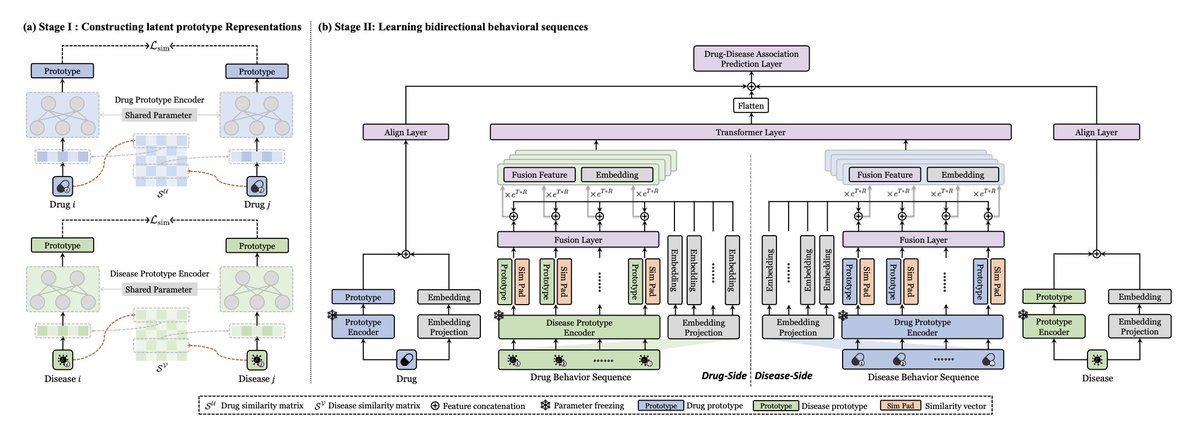
BiBLDR: Bidirectional Behavior Learning for Drug Repositioning
1.BiBLDR reframes drug repositioning as a behavioral sequence prediction task, inspired by recommendation systems. Instead of modeling associations via graphs, it learns from interaction patterns between drugs and diseases, enabling stronger generalization—especially for new drugs.
2.The method constructs bidirectional behavioral sequences, representing both drug-to-disease and disease-to-drug associations. This dual perspective captures more complete interaction signals than unidirectional models.
3.BiBLDR is the first to apply Transformer architecture to drug repositioning using behavior sequences. The model leverages multi-head self-attention to extract complex semantic patterns in both drug and disease behavioral contexts.
4.A two-stage learning strategy is proposed: • Stage I builds latent prototype spaces for drugs and diseases using similarity data and Siamese networks. • Stage II uses these prototypes, enriched with explicit similarity information, as input to the Transformer to predict associations.
5.Similarity fusion plays a central role. BiBLDR integrates numerical similarity values directly into prototype features within behavioral sequences, enhancing contrast between similar and dissimilar entities.
6.The model introduces a logarithmic weighting scheme in behavioral sequences to emphasize positive associations during training, aiding contrastive learning and mitigating sparsity.
7.BiBLDR demonstrates state-of-the-art performance on three benchmark datasets (Gdataset, Cdataset, LRSSL), outperforming both classical and deep learning methods, including GCN-based approaches, in AUROC and AUPRC.
8.In cold-start scenarios, where novel drugs have no known associations, BiBLDR outperforms existing methods with a large margin (e.g., AUPRC of 0.6194 vs 0.3484), validating its ability to generalize beyond observed data.
9.BiBLDR maintains robustness under extreme data sparsity, thanks to the independent prototype construction stage, which does not rely on the association matrix’s density.
10.Ablation studies confirm the value of each design component: bidirectional modeling, prototype spaces, similarity fusion, and Transformer layers all significantly contribute to performance.
11.In real-world case studies on lung cancer and hypertension, BiBLDR achieved high hit rates (80%–90%) in top-ranked predictions. For unverified predictions, molecular docking experiments confirmed strong binding affinities.
12.In conclusion, BiBLDR offers a novel and effective direction for drug repositioning research, combining strengths of recommender systems, prototype learning, and attention-based modeling.
💻Code: https://t.co/iWVwz7zms9
📜Paper: https://t.co/UrXbL8ynJ6
#DrugRepositioning #Transformer #DeepLearning #BiomedicalAI #RecommendationSystem
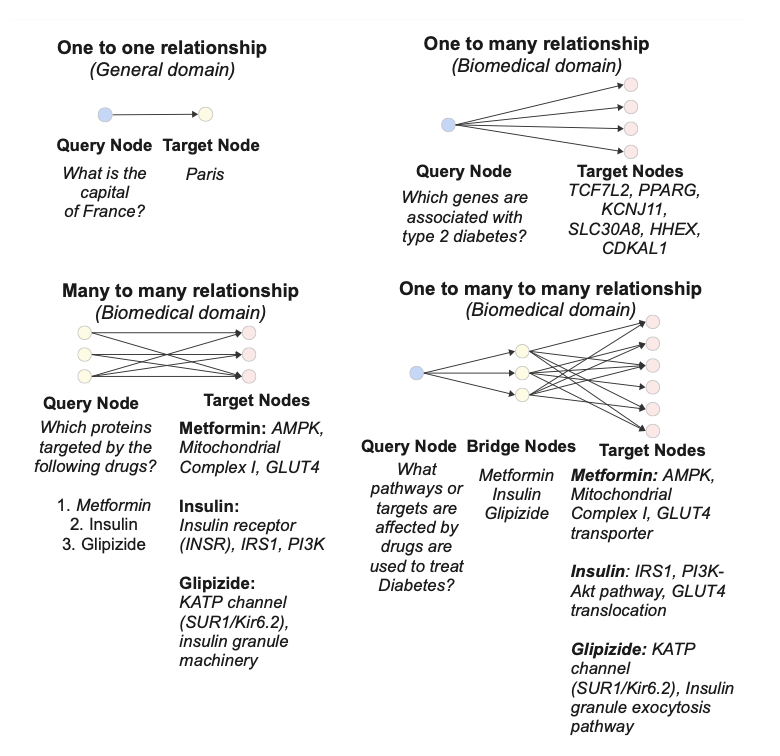
BioHopR: A Benchmark for Multi-Hop, Multi-Answer Reasoning in Biomedicine
1.BioHopR introduces a new benchmark specifically designed to evaluate multi-hop, multi-answer reasoning capabilities of LLMs in the biomedical domain. It captures real-world complexity by focusing on one-to-many and many-to-many relationships, such as drug–disease–protein connections.
2.Unlike previous biomedical QA datasets that mainly target single-answer or template-based reasoning, BioHopR supports both 1-hop and 2-hop reasoning tasks using structured knowledge from the PrimeKG graph. This allows assessment of stepwise reasoning with multiple valid answers.
3.The benchmark contains 2,494 1-hop and 7,633 2-hop questions, totaling over 279,000 answers. Each query averages over 36 answers, emphasizing the challenge of handling exhaustive, many-to-many mappings in biomedical data.
4.A core innovation is the one-to-many-to-many design: for example, a single drug (query) can be linked to multiple proteins (bridge) and further to multiple diseases (target), reflecting real clinical reasoning scenarios.
5.BioHopR evaluates models’ precision based on cosine similarity using BioLORD-2023-C embeddings with a strict threshold (0.9), ensuring high-confidence matches in prediction evaluation.
6.State-of-the-art proprietary models, especially O3-mini and GPT4O, outperform open-source biomedical models in both 1-hop and 2-hop tasks. O3-mini achieves the highest 1-hop precision (37.93%) and ties with GPT4O in 2-hop precision (14.57%).
7.Open-source biomedical models, such as HuatuoGPT-o1 and UltraMedical-8B, exhibit severe difficulties in multi-hop tasks. HuatuoGPT-o1-70B fails almost entirely (Prec_HOP2: 0.00%), revealing a gap between intended capability and actual performance.
8.All models suffer a sharp performance drop when moving from 1-hop to 2-hop tasks, demonstrating that inferring intermediate bridge entities remains a major bottleneck in biomedical reasoning.
9.Qualitative case studies (e.g., on diabetes and schizophrenia) show proprietary models like GPT4O can produce medically justifiable answers even when they don't align perfectly with ground truth, while open-source models often fail to follow task constraints.
10.BioHopR also reveals prompt sensitivity: single-answer prompting outperforms multi-answer prompting significantly (e.g., GPT4O's 1-hop precision drops from 32.88% to 8.09% when prompted for multiple answers).
11.Some relation types (e.g., Phenotype:Disease:Drug) show slightly better performance in multi-answer prompting, suggesting structured queries with clear entity roles might be more model-friendly.
12.By benchmarking models on complex, real-world multi-step biomedical questions, BioHopR establishes a much-needed evaluation standard and exposes critical gaps in both reasoning depth and answer completeness.
13.Despite limitations like reliance on PrimeKG and coverage of only four entity types (Drug, Disease, Protein, Phenotype), BioHopR sets the groundwork for building more robust, interpretable LLMs for biomedical applications.
14.The authors emphasize that BioHopR is for research use only and not suited for clinical deployment without rigorous validation, mitigating risks of misuse in high-stakes settings.
💻Code: https://t.co/18n3mlKwr2
📜Paper: https://t.co/1qvSzSRQSi
#BioHopR #LLMs #BiomedicalAI #MultiHopReasoning #BioNLP #KnowledgeGraphs #MedQA
Federated Learning in Genetics: Extended Analysis of Accuracy, Performance and Privacy Trade-offs
1.This study evaluates the feasibility and trade-offs of applying federated learning (FL) to large-scale transcriptomic data for tasks such as disease prognosis and cell type classification, showing that FL can achieve high model quality while preserving data privacy.
2.Using two real-world datasets—acute myeloid leukemia (binary classification) and human brain cell types (multi-class)—the authors demonstrate that FL can achieve AUCs up to 0.98, approaching centralized training performance without sharing raw data.
3.The authors benchmark two widely used FL frameworks, TensorFlow Federated (TFF) and Flower (FLWR), comparing model accuracy, memory consumption, runtime, and network usage under varying degrees of client and data heterogeneity.
4.A key finding is that model performance depends more on the machine learning model architecture (e.g., deep learning vs logistic regression) than on the choice of FL framework, enabling institutions to choose frameworks based on usability and infrastructure compatibility.
5.FL remains robust under moderate class imbalance and non-IID (non-identically distributed) data, especially when using deep learning. However, extreme imbalance (over 90%) or excessive client fragmentation leads to significant performance degradation.
6.Injecting Gaussian noise into model weights—simulating differential privacy—reduces model accuracy significantly beyond a noise threshold (σ ≈ 0.07–0.085), underlining the delicate balance between privacy protection and model utility in medical FL applications.
7.The number of clients impacts model quality: more clients lead to lower per-client data volume, which hurts accuracy. A small number of clients with sufficient local data performs comparably to centralized learning.
8.Increasing training rounds generally improves robustness against class imbalance in deep learning models, but not for simpler models like logistic regression, indicating algorithm-specific responses to FL tuning.
9.Global training time is heavily model-dependent: FL outperforms centralized training for deep models via parallelization, while logistic regression converges faster in centralized setups. FLWR showed faster training than TFF in most scenarios.
10.Memory and network demands increase with the number of clients and training rounds, but this load is effectively distributed across clients. FLWR is more memory-efficient and network-light compared to TFF.
11.The study confirms that FL is a viable alternative for precision medicine applications, enabling cross-institutional learning on transcriptomic data, especially when data cannot be shared due to privacy or regulatory restrictions.
12.All experimental code is publicly available, providing a valuable resource for benchmarking and reproducing federated learning pipelines in biomedical data science.
💻Code: https://t.co/1DC6zISMkW
📜Paper: https://t.co/e83ZyzdTPI
#FederatedLearning #Genomics #PrivacyPreservingAI #Transcriptomics #PrecisionMedicine #MachineLearning #BiomedicalAI #DifferentialPrivacy

RL-Finetuning of OpenAI o1-mini to Enhance Biomedical Reasoning
1.This study explores whether reinforcement learning (RL) finetuning can improve the biomedical reasoning of OpenAI’s o1-mini model, which was originally optimized for complex multi-step tasks like math and code.
2.The authors evaluate o1-mini across two domains—gene classification and small molecule property prediction—and show that RL finetuning leads to substantial performance gains in gene classification tasks.
3.On five gene classification benchmarks, RL-finetuned o1-mini (o1-finetuned) outperforms GPT-4o-mini (4o-finetuned) and matches or exceeds the performance of domain-specific models like GenePT, achieving top accuracy (0.75) and F1 score (0.75).
4.Notably, the RL-tuned o1-mini provides more precise and biologically informed reasoning—for example, correctly identifying non-methylated promoter states and accurately classifying transcription factor sensitivity—where the base model failed.
5.In contrast, small molecule property prediction yielded mixed results. Though finetuning improves metrics, many of these gains come from shortcut behavior like always predicting the majority class, reducing interpretability and biological value.
6.For datasets with high class imbalance (e.g., 84% inactive samples), o1-finetuned collapses to trivial predictions, emphasizing the need for class-balancing or more informative reward functions in RL training.
7.The study also benchmarks against Chemprop, a GNN model specialized in chemical property prediction. Chemprop consistently outperforms the LLMs in ADMET prediction tasks, especially when structural reasoning is crucial.
8.The most promising result beyond gene classification was on P-gp inhibition, where o1-finetuned outperformed both Chemprop and baseline models, suggesting some LLM potential for specific molecule classes.
9.For antibiotic prediction, class balancing greatly improved LLM performance. However, even with balancing, Chemprop still outperformed LLMs when SMILES strings were used, underscoring the current strength of GNNs for molecular data.
10.This work highlights both the potential and limitations of adapting reasoning-focused LLMs for biomedicine. RL finetuning can enhance structured reasoning in genomics but may fall short for molecular tasks unless supported by robust data and task design.
11.The authors advocate for continued research into task-specific prompt design, reward function engineering, and hybrid modeling to fully unlock the potential of reasoning LLMs in biomedical applications.
💻Code: https://t.co/SsfjLXQmAc
📜Paper: https://t.co/boUbFp73ff
#BioLLM #ReinforcementLearning #GeneFunction #DrugDiscovery #GPT4o #o1mini #BiomedicalAI #MolecularReasoning #LLMFinetuning #Chemprop #AI4Science #PrecisionMedicine

VITAGRAPH: Building a Knowledge Graph for Biologically Relevant Learning Tasks
1.VITAGRAPH is a new biological knowledge graph purpose-built for machine learning tasks in network medicine, including drug repurposing, protein–protein interaction (PPI) prediction, and side effect identification.
2.The graph is constructed by extensively cleaning and enriching the popular Drug Repurposing Knowledge Graph (DRKG), removing redundancy, non-human data, inconsistent labels, and unresolvable identifiers.
3.VITAGRAPH integrates biologically meaningful node features like molecular fingerprints (for compounds) and Gene Ontology-derived binary vectors (for genes), enabling more expressive graph learning.
4.The authors enhanced DRKG by reintroducing pathway nodes via Reactome, and incorporating high-confidence compound–side effect edges from OnSIDES, adding 2,153 pathways and over 339,000 new edges.
5.They excluded compounds without valid SMILES representations and used Morgan fingerprints (radius 2, 2048 bits) for standardized chemical features, improving chemical interpretability and utility.
6.Gene features were collapsed from star-shaped subgraphs into one-hot encoded vectors describing pathways, molecular functions, biological processes, and cellular components—yielding biologically rich node representations.
7.The final VITAGRAPH consists of 48,058 nodes and 4,004,583 edges, after eliminating nearly 2 million duplicate or inconsistent rows from DRKG.
8.Benchmarking across three tasks (drug repurposing, PPI prediction, and side-effect detection) using R-GCN and CompGCN shows that VITAGRAPH matches or outperforms DRKG—even when DRKG's results were inflated due to data leakage.
9.Detailed leakage analysis reveals that DRKG suffers from up to 65% interaction overlap between training and test sets in the PPI and drug repurposing tasks, undermining its benchmarking reliability.
10.In contrast, VITAGRAPH avoids such leakage, providing a clean and biologically relevant foundation for graph machine learning and link prediction experiments.
11.VITAGRAPH’s modular pipeline is publicly available, letting users reproduce, customize, or extend the graph to suit specific biomedical questions or integrate new datasets over time.
12.By releasing both the dataset and code, the authors establish VITAGRAPH as a reproducible and high-quality benchmark to support future advances in computational biology and biomedical AI.
💻Code: https://t.co/9tFmPjYKDp
📜Paper: https://t.co/Ed1MlbEtOW
#KnowledgeGraph #Bioinformatics #ComputationalBiology #DrugRepurposing #PPI #GNN #GraphLearning #BiomedicalAI #DRKG #VitaGraph #MachineLearning

AI4CellFate: Interpretable Early Cell Fate Prediction with Generative AI
1.This work presents AI4CellFate, a generative AI framework that predicts single-cell fate from microscopy images using only early time points—enabling high-throughput, low-bias, and interpretable live-cell imaging analysis.
2.Unlike traditional feature engineering approaches, AI4CellFate learns biologically meaningful representations through an adversarial autoencoder combined with multi-objective loss, including reconstruction, adversarial, contrastive, and covariance terms.
3.The model predicts whether a cell will divide (fate 1) or not (fate 0) using just the first frame from live-cell imaging, achieving precision of 72%, significantly outperforming hand-crafted tabular feature baselines capped at ~65%.
4.Latent space engineering ensures that the two learned features (z₀, z₁) are interpretable and disentangled: z₀ correlates with ERK activity (signal intensity), and z₁ with cell size—both biologically linked to future proliferation.
5.Visual perturbations in latent space enable synthetic generation of nuclei images along interpretable axes, offering visual insight into what cellular changes drive fate predictions—bridging prediction and understanding.
6.Performance remains stable across the cell lifetime and generalizes well with as few as 500 annotated cells, highlighting its suitability for data-scarce, high-variability biological systems like drug-tolerant persister cells.
7.Compared to 78 combinations of hand-selected tabular features, AI4CellFate's latent representation consistently provides superior accuracy and reproducibility, while avoiding human bias and feature selection pitfalls.
8.Training is lightweight (fewer than 10⁶ parameters), runs efficiently on standard hardware, and is guided by a principled early-stopping protocol based on latent space separation, KL divergence, and classification metrics.
9.This interpretable latent space and early-fate prediction capacity make AI4CellFate ideal for integration into smart microscopy pipelines, accelerating biological discovery in cell signaling, drug response, and cancer resistance.
10.The framework exemplifies how generative AI and contrastive learning can be used not just for image synthesis but as scientific tools for extracting and interpreting actionable biological insights from high-dimensional data.
💻Code: https://t.co/oWXCzfRnVM
📜Paper: https://t.co/xmwNT3xkqR
#CellFate #LiveCellImaging #GenerativeAI #AdversarialAutoencoder #ContrastiveLearning #ComputationalMicroscopy #CancerBiology #ExplainableAI #AI4Science #BiomedicalAI

Last Seen Hashtags on Sotwe
brosis()**************()**********************************
Seen from Germany
jalanrusaklampung
Seen from United States
ديااثة
Seen from Netherlands
sex animation
Seen from Oman
ngentotin ibu
Seen from Singapore
Otob
Seen from Turkey
pashton
Seen from Singapore
finansalköle
Seen from Turkey
بدوي
Seen from United States
插马眼
Seen from Germany
Most Popular Users

Elon Musk 
@elonmusk
239.8M followers

Barack Obama
@barackobama
118.6M followers

Cristiano Ronaldo
@cristiano
114.3M followers

Donald J. Trump
@realdonaldtrump
111.7M followers

Narendra Modi
@narendramodi
106.9M followers

Rihanna
@rihanna
98.6M followers

NASA
@nasa
92.1M followers

Justin Bieber
@justinbieber
91.7M followers

KATY PERRY
@katyperry
89.9M followers

Taylor Swift
@taylorswift13
83.9M followers

Lady Gaga
@ladygaga
75.4M followers

Virat Kohli
@imvkohli
73.3M followers

Kim Kardashian
@kimkardashian
70.8M followers

YouTube
@youtube
68.6M followers

Neymar Jr
@neymarjr
66.3M followers

Bill Gates
@billgates
65.1M followers

Selena Gomez
@selenagomez
63M followers

The Ellen Show
@theellenshow
62.1M followers

CNN
@cnn
61.7M followers

X
@x
60.6M followers