

Top Tweets for #BoltzGen

Towards Generalizing Pretrained All-Atom Representations to Unified Binder Design
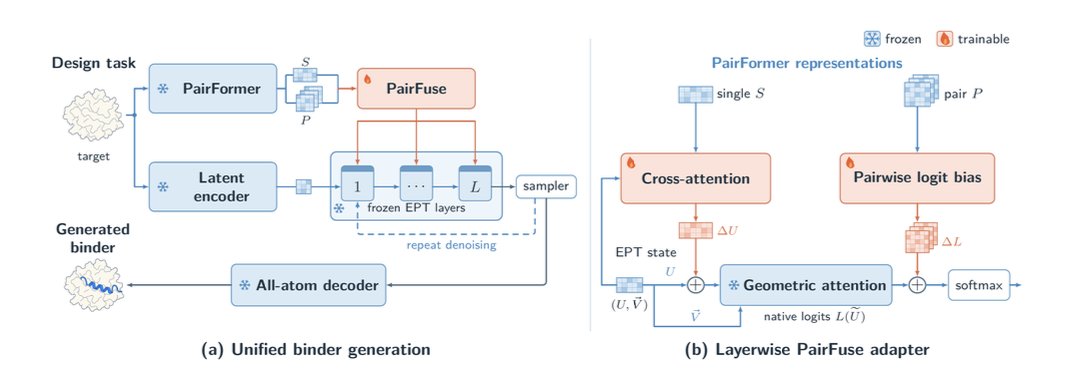
1 PairFuse is a parameter-efficient way to transfer pretrained all-atom knowledge (single + pair representations from a frozen PairFormer, e.g., BoltzGen) into a separately pretrained unified geometric latent diffusion model (AnewOmni), enabling one framework to improve antibody, peptide, and small-molecule binder design with a shared fusion checkpoint.
2 Key idea: fuse not only token-level features but also pairwise interaction information into the diffusion denoiser. Prior lightweight adapters mostly condition on features; PairFuse additionally injects pairwise structural signals directly into the denoiser’s attention to steer geometric interactions during denoising.
3 Architecture: both backbones stay frozen; only small layerwise adapters (~4.03M trainable params) are trained. At every EPT denoiser layer, PairFuse (i) enriches invariant block features via cross-attention to pretrained single representations, and (ii) adds attention-logit biases derived from pretrained single and pair representations to modulate native geometric attention.
4 Scalar-feature fusion: current EPT scalar states query pretrained single representations; a pair-dependent bias derived from pretrained pair representations is included inside the cross-attention softmax. The update combines a cross-attention residual (can propagate donor info to blocks lacking direct correspondence) plus a masked direct projection for blocks that do correspond to PairFormer tokens.
5 Pairwise attention fusion: PairFuse adds an explicit bias term to the native attention logits, including (a) a single-conditioned term when the key has a donor token, and (b) a direct pair-representation term when both query and key blocks have donor-token correspondences. This is designed to guide denoising-time interactions without touching equivariant vector operations.
6 Geometric guarantee: the paper proves the augmented denoiser preserves rotational equivariance as long as transferred representations and masks are rotation-invariant. Because PairFuse only modifies invariant scalar features and attention logits (not the equivariant vector machinery), equivariance holds for arbitrary learned adapter parameters.
7 Expressivity guarantee: the paper proves that directly fusing pairwise information into attention logits can represent attention patterns that feature-only fusion cannot reproduce when native query–key projections have fixed width (under a rank condition). This formalizes why “pair-to-attention” transfer can add capability beyond enriching node features alone.
8 Results on unified binder design benchmarks (30 generations/target; shared checkpoint across modalities): on antibody HCDR3 design (RAbD), PairFuse improves complex RMSD (2.5563 → 2.3748 Å), increases DockQ (0.6853 → 0.7019), and raises native-contact recall (50.96% → 52.43%); RMSD≤2 Å rate rises notably (34.00% → 41.61%).
9 On peptide design (LNR), PairFuse achieves better structure/interface quality: complex RMSD (8.5619 → 8.2821 Å), DockQ (0.4280 → 0.4383), contact recall (33.19% → 34.10%), and interface lDDT (0.4197 → 0.4291), with a small drop in amino-acid recovery, highlighting a structure/interface vs sequence-recovery tradeoff.
10 On small-molecule design (CrossDocked2020 subset), PairFuse improves docking and composition metrics versus AnewOmni: Vina score (-5.1279 → -5.1517), Vina min (-5.9715 → -5.9841), High Affinity (44.82% → 46.83%), and Atom-type MAE (0.4188 → 0.3775). The paper notes a limitation: unknown generated ligand structures have limited donor-token correspondence, constraining how much PairFormer information can be transferred.
📜Paper: https://t.co/pPiegELUCy
#ComputationalBiology #ProteinDesign #AntibodyDesign #PeptideDesign #DrugDiscovery #DiffusionModels #GeometricDeepLearning #Equivariance #GenerativeAI #MachineLearning
BoltzGen: Toward Universal Binder Design
1. BoltzGen introduces an all-atom generative model capable of designing proteins and peptides to bind a wide range of biomolecular targets. This model unifies design and structure prediction, achieving state-of-the-art performance in folding while enabling the generation of high-affinity binders for novel targets.
2. A key innovation is BoltzGen's ability to incorporate flexible design constraints, such as covalent bonds, structure templates, and binding sites. This flexibility allows researchers to tailor the design process for various applications, including nanobodies, cyclic peptides, and antimicrobial agents.
3. The model was experimentally validated across eight diverse wetlab campaigns, demonstrating its effectiveness in generating functional binders for 26 different targets. Notably, it achieved nanomolar binders for 66% of novel protein targets, showcasing its potential for drug discovery.
4. BoltzGen's computational pipeline includes inverse folding, refolding analysis, and affinity prediction, ensuring that generated designs are not only structurally accurate but also likely to be expressible and functional in biological contexts.
5. The authors have open-sourced the model weights, data, and both inference and training code, making BoltzGen accessible to the broader scientific community. This democratization of state-of-the-art biomolecular design capabilities could accelerate research in protein engineering and drug development.
📜Paper: https://t.co/Ga9pvu9yRV
#BiomolecularDesign #ProteinEngineering #DrugDiscovery #AIinBiology


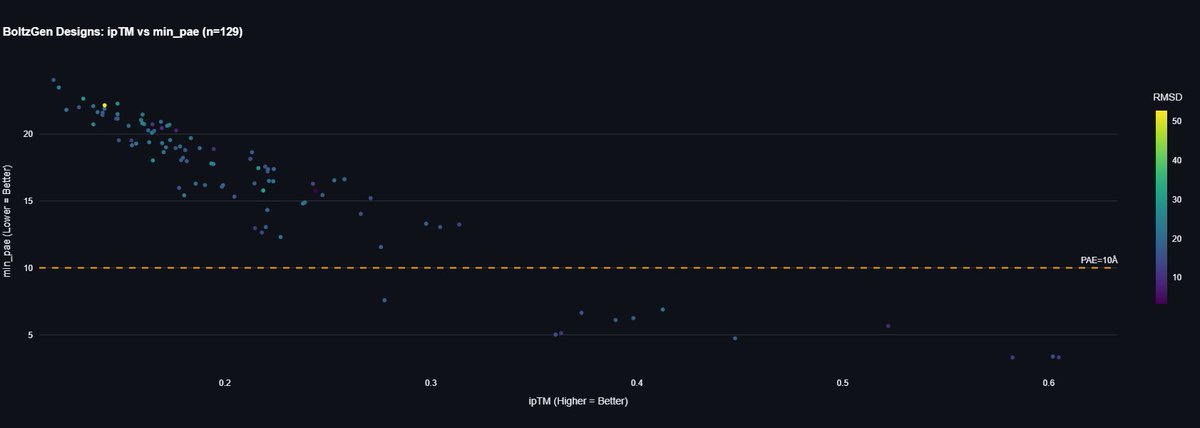
Building on my earlier post showing 13k Boltzgen protein binders - I changed some parameters with the intent of learning more about how the model works on a deeper level. There are potentially some insights even from a small batch.
Today I generated a brand new 100 Boltzgen scFv-style binders with modified low-level parameters (see prev post).
To me this plot looks (ahem way less cool than the orig below) like it has two linear phases. With a fan of samples showing minimization of SAE we also see strong correlation with higher calculated iPTM values.
Suggesting as binding improves so does pose. This makes sense intuitively.
What is still elusive (DM me if you know) is the 1-shot parameter set to push these values to the extreme. Many of the 'best' samples here are from the last 10-20% of the run. This is after the model has modified it's behavior some; step scale and noise scale.
These two things change how big of 'step' on the gradient the diffusion model should take towards being a binder.
Mathematically it is something akin to calculate the diffusion gradient and step away from that steepest gradient (3D slope basically). This says, find where downhill is steepest and go exactly the opposite way. Like a junior skier who isn't ready for that set of trees they found themselves in.
The noise feature says - well even though we are marching towards 'inevitable binding' we are also willing to be a lil wonky and inject some noise to allow for otherwise unobservable deterministic outcomes to be observed. AKA new stuff to show up.
I like to climb the 14,000 ft mountains in Colorado when I'm not working. The metaphor I want to use here from those experiences is;
Do we take the switchback trail, nice and easy up the mountain? Or do we march straight up the rock and thistle filled gully to straight the top.
Boltzgen is not a mountain climber (though it does perform incredible feats). It needs to take big enough steps towards the summit to get there before diffusion ends, but not so big it just steps right over the whole mountain and never ends up on the summit.
If I am seeing better 'quality' later, with bigger step scale and smaller noise scale - that tells me something very useful about the starting conditions of diffusion and what I might need to do to push it.
Thanks for coming to my TED talk.

Really important BioAI article on BoltzGen:
A comprehensive exploration of BoltzGen's architecture: from molecular representations to diffusion-based generation of protein binders https://t.co/Qrfbc9isEx

Hey everyone - there's been lots of ML models related to protein design and related work almost weekly, so I wanted to share a site I've been working on. It hosts pre-configured programs like BoltzGen, RFdiffusion, DiffDock, AF2, etc, in a simple interface @subseqbio, as well as API. If anyone wants to try it out you can dm me for some free credits. Thanks!
Last Seen Hashtags on Sotwe
เถียงนา
Seen from Thailand
ScratchItDownWithTheTyrant
DonaldTrumpForPOTUS2016
Seen from Malaysia
NigeriaSaudiExpo
Seen from Korea
双马尾
Seen from United States
GrandadWasaRomantic
Seen from United States
in front of husband
Seen from Egypt
CU1월행사
Seen from United States
NAOKO_THANKSGIVING_PARTY
Seen from Korea
vamoscuidardasfamilias
Seen from Indonesia
Most Popular Users

Elon Musk 
@elonmusk
239.6M followers

Barack Obama
@barackobama
118.5M followers

Cristiano Ronaldo
@cristiano
114.3M followers

Donald J. Trump
@realdonaldtrump
111.7M followers

Narendra Modi
@narendramodi
106.9M followers

Rihanna
@rihanna
98.6M followers

NASA
@nasa
92.1M followers

Justin Bieber
@justinbieber
91.7M followers

KATY PERRY
@katyperry
89.9M followers

Taylor Swift
@taylorswift13
83.9M followers

Lady Gaga
@ladygaga
75.4M followers

Virat Kohli
@imvkohli
73.3M followers

Kim Kardashian
@kimkardashian
70.8M followers

YouTube
@youtube
68.6M followers

Neymar Jr
@neymarjr
66.3M followers

Bill Gates
@billgates
65.1M followers

Selena Gomez
@selenagomez
63M followers

The Ellen Show
@theellenshow
62.1M followers

CNN
@cnn
61.7M followers

X
@x
60.6M followers